2026-2027 NHL team preview: New York Islanders


LAST SEASON
Though Hall of Fame executive Lou Lamoriello only ever committed to a half-hearted tank job on his way out the door of the New York Islanders organization in 2025, the 23rd-place finish he left in his wake ended up being all the Isles needed to start fresh. The unlikeliest of draft lottery wins secured New York the No. 1 overall pick on May 5 and, after the hiring of Tampa Bay Lightning GM Julien BriseBois’s highly-coveted lieutenant, Mathieu Darche, to replace Lamoriello on May 23, the Islanders were already more interesting than they’d been at any point in the post-Barry Trotz interregnum just weeks into the offseason.
A top pick, let alone one that wasn’t earned through the humiliation of a 60-point season, was always going to send a jolt through a proud, frustrated fan base like the Islanders’. Still, no one knew just how lucky New York had really gotten until the puck dropped on the 2025-26 season. Most experts agreed that consensus top player Matthew Schaefer, the speedy defenseman Darche and Co. picked first at the 2025 NHL Draft, did not have the transformative, franchise-saving ceiling projected for recent top picks Macklin Celebrini and Connor Bedard. That thesis went out the window sometime in October.
Schaefer was dynamite from wire to wire, an explosive skater who averaged over 24 minutes of ice time and potted 23 goals from the blue line at an age when very few defenders even sniff an NHL lineup. Schaefer and resurgent franchise goalie Ilya Sorokin were so good, in fact, that they covered up deep cracks (299 xGA, last in NHL) in the foundation of an otherwise bloated and ill-conceived roster that waited to crumble until after Darche had already executed a Lamoriello-esque double down with several confounding trades. When the Islanders did inevitably collapse (7-11-0 after the trade deadline), the impact was such that erstwhile coach Patrick Roy was not allowed to see out the final four games of the season; Darche jumped the queue for Peter DeBoer, the Game 7 savant who hasn’t coached a rebuilding/re-tooling/re-whatever team in over a decade.
The Isles have Schaefer, who didn’t turn 19 until last week and will only become more dominant with age. They have an underrated youth brigade also featuring center Cal Ritchie and wingers Simon Holmstrom and Emil Heineman. They have a rejuvenated pipeline that should spit out several high-quality NHLers over the next two years. Why, then, have so many of Darche’s moves, like trading for Brayden Schenn, extending J-G Pageau, and even hiring DeBoer, felt like a desperate attempt to squeeze a contention window out of the corpse of those old Trotz teams? The Schaefer era was supposed to be a clean slate. So far, it feels a lot like an identity crisis.
KEY ADDITIONS & DEPARTURES
Additions
Vitek Vanecek, G
Matthew Kessel, D
Matias Maccelli, LW
Departures
Anders Lee, LW (UTA)
Maxim Shabanov, RW (MIN)
Marc Gatcomb, RW (VGK)
David Rittich, G (NJD)
Adam Boqvist, D (UFA)
Carson Soucy, D (UFA)
OFFENSE
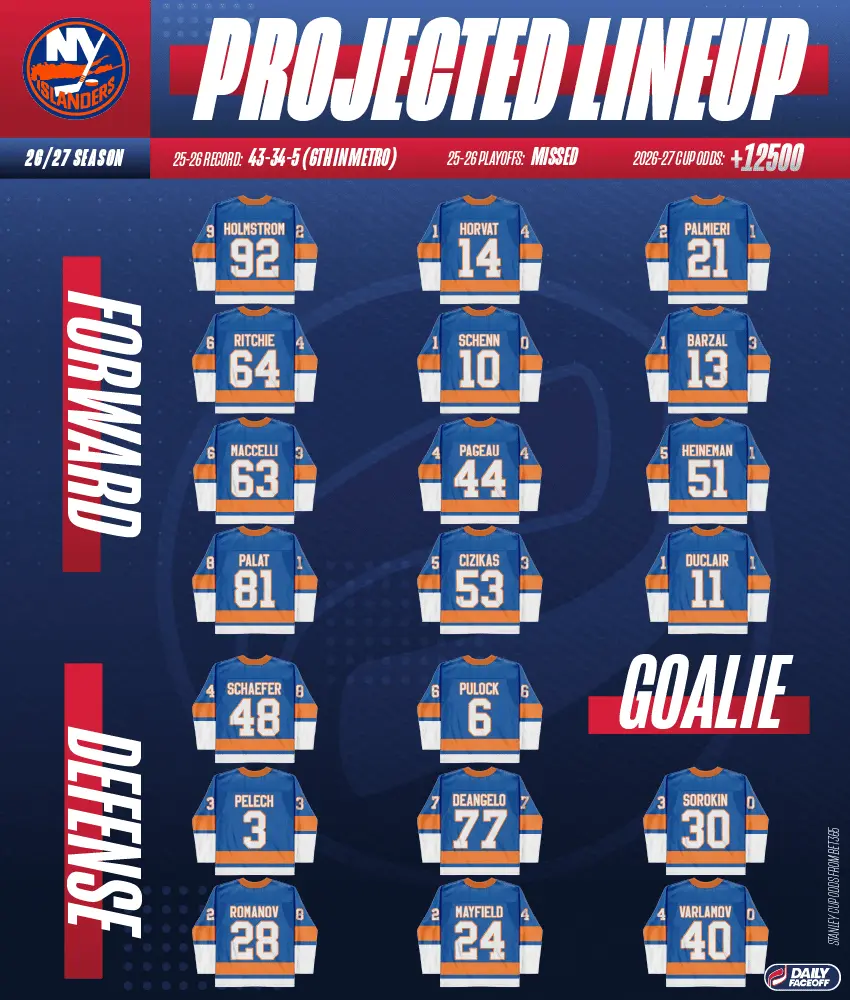
The Isles’ 229-goal, 25th-ranked scoring output was actually an improvement for the club, which hasn’t had a top-20 offensive season since John Tavares left Long Island over eight years ago. Mat Barzal and Bo Horvat are by far the most talented of a motley crew of forwards as legitimate top-line options, though neither man provides a team-lifting boost like the game’s true superstars.
Barzal bounced back from an injury-ravaged 2024-25 to pace New York in points with 72. Barzal remains an excellent set-up man (52 A per 82 career GP), but he’s 29 now. It feels safe to assume the former Calder winner’s overall production (two 20-goal seasons, career 10.5 S%) will never match his gorgeous skating stride and dizzying puck handling. Horvat, who represented Team Canada at the Olympics, is something of an anti-Barzal, a workhorse pivot whose relentless north-south game keeps him on the scoresheet but somewhat caps his potential as a playmaker; his impressive 31-goal pace as an Islander exactly matches a not-as-impressive 31-assist average.
Kyle Palmieri, who will turn 36 in February, still had a nose for a greasy goal when last we saw him, but that was just before he tore his ACL in late November. The ease with which we can pencil him back into his old spot in the top six after a major late-career injury speaks to New York’s need for goal scorers. Schenn, who turned 35 last month, similarly defaults to a top-six role for lack of competition. Barzal will get long looks at center for DeBoer, and Ritchie’s future is down the middle, but until either of those guys can win a faceoff, they’ll need the old Schenn, an old warhorse whose 39-point return last season was his worst in a full campaign.
Ritchie, a brainy young playmaker who seemed to find his NHL sea legs after teaming up with the veteran power forward Schenn, is the most promising forward projected to skate with the Islanders on opening night. Still, other young guns outperformed him in 2024-25. Holmstrom’s ability to both force and anticipate blue-line turnovers has made him a wickedly efficient scorer on the rush (19.5 career S%), and fellow Swede Heineman is a bowling ball (247 hits) whose 22-goal breakout wasn’t as unsustainable as you might think; he loves to fire off that huge shot from the high slot (96th percentile in mid-range shots).
On the subject of up-and-comers, Schaefer’s wicked wrister helped him finish second among defensemen in goals, behind Washington’s Jakob Chychrun, and record the most points by an 18-year-old defenseman in NHL history (59), ahead of Hall of Famers Phil Housley and Bobby Orr. Perhaps most impressively, Schaefer finished tied with Chychrun and others in 18th for power-play production by a defenseman (18 P) despite the Islanders’ typically dismal performance as a unit (16.5%, 30th). Schaefer can start doing Makar things if the rest of that man advantage shapes up. He is that good.
DEFENSE
The Islanders hung their hat on defense during their early 2020s pomp, but their entire strategy for stopping goals last year boiled down to “start Sorokin and pray.” Incredibly, it worked out quite well for the bottom line: only four teams conceded fewer goals. Still, Darche wouldn’t have fired Roy if he couldn’t sense how unsustainable it all was. Now, it’s DeBoer’s job to coax improved under-the-hood results from a mostly unchanged group.
The coach’s most intriguing puzzle piece, naturally, is Schaefer. A comet of a skater who hit 20 mph on the gun more than any other NHL defenseman, Schaefer is already excellent at carrying the puck out of trouble. That killer speed gives him all the tools to become an outstanding defender against the rush and zone entries, too. Having faced the ninth-most ice time against “elite” competition of any defenseman last season, by PuckIQ’s definition, Schaefer is also ahead of the curve in terms of his willingness to approach defensive assignments with total commitment, a problem for most dynamic young blue liners. He has potential to become the most complete defenseman we’ve seen in a very long time, but the personnel around him isn’t exactly the best environment for his growth.
Schaefer’s usual partner Ryan Pulock continues to garner usage like the top shutdown option he was five years ago, but since then, he’s been less than the sum of his parts: a burly frame, smooth stride, and terrifying slapshot. Schaefer actually earned better results in his initial connection with frequently penalized third-pair dreadnought Scott Mayfield (49.31 xGF%, up from 45.86% with Pulock). That may have had more to do with light early-season usage than their chemistry. That Schaefer posted a 59.18% expected-goal share away from both Pulock and Mayfield proves Darche hasn’t yet found him a long-term partner.
Darche did, however, bring back Tony DeAngelo on an above-market two-year contract to run back one of the worst defenses in the NHL. Tony D still has solid offensive instincts (35 P in 76 GP), but he’s unplayable on defense without Adam Pelech around to babysit. Pelech bounced back from his scary history of head injuries to lead New York’s defense corps in every chance prevention category. Long the conscience of the Islanders’ ‘D,’ Pelech was far more effective alongside longtime collaborator Pulock, just another reason for DeBoer to find a way to untether the latter from Schaefer.
Could Alex Romanov be the key to dropping everyone else into more fitting blue line roles? It wasn’t too long ago he was a respectable top-four basher (+15, 186 hits, 20:47 ATOI from 2023-25), the thunder to Noah Dobson’s lightning, but Romanov has a lot to prove in 2026-27. The max-term, $6.25-AAV extension he earned through his chemistry with the since-traded Dobson already looked rough through 15 brutal outings of partnering with DeAngelo (3-9 game score, 35.20 xGF% as a unit) before a garbage hit by Dallas’s superstar cheapshot artist Mikko Rantanen busted Romanov’s shoulder and ended his year. Could a steady start as a bottom-pair shot-blocking type earn Romanov another chance to caddy for a star defenseman, this time on his off right side opposite fellow lefty Schaefer? If Romanov cannot play his way up the lineup, expect Darche to try to dump his contract before it becomes trade-protected next summer.
GOALTENDING
The league-wide SV% crisis means Sorokin’s numbers aren’t as eye-popping as they were during his early-career emergence, but the Russian, still in the thick of his prime at 31, remains unbeatable when he’s on. Sorokin’s .519 quality start % may have been uncommonly low among the league’s elite, but consider how difficult it was to hold it together behind last year’s Isles; no goalie faced more high-danger shots than Sorokin’s 505. The netminder’s razor-sharp focus and expert positioning allowed him to save the highest percentage of those looks (.869) of any goaltender with more than five appearances.
If Sorokin had only started faster and finished stronger (easier said than done given the Islanders’ overall collapse), he might have won his first Vezina instead of finishing runner-up for the second time; in 42 games between the end of October and the beginning of April, he posted a ridiculous .916 SV%, a full 10 points higher than his final .906 mark, and each of his league-high seven shutouts. Sorokin’s 55-game workload probably won’t change much next season and shouldn’t cause him any more late-season fatigue if the defense in front of him is even slightly more capable. The other 28 starts, the Isles hope, will go to an old friend.
Semyon Varlamov has missed nearly two full seasons with knee injuries and would have been a perfect candidate for LTIR semiretirement as a 38-year-old backup in the last year of his contract. No one told him that, though, and a competitor of Varlamov’s caliber wouldn’t have heard it, anyway. You have to admire the determination ‘Varly’ already showed to work his way back to an AHL rehab stint at the tail end of last season. Can the veteran netminder still hack it in the National League? He took Sorokin’s net fair and square ahead of the playoffs in his last healthy season, but that was over two years ago, and Varlamov’s preference to challenge shooters out high and trust his athleticism in recovery would make any loss of explosiveness potentially disastrous.
Vitek Vanecek is New York’s veteran third goalie. Vanecek is an experienced hand (210 GP) who will step up into a backup role if Varlamov doesn’t have it anymore. Darche and DeBoer will hope they don’t have to ask him to do more than clear waivers; Vanecek’s confidence has been shot for a long time (.886 SV% since 2023).
COACHING
I’ve already wondered aloud about the timing of DeBoer’s hire, given that he has nothing left to achieve but winning the Stanley Cup. The Islanders sure don’t look like they’ll win one any time soon. Still, DeBoer is a highly accomplished bench boss who should rehab the Islanders’ sense of structure. His preference for aggressive transition offense could do wonders for Barzal, Schaefer, and Horvat, an underrated burner in his own right.
The Long Island fans will be delighted to hear DeBoer can bring some much-needed tempo to UBS Arena, but what they really need is a system that can turn up the heat without giving chances right back at the other end. The Islanders have willing bangers in Heineman and Schenn and adept puck thieves in Holmstrom and Pageau, but their defensive results did not live up to their respective reputations last season. DeBoer will need to get more from his checkers if New York is to cut back on the one-and-done zone entries that so infuriate its fans.
Another thing that infuriates Isles’ fans is their club’s power-play woes, but the news on that front is less than encouraging. Rocky Thompson is back on an NHL bench after a year in charge in AHL Bridgeport. Thompson’s Philadelphia Flyers finished dead last in power-play efficiency over his three seasons assisting John Tortorella, one of only two clubs (ANA) to convert less than the NYI during that time.
ROOKIES
This will be a critical season for several high-profile Islanders prospects. They’ll spend most of it in Ontario, though, where the long-suffering Bridgeport Islanders were rechristened the Hamilton Hammers over the summer. With failed veteran experiments Ondrej Palat, Anthony Duclair, and perhaps even a healthy Pierre Engvall taking up space in the big leagues, there just aren’t enough roster spots to evaluate Cole Eiserman and Victor Eklund in the NHL from Day One.
Eklund and Eiserman both had productive forays into the AHL late last year and could flourish on a Hamilton team Darche eagerly sought to improve during the offseason. Where Eiserman’s pro career will rely entirely on his ability to find looks for his huge shot, fellow lottery selection Eklund is such a strong competitor that he’ll probably carve a middle-six niche even if he doesn’t become an elite NHL scorer. The latter’s likable off-puck traits give him a clearer short-term path to playing time, but both players are probably at least a Palmieri trade away from a real opportunity in the show. Barring an injury crisis, Eiserman and Eklund’s respective debut timelines will depend entirely on the Islanders’ success or lack thereof.
Defenseman/freight train Kashawn Aitcheson might have the highest ceiling in the Isles’ pipeline if he puts it all together, but, like most mortal 19-year-old defensemen, he’s a ways away from a regular NHL role. A steady diet of minutes in Hamilton would be better for Aitcheson’s development at this stage. Isaiah George, who burned his Calder eligibility two seasons ago, is far more likely to mix it up for a roster spot as a low-maintenance penalty-killing type with three extra years of physical maturity on Aitcheson.
BURNING QUESTIONS
1. What’s the plan? Really, this is the only question for the Islanders. If Darche got a little ahead of himself by adding to a bubble team with no expectations, well, okay. He’s new to the big chair, his early draft record looks tremendous, and the only bad money he personally put on the books past the end of Schaefer’s rookie deal in 2028 (there’s plenty left over from ol’ Lou) is from Pageau’s altogether harmless extension, which ends in 2029, and an admittedly risky Romanov contract that could yet break his way. Darche can very quickly transition the Islanders from a team built around Barzal/Horvat/Sorokin to one that’s all about Schaefer. That is the plan, right? Using the most exciting young defender in the NHL to breathe new life into a long-dead contention window instead of opening a new one would be very foolish. It’d also be very on brand for a franchise that lives by Murphy’s Law.
2. What’s cooking on the right side? Darche selected Malte Gustafsson 13th overall last June, the third left-shot defenseman he’s selected in the first round in two years. That side is settled in the long term and short term. Schaefer will be around for both timeframes; Pelech, 32, isn’t as old as you think; and Romanov could yet rehab his reputation. The right side, meanwhile, could sure use a facelift. Pulock, DeAngelo, and Mayfield are all either past their primes, overpaid, or both. Not one of them belongs on a top pair, even if Pulock could still chew through some tough minutes as a No. 4. Perhaps George steps into the lineup and shifts a lefty over to the right side as Mayfield goes to the press box, but that’s a band-aid. I won’t make any snide Noah Dobson remarks, but righties are needed on Long Island. Good ones, at least.
3. How long is Lou’s shadow? Lamoriello’s legacy as Islanders GM is complex. On one hand, he helped create the first positive hockey memories for a generation of Isles fans by powering through the Tavares saga to assemble a tough-as-nails back-to-back conference finalist. On the other hand, Trotz gets plenty of the credit for those teams and none of the blame for Lou’s tenuous understanding of the salary cap. Pulock at $6.15 million through his age 34 season is rough. Mayfield at $3.5 million until he’s 36 is quite insane. Even the Duclair deal, which made some sliver of sense at signing, nosedived almost immediately. Don’t forget Engvall, who played 0 games of pro hockey last season, is signed through 2030. Cap space won’t be an issue after this season, but what is Darche supposed to do with all the human beings signed to these negative value contracts?
PREDICTION
If you skipped the ~3000 words it took us to get here, the short version is this: Schaefer is special, Sorokin is great, but there’s work to do everywhere else, and it doesn’t feel like Darche can build his version of the Islanders until Lamoriello’s is gone.
Cap room and roster space will be abundant next offseason, but Darche spent this one in a holding pattern; he seems content to wait patiently for the windfall while his handpicked next generation gestates in Hamilton. That strategy could pay off long-term, but it didn’t fix anything about the roster DeBoer’s inheriting, which vastly overperformed to earn even 91 points last season. The Isles are a long shot to repeat the trick, and even then, they wouldn’t crack the playoff picture in a crowded Eastern Conference.
DAILY FACEOFF NEWSLETTER