2026-27 Fantasy Hockey Strength of Schedule

In Fantasy Hockey, we use the NHL schedule to our advantage all season long, but it’s often overlooked during draft season.
Most managers lean heavily on rankings and projections when deciding who to draft. While those should remain the foundation of your draft strategy, the schedule can be a valuable tiebreaker—especially when filling out your bench.
The goal is simple: draft players you’ll actually be able to get into your lineup. A productive player loses a lot of value if most of his games come on busy nights when your starting lineup is already full.
If you want to run your own schedule analysis, I pulled the full 2026-27 NHL Schedule from hockey-reference.com and organized it by team in a Google Sheet.
Games Per Week
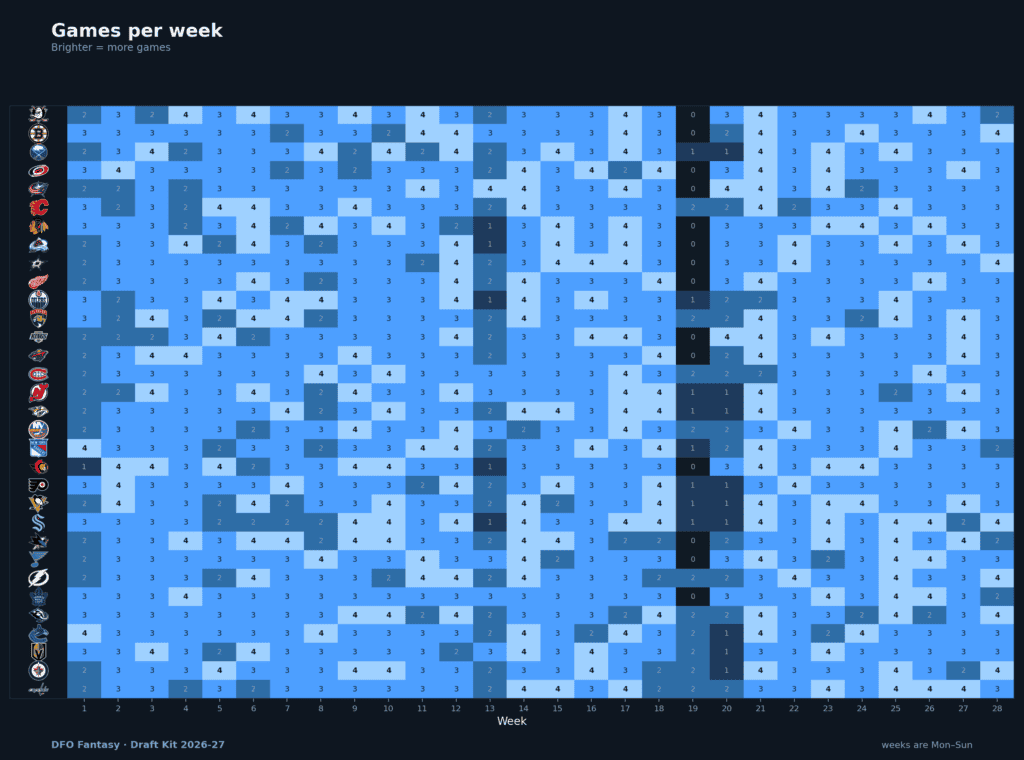
Firstly, here’s a handy week-by-week guide showing how many games every NHL team plays throughout the Fantasy Hockey season.
Use it on draft day to identify schedule advantages, then bookmark it for the regular season. Once the season starts, it becomes an even more valuable tool for planning waiver adds, streams and weekly lineup decisions.
2026-27 Fantasy Hockey Strength of Schedule
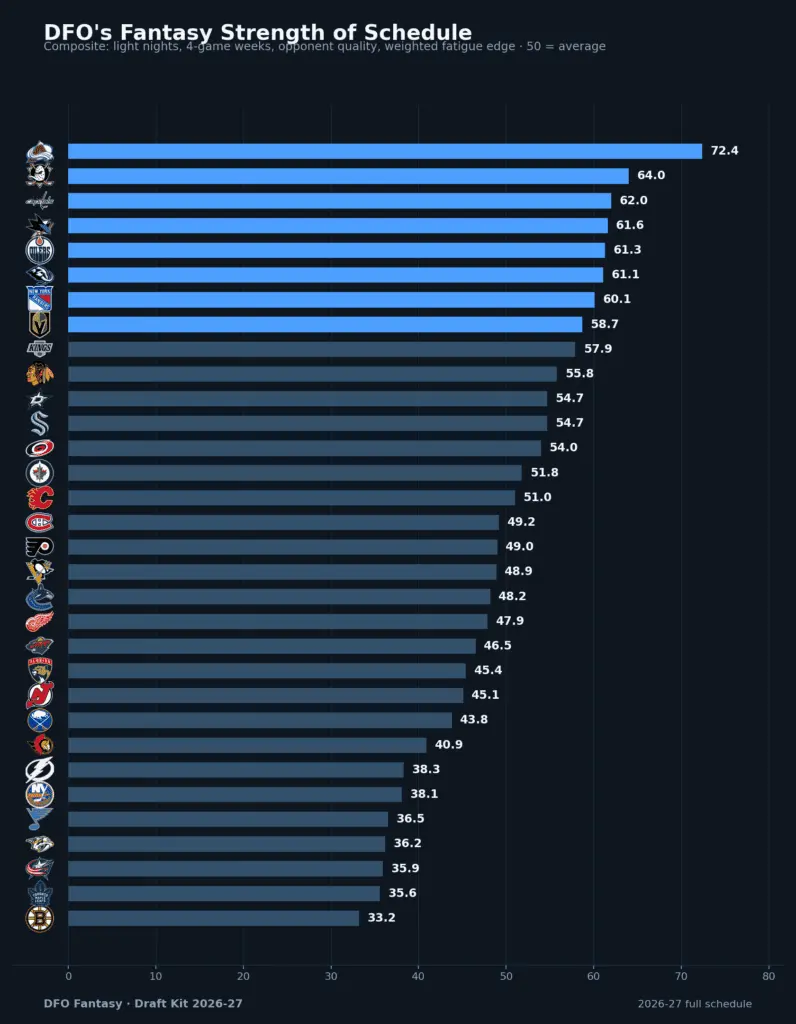
Our 2026-27 Pre-Season Fantasy Hockey Strength of Schedule is generated using four factors:
- Light Nights
- Opponent Quality
- Four-Game Weeks
- Weighted Fatigue Edge
Each factor is broken down below, along with how you can use it to your advantage on draft day.
What is a Light Night?
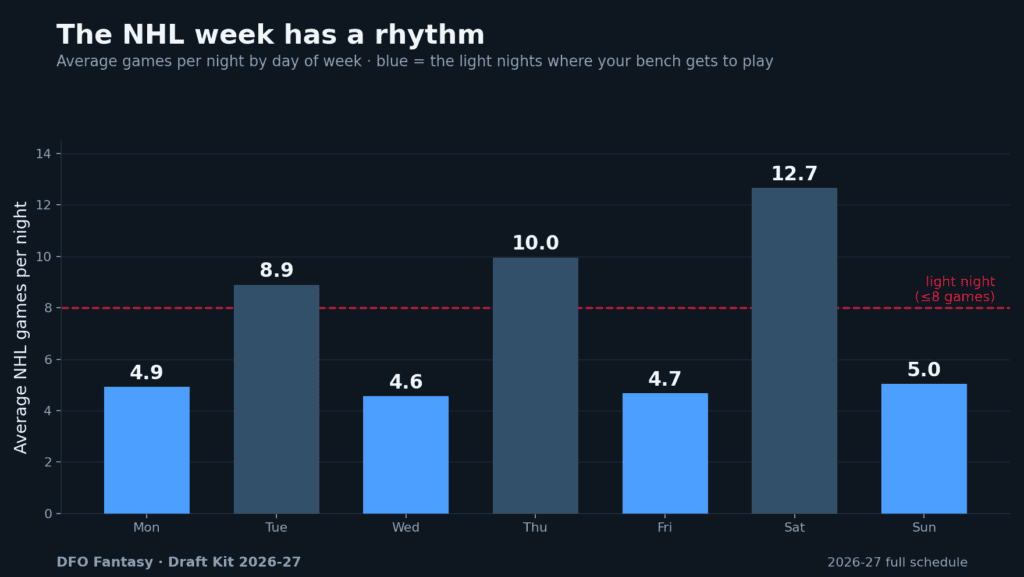
Of all the schedule factors, Light Nights may be the most important when building out your bench.
We consider a Light Night any day with eight or fewer NHL games. On those nights, you’ll almost always have open lineup spots, giving your depth players a much better chance of actually making it into your starting lineup.
The NHL schedule is very consistent in this regard. Mondays, Wednesdays, Fridays and Sundays average around five games, while Tuesdays, Thursdays and Saturdays are considerably busier.
Most Light Nights
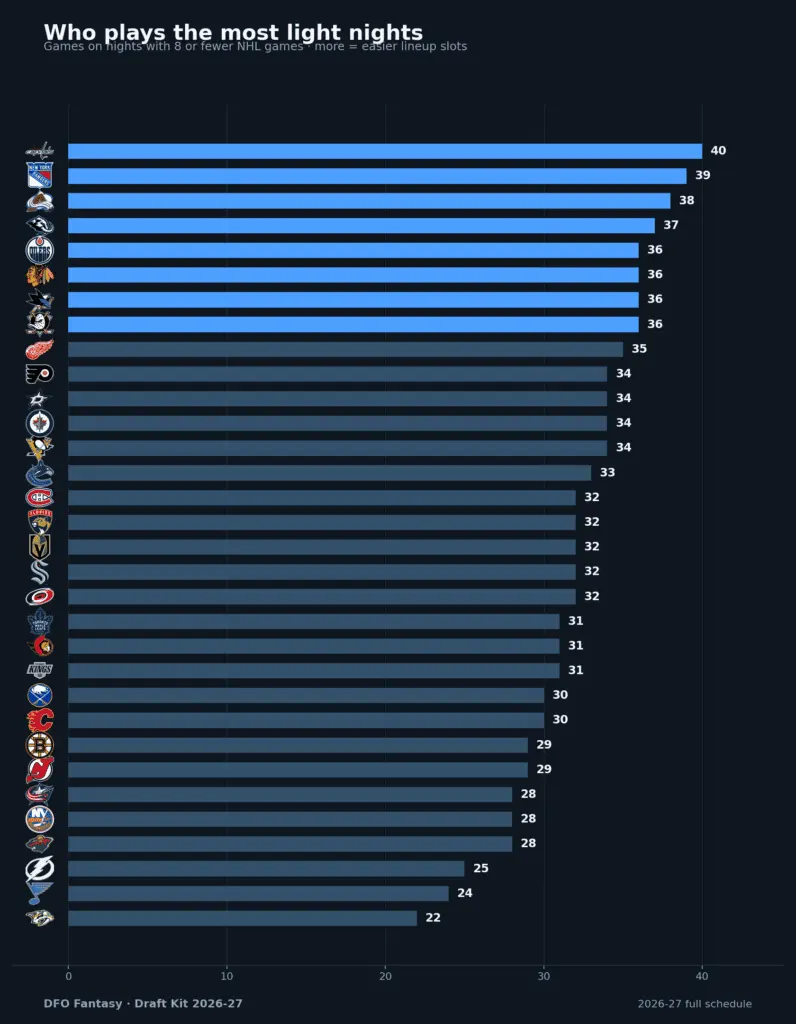
As you can see, the Washington Capitals, New York Rangers and Colorado Avalanche have the most Light Nights in the NHL this season, while the Nashville Predators, St. Louis Blues and Tampa Bay Lightning have the fewest.
That doesn’t suddenly make Filip Forsberg or Nikita Kucherov bad fantasy picks. It does, however, make me more interested in targeting Capitals, Rangers and Avalanche players late in drafts to fill out my bench instead of similarly ranked players from teams like Nashville or St. Louis.
Late-Round Light Night Targets:
Washington Capitals
- Jordan Kyrou (ADP – 138.8 | 19% Drafted)
- Dylan Strome (ADP – 142.6 | 11% Drafted)
- Pierre-Luc Dubois (ADP – Undrafted)
New York Rangers
- Alexis Lafreniere (ADP – 142.5 | 90% Drafted)
- Gabe Perreault (ADP – 129.0 | 3% Drafted)
Colorado Avalanche
- Brock Nelson (ADP – 133.4 | 65% Drafted)
- Nazem Kadri (ADP – 146.3 | 65% Drafted)
- Artturi Lehkonen (ADP – 139.6 | 12% Drafted)
- Gabriel Landeskog (ADP – 134.4 | 8% Drafted)
Utah Mammoth
- Logan Cooley (ADP – 120.0 | 91% Drafted)
- Vincent Trocheck (ADP – 134.3 | 4% Drafted)
- Anders Lee (ADP – Undrafted)
Edmonton Oilers
- Ryan Nugent-Hopkins (ADP – 138.5 | 15% Drafted)
- Matt Savoie (EDM – 135.5 | 2% Drafted)
Chicago Blackhawks
- Patrick Kane (ADP – 133.7 | 24% Drafted)
- Anton Frondell (ADP – 138.5 | 14% Drafted)
- Tyler Bertuzzi (ADP – 138.5 | 5% Drafted)
- Frank Nazar (ADP – Undrafted)
- Roman Kantserov (ADP – Undrafted)
San Jose Sharks
- Ivar Stenberg (ADP – 133.3 | 34% Drafted)
- Michael Misa (ADP – 130.5 | 5% Drafted)
- Mason Marchment (ADP – 130.9 | 2% Drafted)
- Igor Chernyshov (ADP – 131.2 | 2% Drafted)
Opponent Quality
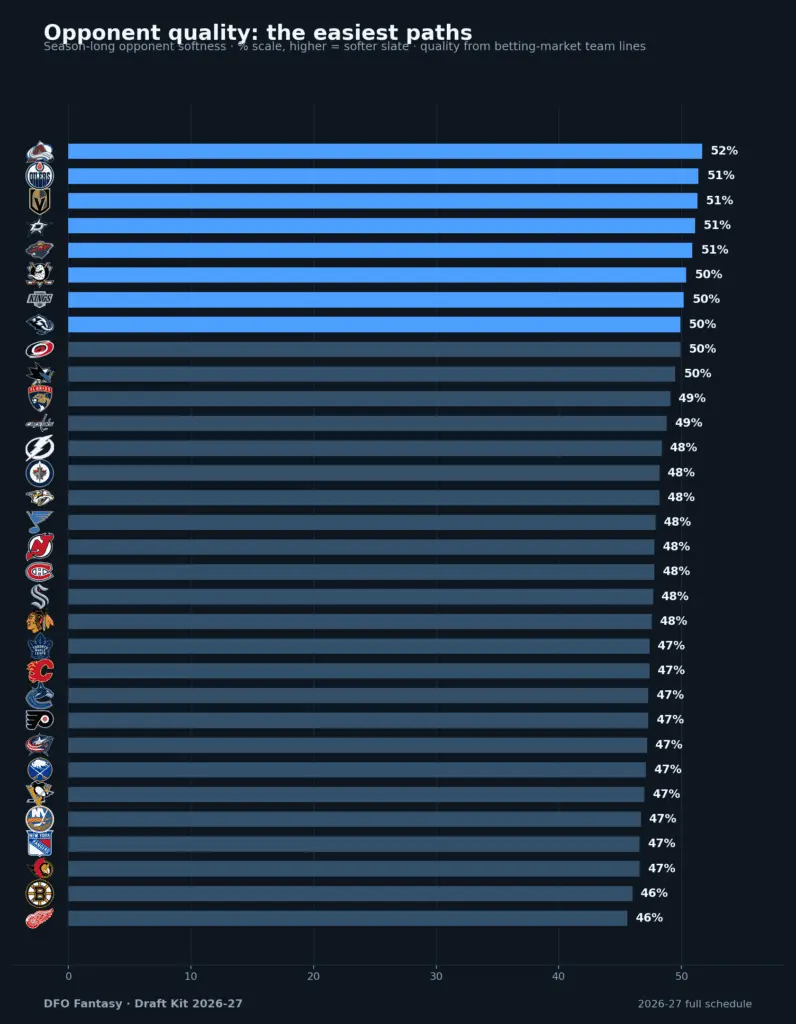
With every team playing 84 games, there’s obviously a tremendous amount of crossover between schedules, so opponent quality doesn’t create a massive edge over a full season. It becomes much more useful on a week-to-week basis when making lineup and streaming decisions.


Cap Summary
Draft Picks
Still, the extremes are worth noting.
It’s a scary thought for fantasy managers who don’t land the No. 1 or No. 2 pick that Nathan MacKinnon (COL) and Connor McDavid (EDM) have two of the easiest opponent ratings this season.
Meanwhile, there’s not a ton to be excited about in Detroit right now. They don’t have a GM, their captain has demanded a trade, and now they enter the season with the NHL’s toughest schedule.
Four-Game Weeks
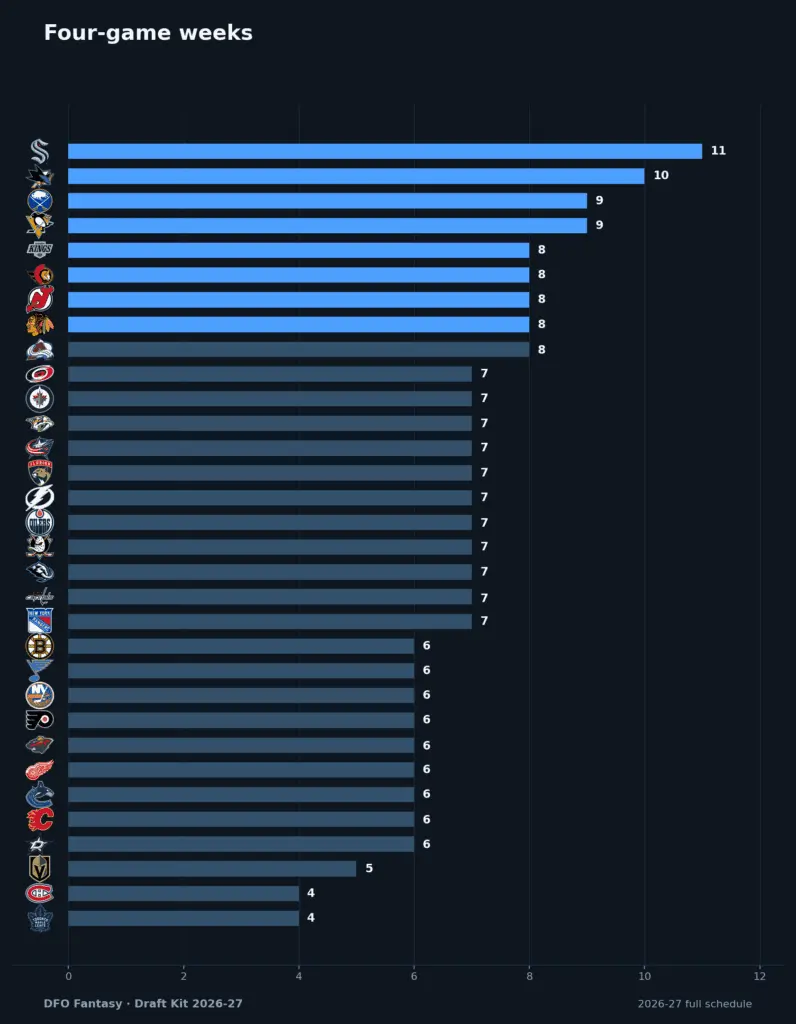
Four-game weeks can also be a useful tiebreaker. An extra game can be the difference between winning and losing a weekly matchup, and players with four games have a higher weekly ceiling than comparable players with only two or three.
There is a catch, though: every team plays 84 games. Teams with a lot of four-game weeks will inevitably have more two-game weeks as well.
For that reason, I’d put more weight on Light Nights when drafting and use four-game weeks as a secondary tiebreaker.
Weighted Fatigue Edge
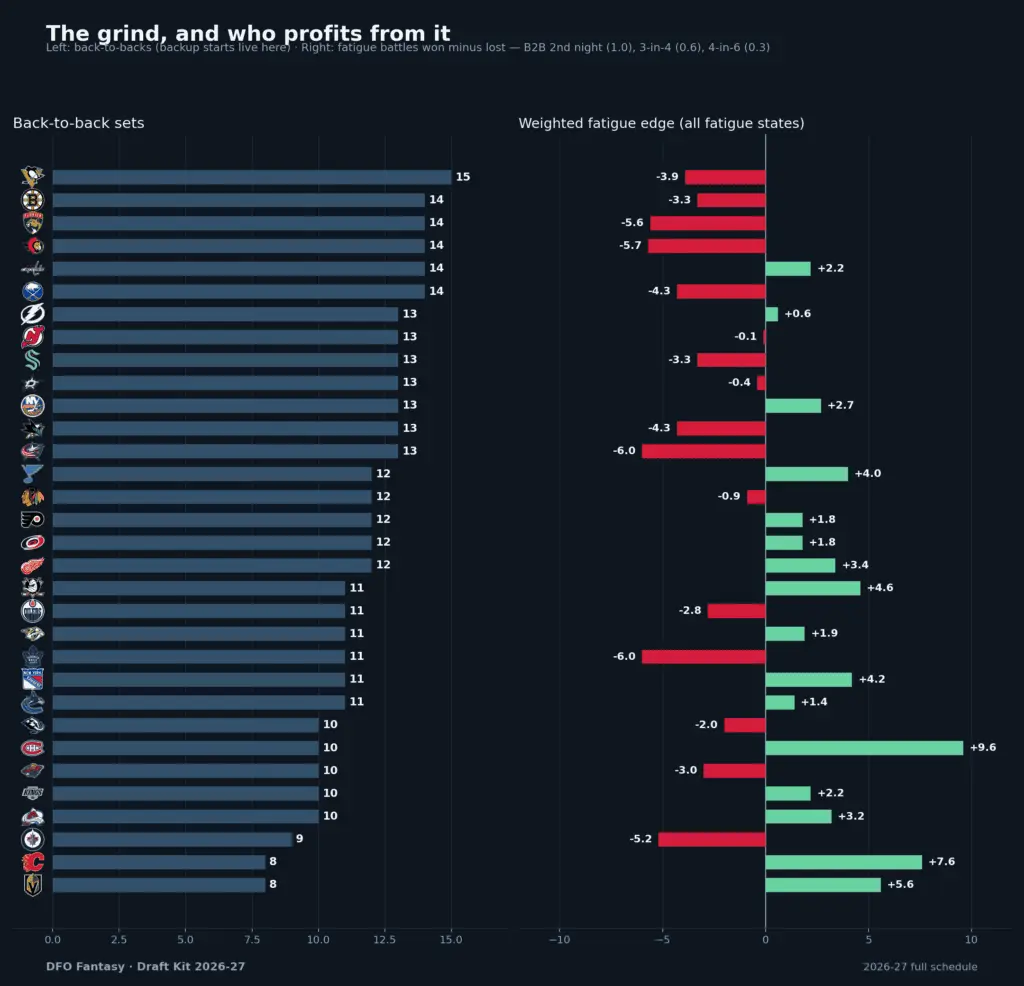
Back-to-backs are particularly important when projecting goalie workloads.
Vegas is tied for the fewest back-to-backs in the NHL this season, so if Carter Hart emerges as their clear No. 1 again, he could be in line for a heavy workload. With only 11 back-to-backs, Igor Shesterkin could also push for 60-plus starts for the second time in his career.
From a skater perspective, it’s useful to identify which teams consistently catch opponents on short rest.
The Montreal Canadiens are the overwhelming winners in that category this season, catching opponents on short rest far more often than they get caught themselves. The Calgary Flames and Vegas Golden Knights rank second and third.
On the other end of the spectrum, Columbus and Toronto are more often caught on short rest, creating a subtle season-long disadvantage.
Fantasy Hockey Playoffs Schedule
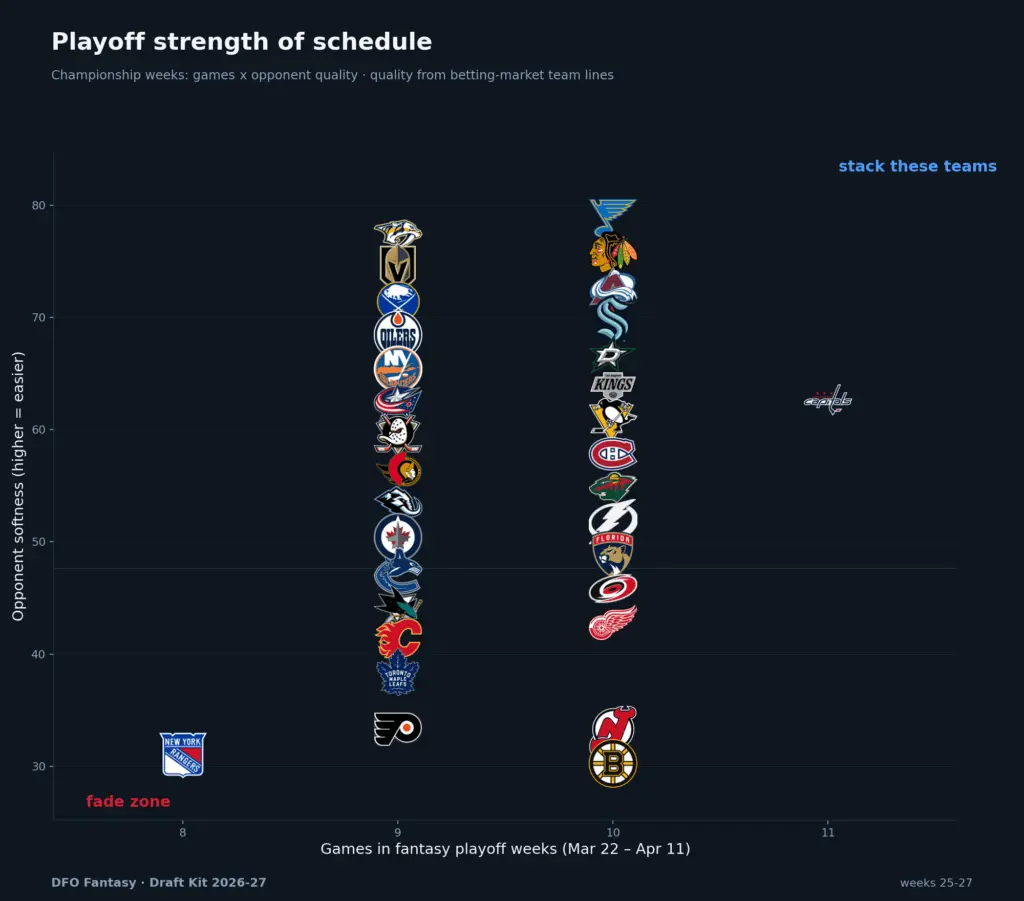
Schedule advantages tend to get diluted over the course of a long Fantasy Hockey regular season. During the Fantasy Hockey Playoffs, however, they become much easier to exploit.
Over a smaller window, we can clearly identify teams with an advantage based on their number of games, Light Nights and opponent quality.
Obviously, you have to make the playoffs before worrying about your playoff schedule, so I wouldn’t reach for a player in October solely because of his March schedule. But it’s absolutely worth using as a tiebreaker on draft day—particularly when a team grades well in both the regular season and Fantasy playoffs.
Among the teams with elite regular-season schedules, the Washington Capitals and Colorado Avalanche also grade out extremely well during the Fantasy playoffs.
The New York Rangers are the opposite. Their regular-season schedule is fantastic, but their Fantasy playoff schedule is an absolute disaster.

