2026 Olympic Women’s Hockey: Top standouts from Feb. 10

Tuesday marked the last (full) day of preliminary round action at the 2026 Winter Olympics.
We saw the final quarterfinal spots in Group B decided, with a couple of entertaining games. Along with an important clash between Finland and Switzerland, the rivalry between the United States and Canada was renewed.
Let’s take a look back at all that happened, and who rose to the occasion, on Day 6 of competition.
Japan 0, Sweden 4
While Japan desperately needed a win to stay in contention for third place, it was Sweden who made sure there was no upset. Hanna Thuvik scored her second goal in as many games to put her team on the board, but thanks to goaltender Riko Kawaguchi, Japan only trailed by one after 20 minutes.
That changed in the middle stanza, as Damkronoma put the pressure on Japan’s defense, scoring a pair to extend the lead. Japan simply ran out of gas in the third, as a power-play goal from Hanna Olsson was the icing on the cake after an impressive opening round for Sweden.
Josefin Bouveng and Mira Hallin also scored in the win, with Hallin potting her first goal at the Winter Games.
However, the win wasn’t without casualties for Sweden. Ohio State star Hilda Svensson took an awkward fall early in the game, and ended up playing just 92 seconds before exiting due to injury. Lisa Johansson was hurt after being cross-checked up high by Japan defender Kanamai Seki. Johansson would later return to the game, posting three shots on goal in 11:47 of ice time.
Sweden outshot Japan 31-20. Kawaguchi stopped 22 of the 26 shots she faced. Wesleyan University product Rei Halloran made five saves in the final few minutes of the game.
The Swedes went 1-for-3 on the power play, while Japan went 0-for-2.
With Sweden (4-0-0) finishing first in Group B, they will take on the third-place team from Group A. With Canada and Finland still having to play on Thursday, the Swedes’ opponent won’t be decided until later in the week.
Japan (1-0-3) misses out on the quarterfinals for the fourth time in five Olympic appearances.
Sweden
Josefin Bouveng, F
Definitely the University of Minnesota product’s best game of the tournament so far. Bouveng is part of an exciting youth movement with the Damkronoma program and has the potential to be a key offensive threat in the knockout stage. She extended Sweden’s lead early in the second period, and added an assist on Hallin’s goal late in the frame. It could be the confidence boost she needs to be effective in the quarterfinals.
Ebba Svensson Träff, G
I don’t think we’ve given Svensson Träff enough credit so far in the tournament. The surprise starter over the experienced Emma Söderberg, the Linköping HC backstop has been solid so far in the tournament. She posted her first Olympic shutout on Tuesday, turning away all 20 shots she faced. While the game became one-sided, Svensson Träff made some nice saves in the first period to keep her team out in front.
Maja Nylén Persson, D
Nylén Persson’s offensive game has been relatively quiet so far in Milan, but the former Borje Salming Award winner came up with a couple of points against Japan, picking up assists on Hallin and Olsson’s goals. The veteran’s role at these Olympics is focused on keeping the opponent’s top scoring threats at bay, which she has done efficiently so far. On Tuesday, Nylén Persson led Sweden with 22:32 of ice time.
Japan
Yumeka Wajima, F
It was a tough tournament for Japan, scoring just seven goals in the group stage. Yet, a player who was key to their success in Olympic qualification and was a prevalent weapon this year was Wajima. She might’ve only scored one goal for her team in Milan, but she was heavily involved in the team’s offense, especially on Tuesday. Wajima led the team with four shots on goal in 15:12 of ice time.
Italy 1, Germany 2
Even though both teams had already clinched a spot in the quarterfinals, the contest at the Milano Rho Ice Hockey Arena had the look and feel of a playoff game. Lots of tight checking, close chances and players doing whatever it took to gain an advantage.
After a scoreless first period, where both teams came narrowly close to finding the back of the net, it was Italy that drew first blood, with Justine Reyes tipping in an Anna Caumo shot just 21 seconds into the middle stanza.
It was part of a second period where Italy looked like the better team, but Germany got a lucky bounce, as a Laura Kluge centering pass was directed off Emily Nix and in just past the halfway mark of the period, with the two sides heading into the intermission tied, 1-1.
The third was tense. Neither team wanted to give an inch, but it led to multiple penalties for both sides. However, neither side was able to cash in on the power play. Overtime looked like a great possibility as the minutes ticked away. Then, Kluge picked the puck out of the air in the neutral zone, darted down the ice, and made a great play to beat Italy netminder Gabriella Durante to score the go-ahead goal with just 89 seconds left in regulation.
The shots ended up being level, 24-24. Italy failed to capitalize on their five opportunities on the player advantage, while Germany went 0-for-4.
Sandra Abstreiter had arguably her best game of the tournament, making 23 saves for Germany, while Durante stopped 22 shots in the losing effort.
With the victory, Germany (3-0-1) will now face the team that finishes second in Group A, while Italy (2-0-2) will have to face the team that finishes atop the pool.
Germany
Laura Kluge, F
That goal was certainly the goal of the tournament. From the simple skill it took to make such a move in tight on Durante, to the magnitude of the goal, it was outstanding. Kluge has consistently been regarded as one of the top players from Deutschland due to her talent and finishing ability. She has been a difference maker throughout the tournament, with her two-point performance paying dividends on Tuesday. Kluge now leads the tournament with seven points in four games.
Emily Nix, F
Nix might not have the same level of point production as Kluge, but that doesn’t mean she hasn’t been involved in the offense. On a line with Kluge and Nicola Hadraschek, Nix has had a hand in the team’s scoring attack. She was credited with her second goal of the tournament and put three shots on goal. With Germany being destined for a tough matchup in the quarterfinals, the dynamic Frölunda HC forward will have a chance to go up against some of the best defenders in the world.
Sandra Abstreiter, G
It hasn’t been a stellar tournament for the Montreal Victoire backstop. Starting with that loss to Sweden last Thursday, Abstreiter hasn’t been able to get into a rhythm. However, against Italy, she had to be clutch, especially in the first 40 minutes. She helped stymie an early onslaught by the host nation and kept her team in the game when they were down in the middle frame.
Italy
Justine Reyes, F
While everyone has been focused on the play of Kristin Della Rovere, Nadia Mattivi and Laura Fortino, Reyes has quietly been a solid contributor for Italy’s attack. The California native potted her first Olympic goal in the loss, using some top-notch hand-eye coordination to make it happen. Yet, she’s been getting pucks to the net and generating offense all tournament long. Playing in the top six, the MoDo Hockey forward has been an important secondary piece for Azzurre.
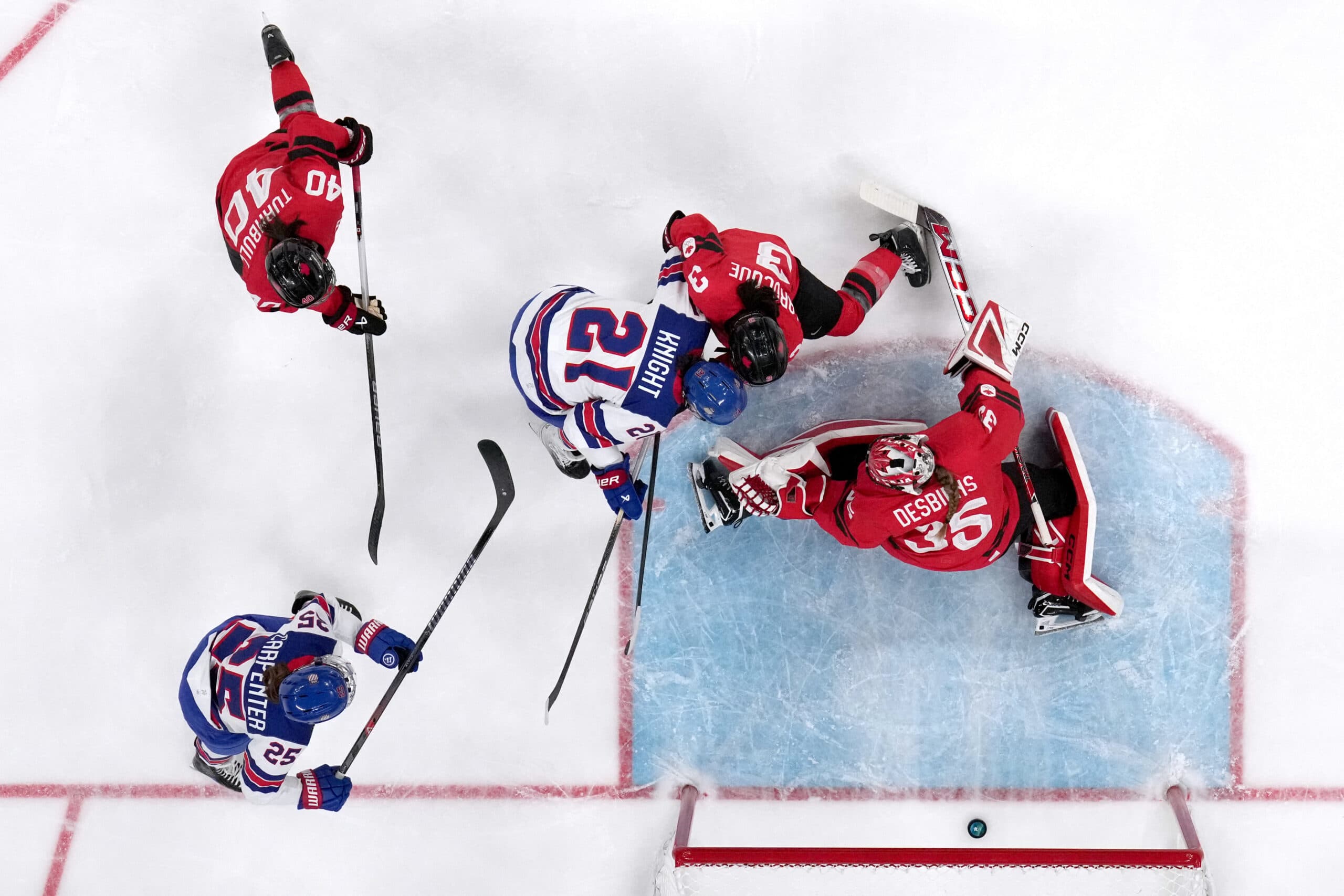
Canada 0, United States 5
By Ben Steiner
It marked the largest margin of victory in the 11-game Olympic history between the two preeminent nations in women’s hockey, eclipsing the USA’s 7-4 win in the first-ever Olympic meeting at the Nagano 1998 Games.
Given the USA’s four dominant performances in the Rivalry Series sweep in the fall, they entered the tournament as heavy favorites, boasting a youthful roster under head coach John Wroblewski.
Meanwhile, Canada opted for experience, keeping much of the core from the past decade and facing a USA side with nine players younger than Jenn Gardiner, Canada’s youngest player at 24. Canada’s experience — the team had an average age of 29 — and confidence despite Poulin’s absence, as beneficial as they can be, struggled to keep up with the Americans.
They hope that doesn’t happen again if these two teams reacquaint themselves in a gold-medal clash.
“I think we just got down early and didn’t find ways to make little plays, I thought we were really sloppy,” said veteran Canadian, Sarah Nurse. “With this ice surface here in Milan, we have to eliminate the neutral zone, and I don’t think we did that today.”
Hilary Knight, who entered the game one goal away from the all-time USA Olympic goals record, forced Canada’s Anne-Rennée Desbiens into an early save before the USA found the back of the net on the second shot from Caroline Harvey, just 3:45 into the matchup.
Hitting the back of the net so early changed the game’s outlook for both teams, even as Canada relied on its recent experience battling from behind against the high-octane Americans.
The USA extended its lead soon after, as Abbey Murphy drew two Canadian defenders below the goalline in the offensive zone, before spinning around and finding Hannah Bilka to finish unchallenged in front of the net.
Kirsten Simms added another to make it 3-0 with a second-period power-play goal, which bobbled over the line, sparking a goalline review, before a failed coach’s challenge for goaltender interference from Canada’s bench boss, Troy Ryan.
Bilka added a second goal, while Harvey and Murphy picked up additional points to put the USA up 4-0 by the end of the second period, before Laila Edwards became the first Black American to score at the Olympics in women’s hockey to make it 5-0.
Harvey headlined the effort with a goal and two assists, while Murphy had three assists, and Bilka scored twice, as the trio of the youngest American stars played a vital role in the landmark victory.
With the win, the USA locked in top spot in Group A and a date with host nation Italy in the quarterfinals, after advancing from Group B with historic victories over Japan and France. For Canada, they look to regroup against Finland after their tournament-opening matchup was postponed due to a Norovirus outbreak within the Finnish team.
All four Group A teams advance to the knockout stage, where Canada will likely face one of Germany or Sweden on the back end of a back-to-back, following the delayed group stage finale against Finland.
USA
Abbey Murphy, F
University of Minnesota standout Abbey Murphy has scored plenty of highlight-reel goals throughout her time in the NCAA and is well established in the USA Hockey picture now at her second Olympics. Still, this might have been her best game. Her assist to Bilka early on set the tone for the dominant performance, and she continued to drive her line, adding another two helpers, while drawing four penalties of the five Canada took in this matchup.
Caroline Harvey, D
Another collegiate standout, Harvey picked up the first goal of the day with a slick toe-drag before firing a shot through traffic, before playing a critical role through linkups with Murphy as her line dominated. The skillful defender is incredibly versatile and showed just how good she can be when tasked with a more offensive role as she was as the American play-driver from the back.
Canada
Daryl Watts, F
Canada’s top six underwent some adjustments without Poulin in the lineup, and the second line, Sarah Nurse, flanked by relative youngsters Daryl Watts and Sarah Fillier, stood out. Watts, in particular, showed a little bit more bite than usual in the way she drove plays forward and allowed Nurse to find open space off the puck. The line combined for four shots, and Watts had two, but overall, it was a disappointing day for Canada’s forwards.
Finland 3, Switzerland 1
While the final score looked relatively close, Finland dominated for most of the game. They put pressure on Swiss netminder Saskia Maurer for most of the contest. While no goals were scored in the first period, both teams found the back of the net in the second period in spades. The Finns struck first with back-to-back goals from Viivi Vainikka and Julia Liikala, the team’s first two goals in Milan. It seemed like Suomi was about to run away with the game like another team did on Tuesday.
Switzerland showed a little bit of life late in the period, as Alina Müller scored her second goal of the tournament. shorthanded, to cut the deficit to one. It was her 14th career goal at the Winter Games, making the four-time Olympian the all-time leading goal scorer in Swiss women’s hockey history at the Olympics.
However, just as soon as the Swiss looked like they were back in the game, Sanni Vanhanen potted her first of the tournament just 35 seconds later to restore the gap
The game calmed down in the third, as Finland locked it down defensively, holding the Swiss to just four shots in the final 20 minutes.
Final shots on goal had Finland leading Switzerland 31-15. Sanni Ahola made 14 saves in her first win of the tournament, while Maurer made 28 saves in her third start of the preliminary round. Suomi went 2-for-5 on the power play, with Switzerland going 0-for-1.
With the win, Finland (1-0-2) moves up to fourth in the group. With Canada losing to the United States, a regulation win on Thursday would push the Finns to second place. Switzerland (1-0-3) will finish last in the group, setting up a quarterfinal with whoever finishes fourth.
Finland
Sanni Vanhanen, F
Heading into Tuesday, Finland was looking for any form of offense. While they were missing Susanna Tapani, the team saw other names come up with key performances, including Vanhanen. She helped set up Vainikka for the team’s first goal of the tournament before scoring a pivotal goal that derailed any Swiss momentum. If the Ohio State freshman can build some confidence off of Tuesday’s performance, she can be an x-factor in the later rounds.
Viivi Vainikka, F
Vanhanen’s former Brynäs IF teammate was heavily involved in the Finns’ attack against Switzerland. One of the premier scorers in the SDHL not only scored the game-winner but also led her team with six shots on goal. An important part of the national team for years, the 24-year-old needs to keep attacking the net and looking for openings to further show what has made her one of the best playmakers in Europe.
Switzerland
Alina Müller, F
Müller was the lone bright spot for the Swiss, outside of another strong effort by Maurer. Müller showed her ability to put the team on her back, even when they’re heavily outmatched. It almost goes without saying the importance of the Boston Fleet forward heading into the knockout stage. She’ll have to put forth a signature effort if Switzerland wants to play for a medal.