2026 Stanley Cup Playoffs: Sabres vs. Canadiens series preview

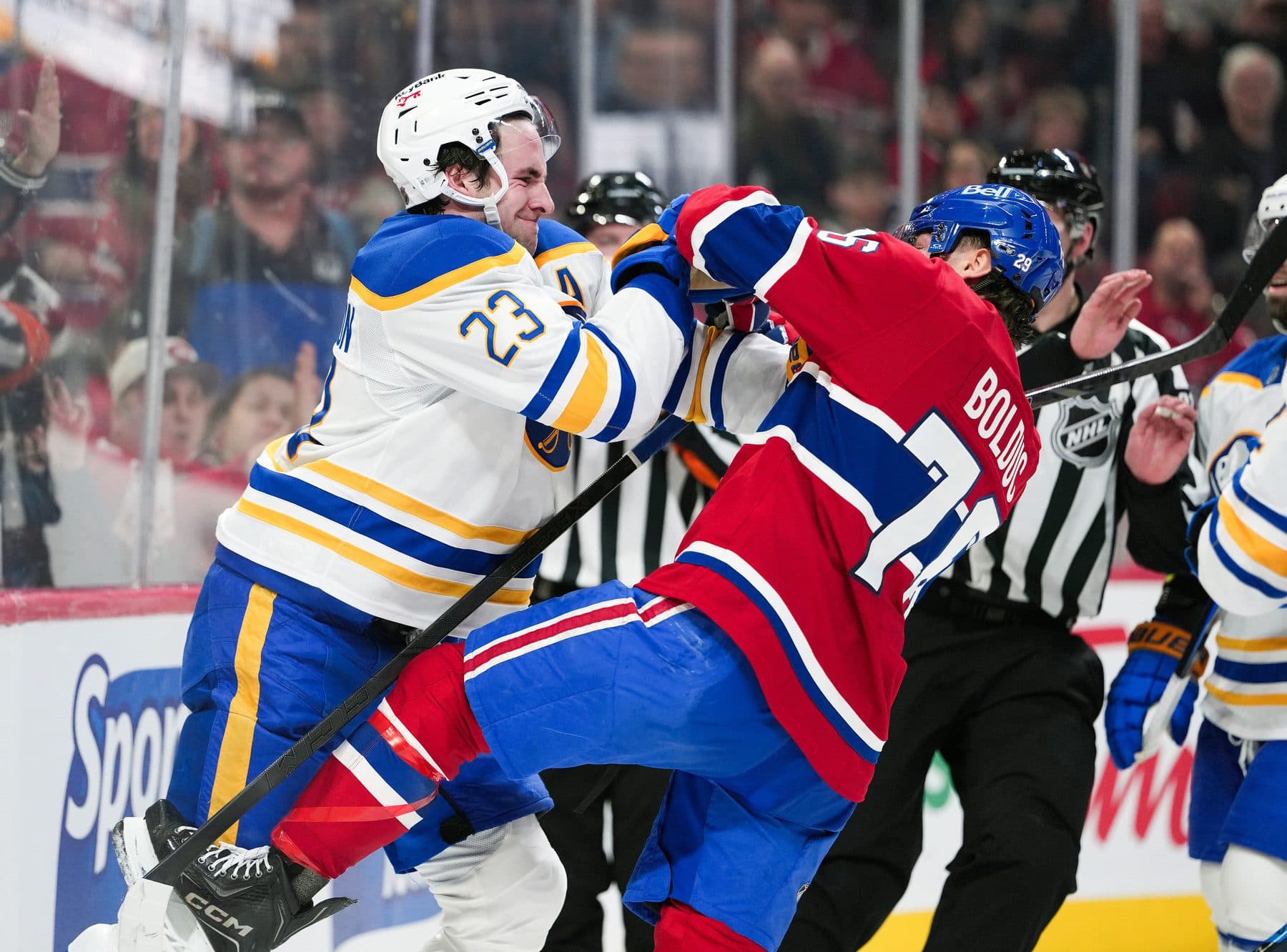
Buffalo Sabres: 1st in Atlantic Division, 109 points
Montreal Canadiens: 3rd Atlantic Division, 106 points
Schedule (ET)
| Date | Game | Time (ET) |
| Wednesday, May 6 | 1. Montreal at Buffalo | 7 p.m. |
| Friday, May 8 | 2. Montreal at Buffalo | 7 p.m. |
| Sunday, May 10 | 3. Buffalo at Montreal | 7 p.m. |
| Tuesday, May 12 | 4. Buffalo at Montreal | TBD |
| TBD | 5. Montreal at Buffalo* | TBD |
| TBD | 6. Buffalo at Montreal* | TBD |
| TBD | 7. Montreal at Buffalo* | TBD |
The Skinny
For the first time since current NHL GMs Chris Drury and Daniel Briere last served as the team’s co-captains in the spring of 2007, the Buffalo Sabres have a winner. Well, a series winner, at least. The Swords have never lifted the Stanley Cup, but they’re one step closer after continuing their return to relevance by knocking off the Boston Bruins in a spirited six-game stand.
The moment threatened to get the better of the Sabres, whose KeyBank Center home shook with every hit, every shot and every save of the opening two contests. Despite an epic Game 1 comeback spearheaded by star sniper Tage Thompson, hitting the road to Boston with a 1-1 split and no goals before the final frame of either contest was, at best, a mixed bag.
Perhaps a little hostility was all it took to shock the Sabres awake. Buffalo would go on to win both subsequent road tilts, at one point scoring nine consecutive goals between Games 3 and 4. A 6-1 romp in the latter secured the Sabres a 3-1 series lead that they finished off on their second try last Friday. Flying colors might be an overstatement, but Buffalo passed its first playoff test in 15 years without too much consternation. The Sabres will next face a team whose fans don’t need any extra motivation to turn their home arena into a madhouse, the Montreal Canadiens.
The Habs proved during the regular season that they could build an elite club around captain and runaway Selke Trophy favorite Nick Suzuki, 51-goal sniper Cole Caufield and diminutive rover Lane Hutson. The Canadiens would still need to prove that a young roster with its share of lightweight, east-west operators could withstand the rigors of playoff hockey against a battle-hardened Tampa Bay Lightning.
Throughout the stand, the Lightning and their army of Cup champions were the team that looked like the inexperienced hotshots, frequently seeking to upset Montreal after the whistle with only marginal success. The Canadiens, meanwhile, reclaimed the series lead four separate times and stripped away any leftover championship sheen from a flustered Tampa team that has not won a series since the 2021 Stanley Cup Final against Montreal.
The Canadiens didn’t dominate. That’s impossible in a seven-game stand featuring four overtime decisions and no games decided by more than a single goal. Still, Montreal never trailed in the series and generally used its skill and composure to lead the dance with a popular pick to make it out of the Eastern Conference.
With the old guard of Boston and Tampa out of the way, the remaining Atlantic Division clash is an intriguing matchup between two of the most promising upstarts from the NHL’s youth brigade. The winner will ride a tidal wave of momentum and self-belief into the Eastern Conference Final.
Head to Head
Buffalo: 2-2-0
Montreal: 2-2-0
If you’re having trouble deciding between these two outwardly similar teams, nothing about their regular-season matchups will offer you any relief. Buffalo and Montreal fought to a perfect draw, both by results and by total score (13-13).
If the Sabres are to take heart from those earlier meetings, they will note that one of the Habs’ victories in the series came in October, before Kevyn Adams got canned and everything snapped into place for the Swords. The success of Thompson, who recorded seven points, including a Jan. 15 hat trick, will also provide cause for optimism.
For Montreal, positive takeaways include starter Jakub Dobes’s excellent performances against the Sabres, both at home and away (2-0, 2.00 GAA, .943 SV%), and Suzuki’s ability to find the scoresheet in each matchup (2 G, 8 P).
Top Five Scorers
Buffalo
Alex Tuch, 7 points
Tage Thompson, 7 points
Bowen Byram, 6 points
Peyton Krebs, 6 points
Rasmus Dahlin, 4 points
Montreal
Lane Hutson, 6 points
Nick Suzuki, 6 points
Alexandre Texier, 4 points
Cole Caufield, 4 points
Zachary Bolduc, 4 points
Offense
Thompson and two-way beast Alex Tuch terrorized Boston’s defense for the entirety of the series, combining for six goals and 14 points as their line with forechecking pitbull Peyton Krebs outscored the B’s 6-0. Krebs might be on the Sabres’ first unit to do the dirty work for his big-name linemates, but, with six points and 13 hits, he’s certainly found a niche there.
Even though Tuch in particular took over the Boston series (and made himself a pile of money as a pending UFA) with his undeniable strength and tenacity, Buffalo’s vaunted defense corps, which helped it finish fifth in regular-season scoring, continues to show up offensively. Bo Byram’s knack for sneaking down into dangerous shooting lanes netted him three goals, and Dahlin brushed off a quiet offensive series by his lofty standards with a goal and an assist in the closeout game.
Dahlin, Byram, and former No.1 overall selection Owen Power (4 A) rank ahead of every forward not named Krebs, Thompson, or Tuch on the Buffalo scoring chart. It’s going to be crucial for the line featuring young puckhounds Zach Benson and Josh Doan, who have been as instrumental as any veterans to the club’s culture change, to turn its ability to shift momentum into goals, especially as veterans Ryan McLeod and Jason Zucker struggle to hold up their end of the bargain.
Though Tuch, Thompson, and the Sabres’ top line set the tone in Buffalo’s victory, Montreal’s own first unit, led by Suzuki and Caufield, struggled mightily to affect play at even strength (1-4 game score, 2 combined points, 39.22% scoring-chance share). Funny as it sounds, that should trouble the Sabres somewhat; Caufield (no 5-on-5 points) isn’t going to remain invisible forever, and Buffalo can’t throw matchup monsters Yanni Gourde and Anthony Cirelli at him for seven games the way Tampa did.
Suzuki was able to buoy his production on the man advantage, where his and Caufield’s usual linemate Juraj Slafkovsky scored all three of his goals in a career-highlight Game 1 demolition of the Lightning. If that was the coming-out part for ‘Slaf,’ someone forgot to tell the Slovak behemoth; the former No. 1 pick hasn’t picked up a point since. With fellow foundational winger Ivan Demidov similarly struggling to establish himself on the scoresheet (1 P), coach Martin St. Louis has had to turn to some unconventional sources of offense.
St. Louis cobbled together a line of Alexandre Texier, Kirby Dach, and Zach Bolduc, talented, physical players who have had to deal with various levels of frustration after promising starts to life in Montreal, midway through the series. The trio has worked out better than St. Louis could have hoped (6-0 game score, 11 combined points). With some help from Hutson, whose stretch passes repeatedly unlocked the Lightning defense, they dragged the Canadians to a crucial Game 5 victory.
Defense
Dahlin and Mattias Samuelsson, a big, nasty defender whose emergence as a 41-point scorer came from deep left field, did an excellent job of suppressing the Boston attack (they conceded just 17.36 scoring chances against per 60 while dominating nearly 60% of expected goals) outside a pair of Game 2 gaffes they quickly shook off. Massive, mobile, and willing to mix it up at the net front and after the play, Dahlin and Samuelsson are tailor-made for playoff hockey.
The same cannot be said for Byram and partner Owen Power, a pair of slick puckmovers without a mean bone between them. Byram and Power nonetheless tormented Boston with their aggressive pinches and fluid positioning as the former top prospects combined to burn the B’s for 9 points and a +11 rating despite some chance-suppression red flags. The truth of this pair of mobile young defenders probably lies somewhere in between its stellar results and middling metrics.
On the Montreal side, any pair that includes Hutson (2 G, 6 P, team-high 27:23 ATOI) is St. Louis’s top option. At just 22 years old, Hutson already displays an ability to dictate the pace of a game reserved for truly great defensemen. Preferred partner Kaiden Guhle, who’s quite good at the one thing the 170-lb Hutson can’t do, hitting (31 hits in Round 1), is back in the lineup after an injury-riddled season (39 GP). Guhle looked no worse for wear (4 A, 22:44 ATOI) in a mean-spirited battle with Tampa. The young duo was generally excellent but will need to be better prepared for Tuch than it was for Brandon Hagel, a similarly disruptive force who showed a rare ability to get Hutson off his game (4-1 game score, 65.22% expected-goal share vs. Hutson).
Quebecois veterans Mike Matheson and Alexandre Carrier started just 21% of their shifts in the offensive zone in a bid to free up more favorable starts for their talented young teammates, and, though they did an admirable job of holding Tampa to just two goals at 5-on-5, they sure paid for it; the Lightning outshot Montreal 45-17 during the pairing’s minutes. The smooth-skating Matheson likely hopes reuniting with big-ticket trade acquisition Noah Dobson, a hard-shooting, high-scoring righty who returned just in time for Game 7 (upper body), will help him get back on the front foot.
As for the defenders among the Sabres’ forward ranks, McLeod and Tuch lead an excellent PK that fared well (87.5%) against Boston’s dangerous power play. Doan, Benson, and fourth-line speedster Beck Malenstyn all bring that elusive “sandpaper” team builders so covet ahead of playoff time. For Montreal, Suzuki typically takes on the toughest matchups, but ‘21 holdovers Phillip Danault, Jake Evans, and Josh Anderson are St. Louis’s second line in terms of usage since they soak up so many defensive zone starts.
Goaltending
If playoff goaltending is a mental challenge, it stands to reason that Buffalo netminder Alex Lyon has been up to the task, and not just because he’s an Ivy Leaguer; Lyon’s circuitous route to regular NHL duty has given him a steely demeanor that’s well suited to the playoffs.
He’s a slightly undersized scrambler who never quits on a play, and his intensity came to the fore during a testy battle with Boston. The 33-year-old gained national attention for his chippy interactions with the Bruins and their fans. Perhaps more important than Lyon’s Hextallian antics? He’s stopping pucks. Virtually all of them (.955 SV%), in fact, over four starts (1.000 quality start%) and a Game 2 relief appearance that spelled the end of erstwhile starter Ukko-Pekka Luukonen’s series.
If Lyon’s sterling form fades, perhaps Sabres head coach/franchise legend Lindy Ruff looks back to a refreshed Luukonen (.825 SV% in 2 GP), the bigger man and more natural athlete. For now, though, the veteran bench boss will surely be content to ride the hot hand.
Dobes didn’t need to wait until midway through his own first-round matchup to get the call; his play after the Olympic break (11-5-0, .916 SV%) left little room for debate over whom the Bell Centre crease belonged to, despite Jacob Fowler’s promising start to life in the NHL. The rookie Dobes is remarkably aggressive in his willingness to get on top of shooters and cut angles with his 6’4” frame and has the swaggering attitude to match.
I won’t christen him the next Dryden yet, but Dobes was a rockstar in Game 7. After outdueling a living legend in Andrei Vasilevskiy, who played better throughout the series than he’ll get credit for, the former Ohio State Buckeye Dobes is fast becoming one of the stories of the playoffs. This next part will help determine whether he goes down as a Jordan Binnington or an Akira Schmid.
Injuries
The official injury report for Buffalo still features Justin Danforth (kneecap) and Jiri Kulich (blood clot), but there was never a chance either man would suit up this postseason. Rookie playmaker Noah Ostlund (upper body), who showed significantly more chemistry with Doan and Benson than burly sniper Josh Norris when Norris was out with an injury of his own, is not expected to be an option in Round 2.
Towering defender Logan Stanley missed Game 6 with an illness but should return to his usual spot next to Conor Timmins on the third pair and penalty kill. Scrappy fourth-line center Sam Carrick has been cleared to practise as he works his way back from an arm injury and could press either Jordan Greenway or Tyson Kozak for time once fully healthy.
With Dobson back, the Habs’ injury list is down to one: Patrik Laine. Unless some unforeseen turn of events renders St. Louis truly desperate, Laine has played his last game as a Canadien.
Intangibles
The Buffalo faithful will tell you until they’re blue in the face that they’re not just happy to be here, that this year’s Sabres are a wagon with a real chance to win the Stanley Cup. Those things are probably true. But after 15 years, is it really possible to avoid patting yourself on the back just a little? Buffalo already won the Atlantic Division and a playoff round. There is simply no way this season does not go down as a historic NHL feel-good story, regardless of the ending. Could all that sappiness whittle down the team on the ice’s sense of urgency just a little bit? Come out flat against a team still riding high off Game 7 adrenaline, and the Sabres will be in big trouble.
On the opposite end of the spectrum, the Canadiens never get to play with house money, no matter how early they are into their contention window. If one of these players makes a game-losing mistake in October, his inbox is full of swear words in two languages. In May, that level of scrutiny goes up to 11. To a man, the Habs would say they’re used to it, that the obsessive passion of their fans leaves them better prepared for the postseason than other clubs. Again, probably true. Surely, though, that level of pressure must feel overwhelming at times. The Canadiens cannot afford to be overwhelmed for even a moment in such an even matchup.
X-Factor
For Buffalo, there’s no getting around how much of a hindrance their ailing power play has become. The Sabres have scored one power-play goal in the past 35 days. That they won a series anyway implies that they are a very good team. That they couldn’t crack open the Bruins, who love taking penalties but can’t seem to kill them, implies a crisis of confidence that would make Jimmy Carter blush. The talent is there, as is a top-five one-timer in the NHL, Thompson’s. Can Buffalo put it all together on the man advantage before it’s too late? They can only play with a handicap for so long.
The Canadiens are struggling to get a key piece of their own offense up to speed. The Habs only get reliable second-line production when Demidov is firing. They stack the rest of their high-end scorers on the Suzuki line, and it should be clear by now that neither Alex Newhook nor Dach can drive the bus on a top-six line. Unfortunately for St. Louis, Demidov continues to struggle with playoff intensity (3 P, -7 in 12 GP). Does that mean the Russian phenom is still too young and weak to stand out on this stage, or is he simply due for a breakout?
Series Prediction
By discarding Boston despite the struggles of their power play and Ryan McLeod-led second unit, the Sabres triumphed while leaving themselves another level to reach. The Canadiens can certainly kick it into third gear, too, given that Caufield, Slafkovsky, and Demidov have been off the pace. The sustainability of the contributions they are getting, though, particularly from streaky scorers like Texier and Anderson, feels suspect.
Expect Buffalo to flex its Cup credentials as Montreal fades down the stretch of what promises to be a wildly entertaining (and unbelievably loud) second-round series.
Sabres in six games.
____
POST SPONSORED BY bet365
_____