Assessing 10 (!) potential trade fits for Rangers’ Artemi Panarin

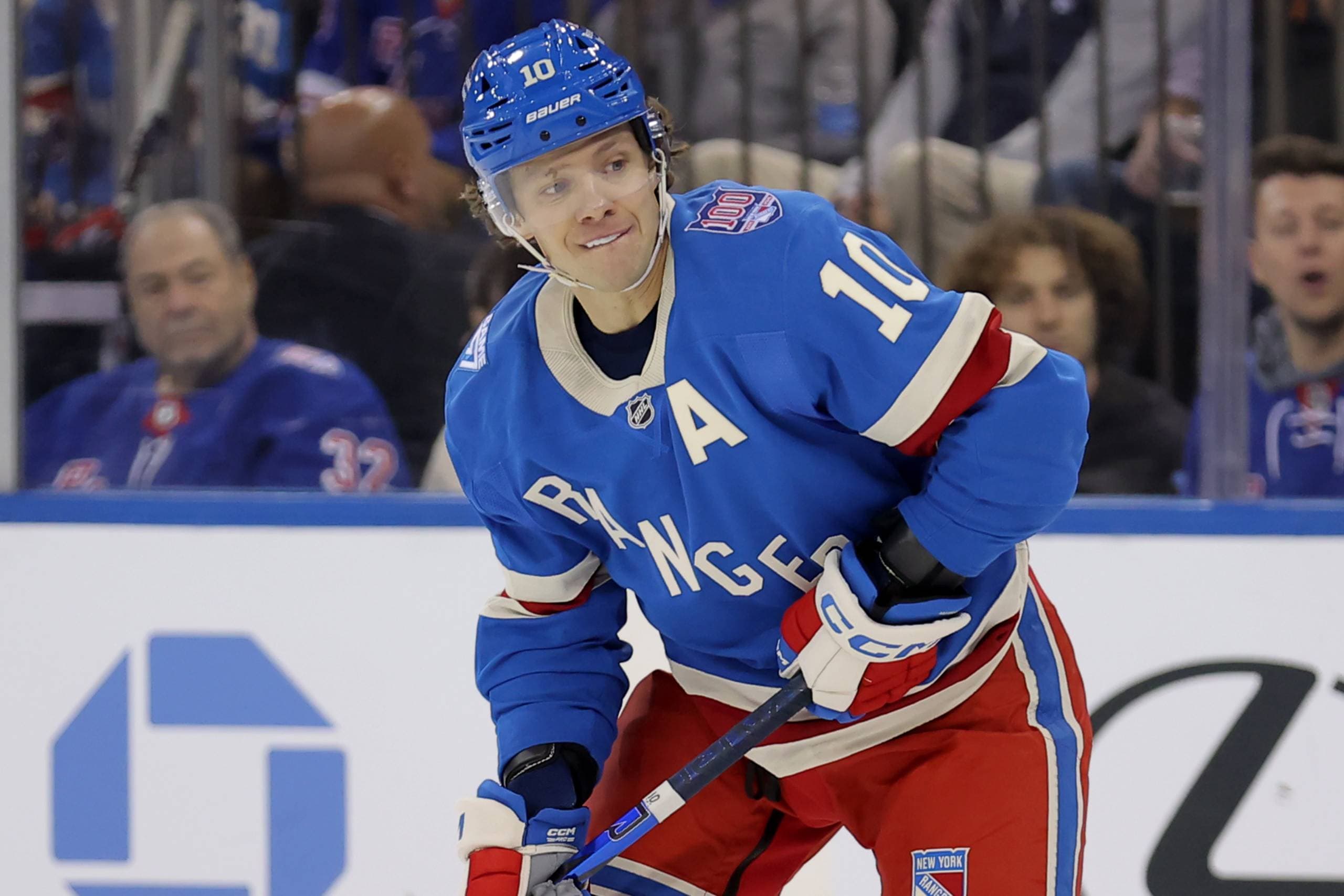
Will ‘The Bread Man’ soon bake up some offense at an arena near you? With every New York Rangers loss and/or catastrophic injury, the salivary glands activate more among the NHL’s contenders. First-line left winger Artemi Panarin is a pending unrestricted free agent, he turns 35 next October, and he reportedly won’t accept a pay cut to re-sign with the Broadway Blueshirts. We know what the endgame is here, right? Barring a turnaround in the standings over the next month and a half, the Rangers will have to consider selling off their prized scorer, whether it means he’s a rental who goes to market in July or he secures an extension as part of a sign-and-trade.
The good news: Panarin will have a massive lineup of suitors should he decide he’s ready to waive his no-movement clause and join a new team. Even at 34, he resides in the upper echelon of scorers league-wide, averaging better than a point per game. He’s just a year and a half removed from a 120-point season. Since he signed with the Rangers six and a half seasons ago, only four players have more points: Connor McDavid, Leon Draisaitl, Nathan MacKinnon and David Pastrnak, making Panarin one of most successful UFA signings of all-time.
Demand for his services thus won’t be a problem. But securing them might be. So many complex variables are in play for a Panarin trade to work now – far more than even a year ago when Mikko Rantanen got hot potatoed between three NHL teams:
(a) Panarin’s aforementioned full no-movement clause gives him control over his landing spot.
(b) The new playoff salary cap rule, fast-tracked from the new collective bargaining agreement to the final year of the current one, requires teams’ postseason lineups to be cap compliant for the first time. No LTIR playoff loophole means it will be much tougher to fit Panarin’s $11,642,857 AAV under the cap.
(c) Another new rule prohibits double retention on salaries within a 75-day period. That means we can’t see a third-party broker retain money on a trade where retention already happened from the original team, such as the 2023 Ryan O’Reilly trade to the Toronto Maple Leafs in which the St. Louis Blues and Minnesota Wild ate 50 and 25 percent, respectively. Nor can we see a player flipped with salary retention twice in a 75-day period. A Panarin trade will allow one team, be it the Rangers or a third-party broker, to retain a maximum of $5,821,429 on Panarin. If it’s the latter, the draft-pick compensation would have to be pretty enticing, too.
With these conditions in mind: which teams make the most sense as viable Panarin suitors? Consider these 10. Yes, TEN. Who wouldn’t want a shot at him? Let’s get nuts. Salary info courtesy of our friends at PuckPedia.
Buffalo Sabres
Why he makes sense: The Sabres have some amazing momentum now, winning 15 of their past 17 games, catapulting themselves into an Eastern Conference Wildcard spot. Typically, a bubble playoff team wouldn’t be linked to a pending UFA, but the stakes are different for Buffalo. This team is hellbent on halting its NHL-record playoff drought at 14 seasons, and if the Sabres remain in a playoff position deep into the winter, it’s time to behave as a buyer in a wide-open conference in which they are now closer to the No. 1 seed than 16th place. General manager Jarmo Kekalainen has already traded for Panarin once, snagging him from the Chicago Blackhawks in a 2017 blockbuster, so the familiarity factor is there. The Sabres are also swimming in draft and prospect capital; for the same reason they were able to spare Matt Savoie for immediate help in Ryan McLeod in 2024 (yes, I’ve come around on that one!), they can spare a top prospect and/or first-round pick and/or viable NHLer. It’s OK to let go of an Isak Rosen or Jiri Kulich, for instance, when you have Zach Benson breaking out and Konsta Helenius still in the system. They Sabres are about as solid a trade partner as the Rangers could want.
Fly in the ointment: As someone who has spent the majority of his life an hour’s drive from Buffalo, I’ll always have a soft spot for the city and its fans. As someone who just shoveled 1.5 feet of snow from his driveway in a single session, I also understand the market is not to every player’s taste and why the Sabres aren’t known for often signing big-ticket UFAs, as ex-GM Kevyn Adams infamous lamented in his palm-tree speech. There’s the matter of Panarin waiving his NMC at all and, if he does, the matter of whether he’d come as only a rental and prefer to test the market in the summer. Kekalainen was already burned once by Panarin when, after the Jackets held him as an own rental for the 2018-19 playoff run, he left for nothing as a UFA. Buffalo the Buyer is a fun concept, but it might be wiser to target a player with term such as Alexis Lafreniere.
Carolina Hurricanes
Why he makes sense: As recently as two years ago, the Canes were the perennially great team that badly needed a star scorer up front. Now? They’re the big-game hunters. They ponied up for Jake Guentzel at the 2024 Trade Deadline and took a big swing for Mikko Rantanen last year, though he only lasted six weeks as a Cane. But we know GM Eric Tulsky is unafraid to make aggressive maneuvers. The Canes have a top-eight scoring offense, but their No. 19 power play could use a boost. They have a sneaky-respectable prospect cupboard and could probably afford to spare someone like Bradly Nadeau if it meant Panarin would sign an extension in Carolina. Carolina is also flush with cap space, meaning the financial component of a trade would be easy enough to figure out.
Fly in the ointment: Are we sure Panarin fits the Canes’ needs the most? With Logan Stankoven not yet taking a big stride forward and Seth Jarvis playing the wing to protect a shoulder injury, the Canes could use a No. 2 center as much as anything – Vincent Trocheck reunion, anyone? – and maybe even some goaltending depth given Pyotr Kochetkov’s season-ending injury and Frederik Andersen’s struggles.
Colorado Avalanche
Why he makes sense: Sportsnet insider Elliotte Friedman recently named the Avalanche, Florida Panthers, Wild and Washington Capitals as teams to watch in the Panarin sweepstakes. The Avs, chasing the 2022-23 Boston Bruins for the NHL single-season wins and points records, are about as all-in as a team can get. They established that truth last year when they sacrificed their top prospect in Cal Ritchie to land Brock Nelson from the New York Islanders without a guarantee of a contract extension at the time. The Avs are a wagon, but their power play is not, curiously sitting 25th in the league. They could use some depth on the wings at 5-on-5, too, with Gabriel Landeskog (currently hurt) and Valeri Nichushkin (frequently hurt) carrying constant risk.
Fly in the ointment: What, exactly, can Colorado…offer the Rangers? Per my colleague Steven Ellis, Colorado owns the 29th-best prospect pool in the NHL, and the best of its lot, Gavin Brindley, isn’t a projected star. The Avs also don’t own a first-, second- or third-round pick in the 2026 Draft. It certainly doesn’t feel like Colorado has sufficient assets to land Panarin in a sign-and-trade, and even the rental acquisition cost will be tough for GM Chris MacFarland to meet.
Dallas Stars
Why he makes sense: The Stars are engaged in an arms race with fellow Central Division superpowers Colorado and Minnesota. The Stars have reached the past three Western Conference Finals without advancing to the Stanley Cup Final and thus need one more big push to break through. Tyler Seguin’s serious knee injury creates a need at forward and probably a $9.85-million crater of cap space; the playoff cap won’t factor in if he won’t be returning at any point in 2025-26. With Seguin out and Mikael Granlund and Mason Marchment gone from last year’s roster, Dallas’ top-nine forward group is thin right now.
Fly in the ointment: Seguin hasn’t officially been declared out for the year. Dallas can only fully leverage all $9.85 million of his cap hit if he goes on season-ending LTIR. Otherwise the relief is only $3.817 million for now. Dallas has already traded away its 2026 and 2028 first-rounders, and its prospect pool isn’t what it was a couple years ago. Making a Panarin blockbuster work would likely require forking over a graduated prospect such as Mavrik Bourque. The Stars also have arguably a greater need to address on the right side of their defense before pursuing anything at forward. They could also use their cap space to get multiple pieces instead of using all of it on Panarin. They might be better off trying to get Blake Coleman (or Nazem Kadri) and Rasmus Andersson from the Calgary Flames, for instance.
Detroit Red Wings
Why he makes sense: Panarin broke into the NHL making magic on a line with Patrick Kane in Chicago. It probably wouldn’t take long for those two to recapture their chemistry. Panarin would also balance the Wings’ lineup so that they don’t have to force the likes of Emmitt Finnie and Marco Kasper into top-line work when they’d be more effective playing insulated minutes at these early stages of their respective careers. Detroit, like Buffalo, has been bad enough long enough that it is flush with future assets and could pretty easily put together a compelling package for Panarin. The Wings could pick from a not-yet-NHLer group including Nate Danielson, Carter Bear and Michael Brandsegg-Nygard. They have two truly elite goaltending prospects in Sebastian Cossa and Trey Augustine. They could involve an active young NHLer such as Kasper if it was necessary to get a sign-and-trade done. Don’t focus too much on the specific names I’m mentioning here, Wings fans – my point is simply that GM Steve Yzerman has tons of options, and that’s before we even factor in draft picks. Cap space is bountiful, too.
Fly in the ointment: The Wings have Kane, Alex DeBrincat and Lucas Raymond as their top wingers already, but their best center behind Dylan Larkin is Andrew Copp. Center is a more concerning hole in Detroit’s lineup, and defense is even bigger. Moritz Seider and Simon Edvinsson need support. Getting it has to be priority No. 1 for Yzerman. Panarin is more of a luxury.
Florida Panthers
Why he makes sense: The Panthers have taken the Evil Empire mantle from Vegas as the team most masterful at pulling off seemingly impossible roster additions and making the money work. Panarin and Aleksander Barkov obviously play different positions and do very different things well, but adding an elite forward of any kind into a top nine missing Barkov would increase Florida’s chances of three-peating as Cup champ.
Fly in the ointment: I have to admit: despite the Panthers being named as a suitor this week, I don’t see it. The only way to fit Panarin under the cap is to place Barkov on season-ending LTIR to get full use of his $10 million rather than just $3.817 million of relief. And the Panthers haven’t ruled out having Barkov back for the playoffs or during the playoffs. The Panthers also have traded away their next couple first-rounders and have the league’s worst prospect pool. They’re better off treating Barkov, plus the soon-to-return Matthew Tkachuk, as the equivalent of their big-ticket additions.
Los Angeles Kings
Why he makes sense: The Kings continue to play elite defensive hockey under coach Jim Hiller, even after GM Ken Holland seemingly cut the team’s legs out from under them with a terrible offseason of moves. They carry the second-lowest expected goals mark in the NHL at 5-on-5. But, as is they case every year, they can’t find the twine. The Kings have the 29th-ranked scoring offense and 27th-ranked power play. They have the third-lowest shooting percentage in the league, which tells us they simply can’t finish with their current personnel. A high-end facilitator like Panarin would make all the difference. He’d also be a strong re-sign candidate in theory given his affinity for large U.S. markets.
Fly in the ointment: The Kings would have to dip into an already-shallow prospect pool to make a strong enough offer for Panarin. If you’re the Rangers, you’d surely ask for Liam Greentree, right? Also, there’s the matter of the standings. The Kings sit outside a playoff spot at press time. A rental would be risky. If they are to land Panarin, it probably has to be a sign-and-trade to make sense.
Minnesota Wild
Why he makes sense: The Wild are pretty open about their desire to stack another major star on top of their blockbuster Quinn Hughes acquisition, and forward is the clear position of need given they have excellent defense and goaltending. Panarin joining fellow Russian Kirill Kaprizov is an exciting proposition, one that could elevate Minnesota into the juggernaut tier alongside Colorado and Dallas, and Panarin and Kaprizov share an agent in Paul Theofanous. Even after including Zeev Buium and Liam Ohgren in the Hughes trade, the Wild still have an enviable stable of young talent they can dip into, including defensemen David Jiricek and Aron Kiviharju and forwards Riley Heidt and Charlie Stramel.
Fly in the ointment: It’s a center, not a winger, that Minnesota needs more than anything, especially after including Marco Rossi in the Hughes trade. As fun as it would be to watch Panarin and Kaprizov between Danila Yurov, it makes more hockey sense for the Wild to pursue someone like Kadri, right?
Vegas Golden Knights
Why he makes sense: Just when we thought we were safe from the Golden Knights’ greedy grasp…William Karlsson sustains a long-term injury. If he were to land on season-ending LTIR, the relief for his cap hit would be $5.9 million, almost exactly what Panarin’s cap hit would be in a deal with 50 percent retention. Just sayin’. Also, if Mitch Marner continues to play center, the hole to fill is on the wing, where Panarin would be a welcome addition.
Fly in the ointment: Being the team that trades away virtually all its top prospects and picks, the Golden Knights obviously lack a deep cupboard of tasty temptations for Rangers GM Chris Drury. The talent pool drops off precipitously after Trevor Connolly. To really make a trade work, Vegas might have to kick in a viable NHLer such as Pavel Dorofeyev. Also: Panarin as a sign-and-trade would be a stretch given the Golden Knights already have $101.6 million committed in cap spending for 2026-27, albeit that number includes Alex Pietrangelo’s $8.8 million when we don’t know if he’ll play again.
Washington Capitals
Why he makes sense: It’s (possibly) Washington’s final ride with goal-scoring G.O.A.T. Alex Ovechkin. The Caps have a deep roster, particularly on defense, and are transitioning in some promising youth led by Ryan Leonard, but it still feels like this season could be the end of something. With or without Pierre-Luc Dubois potentially sliding to LTIR as he navigates a multi-month injury, Washington could make the cap space work. Last season, almost every player on the team had a career year, and with the expected regression hitting hard in 2025-26, Washington has slipped from second to ninth in goals per game. Panarin would be an exciting jumpstart for the offense.
Fly in the ointment: Maybe the Rangers are OK helping a division rival if the trade is a rental and they’re out of the playoffs anyway. But if the Caps wanted to extend Panarin, that idea might give Drury pause. Also, as is the case with the Kings, the Capitals aren’t locked into a playoff spot, so they’d have to assess whether it’s worth paying the hefty price for a mere rental. The rival factor applies to the Hurricanes, too.
_____
POST SPONSORED BY bet365