Brady rules, Swayman struggles: Recapping the good, the bad, and the ugly from Team USA’s group play

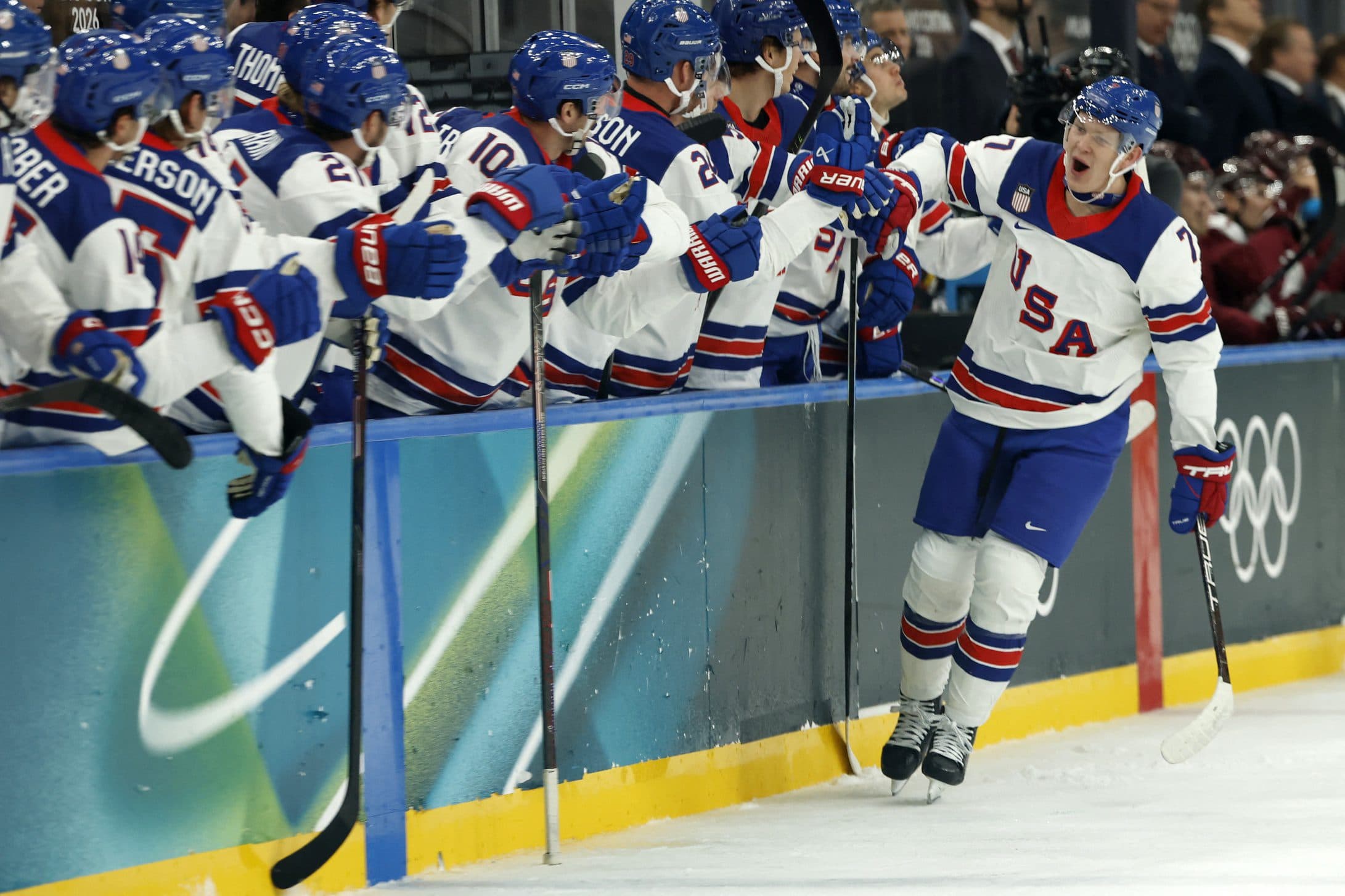
In many ways, Group C at the Milan Cortina Olympics was a perfect draw for a powerhouse like the United States.
They were never going to lose to Latvia or Denmark. But both teams had just enough talent and toughness that the contests would be more informative than, say, an 11-0 shellacking of Italy. Germany and its three legitimate NHL franchise players (Leon Draisaitl, Tim Stutzle and Mo Seider) would provide a nice stress test to close out group play, but wouldn’t have the depth to last 60 minutes with the Americans.
That’s how the Americans would have viewed things going in, and that’s how they surely view them now that they have finished the group stage seeded second overall behind, you guessed it, Canada.
Against Latvia, the U.S. team got off to a nervy start before picking up the pace to earn a 5-1 victory. Denmark similarly succeeded in drawing the Americans into a cagey, frustrating first frame and even took a lead twice, first off an uncharacteristic meltdown by Zach Werenski and then via a 90-foot wrist shot past Jeremy Swayman. Team USA’s quality carried the day in a 6-3 win, all the same. Against Germany, there was another 5-goal explosion, except without any caveats; after spending large parts of their opening games in second gear, Auston Matthews, Zach Werenski, and Co. hit the gas from the opening bell to earn a 5-1 win in their most complete performance of the tournament.
For Team USA, the goals, the wins, and the moments of individual inspiration have been there. Still, a soft but not completely irrelevant group was supposed to provide them with a learning experience ahead of the heavyweight contests to come (perhaps even a title fight with their cousins from the Great White North), and it succeeded in exposing strengths and weaknesses ahead of their meeting with the winner of Sweden vs. Latvia. Read on for what worked for the Americans, what didn’t, and one particularly confounding self-inflicted wound.
Good: Big game Brady Tkachuk
If you have spent any amount of time scrolling through the caustic wasteland that is hockey Twitter, you’ll have seen your share of cheap shots in the direction of Brady Tkachuk. The Ottawa captain is a subject of constant ridicule from all corners of Canada save for its capital, all with the qualifier that his abusers would take him on their team in a heartbeat. To find out why, you only need to watch Tkachuk play. He is destructive, irreverent, and, at his best, unstoppable. Lucky for Team USA, Tkachuk is always at his best when he dons the Red, White, and Blue.
On a line with older brother Matthew, Brady’s game brought him as close to mainstream stardom as an American hockey player can get in today’s sports landscape with his heavy hits, tide-turning goals, and roaring celebrations at the 4 Nations Faceoff. Nothing has changed at the Olympics. When Team USA risked embarrassment against Denmark, it was Tkachuk facewashing Danish defenders, jawing at them, making himself a nuisance. Later in the game, it was Tkachuk scoring to notch the game at two goals apiece with a one-time wrister that clinked off iron and in.
Tkachuk’s pair of unsaveable goals against Latvia and Denmark brought his tally as a senior international to 12 goals in 15 games. Add in his limited Stanley Cup Playoff experience, and Brady has 16 goals in 21 outings. While Brady didn’t add to his tally against Germany, he produced his usual output of hits, quality looks, and, of course, yapping. The big man has always been an excellent top-line power forward for the Senators, but when the pressure is on, he transforms into an irresistible force on par with the world’s best. The online barbs aren’t slowing down, but until another international team finds the antidote for Team USA’s monstrous No. 7, neither is Tkachuk.
Bad: Slow starts can’t continue into the knockout round
There were common themes throughout Team USA’s first two group games, and not all of them were positive. Against both Latvia and Denmark, any new hockey viewer would have been hard-pressed to identify which of the two teams was full of NHL All-Stars and which was one of the tournament’s minnows. They were cagey, close-run affairs through 20 minutes, and Team USA actually came out on the losing end of the combined score by two goals to three. Against stiffer German competition, though, the Americans ran rampant from the drop of the puck.
Instead of trusting that their superior depth would eventually produce the sort of highlight-reel goals that unlocked the Latvian and Danish defenses, Team USA consistently forced the issue from the opening whistle. They could easily have led by more than the Zach Werenski wrister that sent them to the room up 1-0. Save for a few nervy moments near the end of the first and on the PK, the Americans played the way they set out to starting last February, going to hard areas, forcing turnovers, and generally overwhelming the Germans with a consistent output of pace and physicality.
Whether their tournament-best performance against Germany was just the U.S. finding its groove after six periods of Olympic hockey or recognizing that going into autopilot like they did in earlier games was a serious risk against Draisaitl, Stutzle (Germany’s lone goalscorer in the route), and JJ Peterka, the American delegation needs to keep the intensity dialed up to 11 in the knockout round. Where bad starts against Latvia and Denmark were always going to be inconsequential in the end, a sluggish opening period in a likely quarterfinal against a loaded, if underperforming, Swedish lineup could end in national embarrassment.
Good: Four lines firing
One game at a time, the U.S. team has found winning deployments for its talented forward corps. There was never any concern over whether the brothers Tkachuk would produce on either side of elite pivot Jack Eichel. True to form, their puckhounding ways produced America’s opening goal of the tournament off Brady’s stick, the first of three even-strength tallies from the line during group play. More surprising was the revelatory play of Jack Hughes, a center at his day job, on the right wing. Hughes dazzled along the wall on Brock Nelson’s line, teeing the smart finisher up for a pair of goals (including one of the highlights of the tournament) in the opening contest before scoring himself against Denmark.
Though they took an extra game to gel after a disjointed outing against Latvia, Auston Matthews’s line was excellent in the Denmark game, thanks in large part to the lively forechecking of the American captain, who set up Jake Guentzel to break through after a few near misses. Matt Boldy suffered through some frustrating moments in the contest but got the Americans off the mark with an excellent solo effort. The unit only improved against Germany, with all three men hemming the opposition in their own zone as Matthews added a pair of goals to his Olympic account, including his first five-on-five tally, and Guentzel and Boldy produced a couple of near misses.
The clear black sheep of the U.S. forward group through two games had been the line centered by Dylan Larkin, the Detroit captain and a 4 Nations standout. Sullivan acted to rectify their even-strength anonymity by replacing Kyle Connor, a top NHL scorer whose game hasn’t translated to best-on-best international play. In his place came hardworking playmaker Clayton Keller, a scratch during the first two contests, opposite sniper Tage Thompson against Germany. It worked a treat, with Keller’s work away from the puck extending the line’s zone time throughout the evening until Larkin eventually set Thompson up for a bomb to extend the U.S. lead to 4-0. Sullivan was smart to give the unit some extra run in the final frame of a game that was already won; their burgeoning chemistry could give him the four-line depth that proved elusive at last year’s internationals.
Bad: Loud mistakes on ‘D’
If the USA is to succeed in the medal round, it will be largely due to a team-wide commitment to defense. The blue line is stacked with a combination of all-world puckmovers (Werenski, Quinn Hughes) and shutdown options (Slavin, McAvoy). Forwards Matthews, Eichel, and Boldy are among the top two-way operators in the NHL. As such, the Americans’ occasional lapses during the group stage were at least mildly concerning.
The U.S. surrendered five goals during their trip through Group C, but a pair of soft ones past Swayman (more on him later) in the Denmark game meant only three are worth anything as lessons on tape. Each was, to some extent, the result of their own mistakes. Against Latvia, an uncharacteristic turnover from Matt Boldy allowed Tampa’s Zemgus Girgensons to fire a hard shot on goal. Brock Faber and Jaccob Slavin, Sullivan’s preferred shutdown pairing, took turns swatting at the puck before Renars Krastenbergs beat Eichel to the punch to tie the game. For four players that will surely log major minutes when it comes time to protect a lead, it was a defensive lowlight.
On Demark’s opening goal, Werenski carelessly blew the zone without noting that his pass up the wall was to the Danes, only recovering in time to kick a rebound past Swayman. When Stutzle scored in garbage time for Germany off an excellent keep by Peterka, it was after Noah Hanifin went down far too early to put him off shooting. One of the most dangerous snipers in hockey had ages to steer around Hanifin and pick his spot past reigning Hart Trophy-winner Connor Hellebuyck. Team USA didn’t make too many mistakes in its defensive zone during the group stage, but the fact that most of them wound up in the net should serve as a reminder of how slim the margins are at a tournament of this magnitude. If Denmark can punish you for a mental error, Sweden definitely can.
Ugly: Where was Oettinger?
The decision to start Swayman against Denmark was not a controversial one outside of the Dallas-Fort Worth Metroplex. Starter Hellebuyck was always going to sit out the second game, and Swayman has enjoyed a very strong season behind a Boston Bruins’ defense that’s not as good as he’s made it look. His .676 quality start % is a big reason Boston has hung around in the postseason race. Jake Oettinger’s career-worst numbers (.897 SV%) are by no means appalling, but Swayman had been better, and his star turn at the 2025 World Championship (7-0, 1.69 GAA, .921 SV%) came with some clout.
There is one drawback to Swayman’s game; when he’s good, he’s great, and when he’s bad, he’s bad. The Alaskan only has 12 non-quality starts this season, but has shipped 5 or more goals in eight of them. On Saturday, Team USA got the bad Swayman. The first Denmark goal was a weird one, off the skate of Werenski and through the former University of Maine Black Bears’ legs. The third, a lightly screened slapshot from a mile out, Swayman will want back.
It’s not those goals anyone will remember, though. Just over eleven minutes into the opening period, Swayman never saw a wrist shot off the stick of Nicholas B. Jensen flutter through the air and into his goal from just inside the red line.
Jensen’s goal ended Swayman’s Olympics. There’s no way around it. Swayman’s Boston coaches have no presence on this staff, and no one’s worried about saving his pride with medals on the line. Sullivan won’t trust him again … so where was Oettinger? Inexplicably, in the press box. Hellebuyck served as backup, and Swayman, effectively a lame duck by the time the puck dropped on the third period, kept the net.
Sullivan must have known he wouldn’t turn to Swayman again at the Olympics the moment the horn blew on Denmark’s second goal. Why didn’t he leave himself the option to evaluate ‘Otter,’ who hasn’t seen game action in two weeks, as injury cover ahead of the knockout round? It’s anyone’s guess.
PRESENTED BY DAILY FACEOFF’S OLYMPIC COVERAGE

Catch Every Goal from the 2026 Milan Games! The 2026 Milan Games are almost here, and the world’s best men’s and women’s hockey players are ready to battle for gold! The Nation Network is bringing you every game, every jaw-dropping save, and all the drama with live reaction streams and full recaps. Don’t miss a moment of Olympic hockey action—men’s, women’s, and everything in between—on the Daily Faceoff YouTube channel. Subscribe now and stay on top of every play!