Breaking down Team Sweden’s 2026 Olympic men’s hockey roster

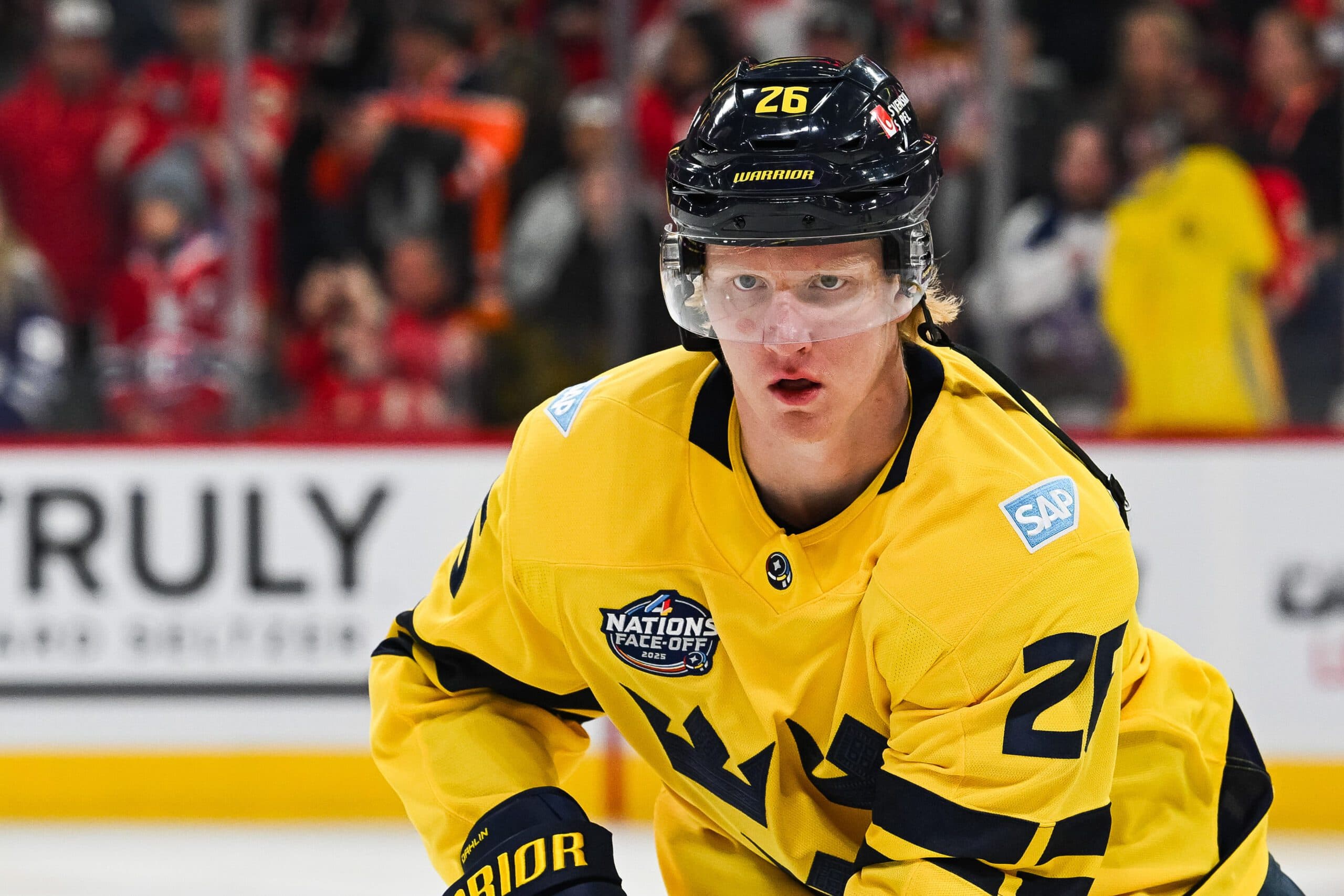
The speculation is finally over. On Friday, head coach Sam Hallam unveiled Sweden’s Olympic roster — a roster that shows the long-anticipated generational shift in Swedish national team hockey will have to wait another four years. Only five of the selected players were born in the 2000s.
Here, we take a closer look at the team and scrutinize Hallam’s choices.
FORWARDS (14)
Jesper Bratt (NJ)
Leo Carlsson (ANA)
Joel Eriksson Ek (MIN)
Filip Forsberg (NSH)
Pontus Holmberg (TB)
Adrian Kempe (LA)
Gabriel Landeskog (COL)
Elias Lindholm (BOS)
William Nylander (TOR)
Elias Pettersson (VAN)
Rickard Rakell (PIT)
Lucas Raymond (DET)
Alexander Wennberg (SJ)
Mika Zibanejad (NYR)
DEFENSEMEN (8)
Rasmus Andersson (CGY)
Philip Broberg (STL)
Jonas Brodin (MIN)
Rasmus Dahlin (BUF)
Oliver Ekman-Larsson (TOR)
Gustav Forsling (FLA)
Victor Hedman (TB)
Erik Karlsson (PIT)
GOALTENDERS (3)
Filip Gustavsson (MIN)
Jacob Markström (NJ)
Jesper Wallstedt (MIN)
Since Olympic hockey with NHL players has not been played since 2014, there are very few players with Olympic experience who will represent Sweden in Milan and Cortina. In fact, only five: Oliver Ekman Larsson, Erik Karlsson, Gabriel Landeskog, Rasmus Dahlin and Pontus Holmberg — all very early in their careers at the time.
Ekman Larsson, Karlsson and Landeskog were in their early 20s when they brought home a silver with Sweden in Sochi in 2014. Dahlin was not even 18 when he was part of the Swedish team at the 2018 Winter Olympics in Pyeongchang, South Korea. Holmberg suited up at the 2022 Beijing Olympics.
Despite this, Sweden will be sending a seasoned roster to Italy next month. The average age is just over 29, and there are only five players aged 25 or younger. This can be seen as a sign that the younger generation of Swedish NHL players has not quite broken through yet.
There are, however, exceptions. Leo Carlsson and Lucas Raymond were part of the 4 Nations tournament nearly a year ago and have only strengthened their positions since then. They should be considered key players on this Swedish team. Raymond was even one of the six players announced back in June. Their strong chemistry at the World Championship this spring suggests they will line up together at the Olympics as well — perhaps even on a Swedish top line.
Otherwise, it is “the usual suspects” who will drive Sweden’s offense. Nylander, Kempe, Forsberg, and Bratt are all wingers capable of producing around a point per game in the NHL. The center position becomes more intriguing following William Karlsson’s withdrawal due to injury. Beyond Leo Carlsson, neither Elias Pettersson nor Mika Zibanejad has stood out in the same way as they did a couple of years ago. Still, the lack of offensive competition made their inclusion fairly obvious. Joel Eriksson Ek adds physicality and two-way strength, while Elias Lindholm provides flexibility with his ability to be just as effective on the wing as at center.
Then there is the defense. Fairly early on, six top names could be penciled in: Dahlin, Hedman, Karlsson, Andersson, Forsling, and Brodin. The debate centered on which two would claim the remaining spots. Oliver Ekman-Larsson was not seen as a particularly hot option heading into the season, but his strong first half with an otherwise underwhelming Toronto Maple Leafs team earned him a well-deserved place.
The goaltending situation ultimately wasn’t very dramatic either. Linus Ullmark’s unfortunate personal situation — which has led him to take an indefinite leave from the Ottawa Senators — effectively locked in the trio of Filip Gustavsson, Jacob Markström, and Jesper Wallstedt. Wallstedt, in particular, has been a major talking point this fall thanks to his strong play with the Minnesota Wild. Who will start the opener against Italy on Feb. 14 remains to be seen, but the current projection here is Gustavsson, just as in the 4 Nations. He has been stronger than the more experienced Markström this season and also has more experience in big games than his Minnesota counterpart.
Challengers? Not really. Samuel Ersson, who joined the 4 Nations roster after Markström’s injury last year, has endured a very difficult season with the Philadelphia Flyers and has lost the starting job to Dan Vladar. Meanwhile, goalies such as Anton Forsberg, Jonas Johansson, and Arvid Söderblom are not particularly close to competing for spots.
Biggest Reach
There were plenty of questions about how the lower part of the forward hierarchy would be constructed. Was there room for William Eklund? Had Emil Heineman and/or Simon Holmström done enough with the New York Islanders to earn a spot? And had Marcus Johansson’s and Mikael Backlund’s reassuring play for Sweden at the World Championship this spring made them serious candidates?
The answer to all of those questions turned out to be no.
Instead, Hallam opted for Alexander Wennberg and Pontus Holmberg as two of his forwards — safe but unspectacular choices. This gives Hallam extra flexibility at center. Still, it would have been more exciting to bring in an offensive force like Eklund, or Marcus Johansson, who is having an outstanding season with the Wild and always seems to gain superpowers when he puts on the blue and yellow jersey. Heineman’s physical presence and goal-scoring touch would also have added value.
Biggest Omission
With the six defensemen expected to log the majority of the minutes feeling firmly set, there were only crumbs left. Ekman-Larsson and Philip Broberg are unlikely to see heavy ice time in Milan, yet they get the nod ahead of established names like Mattias Ekholm and Hampus Lindholm.
Ekholm had a minor feud with Hallam after the 4 Nations, but it is more likely the fierce competition — rather than anything else — that cost Ekholm here. Lindholm has dealt with his share of injury issues and makes way for the younger Broberg, whose skating and strong two-way play with the St. Louis Blues have put him firmly on the map.
Burning Question
What does the lack of a true superstar mean for Sweden’s medal chances?
Canada and the United States have several. Finland (Mikko Rantanen), Czechia (David Pastrňák), and Germany (Leon Draisaitl) can also boast players of true world-class caliber. Sweden, however, does not currently have a player who sits at the absolute top of his position globally.
Dahlin may be the closest, but he has had a season in which bigger and more important things than hockey have dominated his life. Nylander, Bratt, and Carlsson also hover on the fringes of the discussion as being among the best at their respective positions, but they are not superstars in the truest sense of the word. Perhaps Tre Kronor can still challenge thanks to their strong depth across most positions — but then someone will need to step up and be that special game-breaker you need in a short, intense tournament.
Projected Lines
Bratt – Carlsson – Raymond
Forsberg – Pettersson – Nylander
Kempe – Eriksson Ek – Landeskog
Rakell – Lindholm – Zibanejad
Wennberg – Holmberg
Hedman – Dahlin
Forsling – Karlsson
Brodin – Andersson
Ekman Larsson – Broberg
Gustavsson
Markström
Wallstedt
_____
POST SPONSORED BY bet365