Conn Smythe race, Hart vs. Andersen, and the biggest storylines to watch in the Stanley Cup Final

Over the weekend, I broke down the matchup between the Carolina Hurricanes and the Vegas Golden Knights, two titans of the modern NHL in the heart of their respective contention windows, in the typical format of our comprehensive Daily Faceoff playoff previews, highlighting the strengths, weaknesses, and key matchups that will define the one series that really matters.
In a Stanley Cup Final, though, analysis must go further than even the deepest look at the X’s and O’s. Legacies, even ones as stellar as those of bench bosses Rod Brind’Amour and John Tortorella, hang in the balance. Redemption arcs for players like Mitch Marner and K’Andre Miller are being spun. For one man, a historic date with the Conn Smythe Trophy as playoff MVP awaits.
The narratives surrounding the euphoric triumph and bitter defeat that await at the end of the most arduous journey in sports are countless. Read on for more on five of the most significant.
Brind’Amour and Tortorella are coaching for a chance at the Hall of Fame
Now that Jeremy Roenick is in, Rod Brind’Amour might be the former player whose Hall-of-Fame bona fides are the most fiercely debated. Are Brind’Amour’s longevity, leadership, and memorability adequate substitutes for the world-beating peak missing from his resume? My colleague Paul Pidutti took a comprehensive look at that debate a few years back, but ‘Rod the Bod’ could skip the queue entirely and get in on the strength of his outstanding coaching credentials alone if he brings the Cup back to Raleigh as head coach of the Hurricanes.
In your cherry-picked stat of the day, the L.A. Kings have never won 50 games in their 58 seasons of existence. Brind’Amour averages 50 wins (well, 49.9 per 82 games) in his eight years behind the Carolina bench. His Canes have never failed to win at least a round of the Stanley Cup Playoffs, and there’s no debating that Brind’Amour’s all-action brand of defense from the front counts lends him some clout as an innovator, too. If the Hurricanes can finally prove that their unwavering commitment to Roddy’s rigid style can take them all the way, it will be hard to keep their coach out of some lofty conversations given his stellar regular-season track record and historic consistency.
Tortorella’s teams have never reinvented the wheel in the way the Hurricanes have. They nonetheless typically buy into his demand for fearlessness on both ends of the ice for long enough to yield strong, sustained results (not you, Vancouver). Those results have been so strong that old ‘Torts’ has two Jack Adams Trophies, a Stanley Cup, and will soon win his 800th regular-season game if he resigns in Vegas over the summer.
The biggest hurdle to Tortorella’s Hall-of-Fame case is that, rightly or wrongly, you need people on the voting committee who like you. Torts lacks any of the genuine cruelty of a Keenan or a Babcock behind his gruff exterior, but his media blowups and epic flameouts have always garnered at least as many headlines as his one-ice triumphs. A second Cup would serve as a lasting reminder to the Hall that Tortorella isn’t just an adversarial crank. He’s an NHL legend, too.
Marner and Miller are taking control of their narratives
You know the story with Mitch Marner. We all do. Though the list of reasons behind the Maple Leafs’ playoff failures in the Core Four era could (and someday will) garner its own book, it was easy to say Marner, physically slight and not particularly quick, just wasn’t cut out for the playoffs. He never failed to reinforce that argument in back-to-the-wall situations.
In Vegas, Marner is writing his own story. The hard-hitting team around him is better equipped to cover for his lightweight game, the leaders are better equipped to block out the (still ample) outside noise, and the market isn’t so predisposed to getting on his back. Marner has landed himself in the perfect situation and is responding with a stellar postseason. The fans in Anaheim, against whom Marner piled up 11 points in six games, will have attached a very different meaning to “playoff Marner” than those in Toronto.
Marner wasn’t the only big name who wore out his welcome in a big market last season. K’Andre Miller was a pariah himself in New York, if to a lesser extent. A massive man with a smooth stride and feathery touch, Miller burst onto the scene for the Rangers as a ready-made 20-minute horse in his early 20s. He was never the problem for their dysfunctional defense. It still drove fans, writers, and, eventually, the front office to frustration that a player with such obvious gifts was never the solution, either. Miller’s preference for playing the puck rather than the body particularly drew the ire of a fanbase that lamented their club’s perceived softness.
It’s tough to argue Miller didn’t, like Marner, land in the ideal environment to utilize his greatest strengths. Skating, stickwork, and puckhandling are the only prerequisites for success on the Carolina blue line, and Miller has each in spades. It’s impossible to argue, knowing what we do now, that the Rangers did all they could to unlock the big blue liner.
Miller has been a (forgive the pun) force of nature for the Hurricanes, his one-time jitters under fire replaced with an unflappable confidence that permeates throughout the Carolina lineup whenever he is on the ice. The Canes are outscoring the bad guys 16-3 during Miller’s five-on-five minutes with a nearly 2-1 advantage in scoring chances. I never did hear back from any of the Ranger fans that seethed at my scathing initial review of the club’s decision to pull the plug on him.
Who has the edge in goal?
Goaltending was the biggest perceived weakness of either conference champion going into the postseason, and it’d be revisionist to call that an unfair assessment.
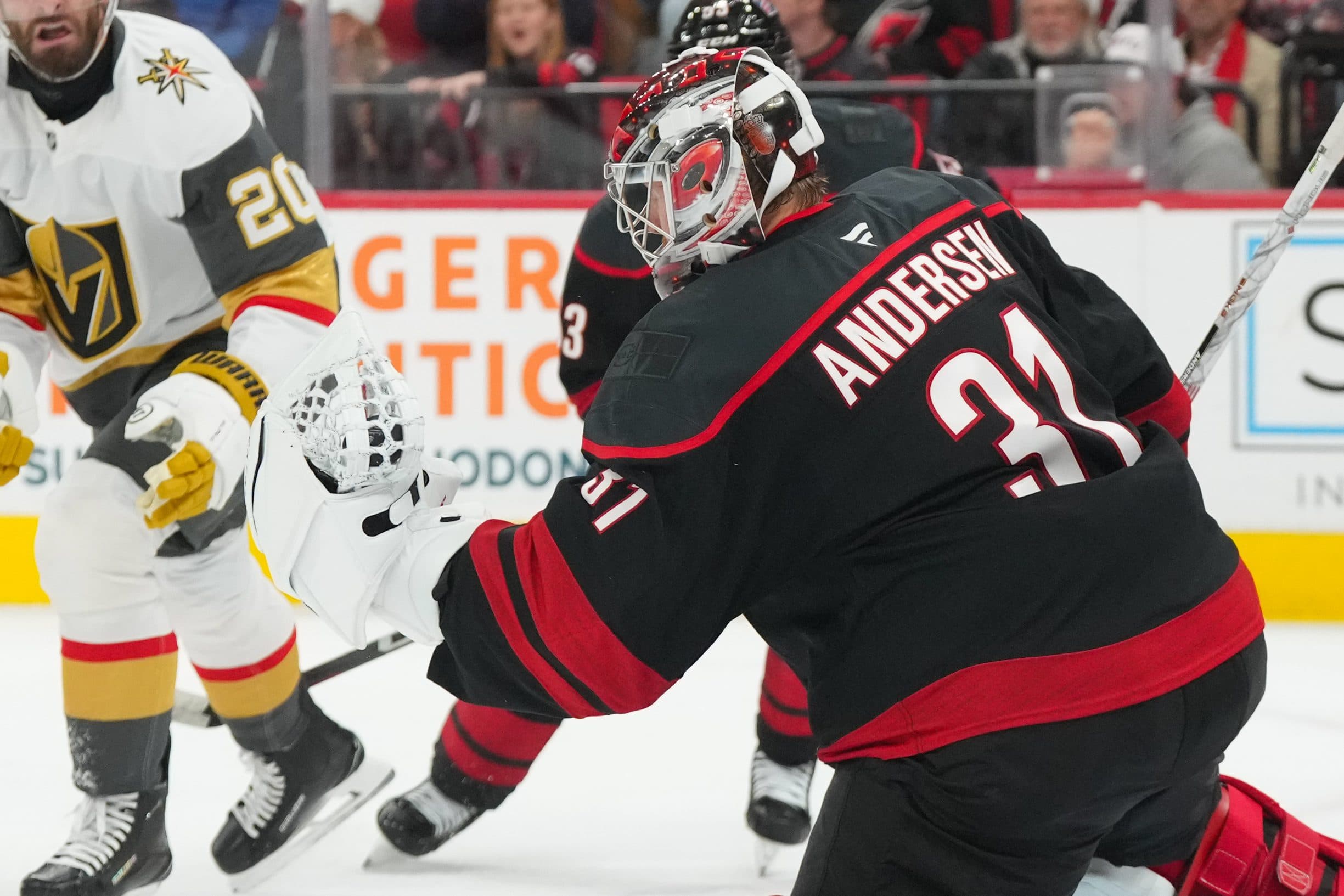
In Carolina, Frederik Andersen decisively lost his job to Calder-ineligible rookie Brandon Bussi before Bussi’s game fell apart (.865 SV% after Olympic break) under the strain of the NHL homestretch. Brind’Amour chose the devil he knew, Andersen, to man the cage in the postseason despite a career-worst season (3.05 GAA, .874 SV%). In Vegas, an ugly team SV% (.879) amid 2023 Cup hero Adin Hill’s catastrophic campaign cost head coach Bruce Cassidy his job despite the Golden Knights’ typically stellar under-the-hood numbers. Tortorella gave his old Philadelphia Flyers pupil, Carter Hart, the reins despite his own struggles (2.71 GAA, .891 SV%).
Strong starts and ill-timed collapses have characterized Andersen’s postseason reputation, but that second part has yet to rear its ugly head in 2026. It might never, given how comfortably the ‘Great Dane’ rebounded from a five-goal shellacking in Game 1 against the Montreal Canadiens. Andersen, an injury-prone goalie who has typically faltered after eight playoff starts in Carolina (.862 SV% before 2026), bounced back to stop 62 of 67 Montreal shots the rest of the way.
The big man’s angles and ability to avoid the soft ones remain elite. He might need to unleash some jawdroppers, though, against a Vegas team that will likely exploit the Hurricanes’ hard-charging forecheck to generate rush chances. Montreal only managed five such chances, but Andersen was up to the task when two teams with strong two-way forwards in Philadelphia (9 rush chances) and the Ottawa Senators (13) got their looks on the rush, stopping several breakaways.
Hart, in just his second postseason, is not a known quantity like Andersen, but has been no less impressive. After a rusty first-round against the Utah Mammoth, he was outstanding against Anaheim and during a major upset of the Colorado Avalanche (.939 SV% in last 10 GP). His positioning, which was sometimes an issue in Philadelphia, has been razor-sharp, and Hart has the athleticism to recover if it fails him. Hart’s 9-0 record when facing 30 shots or more this postseason suggests a goaltender who is at his strongest when he gets involved early and often, which could be a critical asset against the Hurricanes’ volume shooting.
Whether it’s the weathered old war horse or the up-and-comer who’s taken a circuitous journey (I’ll get to that) to fulfilling his immense potential that backstops his club to Cup glory, don’t try saying you saw it coming. Both men have saved their best for last.
The race for the Conn Smythe is in the home stretch
Playoff MVPs come in all shapes and sizes. In the past decade, minute-munching defensemen (Makar, Hedman), crafty, clutch scorers (Bennett, Marchessault), goaltending bulwarks (Vasilevskiy, Holtby) have taken home the award. This year’s shortlist for the spring’s second-most prestigious trophy isn’t terribly short.
Should Carolina triumph, a win for Andersen, playing with a heavy heart after the loss of agent and friend Claude Lemieux, would be an acknowledgement of the watertight defense in front of him and his preposterous stat line (1.41 GAA, .931 SV%, both league bests). Could that same defense, which has kept Freddy from having to steal one since Game 2 of the second round, work against the Dane’s case? Top-scorer Taylor Hall’s resurgence (16 P in 13 GP) has engrossing narrative value, but he’ll need to share the spotlight (and split votes) with equally brilliant linemates Jackson Blake (15 P) and Logan Stankoven (9 G). Miller has been the Hurricanes’ most dominant skater, but franchise icon Jaccob Slavin is still the top dog on defense in key situations, which could dock Miller some points.
A Vegas victory would likely lead to a more straightforward selection. Marner’s heroics on the back of years of failure in Toronto have been the story of the Stanley Cup Playoffs. He’s a superstar who’s leading the field in points (21), and Jack Eichel’s status as the Golden Knights’ true centerpiece can’t cover for his missing shooting gloves (2 G). Hart’s play in goal is certainly deserving of consideration, but his recent criminal trial for sexual assault casts a long shadow despite a not-guilty verdict. It was the latest blemish on the sport’s embattled reputation and an easy excuse to go with the easy answer, Marner.
What will the copycat league learn this time around?
After two Stanley Cups and three Wales Trophies in three seasons, the success of the rough-and-tumble Florida Panthers had a pervasive influence on roster-building throughout the NHL, especially among the Cats’ biggest enemies.
It never worked, of course: the Tampa Bay Lightning’s obsession with being just as mean as their one-time little brother clearly psyched them out in a first-round upset loss to Montreal; the Maple Leafs’ planned transformation from small and skilled to tough and “snotty” left them lumbering and useless; and, though a return to the Big, Bad ways of old galvanized the surprising Boston Bruins in some ways, it also left a spotty penalty kill overexposed.
The lesson there should be that, by trying to beat the masters of the dark arts at their own game, you’re playing right into their hands. In reality, the lesson is that the NHL follows the leader, and with the injury-ravaged Panthers somewhere on a beach, the copycat league will doubtlessly try to ape the new king of the hill in the coming months. This time, roster strategy, not on-ice tactics, will come to the fore.
No one except for the Senators, whom Carolina dispatched in four, and the Kings, who already missed the boat, has replicated the Hurricanes’ smothering, three-zone defense with any measure of success in recent years. Their methods of player acquisition and development will, however, hearten patient GMs like Philadelphia’s Daniel Briere and Washington’s Chris Patrick, division opponents who have seen the merits of the Canes’ methodical approach up close.
Outside of former No.2 overall selection Andrei Svechnikov, Carolina hasn’t needed premium picks to identify value in the draft. Except for the recent two-part trade involving Mikko Rantanen and the Miller swoop, they haven’t had to sell the farm to compete, either. Analytically-inclined GM Eric Tulsky and the Hurricanes are a refreshing example of the old Herb Brooks (Kirk Gibson?) mantra of finding the right players, not the best ones.
For Vegas boss Kelly McCrimmon, it’s all about the best players, all the time, any way he can get them. The only player of note the Knights drafted and nurtured in AHL Henderson is Russian sniper Pavel Dorofeyev (72 G since 2024, 10 in playoffs), a third-round lottery ticket that hit the jackpot. Otherwise, McCrimmon has skipped to the front of the line for any NHL star who has shown even the faintest hint of discontent with his current digs, from Eichel to captain Mark Stone to former Calgary Flames defenders Rasmus Andersson and Noah Hanifin, etc., etc. Oh, and don’t forget Marner, whose UFA rights were traded to McCrimmon just ahead of July 1 and free agency.
If the Golden Knights win their second Cup in four seasons, it will erect a big, Vegas-worthy neon sign to other hyper-aggressive contenders like Colorado, Tampa, and, of course, Florida, to keep doing what they’re doing. Who needs draft picks, anyway?