EBUGs Unmasked: Inside the life of an emergency backup goalie

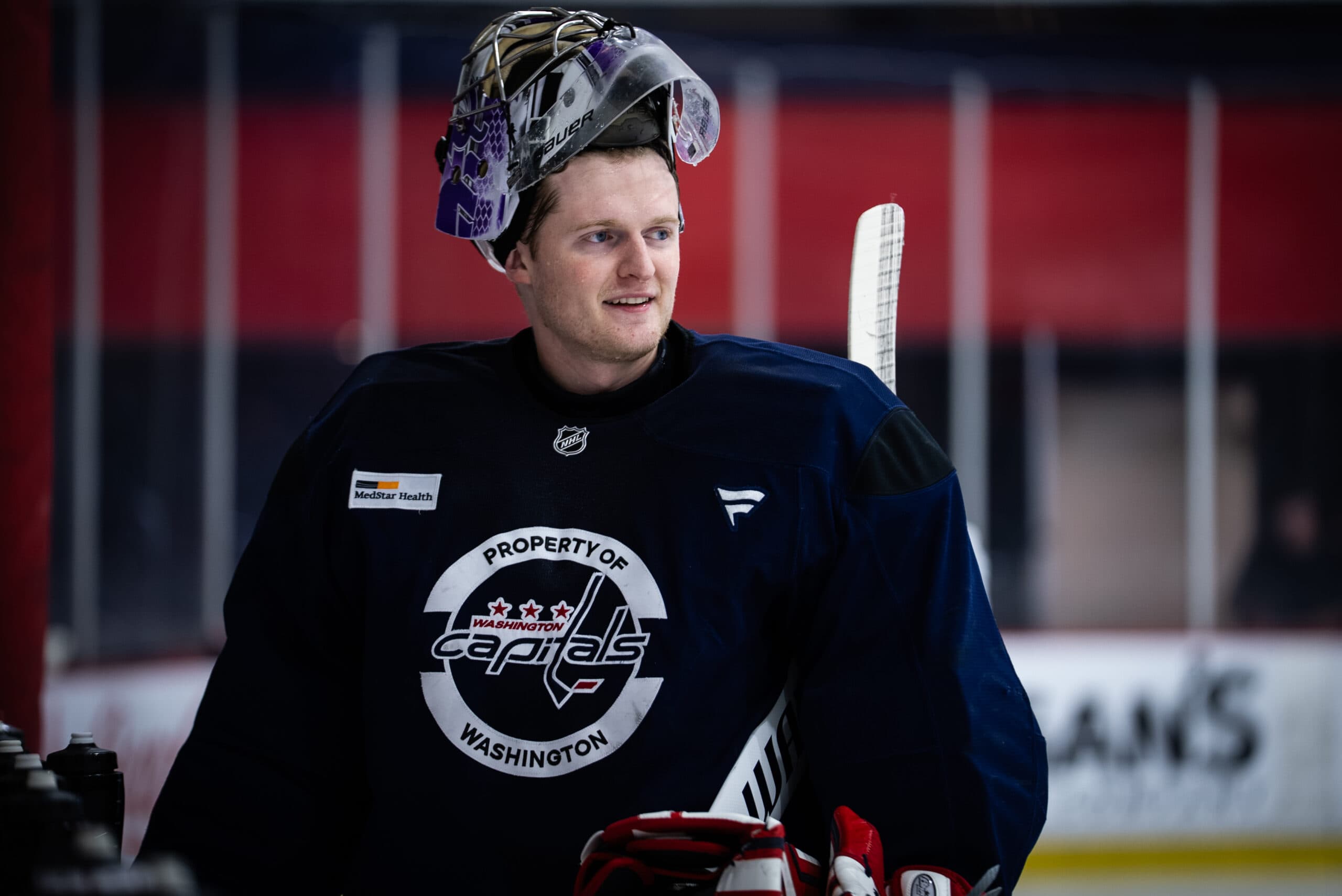
Just get any piece of his body to touch this puck, and Connor Leslie will be proud.
He’s supposed to be embarking on a career in law enforcement right about now. He’s been paying the bills working at a gun range. Instead, he’s staring down Alex Ovechkin’s one-timer, again and again and again, until ‘Ovi,’ the greatest goal scorer who ever lived, feels like he has it calibrated well enough for the day.
Leslie has to avoid fanboying out too much. He has a job to do. He’s trying to keep Washington Capitals goaltenders Logan Thompson and Charlie Lindgren fresh. It’s scary facing the patented Ovechkin shot, which beats Leslie most of the time – it’s famous for a reason, he says – but he’s thrilled if he can block, deflect, even graze one of them.
Day to day, he’s doing his best to stand in for an NHL goalie, getting in front of shots, trying not to make things too easy for the Capitals’ players. He thinks he’s merely part of the background, barely noticed. But not today, when Tom Wilson asks the coaching staff to pause the drill instruction for an announcement.
“It’s Les’ birthday today, guys,” Wilson tells the group.
Leslie is turning 25 today, and he stands on the ice, in full NHL-regulation gear, listening to the Capitals sing Happy Birthday to him. It’s surreal. Leslie is one of them now. He’s an emergency backup goalie, better known as an EBUG, and it’s a full-time job.
It is for Kyle Konin, too. He’s been at it for a while with the Tampa Bay Lightning, but it’s more official now. He’s accompanying the team for every road trip. He’s flying on private jets for the first time in his life. He’s avoiding the in-flight card games lest he have his bank account cleaned out. And he’s eating steak. So much steak. He’s “not even a steak guy,” he says, but he’s had seven steaks in the past seven days, the best cuts imaginable. The EBUG role hits different, as does the lifestyle, when it’s 24/7.
And it hits different when you do more than just provide emergency backup goaltending. That’s Jorge Alves for the Carolina Hurricanes. He moonlights as their full-time EBUG, but he’s also their full-time head equipment manager. He’s making sure Brandon Bussi and Pyotr Kochetkov are feeling comfortable in their gear, and now Alves is tailoring his own equipment to make sure it meets NHL senior director of hockey operations Kay Whitmore’s regulations.
Heck, the Vegas Golden Knights’ EBUG, Daren Millard, is also one of the team’s broadcasters. No two EBUGS are the same. And that’s what makes it so fascinating that they’ve become a league-wide staple, 32 people who took 32 very different paths to the job, as every franchise adheres to the new CBA that kicked in last month.
If you need a refresher: the EBUGs are no longer local guys off the street who can show up at the rink and stand in for either team should disaster strike during a game. Think David Ayres, who was the Zamboni driver for the AHL’s Toronto Marlies, infamously suited up for the road side and helped the Hurricanes beat the Toronto Maple Leafs in 2020. The EBUG is still local to his NHL team’s market nowadays, but he serves only that team. He also does it full-time for the duration of the season and travels with his club. He participates in practices and morning skates to take excess reps away from the NHL goalies on the roster. He must have fewer than 80 games of professional hockey experience and none within the past three years, and he must not have played a game under a standard player contract before. He also must wear No. 00 on his jersey.
But after that, who the EBUG is, how old he is, how he gets the job, and what other contributions he makes to the team vary widely across the league.
Leslie impressed the Caps last winter around the time of the Olympics when he came in to relieve Thompson, who was getting some rest due to his responsibilities with Team Canada. Washington’s extra practice goaltender Parker Milner wasn’t available that day. Caps goaltending coach Scott Murray had a good understanding of, and relationships with, the experienced local goalies, knowing the D.C. area isn’t quite a hockey hotbed and thus required him to do his diligence well in advance. He was familiar with Leslie, who had played for the Washington Little Caps as a high-schooler and was wrapping up his NCAA Div. III career with Amherst College.
Leslie came in that day with nothing to lose, and it showed.
“At this point in time, I hadn’t played for a little bit, and I was ready to just relax, a little bit worried about getting my career started up, but it was one of those opportunities where it’s like, ‘This is their actual like team practice. How could you not jump at that opportunity?’ ” Leslie said. “So I told them I would be there at that skate, and I showed up, and it was just me lingering with the goalies. It honestly ended up being one of the best skates in my life, surprisingly, and I think it was mainly just because I had that mindset of, ‘Go out, have fun, just enjoy this experience.’ I thought I’d never get to do this again.”
He bonded with the players with his easygoing personality and, after that practice day, Murray revealed to Leslie that he was more or less auditioning for a larger role in 2026-27 with the CBA changes coming. Leslie jumped at the opportunity, even though it meant pausing his career in law enforcement for at least a year.
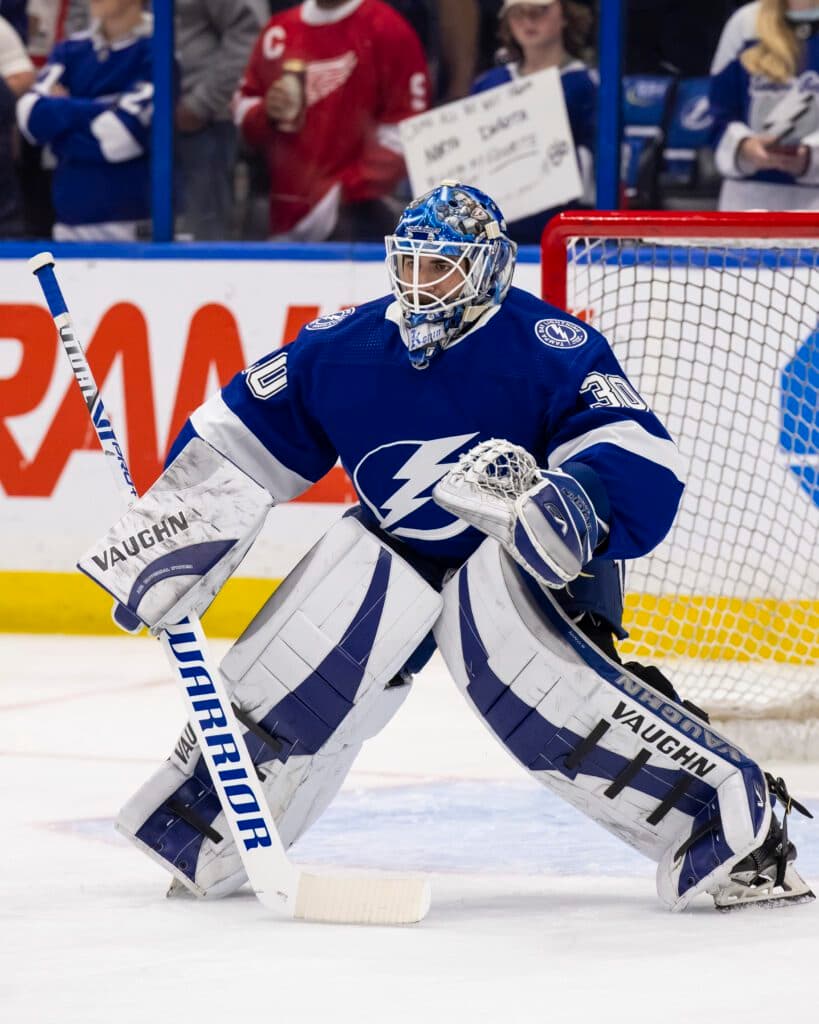
Kyle Konin (courtesy of Tampa Bay Lightning)
Former NCAA Div. II netminder Konin, 28, was already familiar to the Bolts, holding down the EBUG job for several years while maintaining his primary career as a goalie mask artist with multiple NHL clients. The transition to the full-time EBUG role was reasonably smooth for him because most of his mask painting happens in the summer – and the Lightning were very intentional in not wanting to upset their environment with a newcomer.
“The deeper we were going into the [hiring] process, we were realizing that the fit with the staff, with the players, with our team was probably the most important thing,” said Lightning goaltending coach Frantz Jean. “The chance of having the EBUG play regularly in games is slim. And we were like, ‘OK, do we want to engage in a process where we interview all those candidates, hold tryouts and things like that?’ And Kyle’s been around for years with us. He’s been doing a great job, always available. He’s very competitive. He can get on the ice and on a quick turnaround when you need him. He doesn’t need to have an extended warmup or anything like that. He’s actually hard to score on, he’s challenging enough for the guys. And the more we looked at it, the more it just made sense to keep Kyle.”
For former ECHL and SPHL goaltender Alves, 47, the transition was about as seamless as any EBUG’s in the league. He’s been part of the Canes for two decades, as far back as their first Stanley Cup win in 2005-06. Not only was he already more or less a travelling EBUG, but he had appeared in an NHL game in 2016-17 – entering not because of an injury but because the team signed him to a PTO just so he could be eligible to take the ice for a few seconds. It was an easy decision for him to continue in the role.
The only major change for Alves is where he gets ready. It used to be literally in a closet, whether he was in an EBUG situation or prepping for practices. But now he has his own actual stall built into the Canes’ dressing room.
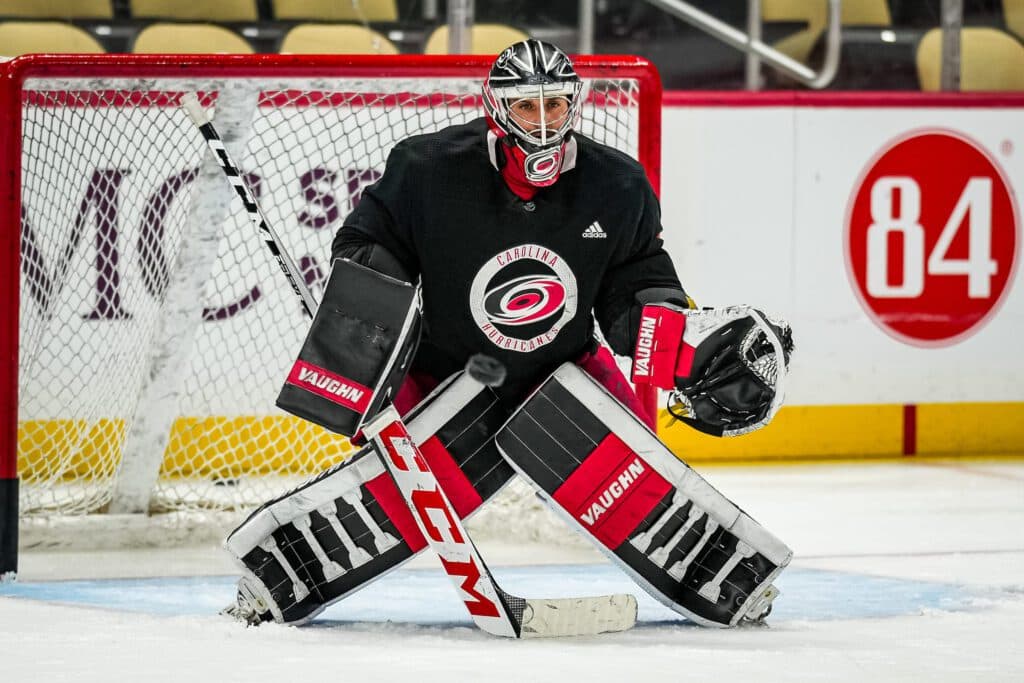
Jorge Alves (courtesy of Carolina Hurricanes)
The EBUGs differ in age and experience, but their primary day-to-day-duties are pretty similar. Most importantly, far above preparing as if they’re actually going to play: they’re absorbing all the extra punishment, the practice reps if the NHL goalies need breathers, the shots from injured or scratched players staying late, anything that lightens the load of the primary puck-stoppers. The EBUG is the “punching bag,” as Alves proudly puts it.
“I practice all the time on game days for the morning skates. I’ll come in towards the end of the practice and take shots from the guys, so that way the [goalies] that are playing or possibly could play that night aren’t overworked. And I’ll go in and skate with the extras and make sure they’ve got a goalie that’s taking shots,” Alves said. “I’ve always looked at the position or what I’ve done with the Hurricanes for 20 years now, not so much as an EBUG because I never really looked at it as, oh, I could possibly get put into a game, but more like a bullpen catcher. In baseball they have the bullpen catcher who sits there and gets the pitchers ready to play…I jump in there and help relieve the guys of some shots. And people don’t realize that, in practice, goalies are facing 400, 500 shots.”
But the on-ice work only takes up so much of a given day. These EBUGs are present full-time, so most if not all their teams find additional jobs for them. That’s easy for Alves, who already had a full-time gig as head equipment manager. But Leslie has become quite the jack of all trades in Washington, for instance. He has assisted the medical staff in running through their emergency injury scenarios, in which he stands in as the “injured” player. He also watches video with Murray, offering observations on certain NHL netminders’ tendencies.
It’s also easy to forget how new the full-time EBUG experiment is. A lot of teams are simply figuring out how the EBUGs assimilate with the players. It can be an easier job for someone like Alves who already has an established rapport with Bussi and Kochetkov. Konin, meanwhile, is pretty familiar with Andrei Vasilevskiy and, now, Dennis Hildeby, who treat him like a member of their battery. He typically hangs out with whichever of them isn’t slated to start the next game while giving the other guy space.
But for teams who’ve hired real newcomers like Leslie, there’s more of a learning curve. There’s an imposter syndrome to overcome. He recalls a team dinner in which he didn’t know where to sit and chose a table by himself, only for Wilson to say, “You don’t want to sit with the boys? Get over here,” and welcome him to eat with the Capitals players. That doesn’t always happen – Leslie more often rolls with the equipment staff on the road for team dinners – but he’s developing more confidence and feeling increasingly like part of the team as the season progresses.
“Everyone on the team’s been great. They all call me ‘Les,’ my nickname, which is cool, and I get to call them by their nicknames, which is fun,” Leslie said. “That was one of the biggest adjustments, going from, obviously I still idolize all these guys, but I’m no longer saying, ‘Oh my gosh, it’s Alex Ovechkin.’ It’s, ‘What’s up ‘O,’ good to see you again.’
“I’m employed through Monumental Sports, so in the beginning it was that middle ground of figuring out: I’m a staff member, but I’m also in the locker room every day with these guys, so it’s figuring out what works best. I never want to overstep and insert myself with the players 24/7, because obviously I’m not a full-extent player. But I’ve really found a good line of being able to chit chat with them while I’ve got the other staff I love talking to as well.”
The EBUGs are everyday employees who help teams in multiple ways. Some of them are developing relationships with the players and feeling like part of their teams. But how much do their teams treat them as actual goalies who require development and coaching? Do the goaltending coaches need to work on them and offer instruction on certain tendencies in case they enter games?
Yes and no. On one hand, most don’t consider the EBUGs true pupils that need molding. It’s still so rare to see one in a game, after all. Six EBUGs have entered actual game action in the past decade and none since 2023. Nevertheless, it seems every goalie coach at least has a good understanding of his EBUG’s strengths and weaknesses, which probably played a role in him being selected in the first place.
“If he ever had to go out there and play, he’s definitely going to look a little bit different than your typical NHL ‘new style’ goaltender,” said Hurricanes goaltending coach Paul Schonfelder. “He’s got some old school in him, which I like, because it gives the shooters a bit of a different look. He’s super competitive. And one thing that I do notice is, and I tell our goalies, he’s got really good hands. He catches pucks really well. Me and ‘Georgie’ are somewhat close in age, and I find that all the goalies back 15, 20 years ago, because equipment wasn’t as good, you’d have better hands. He’s not the biggest guy, but he’s played pro, he played college, he banged around in the East Coast League and the Southern Professional League, and he obviously played at a high level when he was younger. So it’s not like this is just something he picked up along the way. He’s got quite a background in it.”
While he has the read on Alves’ game, Schonfeld is mostly hands off, partially because Alves is so busy doing his other job with the equipment. The Caps, meanwhile, have offered some specific instruction to Leslie – in small doses only.
“We talked at the start of the summer about being a little bit more inside his paint, setting his feet a little bit more and learning how to make saves without having to charge it and be over-aggressive,” Murray said. “Part of it’s to save energy, part of it’s to make it realistic for [the shooters], but also part of it was to be able to make it harder on them if it wasn’t just a direct shot. So he learned how to do that, and he quickly adapted to being a little more simple and learning how to make saves a little deeper, which has allowed him to defend anything that’s not coming straight at him. As time goes on and he gets comfortable here, there might be the odd thing that I’ll throw at him, but I don’t want to overcoach him, either.”
Much more important than the EBUG’s play: his availability. If the entire purpose of his existence is to come in if the starter and backup goalies are unfit to play, the EBUG has to keep his body in excellent shape and stretch properly. If there’s one area the teams work on the closest with their EBUGs, it’s fitness. As Leslie explains, the actual shots faced in practice are manageable given “I’m not really feeling these shots because I’m wearing gear that’s top of the line stuff that I’ve never worn before” – but stamina for day-to-day work and flexibility for avoiding pulls and strains are paramount.
That’s why the Caps had to make Leslie change his body.
“The way we’re set up is, let’s say it’s before practice, you’re on for 15 minutes, and then you watch the practice, and if you need to jump in, you jump in, but then after practice, you’re back on for 15 minutes,” Murray said. “And he had at that point been training for the [law enforcement] job he was going for, which required him to put on some muscle. And he said right away, ‘Oh, I’m going to have to change my training if I do this,’ because it is more intense cardio. It’s almost a sprint for 15 minutes. So that’s one thing he had to learn. He’d just put on 20 pounds of muscle – he had to lose, not 20 pounds of muscle, but he had to get in different shape…you’re getting worked, and your body will take a beating over time if you don’t take care of it.”
For Konin, the change was about the diet. In previous EBUG years when he wasn’t travelling with the team, his habits might slip with, as he puts it, “A few Burger Kings or Chipotles.” Not anymore. He’s eating cleaner, and he’s working out like a real pro.
“Kyle is a really good athlete, not in terms of a gym athlete, a guy that’s really good at working out, but he’s very limber, he’s explosive naturally. He’s got good stamina,” Jean said. “But this summer, I gave him a call. I said, ‘Kyle, you’ve got to get in better shape. You’re not just showing up once or twice a week now, you’re there all the time, and you’re going to be around the players more, and the guys are going to expect you to put in some time in the gym, put in the extra effort. That’s how you’ve got to get respect from the guys. And he bought in. He started to do a little bike program with a little bit of weights and all that stuff.”
Just a couple months into the full-time EBUG era, every NHL team is still feeling out the position. Some have gone out of their way to aim for stability, selecting older goaltenders who already have relationships with their teams and won’t be using their jobs as springboards to get back into playing professionally. Others aren’t looking too far ahead and have gone with younger hires who felt like the best picks for the job in the present. There’s no wrong answer. As for what each team’s criteria will yield on the ice: we wait for the next EBUG appearance in-game. That’s when we’ll see the impact, if any, of the full-time immersion. Maybe the increased on-ice work means an extra save here or there.
No matter what happens, though, the EBUGs try never to take their opportunities for granted.
“Here I am the official EBUG now, so it’s mind blowing,” Alves said. “Obviously I enjoy every day going to work and doing my equipment job, but I get that extra bonus of being able to live out my dream with the greatest hockey players in the world and practice with them every day. It’s a dream come true.”
_____
POST SPONSORED BY bet365