Five lessons other NHL teams can learn from the Hurricanes

The NHL is a copycat league. When a team is doing well, every other team wants to be them. Often, they achieve this by copying them. Whether it’s by building towards a similar play style or by taking the castaways of those winning teams, teams often try to zig towards the winners’ direction but are a step behind, sometimes to their detriment.
But it doesn’t mean there are no lessons to learn from winning teams either. They succeed for a reason, and it’s usually because they are smart. So it’s important for the other teams to pay more attention to the process of the successful teams, and not at the result, if they want to replicate it.
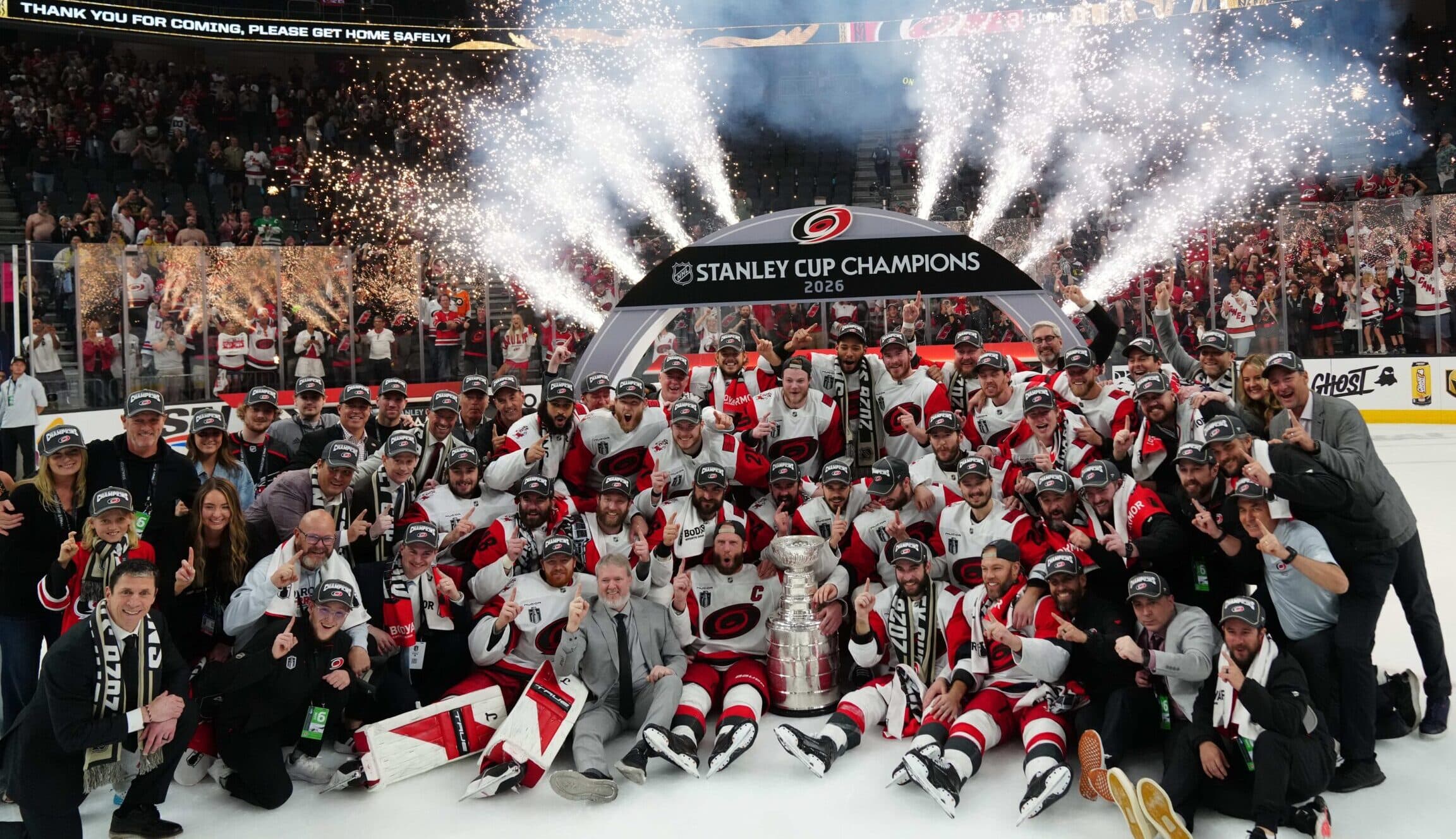
There are few teams more process-oriented than the Carolina Hurricanes, so it’s no surprise they finally found themselves hoisting the Stanley Cup this season. But as teams begin their annual tradition of copying the winner, what lessons should they focus on when trying to replicate the success of the Canes? Let’s look into it.
(And no, it’s not “analytics work.” If you haven’t learned that lesson yet, you’re so far behind the eight ball you’ve already knocked it into the pocket yourself.)
Hockey is a weak-link sport, not strong link
Some sports are strong-link sports. The NBA is the most guilty of this, because of how much court time their star players get. A quick look at the minutes-per-game in this year’s NBA playoffs shows a significant number of star players playing at least three-quarters of the game. Devin Booker. Jalen Brunson. Kevin Durant. Shai Gilgeous-Alexander. James Harden. LeBron James. Nikola Jokic. Donovan Mitchell. Jayson Tatum. With the best players playing so much, their impact on a game is much more significant. Even soccer sees this to a degree with some of their star players playing most of the important minutes, although they share the ball as one of 11 players compared to basketball’s five.
But hockey isn’t quite the same. Only a handful of the best defensemen play around half of the game, while the best forwards will play 24-25 of the 60 minutes at most. A superstar can have an impact on a game and sometimes carry a team to a win, but very rarely can one carry a team to a Stanley Cup.
But what does help a team’s Stanley Cup chances is having as few weak links as possible. Look no further than this year’s Stanley Cup Final. The Vegas Golden Knights got some excellent performances from Mitch Marner, Shea Theodore, Brayden McNabb, and, at various points, Carter Hart, Jack Eichel, Pavel Dorofeyev, Mark Stone and Brett Howden. When all were operating at their best, the Golden Knights were unstoppable.
But Vegas also had several weaknesses. Their fourth line bled chances when they were on the ice. Their second pair of Rasmus Andersson and Noah Hanifin made mistake after mistake which cost the team. And come the Cup Final, Hart fell apart and either took the Golden Knights out of games or brought the Hurricanes back in it. Carolina was at their best when they exposed Vegas’ weaknesses.
For the Canes, their biggest criticism for the past several seasons was their lack of superstar talent, and this season, it was still an issue. Sebastian Aho, Andrei Svechnikov, Seth Jarvis and Nikolaj Ehlers are all excellent players, but none of them usually is the superstar player who overwhelms the other team. In fact, they all took steps back in the postseason except for Ehlers, who produced at a point-per-game pace.
But where Carolina lacked in star talent, they also lacked in weaknesses. In fact, their biggest weakness was the top line of Aho, Svechnikov and Jarvis. Jordan Staal’s line shut down the top competition and freed up Taylor Hall, Logan Stankoven and Jackson Blake to run rampant on weaker competition. The Canes’ top two pairings were all excellent defensive players, which in turn allowed them to shelter power play specialist Shayne Gostisbehere and rookie Alexander Nikishin on their third pairing. Carolina’s elite defensive structure allowed their goalies to be successful, and even when they weren’t, it wasn’t detrimental to their game. Even their fourth line was as solid of a fourth line as you could expect.
That’s what made winning four games out of seven tough for the Golden Knights. They could not find a weakness to exploit to allow their lineup to thrive. So when their top performers went quiet, there was no other answer. And when Carolina’s biggest “weakness” in Aho (five points in the Final), Svechnikov (three goals, four points) and Jarvis (three points) started to pick up their play and weren’t outplayed by the opposition (55.27% 5v5 expected goals share), it was game over.
Sure, superstars can win you championships. But if you can’t accumulate star talent on your roster, the other way to go about it is to be deep across the rest of your roster. Yes, the Hurricanes do have some players who are elite at their craft, but it comes in their own zone with players like Staal and Slavin, not as the traditional elite player.
(Seattle Kraken, if you’re reading this, this doesn’t apply to you. Get some talent on your roster.)
Embrace the challenge of finding a replacement
This idea is not mine. If you’ve heard any show my colleague Jeff Marek has appeared on in the last month, he’s probably mentioned how much Hurricanes general manager Eric Tulsky embraces the challenge of finding a replacement. And he’s 100 percent correct.
One thing which holds many general managers back is their fear of losing someone who’s played an important role for their team, even if retaining them would be a disadvantage to them. Whether those players are coming off an unsustainable season in a contract year or they are on the wrong side of 30 and don’t have many top performances left in the tank, GMs still get scared of losing them because they’re the devil these teams know. So they lock them up long term with bad money, and then it burns a hole in their salary cap sheet and hampers their ability to improve in the future.
But if you look at the players Carolina has moved on from throughout their recent run of success, you’d think they were rebuilding. Jake Guentzel. Dougie Hamilton. Martin Necas. Nino Niederreiter. Dmitri Orlov. Brett Pesce. Mikko Rantanen. Brady Skjei. Teuvo Teravainen. Vincent Trocheck. All great players, and yet their losses never fazed the Canes.
Instead, Tulsky sees a depreciating asset, and instead of overcommitting to them, finds the next (or the cheaper) version of them. Hamilton doesn’t want to re-sign? Find cheaper ways to replace his power play production in Brent Burns, Tony DeAngelo and Gostisbehere. Orlov and Pesce want too much money? Sign Sean Walker for less money and develop an unproven Jalen Chatfield. Rantanen isn’t a fit? Flip him at the deadline for Stankoven and a bunch of draft picks, flip a pick for K’Andre Miller, and use the cap space to sign Ehlers.
You have to do the work to pull these off correctly, but isn’t that one of the primary roles of a general manager? And at long last, it paid off for Tulsky and the Canes.
Physicality is more than just hits…
After two consecutive Stanley Cup wins from the Florida Panthers, one of the big “lessons” some teams took away from their success was how they need to get bigger and be more physical. Some teams decided to follow suit and size up, including the victims they eliminated along the way (*cough* Toronto Maple Leafs), and those teams took a step back. The problem was they took the wrong lesson from physicality: it wasn’t so much about laying out hits and being physically tough to play against, it was about having players who could physically play through those tough moments and still make the plays.
The Hurricanes have never shied from physicality, especially under Rod Brind’Amour. Most of it comes from their relentless play style (particularly their forecheck) and how most players would run through a wall for their head coach. But as we saw in the Stanley Cup Final (especially as the Golden Knights began to run out of answers), Carolina’s players weren’t winning because they were physical towards Vegas. In fact, they were only ninth in hits per 60 minutes in the playoffs. What the Canes were doing was playing through the physicality.
There were no better examples of this than during their first goals in Games 5 and 6 of the Cup Final.
In Game 5, Staal maintains the Hurricanes’ relentless forecheck and finishes a hit on Brayden McNabb in the corner. For many teams chasing physicality, the sole focus is finishing their checks. But Staal immediately pivots, adapts to the developing play in front of him, and drives the net to tip the puck past Hart and tie the game.
And then in Game 6, it’s the other way around. This time, as Hall finds the puck on his stick at the Canes’ blueline, he also spots Ivan Barbashev flying towards him and hitting him along the boards. That could shake up some players, but for anyone on Carolina, it’s nothing.
Video via Instat
The next shift, Hall is found in a similar spot (on the left side of the ice this time), ready for an outlet pass from Slavin, and Hall flies into the zone and wires a shot past Hart for the game-opening (and ultimately Stanley Cup-winning) goal.
Teams often build their roster for physicality so they will be feared by other teams. But for the Hurricanes, the more important factor is building the team up so they don’t fear anyone.
…and size still isn’t everything
What many NHL teams would find surprising about the Canes’ physicality is how size isn’t the driving force of it. This season, their roster was the 25th in height (an average of 6-foot-1) and were 18th in weight (an average of 201 pounds). Among playoff teams, they were 12th and 10th. As some teams chase to get “bigger,” Carolina didn’t let a desire to play tougher stop them from going after smaller players.
Heck, some of the Hurricanes’ toughest players were their smallest players. Jarvis has an annoying element to his game, and he’s 5-foot-10. Walker is one of the Canes’ scrappiest defensemen, and he’s 5-foot-11. The entire Hall, Stankoven and Blake line were a nuisance for their competition, and they come in at 6-foot-1, 5-foot-8 and 5-foot-11. It’s ironic how, as the draft approaches next week, many teams will still pass on the small players after watching what the Hurricanes did in the playoffs.
Of course, it’s not as simple as “draft every small player” either. In fact, while forwards under six-foot at the draft have a solid success rate, defensemen don’t see the same success rate. JFreshHockey broke it down earlier this week, and while some develop into top-four defensemen, and a couple into top pair or elite defenders, just as many find themselves in bust territory.
The lesson? Teams should look towards adding short forwards at the draft (especially when the value seems optimal) but still be more cautious about defensemen. In fact, as Carolina demonstrated with both of their short defensemen in Walker and Gostisbehere, the more optimal route is to let the other teams draft and develop them, and then when they are eventually undervalued for their size, sign them to affordable contracts and let them thrive in important roles.
In case you were curious, there are seven defensemen set for free agency who are under six-foot. Only one of them made more than $2 million per year on their last contract (Connor Clifton) and only two (Tony DeAngelo and Nick Blankenburg) are projected to make more than $2 million per year on their next deals, according to AFP Analytics.
Patience is a virtue
It’s a tale as old as time. A team builds a core of elite talent to contend for a championship, but year after year, they fall short. Eventually, the public cries for change, citing the group “doesn’t know how to win.” The team tries to ignore it until it becomes too much, and they start to make changes, often overhauling the entire philosophy of the organization.
The Hurricanes could have done this. While their core of star players aren’t as high-end as other elite teams’, it was the Canes’ philosophy which came into question. Their relentless forecheck wore down their players too much and exhausted them by the time they were deep in the playoffs. They lacked the star power to go up against the best teams in the league. They disappeared in the Eastern Conference Final. Carolina had plenty of critics, and they could have listened.
But instead, the Hurricanes stayed the course. They looked at their league-leading 55.91% regular season 5v5 expected goal share during their playoff streak, and how their 53.43% share in the playoffs wasn’t far off, and knew things would break through. They noticed how the goalies who eliminated them consisted of Tuukka Rask, Tuukka Rask, Andrei Vasilevskiy, Igor Shesterkin, Sergei Bobrovsky, Igor Shesterkin and Sergei Bobrovsky, who were all elite, Vezina-caliber goaltenders, and figured it had something to do with their eliminations, and not the talent of their roster.
Carolina could have dealt any of their core players and tried to make changes. They could have decided Brind’Amour wasn’t the coach to get the job done. But, they kept the band together, spent efficiently, continued to improve around them, and just did the best they could to position themselves for a Stanley Cup. In fact, the only significant change they made was to their general manager, and that was a choice from Don Waddell, not the Canes. And they still went in-house and promoted Tulsky, who’s even more process oriented than Waddell. This thought process extends to ownership, and it’s paid off.
That’s not to say you can’t touch the core. Necas was a part of Carolina’s core, especially after his start to the 2024-25 season. But when Rantanen was on the table, he was a clear-cut improvement to their core group which they couldn’t pass up. And when it didn’t work out, the Canes turned him into secondary pieces like Stankoven and Miller who will be impact players for years to come.
And now that Carolina has a Stanley Cup with this group, those past failures almost strengthen their history. Before, their Eastern Conference Final appearances were choke jobs. Now, they’re a team who made the Final Four in four of the last eight years. Only the Golden Knights can boast the same level of consistency among the Cup winners in that span, although they had one more Cup Final appearance. Carolina still needs another Cup or two to truly cement themselves as a modern dynasty, but it’s a much better look now.
Perhaps the scariest part about Carolina’s patience all these years is there is still more room to grow. They have 13 of their players locked up for the next three seasons, only Nikishin and Frederik Andersen left to re-sign, almost $12 million in cap space to work with this summer and four first-round picks in the next three years. Staying the course has not only given them present success, but it has positioned them to remain in this spot for many years to come.
_____
PRESENTED BY THE DAILY FACEOFF NEWSLETTER

Recently by Scott Maxwell
- Seven players who took major steps in the 2026 Stanley Cup Playoffs
- Five crucial stats to define the 2026 Stanley Cup Final
- 2026 Conn Smythe Trophy power rankings: Playoff MVP candidates entering the Stanley Cup Final
- Have the Carolina Hurricanes won the Mikko Rantanen trade?
- Six NHL players who underperformed defensively in 2025-26