How the Wild landed Quinn Hughes – and why the other suitors struck out

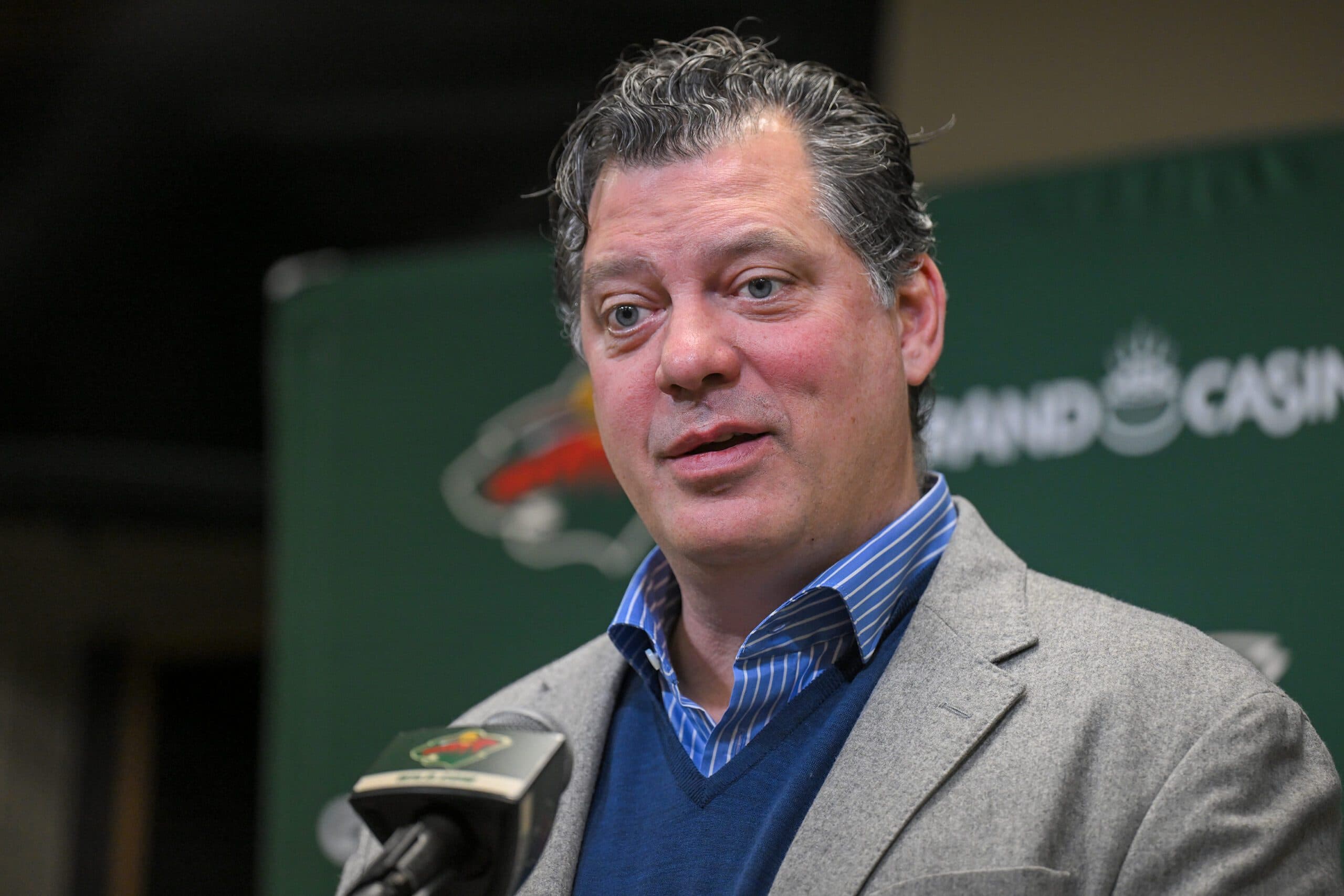
It may be a non-PG way of putting it, but Minnesota Wild GM Bill Guerin put his you-know-what on the table this past Friday night. After weeks of speculation surrounding All-Star defenseman Quinn Hughes’ future with the Vancouver Canucks, the Wild came out of left field landing the 2018 first-round pick. Sending a monster package of forwards Liam Ohgren and Marco Rossi, defenseman Zeev Buium and a first-round pick in 2026 to western Canada, the Wild put a massive offer on the table that was outmatched by any other interested club.
According to the Athletic’s Pierre LeBrun, there were six teams in on Hughes, most notably the Detroit Red Wings, New Jersey Devils and New York Rangers. And while the Philadelphia Flyers weren’t among the most serious contenders, they were among the teams who at least kicked tires on Hughes in the early stages of the process.
According to sources in Minnesota, there wasn’t much of a negotiation in this deal. As both Guerin and Canucks president of hockey operations Jim Rutherford alluded to in their respective media availabilities, the package that landed Hughes in the Midwest was the same one initially presented by Guerin early last week.
According to a source, the Wild knew what the Canucks were looking for and immediately presented a deal they thought could satisfy the latter’s needs. In discussion with a handful of teams at that stage of the process, the Canucks sat on the deal for several days and eventually circled back to pull the trigger when they couldn’t find a deal that would eclipse it.
The team everybody had circled was the Devils, as Hughes brothers being there has long since been assumed to be a huge draw for the former Canucks captain. I reached out to a New Jersey source to see what they had on the table; while I didn’t get specific names, it sounds like the Devils didn’t have the necessary pieces to execute the deal.
According to the source, the Canucks wanted a center and left shot defenseman (ie. Rossi and Buium) as part of a package for Hughes. Everyone had circled 2022 second overall pick Simon Nemec as the center piece of a theoretical package for Hughes; Nemec being a right shot rearguard probably threw a wrench into things. The Devils themselves are shallow as far as centers go – and are looking for a pivot in their own right – making the fit difficult from the jump. Beyond Dawson Mercer (who is arguably more of a winger), there aren’t many other players that would make sense to check that box from the Devils’ roster.
I spoke to a Flyers source about their involvement on Hughes. Given the connection between Hughes and head coach Rick Tocchet (along with Philadelphia’s need for a top defenseman) it did make sense – at least on paper. According to a source, while the team did reach out, it became evident “very early” in the process that the price Vancouver was asking was too rich for GM Danny Briere to pay up.
While the Canucks did not come out and specifically ask, the source did say the Canucks heavily hinted towards the asking price being centered around either Matvei Michkov or 2025 sixth-overall pick Porter Martone. Speaking with a league source, the belief is that the Flyers would’ve needed to give up Martone or Michkov in any deal for Hughes. Though neither is a centers or left-shot defenseman, the talent of either player would’ve at least had the Canucks engaged. When the Flyers did not entertain either, it more or less killed any prospective deal in the cradle.
If you look at all the other teams involved, the hit to their respective organizations to give up the necessary pieces to land Hughes would’ve been tough to swallow. According to Sportsnet’s Elliotte Friedman, the Canucks had their sights set on defenseman Simon Edvinsson as part of a package as far as the Red Wings go. The Wild being able to pony up the assets and still remain competitive is a testament to the team’s stellar drafting under the Guerin regime, led by director of amateur scouting Judd Brackett.
Now the question is this: what is next for the Wild?
Based on my reading of the tea leaves, my sense is this isn’t the last move for the Wild, especially considering Guerin’s aggressive nature as a GM. Going back to the summer, I had heard that Guerin was looking to go all in with their new found cap space following the drastic reductions of the buyouts to Zach Parise and Ryan Suter. They wanted to address their center position (presumably via Sam Bennett or Brock Nelson) over the summer but ultimately had to tread water due to nothing bearing fruit in the free agent pool. But with cap space still available and the Wild pushing their chips in the middle following the Hughes addition, it could be a sign of things to come.
According to PuckPedia, the Wild have a little less than $3.8 million in projected trade deadline cap space. They could always move out money to create more room; while I can’t say for certain, I wonder if forward Ryan Hartman could be a candidate to be moved out if need be. The 31-year-old is under contract until 2027 and carries a $4-million AAV along with a 15-team no trade list.
Should the Wild look to explore the trade market again, the assumption is that it will be to address the middle of the ice. Especially with Rossi now gone, the Wild could use a reinforcement to better insulate Danila Yurov and Joel Eriksson Ek.
I’ve heard from team sources that the Wild like Calgary Flames center Nazem Kadri. Kadri, 35, comes with a hefty AAV of $7-million until 2029, but would (at least on paper) check all the boxes for the Wild; as a center and someone who brings grit, Kadri would surely fit right into a Guerin type of team. But given Kadri’s age and contract, I imagine the Flames would need to retain on any prospective deal for the Wild to entertain.
The Flames are willing to retain on Kadri if the price is right, but the amount will be contingent on if whether can clear it with ownership. Assuming ownership gives the green light, I’m told the Flames are open to retaining up to 50 percent, according to team sources. Speaking with people close to the situation in Minnesota, the feeling I get is that the Wild would be open to giving up a first round pick and a prospect should the Flames make Kadri a $5-million (or less) player.
The other wrinkle in this is Kadri’s 13 team no-trade list, which I’m told by sources from both the Flames and Wild includes Minnesota. The Flames would consider approaching Kadri about amending said clause if a deal made sense; could Minnesota’s recent moves help convince the 2009 seventh-overall pick? According to several league sources, they think that could be the case.
St. Louis Blues captain Brayden Schenn was brought up Monday on DFO Live as a candidate for the Wild. Much like Kadri, Schenn brings a certain level of sandpaper conducive with the Wild’s identity, along with being a center. Both Kadri and Schenn have won Stanley Cups, which could be beneficial to a Wild team looking to take the next step.
If the Hughes acquisition means anything, it is that the Wild are ready to keep pace with the likes of the Colorado Avalanche and Dallas Stars in the ever competitive Central Division. Even if it is just two years of Hughes, the Wild have put themselves in a position to be among the top teams in the NHL. Now the question is whether Guerin will look to further bolster his team; if history tells us anything, Guerin’s reputation as one of the league’s boldest executives suggests that is a major possibility.