It’s up to Chayka, Sundin to prove they aren’t dubious Leaf hires. And they know that



TORONTO – That was something.
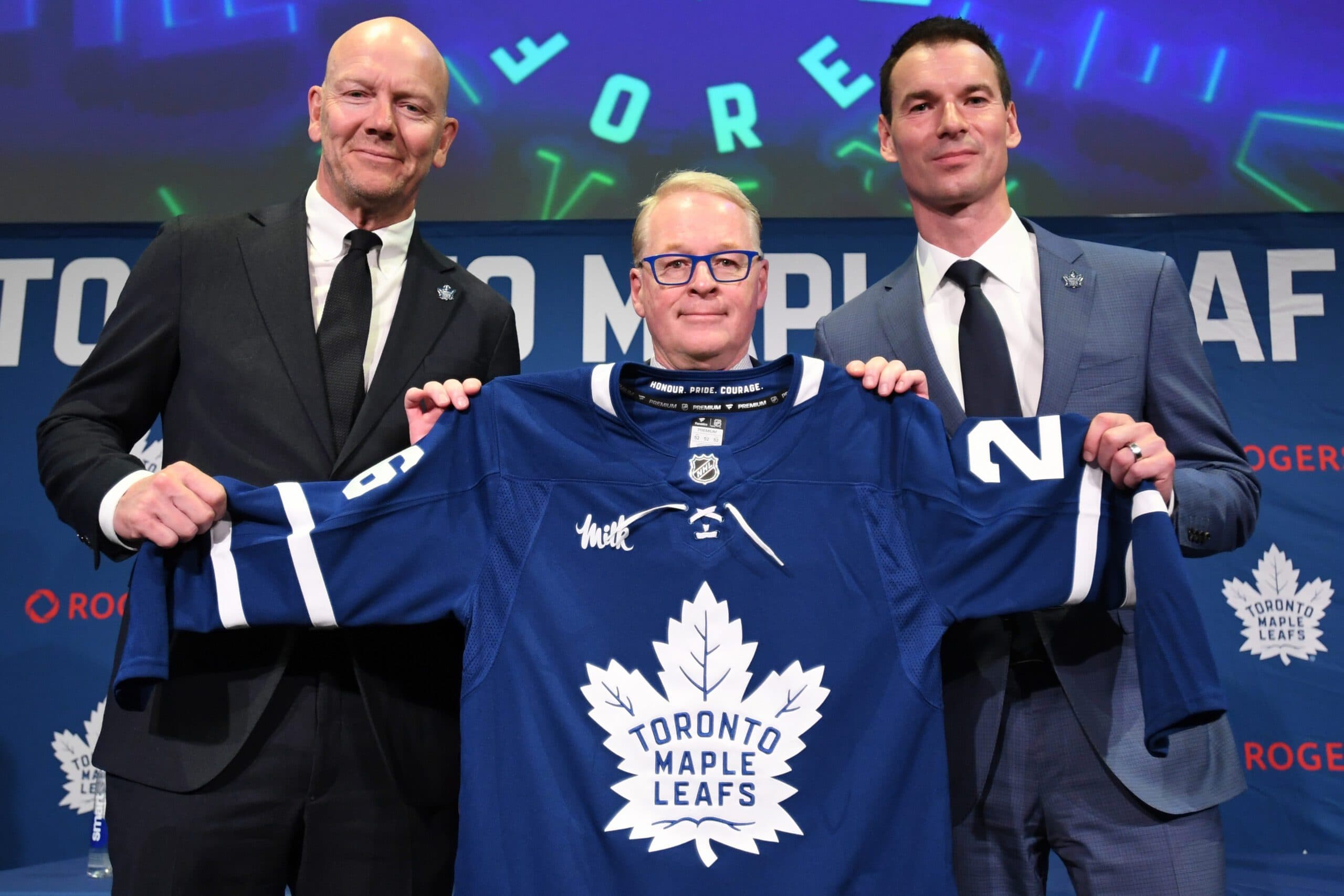
Introductory press conference? Yes. But it was no celebration. The unveiling of John Chayka as the Toronto Maple Leafs’ 19th GM, and his new brain trust partner Mats Sundin as senior executive advisor of hockey operations, felt closer to a new boyfriend smiling through his teeth at the dinner table, palms sweaty, trying to impress his future in-laws at their first meet-and-greet while they grill him mercilessly with skeptical questions.
Chayka, 36, was understandably and visibly nervous addressing the media for the first time in his new post. Sundin, already a veteran of the market as a longtime captain during his 13 NHL seasons as a Leaf, looked far more comfortable in his own skin Monday afternoon at Real Sports Bar & Grill. But the tone was awkward for what can typically be an exciting moment while a franchise transitions. There was simply a lot to answer for in Toronto’s decision to hire Chayka and Sundin as successors to GM Brad Treliving. As was instantly apparent Monday, Chayka and Sundin, the former in particular, must approach their new roles with a degree of defensiveness, because, on paper, they were questionable choices at best from a franchise desperate to squeeze competitiveness out of their club while superstar Auston Matthews remains under contract.
Chayka is only 36 now, which makes it all the more remarkable he has four seasons under his belt as an NHL GM already and one prior as an assistant GM, all with the franchise then known as the Arizona Coyotes, a tenure that ended seven years ago this July and marked his most recent time working in the league. Chayka was an extremely active GM while in charge, making a staggering 41 trades between 2016 and 2020. But was he a particularly successful one? His teams never finished with a points percentage higher than .524. They reached the playoffs once, but that was a hollow accomplishment given they earned the right to play because of the COVID-19 bubble format, which invited 24 teams into the tournament. He resigned from his position just as the qualifier round was set to begin. When he first signed with the Coyotes as their assistant GM in 2015, he joined a franchise that was already at the NHL’s rock bottom, having finished 29th out of 30 teams in 2014-15, so it’s not like he steered them off the cliff himself, but he certainly didn’t steer them back onto the road. And for all Chayka’s reputation as a stats whizz: his teams finished dead last, 24th, 17th and 18th in expected goal differential across his four seasons as GM. It’s not like he built a team with tremendous underlying metrics to support his hiring as the youngest pros sports GM of all-time after the co-founding of the successful analytics company Stathletes.
Chayka’s NHL resume would make any GM a curious enough hire, particularly after the seven-year layoff… before we even factor in the track record of suspicious operation. The Coyotes were stripped of their 2020 and 2021 first-round picks for violating the league’s scouting combine policy for conducting physical tests on players. Chayka was still GM when the NHL began its investigation into the violation, and he resigned roughly a month before the punishment was announced. In 2021, NHL commissioner Gary Bettman suspended Chayka for “conduct detrimental to the league and game” after Chayka was ruled to have breached his obligation to Arizona by actively seeking a job opportunity with the New Jersey Devils.
“Arizona was really challenging – at the same time I loved it, I don’t really have a bad word to say, I met a lot of great people, my kids were born there,” Chayka said Monday. “And we scratched and clawed every day to keep that team there. There was ownership changes. And whenever there’s an ownership change, usually there’s management change. We had four CEOs during my time as well. And that leads to different visions and different timelines and there’s just stresses that are realities to that. Ultimately, there was a contract disagreement, that’s what it was. And for me, it was in the best interest of the organization to resign when I did.”


Cap Summary
Draft Picks
On top of the two prior controversies: Monday morning, hours before Chayka’s official introduction as Leafs GM, insider Frank Seravalli reported that, as Chayka works to fill out his staff, other teams “expressed concern to the NHL that employees under contract may have been contacted without proper permission.” The NHL “looked into the inquiry and found the claim to be unsubstantiated,” Seravalli reported, but the optics of rivals already sniffing around Chayka’s behavior aren’t great.
All these Chayka stories represent a long way of saying: we can’t pretend for a moment his hiring isn’t a total head scratcher for a franchise under immense pressure. It’s a decision that required repeated justification from MLSE president Keith Pelley Monday, coming out in short, vague, unconvincing soundbites regarding “due diligence.”
As for Sundin: he’s one of the most beloved and accomplished players in franchise history. He never brought a Stanley Cup or even a Final berth to Toronto but, with each passing year of failure in the Matthews era, Sundin’s success in helping the Leafs to multiple deep playoff pushes looks more impressive to the fan base. The Leafs won seven playoff series during Sundin’s run and reached two Eastern Conference Finals. That’s all lovely to remember, but what does it have to do with Sundin joining the club now as senior executive director of hockey operations? Sundin’s profile has been among the lowest of his player generation since his retirement in 2009. He has consulted on and off for the Swedish national team at the World Championship and World Cup of Hockey, and he’s popped up at some Leaf alumni events, but…he’s never worked in an NHL front office.
“I’ve watched every Leafs game and other league games over the past 10 years, worked with the national team with Sweden in one period, covered the Olympics in TV, so I think I’m up to date on both the National Hockey League today but also the prospect side, mostly watching Europe,” Sundin said Monday.
That’s nice to hear but, uh, typically, players sponge up experience in apprenticeships following their careers – for years – if they want to become part of a front office someday, as Jason Spezza has with the Leafs and Pittsburgh Penguins and Alex Steen has with the St. Louis Blues. So what makes Sundin the right man for the job besides, to put it bluntly, vibes? Pelley seemed to have a difficult time Monday fully explaining how much decision making power Sundin will even have.
“At the time of the interviews it was really fascinating: neither John or Mats at anytime talked about titles,” Pelley said. “They only talked about goals… In fact, I don’t even think Mats knew what his contract title was until he got the contract himself. So I can tell you unequivocally that these two gentlemen are totally focused on one thing and that’s bringing the Stanley Cup to Toronto. The way it will work is John is the general manager of hockey operations and I think these two will work collaboratively together on everything…Mats has a role within hockey operations, but it will be something completely collaborative throughout the entire process.”
Sundin didn’t know what his title was until he saw the contract? You said the quiet part out loud, Mr. Pelley.
Clearly anticipating the pitchforks, Pelley did his best to get out in front of the controversial circumstances surrounding the hirings. He made sure to mention that the Leafs interviewed 27 people before settling on Chayka, and that search firm head Neil Glasberg did not have a say in the hiring process, also insisting that the notion of Glasberg being Chayka’s agent was nonsense. Pelley even refuted the report that former Leaf Tie Domi played a part in the hiring. Pelley was quick to connect Sundin and Chayka as long time acquaintances with a respectful relationship, revealing that the pair had met in 2012 at the Memorial Cup – a story Chayka echoed Monday.
But no spin will convince one of sports’ most jaded and hopeless fan bases that the hirings make sense. That doesn’t mean Chayka and Sundin are destined to fail. Not by a longshot. If you want to approach Chayka’s hiring as an optimist: he’s never had a full war chest. In the Coyotes, he was running a team barely capable of keeping its lights on and perpetually on the verge of relocation. The Coyotes did a decent job spending to the cap by the end of Chayka’s tenure, but now he’ll have every possible resource at his disposal in Toronto even outside the cap, not to mention the ability to spend to the rising cap, projected for $104 million in 2026-27 and $113.5 million in 2027-28. It’s possible he’s being massively underestimated. And perhaps Sundin’s fresh perspective is exactly what a fledgling franchise needs. The Leafs couldn’t be making decisions worse of late, so how catastrophic can Sundin’s guidance be? At very least, his addition as a relative outsider should have a tangible impact on a touch point he referenced Monday: the dressing room culture and the idea that winning teams consistently have close-knit groups.
“If you get a team that’s winning and has success, you have a very strong locker room and there’s buy-in on a bigger vision of what we’ve got to do together,” Sundin said. “That’s very important.”
Nevertheless: the Leafs’ new duo will have to accept that the optics simply won’t be great for a while. A reductive argument might claim they represent a clearance-rack version of the Toronto front office duo that preceded Treliving: Dubas, a young, analytically minded GM, and Brendan Shanahan, a respected Hall of Famer turned team president on a quest to repair the franchise’s reputation. Pivoting back to a similar archetype doesn’t feel like a winning move, and it also makes Chayka and Sundin seem more like pawns being manipulated by Pelley, particularly when Sundin isn’t being empowered in a president role. As Toronto Sun columnist Steve Simmons posed in a feet-to-the-fire question about Chayka Monday: how does Pelley justify a hiring identified as a bad one by 19 of 20 league sources asked for their opinion on it and dubbed a “con man”? In other words: how many trees did Pelley shake before making his choice, really?
It’s up to Chayka and Sundin to prove that, regardless of what really happened in the hiring process, they were the right picks.
“The game has evolved since I left the Coyotes,” Chayka said. “I view that as a shift as a positive. I didn’t live off the grid. I stayed obsessed with the game, our league. The role of the process, data, integrated decision making, these are no longer emergent ideas. They’re essential to how an elite NHL organization is operating. That alignment between where the game stands today and how I believe in building teams, that’s part of what makes this opportunity so incredibly compelling.
“I also understand another reality: nothing I say today earns credibility in this market. That will come from how we operate, the decisions we make, the consistency of our approach, and ultimately the results we achieve on the ice.”
If Chayka and Sundin are not who they claim to be in this context, and Pelley has made the wrong bet: he threatens to plunge the franchise into its most hopelessly dark era since Harold Ballard’s reign.
____
POST SPONSORED BY bet365
_____
Recently by Matt Larkin
- Top 50 NHL UFAs of 2026: Bobrovsky isn’t in the playoffs, yet his value is rising
- Why Blackhawks need to be 2026 NHL offseason’s most aggressive team
- 2026 NHL Draft Lottery Chaos Rankings: Which winning team would be pure rage bait?
- It’s time for the Senators to have the Brady Tkachuk trade conversation

