Good, Bad, and Coyote Ugly: Revisiting Leafs GM John Chayka’s track record in Arizona

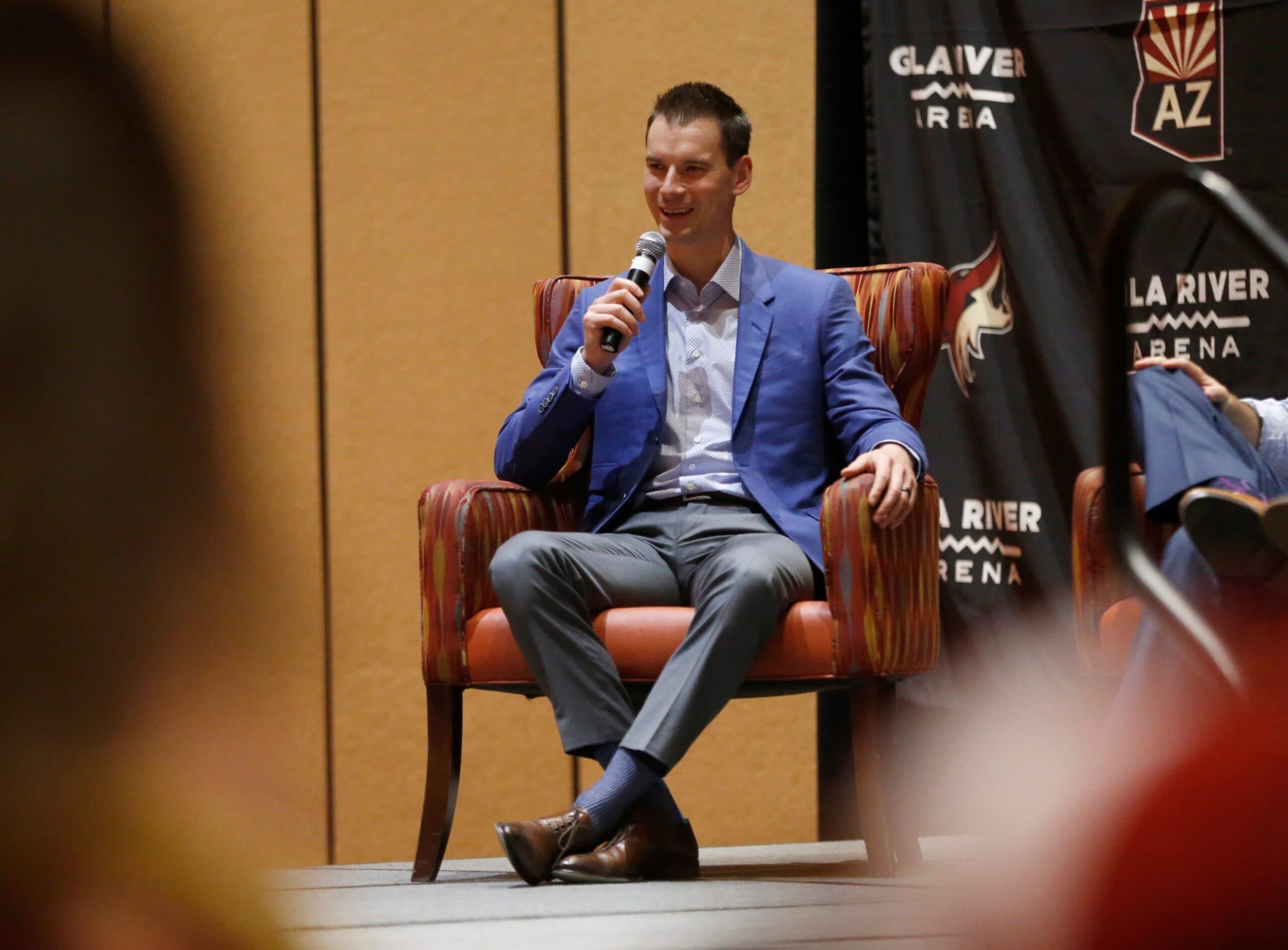
The Toronto Maple Leafs shocked the hockey world earlier this month when they officially named John Chayka as their new general manager.
Chayka, 36, is a full decade removed from when he took his first management gig with the Arizona Coyotes. He made headlines across the sports world at the time for being the youngest GM in NHL history. Over his four years in the desert, the Coyotes compiled a 131-147-38 record. Their lone playoff foray came when they qualified for the COVID bubble bracket; Chayka stepped down from his post just before the tournament began.
But it would be an understatement to say Chayka’s tenure in Arizona was chaotic. He traded with reckless abandon while in the Coyotes’ GM chair, making another deal seemingly every other week, and while he eventually got the team close to the salary cap in his final season, he did so via a rash of largely inefficient signings and acquisitions. And that’s saying nothing of his abrupt transition from upstart executive to fast food franchisee.
The Leafs had their pick of potential future general managers after they relieved Brad Treliving of his duties in March. They picked Chayka. Now, all we can do (at least, until he starts wheeling and dealing in Toronto) is to take another look back at what Chayka accomplished in Arizona and see if there’s anything positive for him to build upon — or if there’s anything bad, or even Coyote Ugly, for him to avoid repeating.
The good
Chayka hadn’t even reached the two-month mark on the job in Arizona before getting down to business at the 2016 NHL Draft. Given his relatively limited track record at that point, it’s fair to wonder just how much he had to do with the Coyotes’ various machinations that year, but still — he was the man at the helm when they took future captain Clayton Keller at No. 7, as well as when they traded up to take Jakob Chychrun at No. 16.
That’s the kind of one-two punch most teams dream of pulling off when they have multiple first-round picks. Keller and Chychrun have both developed into star players, and Chayka eventually signed both to long-term contracts that turned out to be bargains (Keller still has two seasons remaining on the eight-year, $7.15 million-AAV deal he signed under Chayka in 2019). And shortly after the 2016 draft, Chayka added another recent first-rounder, acquiring Lawson Crouse from the Florida Panthers in exchange for taking on Dave Bolland’s contract. It was a smart move to weaponize Arizona’s plentiful cap space and add a promising young player who has since become a four-time 20-goal scorer.
Chayka also identified a great running mate for Keller in Nick Schmaltz, whom he acquired from the Chicago Blackhawks in 2018. Schmaltz is a versatile top-six forward with a great shot, and he and Keller have spent virtually every second of the last eight seasons attached at the hip. Sure, Chayka had to pay a pretty high price to get Schmaltz in the first place, giving up a pair of recent first-round picks in Dylan Strome and Brendan Perlini, but both players had stagnated in the desert and Schmaltz has been a perfect long-term fit with Keller.
Aside from that, Chayka’s best trade was probably when he acquired Darcy Kuemper from the Los Angeles Kings for the low, low price of Scott Wedgewood and Tobias Rieder. Kuemper was fantastic in Arizona (when healthy) and was ultimately traded for a first-round pick, while the Coyotes later re-acquired Wedgewood for free. Chayka also did a decent job of selling long-tenured center Martin Hanzal to the Minnesota Wild for first- and second-round picks. And … that’s about it.
The bad
The later stages of Chayka’s tenure in Arizona were marred by short-sighted attempts to accelerate his proto-rebuild attempt. And while, sure, it resulted in the Coyotes making an appearance in the 2020 bubble playoffs, even winning the qualifying round against the Nashville Predators, it’s hard to say any of his significant veteran additions really paid off. Leafs fans had better hope that Chayka exercises more discretion in spending their comparatively fewer assets.
Chayka took some of his biggest swings in the 2019-20 season, which proved to be his last as Coyotes GM before being replaced by Bill Armstrong (who remains in that role to this day, now in Utah). Shortly after the 2019 draft, Chayka pulled off a major trade with the Pittsburgh Penguins, acquiring Phil Kessel in exchange for Alex Galchenyuk and recent first-round pick Pierre-Olivier Joseph. Kessel was 32, had three seasons left on his contract, and sought to be reunited with former Penguins assistant coach Rick Tocchet, with whom he’d won the Stanley Cup in 2016 and 2017; the Coyotes desperately wanted star power. The trade didn’t really work out for anyone, as Kessel scored just 42 goals in 208 games over three seasons in Arizona while Galchenyuk and Joseph quickly flamed out in Pittsburgh. But at least it gave us this photo:
OK, fine. But then, just more than six months later, Chayka, purportedly under pressure from ownership, traded a huge package — a first-round pick, a third-round pick, Kevin Bahl, Nick Merkley, and Nate Schnarr — to the New Jersey Devils to acquire Taylor Hall, who was just over a year removed from a surprise Hart Trophy win but had struggled with injury issues and inconsistency ever since. While it was neat to see the Coyotes throwing serious assets around after leading the Pacific Division early in the season, Hall wasn’t a great fit under Tocchet, and Arizona likely would’ve missed the playoffs outright if not for the expanded field in the bubble. New Jersey used the first-round pick on Dawson Mercer.
Then, there’s the drafting. Oh, the drafting. In 2017, Chayka picked Joseph at No. 23; he never played a game for the Coyotes. Whatever. (The bigger story that summer was Chayka unceremoniously severing ties with Shane Doan). But the following year, Chayka reached for young center Barrett Hayton with the No. 5 pick, choosing him over Quinn Hughes, who went to the Vancouver Canucks two spots later. Hayton has turned into a fine third-line center and is still in Utah to this day, but that’s a big miss. Perhaps recognizing his mistake, Chayka traded up from No. 14 to 11 in 2019 to go for a somewhat Hughes-like defenseman in Victor Soderstrom, who became a major bust. The next seven picks: Matt Boldy, Spencer Knight, Cam York, Cole Caufield, Alex Newhook, Peyton Krebs, and Thomas Harley. Woof. And amidst all of that, the only successful later-round picks during Chayka’s tenure were Bahl, Matias Maccelli, and, uh, Ty Emberson — all of whom are now elsewhere. After a few relatively dry years at the draft under Kyle Dubas and Treliving, Toronto needs Chayka to turn over a new leaf this time around.
The Coyote Ugly
Chayka made his fair share of mistakes with draft picks and in trading for veteran forwards. But in 2017, he combined both of those poor tendencies into one truly awful move. Arizona had just drafted Keller at No. 7 overall the previous year, and they’d ended up with the No. 7 pick again in 2017. But instead of, y’know, using it, Chayka decided to trade it to the New York Rangers, along with Tony DeAngelo, in exchange for veteran center Derek Stepan and promising backup goaltender Antti Raanta. Stepan played three seasons in Arizona, topping out at 15 goals in 2018-19, while Raanta generally performed well but struggled mightily to stay healthy over his four years in the desert. It was exactly the kind of short-sighted, win-now move you’d expect a team to make after multiple seasons as a contender, not five years removed from its last playoff appearance, and the only saving grace in this case was that New York blew the pick on Lias Andersson instead of taking, for instance, Martin Necas or Nick Suzuki.
But even that move is small potatoes compared to what came later. The Coyotes took incremental steps forward over Chayka’s four years at the helm, and although some of his trades for veteran talent may have been ill-advised, his team ultimately became more competitive in the Pacific Division. Things became more chaotic after the COVID-19 pandemic hit in early 2020, but it soon became apparent that Chayka’s Coyotes would get the opportunity to compete in the playoffs in Edmonton that year as part of the NHL’s return-to-play plan. Hall seemed potentially receptive to the idea of staying in Arizona. It seemed like it might be time for Chayka to start being even more aggressive.
Instead, he quit.
A week before the Coyotes hit the ice against Nashville in the qualifying round — a series they won, remember — Chayka abruptly vacated his post as general manager. The Coyotes were furious. At a time when things were finally starting to look more positive for the organization, Chayka cast yet another dark cloud over them. It turned out that Chayka had interviewed for a job with another team, rumored to be the Devils, mere months after signing a multi-year contract extension with the Coyotes. The relationship between executive and team disintegrated from there, with Chayka skipping out on a pivotal meeting between Hall and Coyotes ownership prior to the bubble playoffs. After all that, it came as little surprise when Hall elected not to re-sign with the club.
After everything that went down between Chayka and the Coyotes, the NHL got involved on multiple fronts. They determined that Chayka had violated league rules during his tenure as GM, holding improper off-ice workouts and testing for CHL prospects ahead of the NHL Draft Combine, resulting in the Coyotes forfeiting their own 2021 first-round pick and 2020 second-round pick. Shortly thereafter, the NHL suspended Chayka from working in the league for an entire calendar year in response to how he handled his departure from Arizona, deeming how he turned his back on the team as “conduct detrimental to the league and game.”
In the wake of Chayka’s tumultuous departure, it took years for Armstrong to build the Coyotes’ asset base back into a healthy position. By then, they were on the verge of relocating to Utah. While the Leafs will never be in those particular circumstances, they’re still in a precarious spot, being without their own first-round picks in the 2027 and 2028 drafts.
Chayka never had the luxury of picking first overall in the desert, and he certainly never had a prospect of Gavin McKenna’s caliber at his disposal. But he also never had to face the pressure of working in the NHL’s biggest market. We’ll see if he’s up to the challenge.
_____
POST SPONSORED BY bet365
_____
Recently by Mike Gould
- From Hughes to Peterka: Recent acquisitions running hot and cold in the 2026 playoffs
- Which 2026 playoff team stands the best chance of stopping the Colorado Avalanche?
- Matvei Gridin is defying convention to become the Flames’ next young star
- Five pending NHL UFAs with the most to play for down the stretch
- The red-hot Ottawa Senators are making the most of a turbulent season
- Are the Oilers and Panthers going to be OK?
- Craig Conroy has re-stocked the Flames’ cupboards like never before
- Comparing the NHL’s top Draft Lottery contenders after the Trade Deadline
- Grading the MacKenzie Weegar trade: Flames commit to rebuild, Utah makes a splash
- The Borrowed Stars: Players who returned to former teams after deadline trades