Sketching out how the Flames can (eventually) trade Jonathan Huberdeau

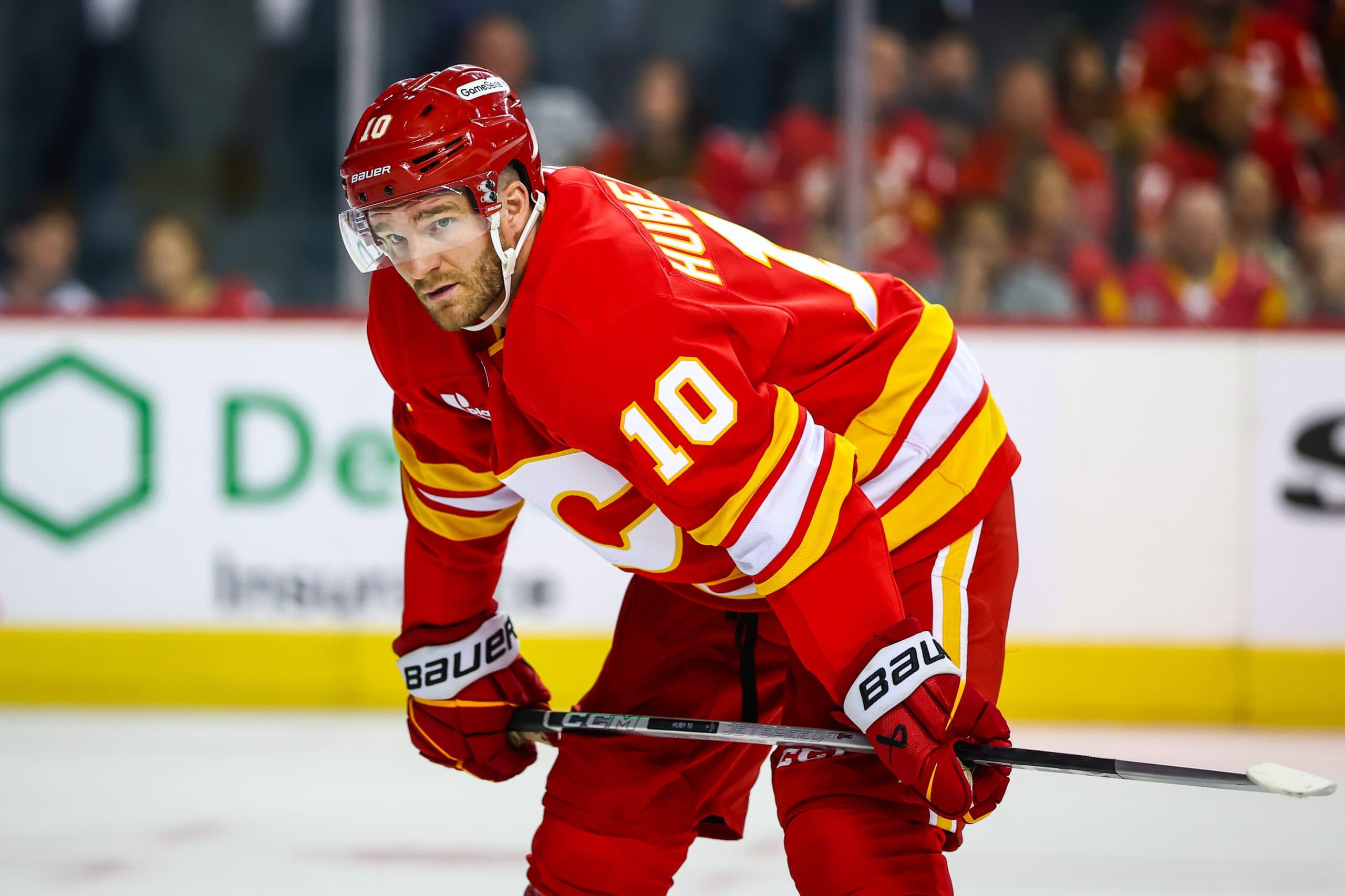
Jonathan Huberdeau must feel like he’s stranded on an island.
Over the last three seasons of Calgary Flames hockey, Huberdeau has been one of the few constants while virtually every other established player in the organization has been sent off to greener pastures.
Craig Conroy’s full list of subtractions reads like the end credits of a star-studded movie: Tyler Toffoli. Nikita Zadorov. Elias Lindholm. Chris Tanev. Noah Hanifin. Jacob Markstrom. Andrew Mangiapane. Rasmus Andersson. MacKenzie Weegar. Nazem Kadri. Blake Coleman. That’s one heck of an ensemble cast … now almost completely disassembled. But Huberdeau remains aboard this sinking ship, still with five years left on his contract, and he must be wondering if he’ll ever find one last lifeboat for himself.
In all fairness, had Huberdeau ever come close to living up to the eight-year, $10.5 million-AAV deal he signed back in 2022, the Flames probably wouldn’t be in this situation. Forced to pivot after learning neither Johnny Gaudreau nor Matthew Tkachuk would return following an incredible 2021-22 season, the Flames opted to hitch their wagon to Huberdeau, Kadri, and Weegar as the leaders of a new-look core. Huberdeau had tied Gaudreau for second in league scoring with 115 points in 2021-22, but after he fell to just 55 in 2022-23 and 52 the year after, it quickly became apparent that the Flames were in trouble: They paid for a superstar and got a second-liner.
Since taking over for Brad Treliving as the Flames’ GM in 2023, Conroy has done a masterful job of converting a roster full of win-now pieces into an enormous stockpile of long-term assets. He even managed to extract value for Kadri and Weegar, two players whose long-term contracts looked like they might become extremely problematic at various points during their Flames tenures. But one of his biggest challenges yet will be handling Huberdeau, who turned 33 in June and recently underwent a surgical procedure from which very few players have successfully returned.
Hampered by a nagging issue throughout the 2025-26 campaign, Huberdeau elected for season-ending hip resurfacing surgery in early March. Before that, he had appeared in only 50 games, collecting 10 goals and 25 points, putting him on a 41-point pace — certainly not very good, but also not far off Matt Coronato’s team-leading 45 points. The expectation around Calgary is that Huberdeau will be ready to report to the Flames’ 2026-27 training camp when it opens on Sept. 17.
Huberdeau travelled to New York City for the operation, which was performed by leading orthopedic surgeon Dr. Edwin P. Su — the same practitioner who carried out Patrick Kane’s successful hip resurfacing surgery in 2023. The veteran forward subsequently began an extensive off-ice rehabilitation process in Stamford, Conn., under the watchful eye of a team of physiotherapists and Flames staffers, and ultimately resumed skating in June. The hope is that Huberdeau follows more closely in Kane’s footsteps than those of Ryan Kesler, Ed Jovanovski, and Nicklas Backstrom, all of whom struggled to return to the NHL in any capacity (albeit much later in their 30s) after having their hips resurfaced.
Barring anything unforeseen, Huberdeau will be in the lineup when the Flames kick off their final season at the Scotiabank Saddledome against the Seattle Kraken on Oct. 1. It may take some time for him to get up to game speed, but he’ll be given every opportunity to get back into a leading role on a Flames team that is underpowered by design. After all, with how many players the Flames have traded over the past three seasons, Huberdeau’s $10.5-million AAV has been instrumental in helping the team reach the salary floor, even if it’s a little misaligned with the value he provides on the ice.
Actually, that’s a bit of an understatement — the value is very misaligned. Huberdeau’s contract is, by consensus, the worst in the NHL, and with five years to go (and no tangible benefit to buying it out) — the Flames are going to have to live with it. But … is there a way they can actually try to get something out of it?
Huberdeau is clearly overpaid, but failing to live up to expectations isn’t the same as being outright bad. If Huberdeau became an unrestricted free agent today, he’d get offers — and after the injury-riddled season he just had, his value is undoubtedly the lowest it’s ever been. But let’s say Huberdeau got back to scoring 50-60 points in the 2026-27 season, and then became a UFA. How much would that 34-year-old version of Huberdeau be worth on the open market?
Obviously, it’s far from a given that Huberdeau will be able to get back to some semblance of playability. But it’s also worth remembering that recent NHL history is rife with examples of teams recouping assets for players once thought impossible to move — just ask Dion Phaneuf, Vincent Lecavalier, Erik Karlsson, and, most recently, Darnell Nurse. If there’s one player archetype GMs consistently covet, it’s the wily veteran with pedigree, size, and leadership. Huberdeau checks all of those boxes. If Huberdeau spends the next two or three years skating alongside the likes of Matvei Gridin, Cole Reschny, and Ethan Wyttenbach as they transform into impactful NHLers, it could work wonders for rehabilitating his image, at least in the eyes of NHL executives, from an overpaid has-been to a useful mentor and secondary scorer.
The other element to consider is the ever-rising salary cap, which jumped from $96.5 million in 2025-26 to $104 million in 2026-27. It’d be silly to suggest that this inflation could ever make Huberdeau’s cap hit anything resembling a bargain, but it might make acquiring it a more palatable proposition — especially as the years continue to pass by. A 33-year-old Huberdeau with five years at $10.5 million against a $104-million cap isn’t worth anything in a trade, but how about a 35-year-old Huberdeau with three years left under a projected $123 million cap in 2028-29?
Say, for example, that two or three years from now, a contending Montreal Canadiens team is looking to bolster their top nine with a veteran playmaking winger who just so happens to be from nearby Saint-Jérôme. If Huberdeau has a couple more seasons like his 2024-25 campaign, in which he scored 28 goals (only two off his career high) and 62 points, he might start to make sense as a trade target for certain teams. Sure, Huberdeau at $10.5 million is a difficult value proposition, but what if the Flames were prepared to retain salary to get him down to $6-7 million for the rest of his contract? And what if they took back a bad contract or two in the deal, like the Toronto Maple Leafs did when they took on Milan Michalek, Jared Cowen, and Colin Greening in the Phaneuf trade? Maybe, just maybe, the Flames could get a couple of draft picks or prospects in return for the Québécois veteran.
There are a lot of ifs in the last few paragraphs. Attempting to sketch out the future is difficult at the best of times, and it becomes even harder when the subject is a 33-year-old winger with a surgically repaired hip. Ultimately, the Flames aren’t in a position where they need to move Huberdeau — as established, his contract is currently keeping them above the salary floor — and they certainly don’t want to replicate the disastrous Sean Monahan trade, in which they gave up a first-round pick solely to clear his contract off the books.
By all accounts, Huberdeau is a consummate professional who has been nothing but supportive toward the Flames’ burgeoning young core. He has worn a letter on his jersey since arriving in Calgary and consistently draws rave reviews as a top-notch teammate. In the 2024-25 season, undoubtedly his best to date with the Flames, Huberdeau put in genuinely laudable work to reinvent himself as more of a physically impactful player. It’d be easy for him to sulk about the Flames’ recent misfortunes, but that doesn’t appear to be his style.
Given where the Flames are in their rebuild, it’s unlikely that Huberdeau’s contract will prevent them from being able to pay any of their future stars. One only needs to look as far as the San Jose Sharks, where Logan Couture’s hefty deal is set to expire the same summer that Macklin Celebrini’s new contract takes effect. In the end, Couture will have sat out almost all of the last four years of his contract while dealing with a chronic hip injury of his own. The same fate could ultimately befall Huberdeau, although the Flames’ positioning in the standings likely won’t change much if he’s in the lineup or not. At this point in his career, Huberdeau is more of a complementary player than a driver, and he alone won’t be enough to elevate the Flames out of the draft lottery.
Let’s face it: With a contract as unwieldy as his, the most likely outcome is that Huberdeau will play out the rest of his contract on a rebuilding Flames team. In the eyes of most fans, he’ll forever be associated with that precipitous, 60-point drop from 2021-22 to 2022-23, and the subsequent mass exodus of talent from Calgary that ensued. As it stands, it’s undeniably difficult to see him ever joining his now-former teammates in getting off that island. But again — being overpaid isn’t the same thing as being ineffective. Huberdeau was one of a very small handful of Flames players to finish above 50 percent in both shots for and expected goals percentage at 5-on-5 last year — and that was with a bad hip. With a healthy return to the Flames’ top line and the No. 1 power-play unit, Huberdeau could feasibly get back to the 50-60 point range for a few more seasons. Any more than that, and things suddenly start to look very different.
On the right team, and with the right linemates, Huberdeau could be a legitimately valuable second-line player again, and he deserves another chance to show what he can do in a winning environment. It’ll be up to him to play his way into those kinds of conversations, but in this rapidly changing NHL landscape, nothing seems impossible anymore.
_____
Recently by Mike Gould
- Top NHL sophomore breakout candidates for 2026-27
- Projecting which NHL teams will send the most star prospects to the 2027 World Juniors
- Nemec, Eklund, and other breakout candidates joining new teams in 2026-27
- Why the Yzerplan failed in Detroit — and where the Red Wings go from here
- Grading the Brady Tkachuk trade: Sens lose captain to Florida, gain valuable retooling capital
- Six potential trade destinations for Ducks center Mason McTavish
- Grading the Joseph Woll trade: Leafs, Flyers swap depth pieces in reasonable fashion
- Taylor Hall is rewriting his own career narrative with the Hurricanes in the playoffs
- After Draft Lottery loss, the Flames must continue their gradual, steady rebuild
- Who should the Calgary Flames draft at No. 6 overall?
- Andersen vs. Hart: Breaking down the 2026 Stanley Cup Final goaltending battle
- Ranking Vegas’ win over Colorado among the most shocking NHL series sweeps ever
- Even after cleaning house, Canucks have an uncertain path forward