2026-2027 NHL team preview: Minnesota Wild

LAST SEASON
The question for the Minnesota Wild coming into the 2025-26 season was whether they signed Kirill Kaprizov for a then record-shattering deal to contend or to save face. Kaprizov is a rare franchise winger with gaudy 82-game averages of 48 goals and 98 points, and losing him to unrestricted free agency would’ve been unacceptable. Still, could the Wild really expect to win with $17 million in cap space dedicated to one player?
General manager Bill Guerin wanted to render the point moot by winning before the aptly named ‘Dollar Bill’ Kirill cashed out. Guerin pushed in his chips and added one of the sport’s true superstars, then-Vancouver Canucks captain Quinn Hughes, via trade to an already playoff-bound team (17-9-5 before Hughes’s MIN debut) in December. With Kaprizov at the helm of a forward group also featuring elite puckhounds Matt Boldy and Joel Eriksson Ek, and Hughes leading the blueline alongside future captain Brock Faber, there was no doubt Guerin had finally delivered on his long-standing promise to bring a contender to the State of Hockey.
Minnesota looked the part of Cup hopefuls the rest of the way, finishing 10th in scoring, fourth in defense, and seventh in points. Not even another brutal Central Division first-round draw could deter the Wild, who knocked off a Dallas Stars team that had played the role of their dismissive older brother in two prior playoff meetings in a six-game stand that Minnesota totally dominated at even strength (19-5) to win its first series in more than a decade.
Then the Colorado Avalanche series happened, and the same old Wild were back, a little too top-heavy, a little too slow, and a little too soft to finally dream big. A year on from those fateful Kaprizov negotiations, the questions in the Twin Cities are much the same. Will the superstar, this time Hughes, stick around? Can Guerin build a winner around him? And are the Wild, for all their star power, finally ready to swim with the sharks in the Western Conference?
KEY ADDITIONS & DEPARTURES
Additions
Maxim Shabonov, LW
Blake Coleman, LW
Olli Maatta, D
Calvin Pickard, G
Departures
Mats Zuccarello, RW (LAK)
Marcus Johansson, LW (Swe)
Vladimir Tarasenko, RW (UFA)
Jacob Middleton, D (CGY)
Jeff Petry, D (UFA)
Nicolas Aube-Kubel, RW (KHL)
OFFENSE
Kaprizov has never scored under a 40-goal pace, fires the puck at volume (3.52 shots per game since 2020, 10th in NHL), and boasts an underrated playmaking element. He is one of the top offensive producers in the NHL by any measure. Still, after signing Kaprizov to the (now former) richest contract in his sport’s history, the Wild need him to be a real-deal MVP candidate year in, year out. Kaprizov was not that in 2025-26. A return of 89 points in a mostly healthy season was actually a down year for ‘the Thrill,’ who averaged 104 points per 82 games in the four preceding seasons.
Perhaps the Wild’s reliance on No. 97 to balance out their top six by elevating hardworking centerman Ryan Hartman and ageless wonder Mats Zuccarello finally dragged down his production. Zuccarello signed with the Los Angeles Kings after his brilliant second act in the Twin Cities (389 P in 452 GP), so his minutes opposite Kaprizov and on the power play will likely go to new guy Maxim Shabonov. A nifty little man in the style of Zuccarello, Shabonov was electric in the KHL but mostly anonymous (18 P in 44 GP) for a New York Islanders squad that imported him without a clear path to top-six opportunities. If the plan is to play him with his countryman Kaprizov, Shabanov will have ample runway to turn his obvious skill into points in his second North American season.
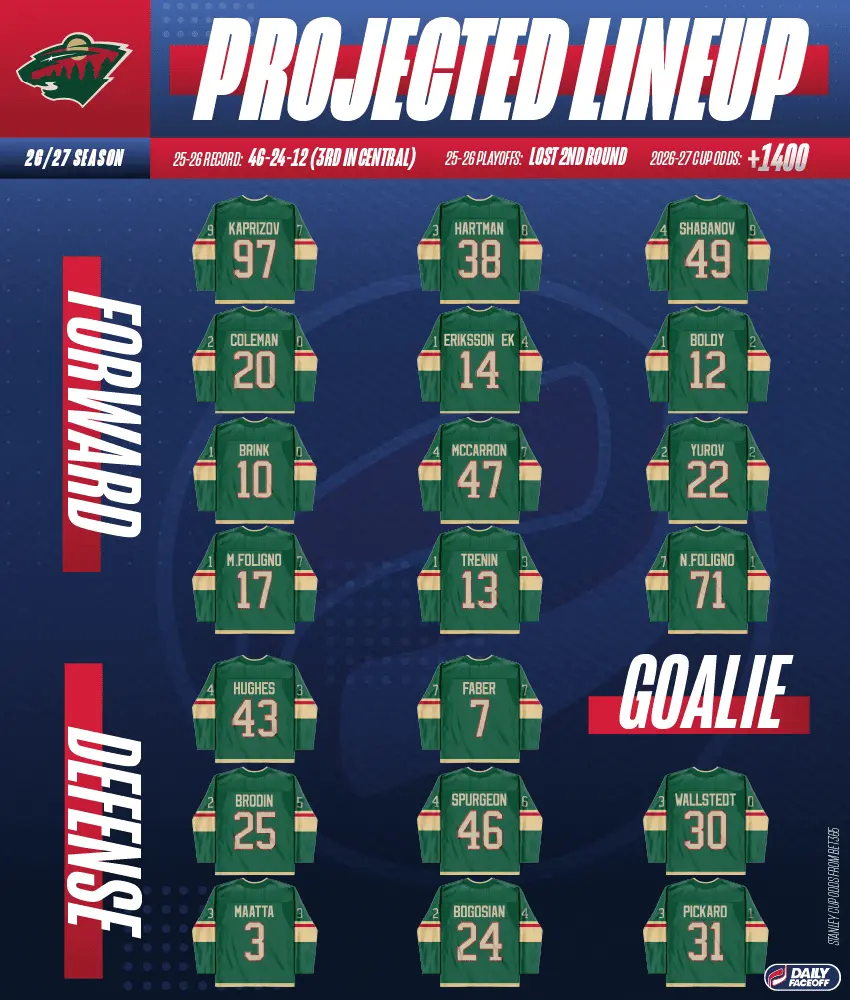
When Kaprizov plays on a super line with Boldy and Eriksson Ek, the Wild flash-fry their opponents (46-25 5-on-5 game score since 2023). Boldy, a budding superstar power forward, and top center ‘JEEK’ do fine without the Russian, too. A devastating combination of power and skill, the brawny duo won their minutes 42-26 last season. Blake Coleman, acquired via trade from the rebuilding Calgary Flames, is every bit as relentless as his presumed new linemates. Even as he nears his 35th birthday, Coleman is a tireless workhorse (152 hits) with four 20-goal seasons to his name. He will help Boldy and Eriksson Ek make life miserable for unwary defensemen.
If the Wild’s bottom six is to provide more offensive support despite the departure of Vladimir Tarasenko (23 G), it will need improvement from youngsters Bobby Brink and Danila Yurov. Local boy Brink surprisingly struggled to endear himself to coach John Hynes after the Wild recruited him at the deadline from the Philadelphia Flyers, where he was a reliable forechecker and bottom-six scorer (38 P per 82 GP) despite his diminutive stature. Brink spent most of the postseason in the press box, and he’ll have a chip on his shoulder after an uneven start to his homecoming. Yurov is a brainy young player who spelled Hartman as Kaprizov’s pivot for stretches, but Yurov needs to adjust to the physicality of the NHL for his soft hands to translate to the scoresheet after a 27-point debut.
Hughes might not be a forward, but he’s every bit as dangerous as Boldy or even Kaprizov. He’s not quite as explosive as Colorado counterpart Cale Makar, but Hughes’s ability to keep the puck on his stick for virtually the entirety of his ice time makes him one of the most singularly influential players in hockey. The third-most prolific assist provider in the NHL since 2021, Hughes racked up 48 helpers in as many games in a Wild sweater. No one took more notice of Hughes’s playmaking than partner Brock Faber, who scored at a 60-point pace after the trade to bury his sophomore slump firmly in the rearview.
DEFENSE
An explosive skater and excellent 1-on-1 defender, Faber is the perfect option to put out fires on the rare occasions Hughes’s roving style backfires in the O-zone. The duo kept expected goals against in check during the regular season (2.51 per 60) and playoffs alike (2.53) while clearing through a massive workload; Hughes and Faber’s 16:58 ATOI as a unit at 1-on-1 led the NHL by more than a full minute. Keeping actual goals under control should be as simple as getting better support from a usually stout goaltending battery (.878 on-ice SV%) for Minnesota’s top pairing, one of the league’s strongest.
The Wild’s second unit of Spurgeon and Jonas Brodin, who rank second and third, respectively, in all-time appearances for the franchise, is similarly enticing on paper. Rolling out two highly respected shutdown options to soak up the toughest defensive starts on behalf of a more offensively inclined No. 1 partnership is Roster Building 101. When those options have more than a decade of built-in chemistry, it should be a series-winning luxury. Indeed, Spurgeon and Brodin were absolutely smothering when they did link up, surrendering just 1.32 (!) goals per 60 in the regular season. That “when” is doing some heavy lifting, though; availability has continually been an issue for the well-weathered duo.
Brodin has missed at least 20 games for four seasons running, and the Wild’s ‘D’ never really recovered from his injury in Game 5 against Dallas. Spurgeon, who will turn 37 this season and has had his own injury woes over the years, didn’t look like someone who can still be the A-Side of a top-four partnership with Brodin out of commission. Colorado’s explosive attack singled out Spurgeon and replacement partner Jake Middleton again and again, burying them beneath a 36-14 scoring chance deficit and -13 combined rating.
After a mostly positive stint as a fan favorite in Minnesota ended on the sourest of notes, Middleton’s salary became a necessary facilitator for the aforementioned Coleman trade. Along with Coleman, the Flames sent veteran defender Olli Maatta to St. Paul in the swap. Maatta’s game is unexciting by design, as he moves too poorly to get away with unnecessary risks at either end of the ice. Having stepped into an unexpected top-four role with aplomb over the past two seasons, the steady Finn ironically is a strong option to mime for Brodin, known for one of the prettiest skating strides in the sport, in a pinch.
While Middleton’s departure left a lightweight defensive corps with even fewer crease cleaners, the Wild’s forwards should more than make up the difference. The stocky Kaprizov is sneakily one of the top cornermen in hockey, and there’s nothing sneaky about either Boldy or Eriksson Ek’s ability to force defensemen into mistakes. That’s just in the top six; deadline acquisition Michael McCarron quickly became a popular checking-line center, Marcus Foligno has long been a destructive force in Minnesota’s bottom six, and versatile Russian Yakov Trenin paced the NHL with an astounding 413 hits.
GOALTENDING
This time last year, Filip Gustavsson was riding high off an excellent first season as the Wild’s workhorse and just weeks from signing a $34-million contract extension. After enduring peaks and valleys in his years as a platoon netminder, the ‘Gus Bus’ had, apparently, pulled ahead of once-prized prospect Jesper Wallstedt in the organization’s estimation. Gustavsson was set to eclipse the .910 mark in save percentage and earn Vezina Trophy votes for the second straight season when the netminder’s game mysteriously collapsed (.853 SV% in 9 GP after 5/11) with only weeks remaining in the season.
Coach John Hynes instead tabbed Wallstedt, free from the taint of the Iowa Wild curse and enjoying a brilliant rookie season, to take over the net against Dallas. An apparently discontent Gustavsson would appear only once in the postseason before going under the knife to clean up wear and tear in his hip. That ‘Gus’ is back in limbo before his extension has even begun is fitting for a player whose career has so frequently swung between brilliant highs and frustrating lows, but where does the 28-year-old’s injury leave the Wild’s crease?
The short- and long-term answers are the same: Wallstedt. After his potential threatened to die on the vine for a rotten AHL outfit while he waited out Marc-Andre Fleury’s career, Wallstedt showed off the poise and positioning that made him a first-round pick throughout his rookie season. After posting an incredible four shutouts in his first 10 starts, Wallstedt evaded the infamous rookie wall and tore off a .922 SV% in 11 starts after the Olympic break before posting a .924 mark to topple the Stars.
The Wild will find out how well Wallstedt fares without Gustavsson taking on the 1A workload and keeping the youngster fresh sooner than they planned. Gus’s injury absence will drag into the season, and journeyman Cal Pickard doesn’t figure to see more than a handful of spot starts in the opening months. Guerin and Hynes will hope a full recovery for Gustavsson opens the door for Minnesota to resume one of the NHL’s best goalie tandems before the sort of fatigue issues that have characterized his Wild tenure begin to affect Wallstedt, too.
COACHING
Hired after uninspiring stints as head coach of the New Jersey Devils and Nashville Predators, Hynes has needed time to earn the respect of the Minnesotan fans. By gaining his long-awaited first series victory and ending the Wild’s first-round woes, Hynes seemed to do just that during his third season in charge.
Hynes doesn’t reinvent the wheel on the whiteboard but has done an excellent job working with each of his players on a man-to-man level and setting a standard without resorting to fear tactics. If earning 104 points and knocking off an elite outfit like Dallas shifted expectations for Minnesota, though, it did for Hynes too. The bench boss will have to clear higher and higher bars to show he is improving along with his team. When a Cup hopeful plateaus, we all know who’s first in line to take the blame.
One area Hynes and his staff will seek to improve is the penalty kill, which, despite finally climbing into the top half during the regular season (79.8%, 16th), cratered in the postseason (60.5%). That’s never going to cut it if Minnesota means to escape the perennially star-studded Central Division bracket. Hynes did lead Team USA’s Olympic PK to perfection, albeit with near-perfect personnel. The additions of Coleman and Maatta, and a full preseason of integration for McCarron should help, though the true test of the new-look penalty kill won’t come until the postseason.
ROOKIES
The Hughes trade and Yurov’s debut left the Wild’s rookie cupboard nearly bare, and it will likely take an injury, a brilliant camp/preseason from a young player, or both for a rookie to crack Minnesota’s opening night roster.
That doesn’t mean there’s no one worth getting excited about who will start the season in Iowa, with the caveat that the AHL club’s long-running struggles do tend to provide an early challenge for developing prospects. Riley Heidt, in particular, struggled to find his sea legs at the pro level, posting just 25 AHL points despite having perhaps the best offensive instincts in the Wild’s pipeline. Hunter Haight fared considerably better and already looks like someone who can bring a sneaky offense to an energy role in the NHL, though, again, there isn’t an obvious spot open for him.
On the blueline, David Spacek racked up 36 points during a season he donned the colors of Czechia at the Olympics. With Daemon Hunt and Zach Bogosian back in depth roles, Guerin seems prepared to expose Spacek to waivers. Given his $850,000 cap hit and solid two-way game, that could end up being a costly gamble.
Spacek, Heidt, and Haight all have NHL depth potential to varying degrees, but the rookie Wild fans really want to see center Charlie Stramel. The hulking Stramel looked like a first-round whiff at Wisconsin before turning things around at MSU, where he rounded out his college career with a 19-goal, 44-point explosion in 37 games as Porter Martone’s center. We won’t know if Stramel is a potential trade centerpiece, an eventual Hartman replacement as a grinder who can play off Kaprizov, or a big lug who beat up on college kids despite lacking NHL-level skill until he gets his feet wet in Iowa.
BURNING QUESTIONS
1. Is signing Quinn Hughes good business? Duh, right? Hughes is a top-1 player in hockey. Keeping two players of his and Kaprizov’s caliber on the same roster long term, especially with Boldy and Faber creeping towards superstar status, should open up a long, fruitful contention window. In a vacuum, at least. Cale Makar, Hughes’s only peer in terms of productivity and age, recently signed narrowly south of the max. To get Hughes anywhere near that number, Guerin needs to give him every dime of Spurgeon’s expiring cap hit and most of Hartman’s. If he sinks $35 million+ into two players, where will the reinforcements come from? And how will he pay Wallstedt? Cashing in on Hughes so soon after acquiring him would devastate fan morale. As a roster-building move, though, it might not be as crazy as it sounds.
2. Is a Hartman replacement realistic? As soon as Dylan Larkin went public about his discontent with the Detroit Red Wings, Wild fans started connecting the dots. Guerin was Team USA GM, and three of his players have gotten to know Larkin well within the national program. The fit is a slam dunk. Minnesota has long needed a center who can outscore Eriksson Ek, who’s more of a 50-point guy than a true 1C, without breaking the bank. Bluntly, though, the Wild have nothing the Red Wings want. Add in the Hughes negotiations, and now might not be the time for another moonshot. Hartman, who works his socks off and can chip in 20 goals a season, is still the best choice to center Kaprizov, even if it won’t be a popular one.
3. What (and where) is Gustavsson’s future? There isn’t a top-tier NHL club lacking confidence in goal. There isn’t a poor one, either. It’s late now, and every club is settled between the pipes in its own mind, at least. Gustavsson and his starter’s contract won’t entice many of them. He’s not the first quality netminder to sign a contract that threatens inefficiency out of the gate, but he may be the best, stomach aches and all. Guerin may want out, but the best result for all involved parties is another solid year from the Swede. The Wild may be looking for an out to clean up their books, but finding one that doesn’t land a top 20-goalie in the Utah Mammoth’s crease could be a tricky proposition.
PREDICTION
If you’d like to know why the Hughes negotiations are so difficult, check back in a few weeks for the Mammoth preview. Cup contenders abound in the Central, and whether the Wild are among their ranks is the question of the summer. The stud blueliner’s reps are wondering the same thing.
I say thee nay. Minnesota needs a lot to go right to play for the chance to represent the West in the Stanley Cup Final and only a little go wrong to spin out of contention by January. ‘GMBG’ should polish his Jim Gregory Award. It could be the only trophy he gets to show for his litany of high-risk moves in the big chair.
_____
_____
PRESENTED BY THE DAILY FACEOFF NEWSLETTER