It’s time for the NHL to get rid of the trapezoid

It’s crazy to think it’s been over two decades since the NHL lost an entire season to a work stoppage. It’s also mind-numbing to think that a rule put in place following that lockout is still around today.
Now, it’s time to get rid of it.
Goaltending saw a couple of changes coming out of the lockout. Along with stricter rules to erase the hook-and-grab era of hockey, netminders were forced to wear smaller pads and limited to where they could play the puck below the goal line – which was also shrunk down after moving the net back two feet. Experimented with during the 2004-05 AHL season, the trapezoid was introduced by the NHL in the fall of the following season. It quickly earned the nickname ‘The Brodeur Rule’, paying homage to New Jersey Devils legend Martin Brodeur. Many regard him to be the best puck-handling goaltender of all time. The rule was later adopted by many other leagues around the world.
The new rule prohibited goaltenders from going out to play the puck in the corners. This took away the opportunity to help their defensemen break the puck out quicker, in another attempt for the NHL to increase scoring coming out of the Dead Puck Era. While offense saw an exponential increase over the last two decades, it’s hard to connect it to the change in where the masked men can and can’t play the puck.
The rule made sense when it was first instituted. The NHL was desperate for offense, and they were willing to do just about anything to make it so…outside of making the nets bigger. With teams still chip-and-chasing at a high rate, the opposition’s forecheck became even more dangerous, leading to more chances. However, in recent years, the geometric shape seems more like a symbol than an actual line to avoid.
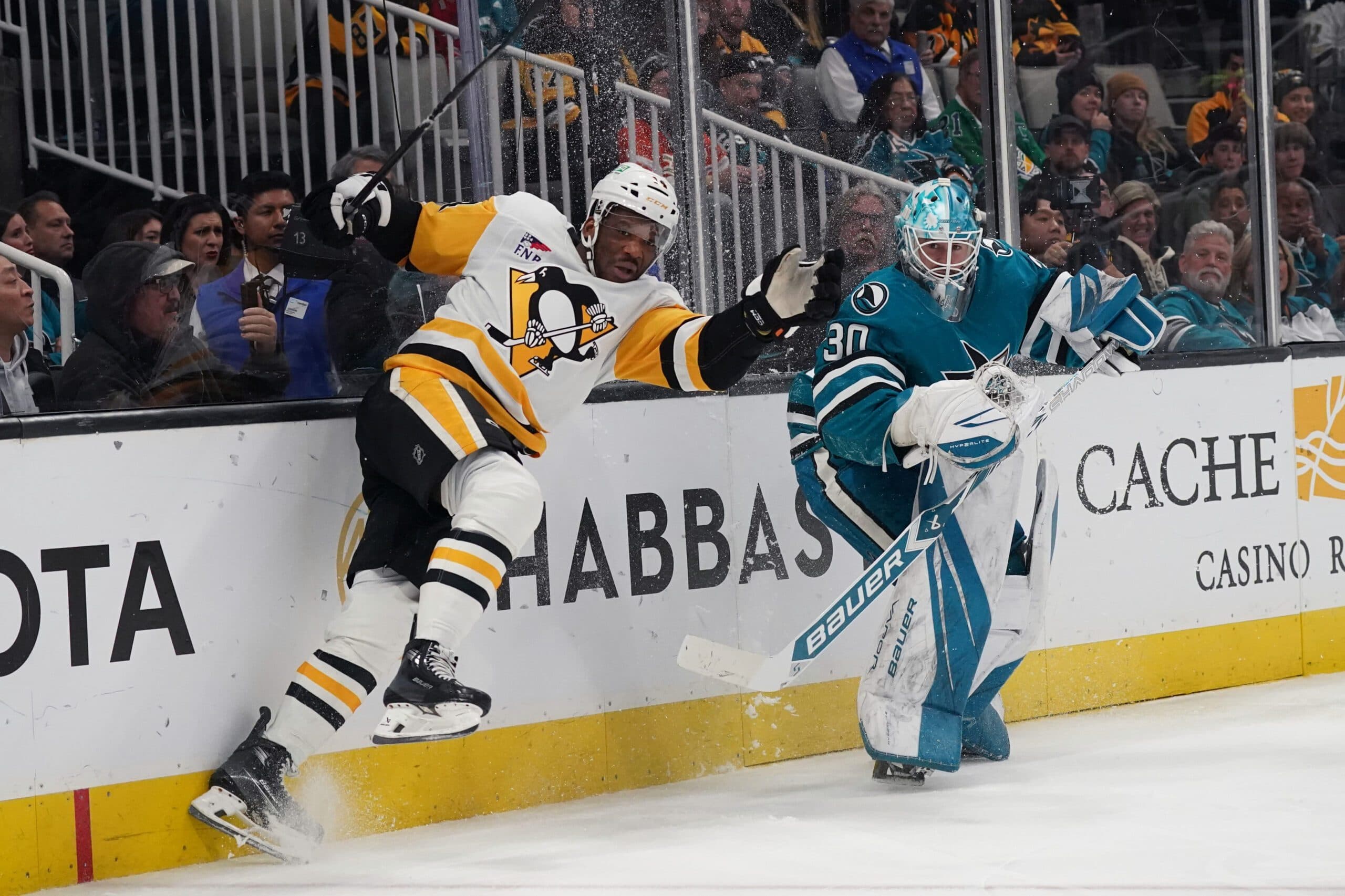
It certainly hasn’t kept netminders from coming out of their net to play the puck. Goaltenders from today, such as Frederik Andersen, Alex Nedeljkovic and Jacob Markstrom, have earned a reputation as being responsible with the puck (for the most part). There are also those who still struggle to handle the vulcanized rubber, leading to many humorous moments. Imagine how many more chaotic moments would occur if goaltenders were allowed to movie off into the corner. I’m sure Martin Biron would be interested in seeing what would happen.
While there have been instances of goaltenders being called for “delay of game” when playing the puck outside the trapezoid, including Vegas Golden Knights goaltender getting busted during the 2023-24 season, backstops have done a pretty good job of keeping out of the corners, though there has been several moments when, while on the power play, a goaltender can only sit helplessly in his crease while a cleared puck comes to a stop in the corner, forcing his teammates to trudge all the way to back from the other end of the rink to get the puck.


Cap Summary
Draft Picks
Along with erasing goaltenders’ freedom to play the biscuit wherever they choose, an underlying issue with the trapezoid is how it puts defensemen in danger. In the olden days, a netminder could skate to the corner and shovel the puck up the glass, or push it behind the net for a defender to pick it up in stride. Now, a D-man has to race back to get the puck, putting themselves in a precarious position, as a hard-pressing forward might be right on their tail. While goaltenders are (usually) safe from getting hit, defensemen have been getting teed off on by forecheckers, with goaltenders unable to provide assistance.
While the NHL might think the trapezoid rule has caused a downturn in netminders handling the puck, point production among the masked men is pretty on par compared to the years leading up to the lockout. Since Pittsburgh Penguins legend Tom Barrasso posted eight points during the 1992-93 season (third-most all-time), the most points a goaltender has registered in a single season is six, which has been reached four times, three times on this side of the work stoppage.
To further prove that goaltenders are involved in the offense in the “trapezoid era,” 42 netminders posted a point during the 2025-26 regular season, the most since (ironically) the 2005-06 campaign, when 48 backstops put their name on the scoresheet. Yes, some of these points might’ve come after a goalie makes a save, but a lot of today’s goaltenders are more than comfortable acting as a third defenseman.
The trapezoid rule made some sense when the NHL first brought it into the league 21 years ago, but it’s time for it to go. The league is always willing to introduce ways to enhance the game, and restoring goaltenders’ ability to play the puck anywhere on their half of the ice should be brought back. It might go back to what the NHL wanted back in 2005, but the trapezoid is just another annoying little thing that us diehard fans have to try and explain to a passerby while watching the game we love.
PRESENTED BY THE DAILY FACEOFF NEWSLETTER