Projected lines for 2026 Olympics: Canada, USA, Sweden, Finland

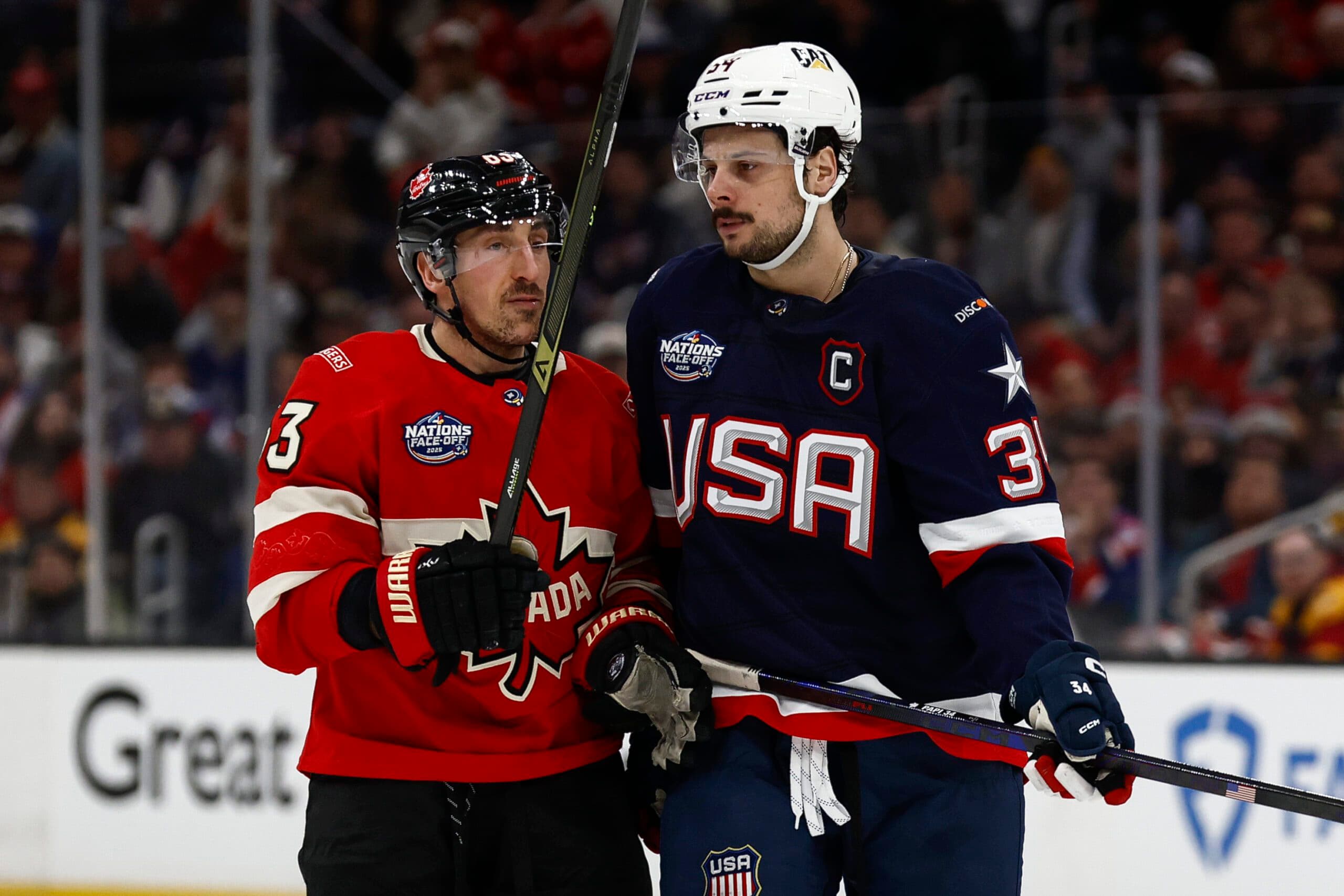
It’s almost time. In 15 days, the puck will drop on the first preliminary game in men’s hockey at the 2026 Milano-Cortina Olympics, arena completion permitting. When Slovakia and Finland lock horns at 10:40 a.m. ET Feb. 11, we’ll witness the first Olympic best-on-best action featuring NHL talent since 2014.
We spent months speculating on which players would make their respective teams. Now it’s time to forecast the lineups drawing from the actual pools of selected players. We’ll do so for the Big Four nations, Canada, Finland, Sweden and USA, who (a) are the only teams that have lineups composed entirely of NHLers, Finland’s Mikko Lehtonen excluded; and (b) gave us a hint of their deployment strategies last year at the 4 Nations Face-Off.
A crucial caveat: the IIHF roster rules differ slightly from those at the 4 Nations. Not only were teams permitted to name 25 skaters for the 2026 Olympics rather than 23 (14 forwards, eight defensemen, three goalies), but they are also allowed to dress 20 skaters for games rather than the NHL’s customary 18. That means teams can dress an extra forward and defenseman, or two forwards, or two defensemen, giving them the ability to deploy specialists for specific duties.
CANADA – By Matt Larkin
(Feb. 5 UPDATE: Factoring in Sam Bennett and Seth Jarvis replacing Anthony Cirelli and Brayden Point, my reconfigured forward lines would look like this: Stone-McDavid-Reinhart, Celebrini-MacKinnon-Crosby, Hagel-Suzuki-Marner, Marchand-Horvat-Wilson, with Jarvis the 13th forward and Bennett the scratch.)
Forward Lines
Mark Stone – Connor McDavid – Brayden Point
Sidney Crosby – Nathan MacKinnon – Sam Reinhart
Brandon Hagel – Macklin Celebrini – Mitch Marner
Brad Marchand – Nick Suzuki – Tom Wilson
Anthony Cirelli
(Scratch: Bo Horvat)
Defense Pairs
Devon Toews – Cale Makar
Josh Morrissey – Drew Doughty
Shea Theodore – Travis Sanheim
Colton Parayko
(Scratch: Thomas Harley)
Goaltenders
Jordan Binnington
Logan Thompson
(Scratch: Darcy Kuemper)
PP1
Nathan MacKinnon – Sidney Crosby – Connor McDavid
Sam Reinhart – Cale Makar
PK1
Brandon Hagel – Anthony Cirelli
Travis Sanheim – Colton Parayko
I know there’s plenty of momentum for playing Crosby and Celebrini together given their chemistry at the 2025 Worlds but, uh, Crosby also has chemistry with his longtime great friend MacKinnon. I’m keeping the top six that ended (and won) the 4 Nations intact. Note that it means Stone plays on the first line; I’m confused whenever I see projections with him scratched altogether. He’s an elite two-way player having a monster year with the Vegas Golden Knights, and he and Brayden Point proved to be McDavid’s optimal linemates at the 4 Nations. Everything changes, of course, if Point’s lower-body injury forces him to miss the tournament. No decision has been made on his status yet.
The bottom six feels pretty interchangeable, but I like the combination of play driving and two-way effectiveness we could get from a Hagel-Celebrini-Marner line, while Marchand and Wilson can cause chaos from the fourth line.
Note that I’ve dressed Cirelli as the 13th forward over Horvat; Canada head coach Jon Cooper reportedly fought for his guy, one of his Tampa Bay Lightning stalwarts, and if you’re bringing Cirelli at all, it’s to use him on your top penalty-kill unit.
I’ve grumbled enough about the choices Canada made for its blueline, three of which I believe were incorrect ones. Working with what we have here: Colorado Avalanche mates Toews and Makar clearly remain a duo, while Morrissey and Theodore bring mobility to the second and third pairs, respectively. Parayko we can use for exclusively for PK1 work as the seventh D-man.
Binnington has been terrible this season, but Canada’s brass, including his own St. Louis Blues GM Doug Armstrong, clearly don’t care given they named Binnington to the team at all. That makes me believe they’ll let him start the tournament on the merit he earned as the championship tender at the 4 Nations. But Thompson or Kuemper could easily steal the crease if Binnington wobbles – like Marty Brodeur did to Curtis Joseph in 2002 or Roberto Luongo to Brodeur in 2010.
FINLAND – By Steven Ellis
Forward lines
Artturi Lehkonen – Sebastian Aho – Mikko Rantanen
Mikael Granlund – Roope Hintz – Kaapo Kakko
Eetu Luostarinen – Anton Lundell – Eeli Tolvanen
Teuvo Teräväinen – Oliver Kapanen – Joel Armia
Joel Kiviranta
(Scratch: Erik Haula)
Defense pairs
Miro Heiskanen – Rasmus Ristolainen
Esa Lindell – Niko Mikkola
Olli Määttä – Nikolas Matinpalo
Mikko Lehtonen
(Scratch: Henri Jokiharju)
Goaltenders
Juuse Saros
Kevin Lankinen
Ukko-Pekka Luukkonen
PP1
Sebastian Aho – Roope Hintz – Mikko Rantanen
Miro Heiskanen – Eeli Tolvanen
PK1
Anton Lundell – Eetu Luostarinen
Olli Määttä – Niko Mikkola
The Finns were the weakest team at the 4 Nations Face-Off, and losing Aleksander Barkov before the regular season even began was a huge blow for this team. But the Finns typically get better as tournaments wear on, and they might have a favorable schedule in Italy.
They’ll play the hosts, a Slovak team that lacks the depth we saw in 2010. Their biggest challenge will be against Sweden on Feb. 13, but we know they’ll be ready for it. Defense will be Finland’s weakest link, but it rarely isn’t internationally – and it doesn’t often bite them in the butt.
The Finns will never outskill anyone. Instead, they’ll roll four lines that’ll suffocate you until the very end, and they’re damn good at it. Rantanen is the obvious star up front – with Patrik Laine missing out, Rantanen is the undisputed one-shot shooter on this team. Rantanen has played alongside Lehkonen at many, many levels so they’ll likely meet up again here. Aho is an easy choice as the No. 1 center, but the Finns will definitely miss Barkov’s two-way dominance.
Fortunately, the depth down the middle isn’t too shabby. Hintz is a solid No. 2 center, while Lundell is having a huge season with the Florida Panthers. Oliver Kapanen has also been a consistent Calder Trophy candidate throughout the season, and while he’ll likely start on Finland’s fourth line, he’s capable of playing on the power play and can move up to a bigger role if needed. The right wing depth behind Rantanen leaves a bit to be desired, but both Kakko and Tolvanen have performed well internationally.
Defensively, this is where things fall apart a bit. Heiskanen will make his return after making a good first impression at the 2018 Winter Olympics. Since then, he has become easily one of the best young blueliners in the league, and he’ll be leaned on to play north of 22 minutes a night. Beyond that, though, it’s bleak. They’ve got a mix of size and hockey sense, but nobody who can really push the envelope if Heiskanen gets injured or struggles in any way. Ristolainen and Mikkola will bring the size, while Lehtonen – the lone player without an NHL affiliation – could step up in more of an offensive role if needed.
If the Finns can steal a game or two in net, they’ll be in excellent shape to at least contend for a semifinal spot. Saros is the pre-tournament favorite to be the No. 1, but, honestly, none of the three goalies on this team has been good. Finland might not be a goalie factory anymore, but all they need is one guy to just get hot at the right time and they’ll be fine.
SWEDEN – By Uffe Bodin
Forward lines
Jesper Bratt – Mika Zibanejad – Lucas Raymond
Filip Forsberg – Elias Pettersson – William Nylander
Adrian Kempe – Joel Eriksson Ek – Gabriel Landeskog
Rickard Rakell – Alexander Wennberg – Elias Lindholm
Pontus Holmberg
(Scratch: Marcus Johansson)
Defense pairs
Victor Hedman – Rasmus Dahlin
Gustav Forsling – Erik Karlsson
Oliver Ekman-Larsson – Rasmus Andersson
Philip Broberg
(Scratch: Hampus Lindholm)
Goaltenders
Filip Gustavsson
Jesper Wallstedt
(Scratch: Jacob Markström)
PP1
Adrian Kempe – Mika Zibanejad – William Nylander
Rasmus Dahlin – Lucas Raymond
PK1
Mika Zibanejad – Joel Eriksson Ek
Gustav Forsling – Rasmus Andersson
Injuries — those damn injuries. As we speak, Sweden has several big names on the injury list, and we’ve already been forced to rule out Jonas Brodin and (almost certainly) Leo Carlsson. On top of that, it’s 50-50 whether Gabriel Landeskog will be able to play in Milan.
It’s easy to look at Carlsson as the biggest loss, but when all is said and done, Brodin’s absence is even more troubling. Here’s a defenseman who ranks among the very best defensively in the entire NHL and whose skating is on par with the elite. On top of that, he has the ability to play both the left and right side — something that would have been a major asset on a blueline featuring only two right-shot defensemen.
If we focus on players who actually will be available (knock on wood), it’s at least encouraging to see Mika Zibanejad starting to resemble the player he once was. After a difficult season last year, he has been a bright spot in what has otherwise been a fairly dense darkness for the New York Rangers. That puts him in line for a key role here. Elias Pettersson has taken plenty of criticism for his recent years in Vancouver, and yes, the production isn’t what it used to be — not even close. That said, he’s working extremely hard and trying to impact the game in ways we haven’t really seen from him earlier in his career. That could make him useful as a matchup center. No, it’s probably not ideal given how productive and offensively dangerous he has been, but sometimes you have to adapt to the circumstances.
On the back end, there are question marks surrounding Victor Hedman’s form following a long injury layoff, which he’s expected to return from shortly. Because of that, we’re handing the reins to Rasmus Dahlin as Sweden’s top defenseman. His time has come to shoulder the heavy responsibility and log the biggest minutes. Defensively, Gustav Forsling will also be asked to carry a major load — especially in the wake of Brodin’s injury.
In goal, Filip Gustavsson feels like the primary option right now. Jacob Markström is having a tough season in New Jersey, and while he brings a wealth of routine and experience that Gustavsson and Jesper Wallstedt don’t yet have, it’s only natural, based on current form, to place Markström on the sidelines.
USA – By Anthony Trudeau
Forward lines
Brady Tkachuk – Jack Eichel – Matthew Tkachuk
Kyle Connor – Auston Matthews – Clayton Keller
Jake Guentzel – Tage Thompson – Matthew Boldy
J.T. Miller – Dylan Larkin – Brock Nelson
Jack Hughes
(Scratch: Vincent Trocheck)
Defense pairs
Quinn Hughes – Brock Faber
Zach Werenski – Charlie McAvoy
Jake Sanderson – Jaccob Slavin
Noah Hanifin
(Scratch: Jackson LaCombe)
Goaltenders
Connor Hellebuyck
Jeremy Swayman
(Scratch: Jake Oettinger)
PP1
Matthew Tkachuk – Auston Matthews – Tage Thompson
Quinn Hughes – Jack Eichel
PK1
Dylan Larkin – J.T. Miller
Jake Sanderson – Jaccob Slavin
The Team USA forward group already feels more cohesive than it initially looked on paper. That’s because 6’6″ sniper Tage Thompson is excelling at center for the surging Buffalo Sabres in between scrappy puckhounds and big, two-way wingers. 4 Nations standouts Jake Guentzel and Matt Boldy, respectively, fit those descriptions to a tee. Thompson isn’t the only American sniper running hot; Auston Matthews has looked rejuvenated over the past few weeks, and streaking Utah Mammoth captain Clayton Keller is a natural choice to play the Mitch Marner role on his wing. Sullivan’s favorite line, the power-speed combo of Tkachuk-Eichel-Tkachuk, rounds out the top nine.
On the blueline, the shutdown chemistry Jaccob Slavin and Brock Faber showed off last February is unlikely to carry over now that Faber partners Quinn Hughes, arguably America’s biggest difference maker, at the NHL level with the Minnesota Wild. With Seth Jones’s ill-timed injury limiting Team USA to just two righties, Slavin, who has struggled through injuries of his own all season, will likely patrol his off right side as he has at times with the Carolina Hurricanes; dynamic Columbus Blue Jackets rover Zach Werenski was also comfortable in that role at the 4 Nations. Some combination of Slavin, the Ottawa Senators’ Jake Sanderson, quietly enjoying the best season of any American blueliner, and Boston Bruins banger Charlie McAvoy will likely draw the toughest D-zone starts.
Special teams shouldn’t be too difficult for Sullivan to sort out. His simplest solution to the power play could be to rely on the elite playmaking skills of Quinn Hughes, Matt Tkachuk, and Jack Eichel to tee up Matthews’s low-slot wrister or Thompson’s howitzer from the left circle.
_____
POST SPONSORED BY bet365