Projecting the 2026 Hall of Fame Class: Bergeron, Price, Räty and endless possibilities

Editor’s note: The original version of this story ran in November 2025. This is an updated version.
The Hockey Hall of Fame is set to announce its newest members on Monday at 3:00 PM ET.
Whose portraits and biographies will be immortalized in hockey’s grand cathedral? The Class of 2026 offers a world of possibilities…
Our 2025 preview identified five potential first-ballot candidates, four of whom were inducted. Two of the Hall’s biggest omissions — Alexander Mogilny and Jennifer Botterill — were also honored. In the 2026 cycle, however, with only two strong first-ballot choices, the Selection Committee has the flexibility to select a handful of qualified holdovers.
With secret nominations and confidential voting, speculation is part of the Hall’s history. We’re going to explore the potential new members and project the Class of 2026. Consider this tiered list of candidates.
QUICK REFRESH ON THE PROCESS
- There is a maximum of seven inductees annually: four Male Players; two Female Players; and one Builder or Referee.
- Each of the 18 members of the Selection Committee can privately nominate one Player, Builder, and Referee by April 15; the Committee then has two months to research the nominated individuals.
- The Committee meets on Monday, June 22 to vote via secret ballot of only those nominated in April; an individual needs 75% of the vote (i.e., 14 of 18 ‘Yes’ votes) to become a Hall of Famer.
- Multiple rounds of run-off balloting are done to reach or at least approach the category maximums.
FIRST-BALLOT WORTHY
Patrice Bergeron
In his usual understated way, Bergeron was a hockey pioneer. Sure, there have been other respected shutdown guys. There have been two-way forwards that impacted both ends of the ice. But no one did it as well, as long, or as consistently as Bergeron. Bob Gainey? He won his last Selke Trophy at 27 and never topped 47 points. A different player for a different era. Sergei Fedorov? He stopped earning serious Selke votes in his mid-20s. Bergeron, meanwhile, was a Selke finalist each of his last twelve seasons, winning the trophy a record six times. He’s the award’s only three-time winner with 400 goals or 1,000 points. Bergeron is one of one, a coach’s dreams come true. The career Boston Bruin should be an easy first-ballot choice.
Noora Räty
Kim St-Pierre (2020) is the only female goaltender in the Hall of Fame. Räty should become the first female European goalie. No other woman has won Best Goalie at the World Championships more than twice. Räty won the award five times. She first earned the honor at age 17, while her fifth arrived just shy of her 30th birthday. Räty’s 10 goalie wins are the most ever at the Olympics, where she led Team Finland to two bronze medals, a notable feat given the Canada/USA stranglehold on the sport.
ONLY A MATTER OF TIME
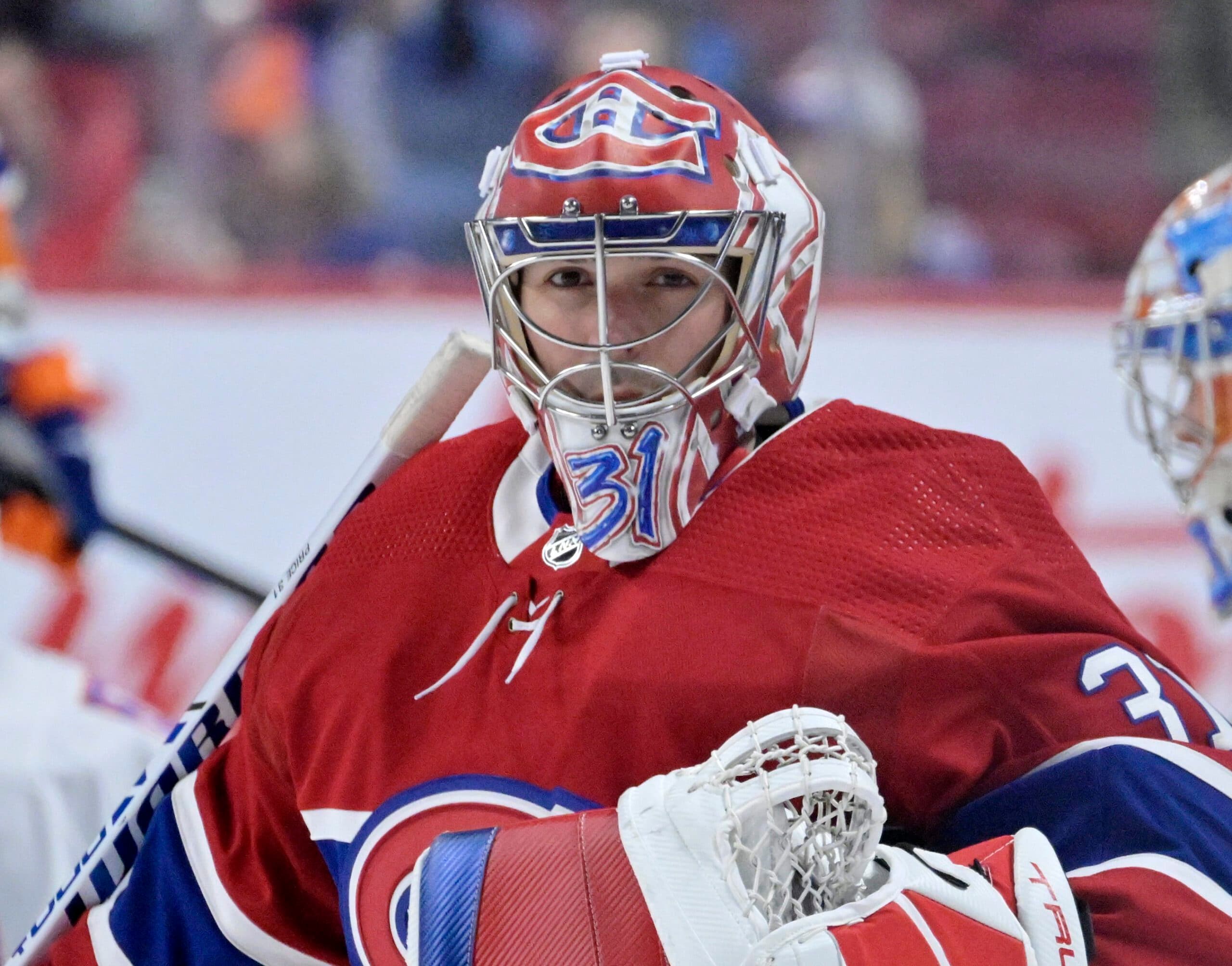
Carey Price
Last year, I left Price out of the first-ballot worthy section. In a stacked class with newcomers Joe Thornton, Zdeno Chara, and Duncan Keith, it was easy to see Price getting lost in the mix. That’s what happened. Statistically, Price’s case is far from perfect — he mixed down years with brilliant ones, was physically out of gas by 32, and Montreal‘s elusive 25th Stanley Cup didn’t materialize. PPS, my Hall of Fame worthiness metric, scores him at 299 versus a standard of 293. Peak Price, however, was iconic. From 2013 to 2017: Hart, Vezina, Lindsay; .928 save percentage; 10-0 record in Olympic/World Cup action. I’d be surprised if Price isn’t inducted in 2026.
OTHER NOTABLE FIRST-TIMERS
Eric Staal
There are lesser players than Staal in the Hall of Fame. In a neutral scoring era, he would have topped 500 goals and approached 1,200 points. The longtime Carolina Hurricane won a Stanley Cup at 21 and was a key part of Canada’s 2010 Olympic gold. But Staal never finished top 15 in Hart voting after his sophomore year. He scored six postseason goals after turning 25. He never got another best-on-best call. PPS has Staal at 214 against a forward standard of 217 — borderline and on the Hall’s edges. That feels right. Contemporaries Henrik Zetterberg (237), Ryan Getzlaf (228), Patrick Marleau (218), and Rick Nash (216) top Staal in PPS and have better or equally compelling cases.
Amanda Kessel
For a time, Kessel was on the short list of best players on the planet. Among those with 40-plus World Championship games, she’s ninth in points-per-game (1.37). The eight above her? Seven Hall of Famers and G.O.A.T. candidate Hilary Knight. Where Kessel’s case goes murky is that between major injuries, boycotting with the players’ union, and last suiting up at 31, her post-college career was short. ‘What-if’ career types — call it the Eric Lindros version — are consistently rewarded in the Male Player category. But with just 14 female players elected, only the most legendary ladies have plaques right now. As the Hall fills its female backlog, Kessel warrants further consideration.
Phil Kessel
Amanda’s brother, Phil, is no slouch, either. The Every Man Iron Man is a fun case. Kessel shrugged convention to exceptional heights. Criticized for his fitness, he played a record 1,064 consecutive games. Pushed out of Boston and Toronto, he went to Pittsburgh and scored 45 playoff points over two Cup-winning runs. Kessel scores 207 in PPS, more Hall of Very Good than Hall of Fame. But even his toughest critic would bump his career up for the iron man feat, Conn Smythe-level playoff work, and Best Forward nod in Sochi. My gut says that such a polarizing player won’t get 14 votes from the Committee. But I think there’s hope that a future Committee of his peers could advocate for Phil.
Rebecca Johnston
While she didn’t have Amanda Kessel’s peak, Johnston was a relentless, enduring fixture for Team Canada for 16 years. The only Canadian forwards to play in more World Championships than her 11 events? Marie-Philip Poulin (13) and Hall of Famers Hayley Wickenheiser (13), Jayna Hefford (12), and Caroline Ouellette (12). Johnston is tied for ninth in Olympic points (26) and ranks 23rd in World Championship points (48). Respected, well-rounded players with big career totals cruise to the Hall on the men’s side. But with so few women inducted to date, the bar remains extremely high.
THE PEOPLE’S PICKS
My social media mentions are a frequent hub for fans and media to name drop popular holdover candidates — these are common mainstream picks.
Rod Brind’Amour
I’ve warmed on Brind’Amour. Not on his playing career in isolation — his PPS is 202 is Hall of Very Good. But it would be a positive, precedent-setting move to elect ‘The Bod’ as a Builder. Would that make him The Body Builder? Bad jokes aside, the Hall separates playing and non-playing careers. But if an overall hockey life is worthy — across playing and coaching/executive careers — let’s call them a Builder and move on. An important note: if Brind’Amour wasn’t nominated back in April, he cannot be considered by the Committee. In other words, his name would have needed to have been put forward before he was a Cup-winning coach.
Shannon Szabados
Technically eligible since 2022, Szabados is arguably the greatest physical talent and best puck stopper in women’s hockey history. She played against men at the junior, college, and professionals levels. In three Olympics, Szabados posted a comical .959 save percentage, twice named Best Goaltender. If Raty enters on the first try, Szabados would be a fantastic choice to join her and Price in a loaded goalie class.
Sergei Gonchar
I’m a longtime backer of Gonchar’s candidacy, outlined here in this 2023 piece. He is a brilliant mind and talent whose excellence is lost from playing in the most offensively suppressed era since expansion. Gonchar’s got the highest PPS (281) among eligible blueliners — above recent first-ballot defenders Zdeno Chara (279), Duncan Keith (258), and Shea Weber (257). It’s time to elect Gonchar. This is a perfect year to make it happen.
Henrik Zetterberg
Zetterberg continues to headline Most Deserving Players on the Outside conversations. Without context, his totals look light: 337 goals, 960 points. But in a neutral era, that’s 1,069 points in 1,111 games — a career 79-point pace as a two-way weapon. A Triple Gold club member and Conn Smythe winner, Zetterberg has a strong case. PPS scores him at 237 in the Qualified tier, the #6 forward among Hall holdovers.
Curtis Joseph
I’ve been pumping Cujo’s tires for a while now. By PPS, he’s the #1 most overlooked goalie, his score of 322 comfortably exceeding the standard by 30. Absent a Vezina (he finished top-five on five occasions) or Stanley Cup (same with Roberto Luongo and Henrik Lundqvist), Joseph’s long and elite career remains lost amidst the legends of his prime (Patrick Roy, Dominik Hasek, Martin Brodeur).
Keith Tkachuk
Playing the ‘if this person is already inducted’ game can lead to poor choices through shaky degrees of separation. But Jeremy Roenick’s 2024 induction, a worthy and celebrated choice, should make Big Walt’s call a formality. Tkachuk led the NHL in goals in 1996-97 and his 538 goals (35th all-time) equate to 584 in a neutral era (27th all-time). By PPS, it’s Tkachuk 257 to Roenick’s 246. Both are qualified.
Meghan Duggan
With Botterill elected, there are many women up for most glaring exclusion. Duggan is a popular choice. Her per-game numbers don’t sizzle but her résumé and impact do. Kazmaier Award. Three NCAA titles. Seven consecutive World Championship gold medals. Captain of 2018 Olympic gold team. Face of Team USA’s near-boycott of the 2017 World Championship seeking fair support for the program. Maybe your pick is Julie Chu? Or Meghan Agosta? Or Karen Bye? Or Jenny Potter? Or Maria Rooth? The female holdover candidates are on another level compared to the male candidates in 2026.
THE HIPSTER’S PICKS
If you know, you know. With proper context, these candidates are worthy. The future ‘Tim Raines’ Hall of Famers that require an open mind to validate.
Patrik Elias
Quietly, Elias was the best offensive player on a Devils‘ core that made three Cup Finals in four years, winning twice. If you’re after sexy totals, Elias isn’t your man. He played at the worst possible time on the worst possible team for scoring. In a neutral era, his stat line is much different: six 30-goal seasons; four 80-point seasons; career highs of 45 goals and 104 points; career totals of 464 goals and 1,144 points. All on a defensive juggernaut that finished top-10 in goals against each of his first 15 seasons. By PPS, he’s comfortably qualified, parked between Jonathan Toews and Roenick.
Peter Bondra
File Bondra in the Wrong Place, Wrong Time folder for snipers. Had the Richard Trophy been created four years earlier, the electric Washington winger would have two in his living room. Bondra scored at a 44-goal pace over a full decade, a long and impressive run of world-class sniping. Perhaps most impressive? Among the 425 members of the 1,000-game club, Bondra ranks fifth in era adjusted goals-per-game (0.49) — wedged between Bobby Hull and Wayne Gretzky!
Tomas Vokoun
Yes, really. Believe it or not, Vokoun’s career body of work is nearly indistinguishable from Price’s.
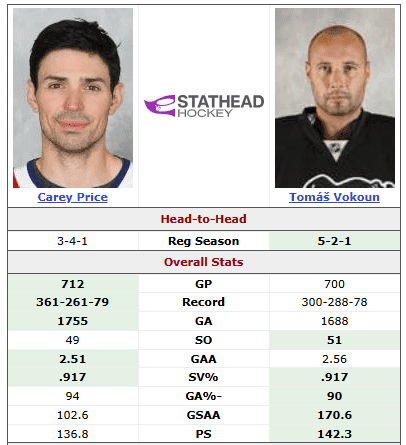
Now that you’re cleaning the coffee off your screen, let’s dig in.
Price has an MVP, a special international career, and a couple of memorable playoff runs. Vokoun got minimal Vezina love, won nine playoff games, and his Czechia teams weren’t heavyweights. But there’s little evidence Price was a better goalie. Hidden in Nashville and Florida, Vokoun’s career earned little fanfare. Yet, he saved 171 goals above NHL average to Price’s 103. That’s 15th-most in NHL history. Vokoun was top-five in NHL save percentage four times (to Price’s two). Vokoun also won two World Championships, going 21-5-1 with a bonkers .942 save percentage over his career.
Vokoun’s not going to the Hall soon. But maybe he deserves a look…
John LeClair
I’ve highlighted Big John’s dominant prime before. It bears repeating: over a six-season window from 1995-2000, LeClair scored at a 48-goal pace in the Dead Puck Era. That same output scaled to Glenn Anderson’s prime? Seasons of 58, 65, 67, 77, 64, and 58 goals — a total of 389 goals in six seasons, or 65 per year. Outside of this period, LeClair’s career was light as he got a late start (four-year NCAA career) and early finish (chronic injuries). But he found time for heroics: two overtime goals in the 1993 Cup Finals and a tournament All-Star team nod in the 1996 World Cup.
PREVIOUSLY OVERLOOKED
Patrick Marleau: No, Marleau was never elite. He did finish fourth and sixth in goals, scoring 44 once. But he only reached 80 points twice despite rarely missing a game. He was good enough to impact two Olympic gold-winning rosters and hung around to score 566 goals in the most games in NHL history (1,779). PPS says he’s right at the standard (+1). I sense few will be excited or disappointed if Marleau slips in one day.
Ryan Getzlaf: Like Price, Getzlaf was lost on a crowded first ballot in 2025. Unlike Marleau, however, the career Anaheim Duck was elite, the runner-up to Sidney Crosby for the Hart and Ross Trophies in 2013-14. His postseason numbers — 120 points in 125 games — and three best-on-best international titles are notable distinctions. At 228 in PPS, Getzlaf isn’t a slam dunk but sits a solid +11 over the standard. He’s a good bet to eventually enter the Hall.
Florence Schelling: Eligible since 2021, Schelling’s case is Hall-worthy. Her emergence on the Swiss national team at 15 years old (!) delivered a 15-year run of relevance to the program. Schelling had a superb NCAA career (.940 save percentage), but her greatest feats were carrying Switzerland to 2012 World Championship bronze (Best Goaltender) and 2014 Sochi bronze (Tournament MVP). Schelling has a goalie-record 44 Olympic outings (.924 save percentage).
Ryan Miller: Miller was famously cooking in 2009-10 — Vezina, fourth in Hart balloting, Olympic MVP. By PPS, he sits right on the borderline and only Joseph, John Vanbiesbrouck, and Price rate above him in eligible goalies. But with Vezina votes just twice in 18 years, Miller may not capture the imagination.
1970s & 1980s Swedish trailblazers: The Hall has never known what to do with early European talent that broke barriers in North America or Soviets from the Summit Series era. With careers weaved across home countries, the WHA, and the NHL, many of the world’s one-time best are the victims of awkward splits or anonyomity. Three Swedes come to mind. Whether current Committee member Anders Hedberg (four 50-goal, 100-point WHA seasons), Kent ‘The Magic Man’ Nilsson (900 points in 711 games in WHA/NHL), or Håkan Loob (Triple Gold Club), there are strong candidates.
(As part of a little-known balloting clause, should fewer players be selected than the max, the Committee votes only on nominated candidates eligible for 15-plus years. It’s why we get the odd throwback choice. In a year light on fresh blood, the conditions are ripe for one of these pioneers to get a surprise call.)
BUILDER CATEGORY
Danièle Sauvageau became the Hall’s first female Builder in 2025. But perhaps the best Builder candidate of any gender remains 75-year-old Fran Rider. A member of the Order of Canada, Rider is widely considered the most impactful person in the evolution of women’s hockey. The Committee has elected women at a snail’s pace historically, so consecutive female builders may be unlikely.
I’m going to suggest three candidates on the men’s side:
- Bryan Murray: while the Stanley Cup escaped him, the late GM and coach built five successful franchises. He delivered credibility to the once-lowly Capitals (1981-90), winning the Jack Adams Award; drafted and developed the pre-dynasty Red Wings (1990-94); brought the newly created Panthers (1994-2000) to the Cup Final; built the foundation of the eventual Cup-winning Ducks (2001-04); and coached the Senators (2005-16) to the Cup Final. A true builder.
- Francois Allaire: likely the most influential goalie coach in hockey history. Allaire’s methods revolutionized the position. Now 70, Allaire was on the staff of three Cup winners — Roy’s Habs (1986, 1993) and J-S Giguere’s Ducks (2007).
- Kerry Fraser: It’s been 12 years since an on-ice official was inducted. To the chagrin of 1990s Leafs’ fans, the famously well-coifed zebra oversaw a record 1,900-plus NHL games and was assigned a dozen Stanley Cup Finals.
PREDICTED CLASS OF 2026
- Patrice Bergeron (1st year)
- Carey Price (2nd year)
- Ryan Getzlaf (2nd year)
- Sergei Gonchar (9th year)
- Noora Räty (1st year)
- Meghan Duggan (6th year)
- Bryan Murray (Builder)
All-time PPS leaderboards: Top 1,500 Forwards; Top 1,000 Defensemen; Top 400 Goaltenders
Data from Hockey-Reference; Quant Hockey; Elite Prospects
Recently by Paul Pidutti
- Who makes the Hockey Hall of Fame All-Snub Team?
- Spoiler alert: Goaltending decides the NHL playoffs
- This ‘Dogg’ won’t stop: Why Nathan MacKinnon is even more dominant than you think
- What can the modern history of No. 1 picks tell us about Toronto’s future?
- Father Time is the destroyer of playoff dreams
_____

Off The Roster is Toronto sports. Hosted by Cabbie Richards, Lindsay Dunn, and Dan Riccio, this is the go-to morning conversation for everything happening in the 6ix – Hockey, Baseball, Basketball and everything in between. From breakout performances and questionable trades to throwback jerseys, viral moments, and the stories fans are actually talking about – it’s smart, sharp, and never scripted. Live weekday mornings on the Nation Network YouTube channel and available wherever you stream podcasts, the show delivers real opinions, real chemistry, and real Toronto energy. Missed an episode? Catch up anytime. Off The Roster—The new sound of the 6ix.