Top 10 Women’s Olympic Hockey Moments

We’re just a few weeks away from the eighth women’s ice hockey tournament at the Winter Olympics. Stars of the game are set to represent their countries in Milan, with the hopes of taking home some hardware.
While there’s plenty of excitement about what is to come in Italy, it’s time to take a look back at some of the biggest moments from the women’s game at the Olympics. While women’s hockey has only been part of the winter program since 1998, there have been several thrilling occasions where legends have been made, and hearts have been broken.
Here are the Top 10 women’s hockey moments at the Winter Games:
Honorable Mention
Nurse’s record-breaking performance
In Canada’s memorable, at times strange run to the gold medal four years ago in Beijing, Sarah Nurse had a coming-out party. While she had been with the senior national team for a couple of years, she wasn’t quite one of the team’s go-to scorers. That changed in 2022, as the Hamilton native scored five goals and 13 assists for 18 points, breaking Hayley Wickenheiser’s 16-year-old record for most points in an Olympic tournament. It catapulted Nurse from great player to superstar.
Nieminen gives Finland a chance
In the inaugural women’s hockey tournament in Nagano, everyone was pointing at Canada and Team USA to be playing in the gold medal game (funny how things never change). Yet, the only team that challenged the North American powers was Finland. The team was powered by Riika Nieminen (now Sallinen). She led the tournament with 12 points, helping the Finns win their first of four Olympic bronze medals.
10. Switzerland’s First Medal
One of the more underrated moments at the Olympics, given how the U.S. and Canada have run the show, came during the rather thrilling 2014 Games in Sochi. In a rather tightly contested tournament from top to bottom, the Swiss finished the group stage with just one point and a goal differential of -15. However, Eisgenossinnen, behind the goaltending of Florence Schelling, defeated Group B winners Russia in the quarterfinals. Though they fell to Canada in the semis, Switzerland rallied from a 2-0 deficit against Sweden to win the bronze medal, marking the country’s lone medal in the event so far.
9. Masks? Bet.
The 2022 Winter Olympics were strange. Another massive COVID-19 outbreak in China overshadowed the event, forcing much of the Games to be viewed from afar. On top of the quiet arenas, there was growing concern around Canada’s group-stage matchup with the Russian Olympic Committee. The game was delayed for over an hour as Canada declined to play, as COVID tests taken by the Russians had yet to be processed. The issue Canada had was that six Russian players had only recently been released from isolation.
The two teams reached a compromise, agreeing to play while wearing N95 masks. Even with the thick protection covering their airways, Canada ran over the ROC, outshooting the Russians 49-12 and running away with a 6-1 victory. At a time when some members of society refused to wear masks for various reasons, some of the best athletes in the world went out and put on a clinic at the highest level of competition.
8. Wickenheiser Lights up Turin
I’ve never been one to hide my love for Hayley Wickenheiser. From her infamous promo after the 2002 Gold Medal Game, she became one of my favorite players to watch. Four years after Salt Lake City, the future Hall of Famer went off on the competition in the last time the Winter Games were in Italy.
The Sasky native is setting a record with 17 points in just five games, including five in a 16-0 beatdown of the host nation. Wickenheiser ended up scoring five goals and adding 12 assists, with two points in the gold-medal game against Sweden (more on that in a minute). It marked the second time she led the Olympics in points, following up her 10-point performance from 2002.
Wickenheiser is still the all-time points leader, male or female, at the Olympics, with 51 points across five Winter Games.
7. Desbiens Stands Tall
Back to Beijing we go. Regardless of the outside circumstances, fans were jacked at the prospect of another championship game between Canada and the U.S., especially given how things played out four years earlier (we’ll get to that). Ann-Renée Desbiens had taken the reins as Canada’s starter coming out of the pandemic, but had yet to prove herself on the Olympic stage.
Any jitters the Quebec might’ve had were brushed off in the preliminary round matchup against the United States. The Canadians were outshot 53-27, but Canada hung on for a 4-2 win. Then, in the gold medal game, Desbiens was able to come up clutch. The U.S. cut a 3-0 deficit to one, but Desbiens made some big saves, 38 in total in the game, giving Canada its fifth Olympic gold. Desbiens led the tournament with a 0.80 goals-against average in five games.
6. That Damn Shootout
The 2018 Games in Pyeongchang were challenging for us North American viewers, staying up late at night or getting up ridiculously early to watch the women’s tournament, which is why many Canadian fans are still ticked off at how the tournament ended. We on the Eastern Seaboard waited until midnight for the gold medal matchup between the usual suspects.
Yet, we were treated to a dandy of a game. The U.S., looking to bounce back after losing to Canada in the group stage, controlled the play, but both Shannon Szabados and Maddie Rooney were sensational. 60 minutes solved nothing, but neither did 20 minutes of overtime. So, for the first time ever, the Women’s Olympic Final would require a shootout.
After six rounds, Jocelyne Lamoureux scored what ended up being the game-winner, giving the Americans their second gold medal. The rather mundane ending to an electrifying tournament led the IIHF to change its OT format for gold medal games, instituting continuous 3-on-3 overtime. It was first introduced at the 2019 Men’s World Championship, one month after…you know.
5. Sweden Stuns the U.S.
Prior to 2006, the U.S. and Canada had met in the final in every major international competition. With the talent the two teams had heading into Turin, it looked like we were going to see a similar tale.
Enter Sweden, which won the bronze medal in Salt Lake City and the 2005 Women’s Worlds. Tre Kronor had a balanced scoring attack and a great netminder in Kim Martin. The team went 2-1 in the opening round, finishing second to Canada in Group A. They were then tasked with facing the U.S. in the semifinals. Despite Team USA taking a 2-0 lead, two goals from Maria Rooth and huge saves by Martin forced extra time. Sweden went on to win in a shootout, becoming the first European nation to advance to a major women’s final.
While they ended up losing to Canada in the gold medal game, Sweden’s upset has gone down in history, as they’re still the only European country to play in a Women’s Olympic Final.
4. Heroes on Home Ice, Captain Clutch is Born
The 2010 Winter Olympics were magical. The beautiful scenery in Vancouver and Whistler made it the perfect spot for the Games. The country’s undying love for hockey made both the men’s and women’s tournaments even more memorable. Days before Sidney Crosby’s Golden Goal, a jam-packed Rogers Arena (called Canada Ice Hockey Place at the time) saw the rise of a future legend in the sport in another thrilling final against the U.S.
Szabados was in her first Olympics, and while she played behind one of the best teams ever assembled, she had to come up with some big saves as the Americans had six power plays in the contest. Only two goals were scored in the game, both coming off the stick of someone named Marie-Philip Poulin. Just 18 years old at the time, the Olympic rookie scored twice in the first period, which proved enough to power Canada to another gold on home ice.
It was the first of many moments where Poulin rose to the occasion in big moments for her country…stay tuned.
3. Revenge in Enemy Territory
In a story that’s similar to what has unfolded over the past couple of months, Canada was not the favorite to win the gold in the second women’s Olympic tournament in 2002. Along with falling to the Americans in 1998, the Canadians had lost eight straight meetings against the U.S. heading into Salt Lake City.
What transpired was one of the most heated games in the sport’s history.
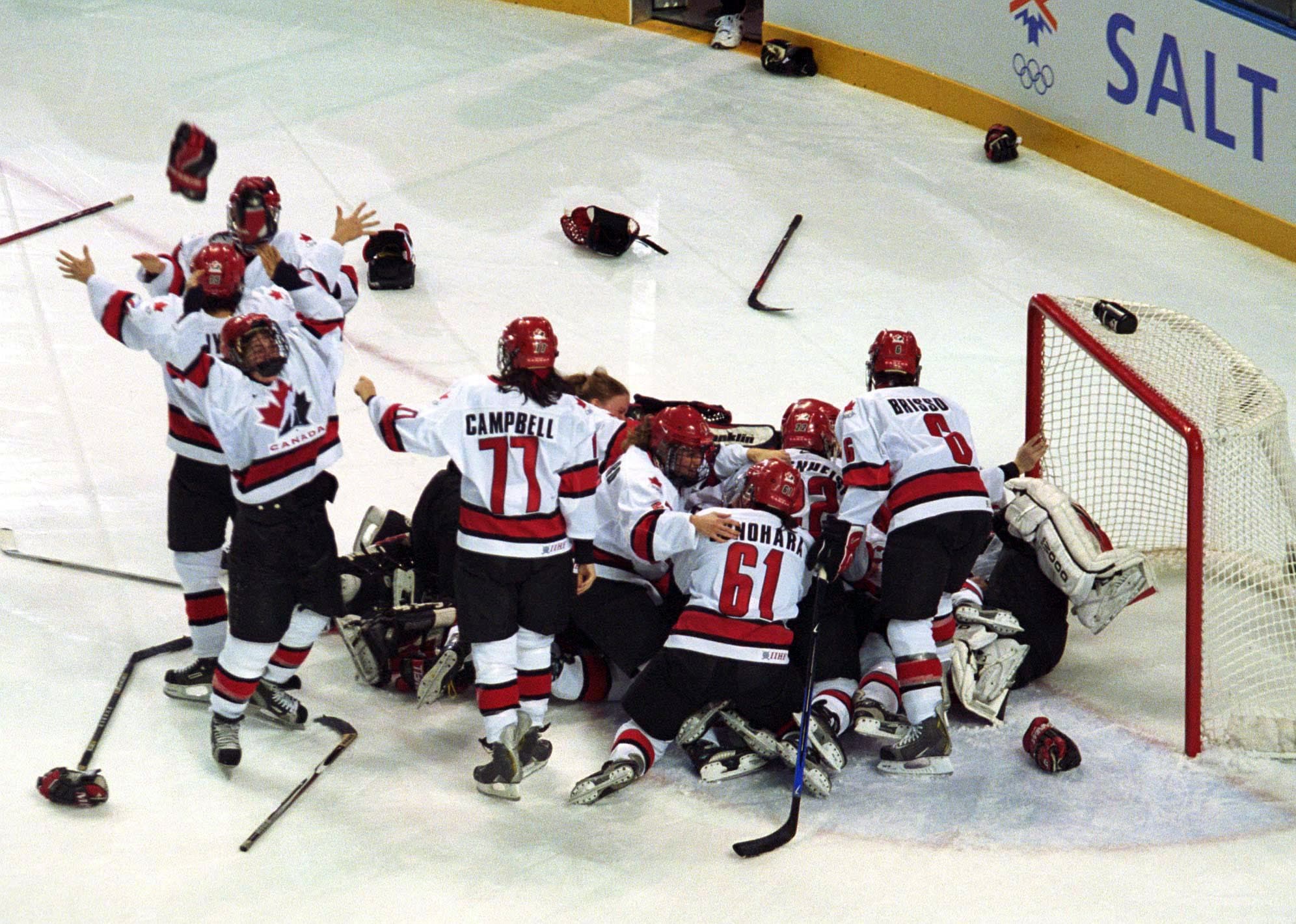
Leading up to the gold medal game, a rumor spread through the Team Canada dressing room that the Americans had a Canadian flag on the floor, and that the U.S. players were walking over it. It ignited a fire under the Canadians, leading to a hard-fought game against the United States, where the officiating was clearly one-sided.
Nevertheless, clutch goals from Caroline Ouellette, Wickenheiser and Jayna Hefford pushed the team to a 3-2 win, clinching the country’s first Olympic gold in women’s hockey. While the flag story was later proven to be a farce, it only further bolstered a rivalry that was, at one point, the fiercest in hockey.
2. Inches from Defeat, Poulin Rises Again
Unquestionably, the most entertaining gold medal game in women’s Olympic history happened in Russia almost 12 years ago. The U.S. had won the WWC the year before, and won the final four games of the National Women’s Team Series against Canada leading up to Sochi. Yet, the Canadians entered the gold medal game as the “home” team after winning their group-stage clash a week earlier.
The Americans built up a 2-0 lead by the early stages of the third period, and carried that cushion for most of the frame, leading many to wonder if it was the U.S.’ time to win gold for the first time in 16 years.
However, Canada started to come back. A flukey tally from Brianne Jenner put her team on the board. It looked like the U.S. was going to ice the game with Kelli Stack shooting the puck toward an empty net, but the puck hit the post, keeping Canada alive.
Enter, Poulin.
No. 29 tied the game with less than a minute to go, giving us the first OT in an Olympic final. On the power play, Poulin sealed the Americans’ fate, giving Canada the 3-2 win.
Poulin had scored just once prior to the gold medal game. Yet, her heroics made her a superstar. She has been Canada’s captain ever since, providing more clutch moments along the way.
1. A Momentous Debut
1998 in Nagano, Japan marked the first time women’s hockey was going to be showcased, giving a global audience to the growing sport that was just eight years removed from its first official world championship. Canada came in as the favorite, having won the first four editions of the Women’s Worlds. However, the Americans were no slouches. Led by Cammi Granato, along with youngsters AJ Mleczko and Sarah Tueting, the U.S. had played well against Canada leading up to the tournament (though no one in their country had any idea).
The first meeting between the two sides in the final game of the preliminary round saw the Americans mount a vigorous comeback, scoring six unanswered goals to come away with a 7-4 win. Three days later, in the final, the U.S. struck first, with Shelly Looney’s tally midway through the third the game-winner, leading the Americans to the first-ever women’s Olympic hockey gold medal.
While many in Canada still view it as a disappointment, the fact that the United States was the team to win it all did wonders for the game south of the border. It ignited a passion for the game that extended beyond the men’s game, with effects still evident today.