Schultz, Cullen highlight top standouts from 2026 U-17 World Challenge

OAKVILLE, Ont. – And that’s that.
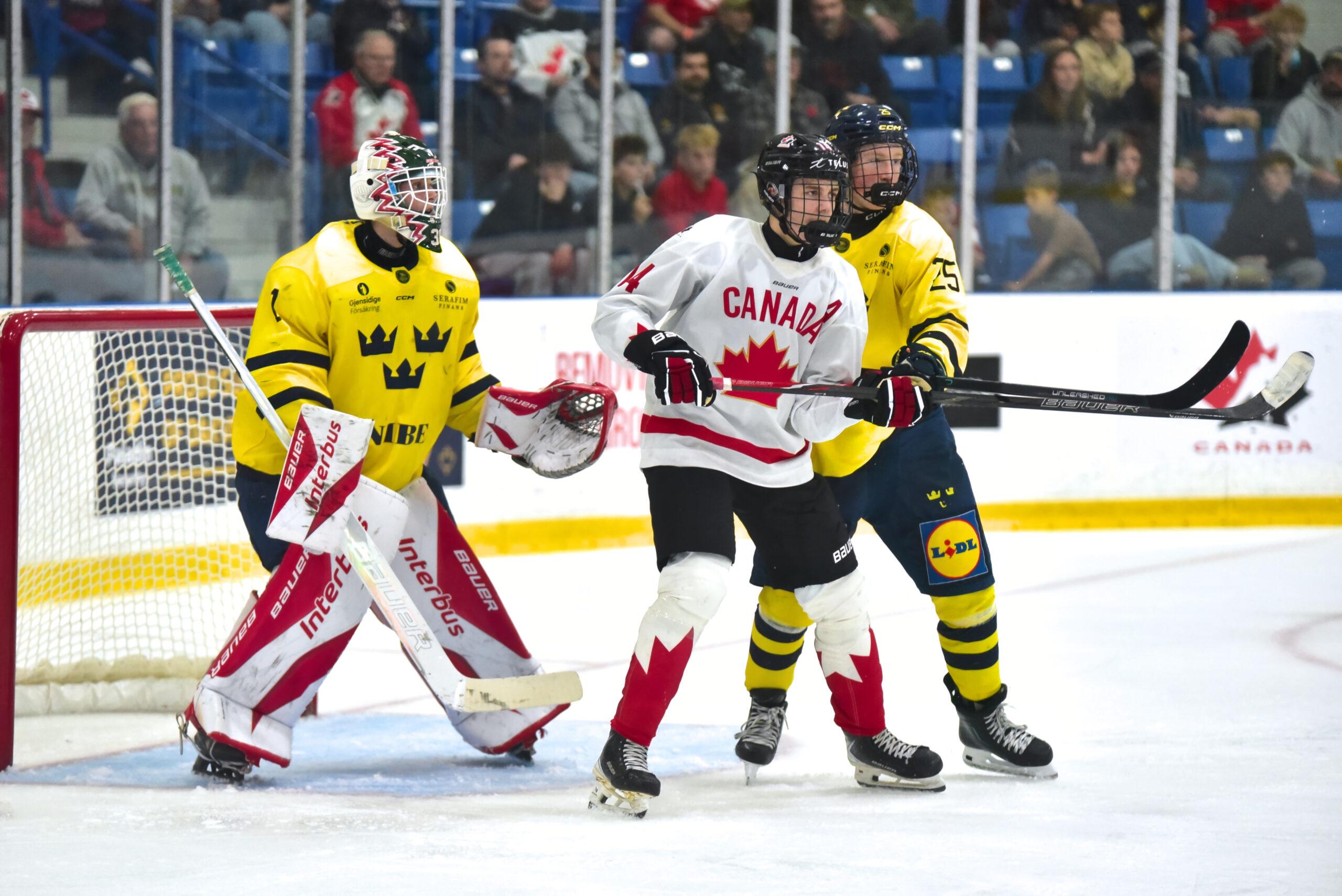
The Under-17 World Hockey Challenge in Oakville was one of the first major international tournaments of the year. It showcased the best 15- and 16-year-olds across the world, including a handful of projected early picks for 2028 and 2029. As expected, top 2028 NHL Draft prospect Maddox Schultz was the best player. But it wasn’t enough to get Canada White the championship they were chasing. Instead, the United States pulled through with a 3-0 shutout win over Czechia, while Canada Red beat their national counterparts in the bronze medal game.
The tournament had its fair share of blowouts, but that’s to be expected with players this young. The bigger focus was actually how much high-end skill was on display. While Schultz received the most hype, Madden Daneault is the one many expect to go first overall in 2029. And that doesn’t include a host of other quality prospects from those two draft years who took center stage.
Today, we’re looking at 10 of the best players from the U-17s in Oakville. We tried to get a fair balance to include every team, but the two squads that finished at the bottom, Finland and Sweden, obviously got a little less love. To help with that, I made the other notables section a bit bigger than usual (Mason Martin, for example, was downright dominant when it mattered for USA):
Kash Kwajah, C (Canada Red, 2028)
From a pure skill perspective, it’s hard not to fall in love with Kwajah’s game. He had four points in a comeback effort against the United States and continued with stellar performances the rest of the way. The Sudbury Wolves star got himself up to speed in the OHL exceptionally quickly, registering 15 points in his first 13 games. You’re not going to find many 16-year-olds with more skill than Kwajah, who can seemingly carve through traffic like its nothing. The hands, the speed, the hockey IQ, all of it – he has all the makings of a legit top-line threat in the NHL one day. Kwajah should have no issue going high in 2028 – scouts love his total package.
Lucas Matheson, LHD (Canada Red, 2028)
Matheson was my favorite defender at this tournament – his creativity and hockey sense were miles ahead of most. I really liked Matheson’s positioning and mobility, and he was one of the few Canadian defenders who could consistently get the puck into scoring position. He has been getting rave reviews for his play in Barrie this year, especially in the final few games prior to the tournament. That carried over to Oakville, where Matheson’s skating and playmaking allowed for some high-end scoring chances. Matheson never seemed to have a bad game – I wish we saw more from him physically, but he seemed to have the puck on his stick more often than not. I think he’s going to be a solid point-producer in the NHL.
Adrian Sgro, LHD (Canada White, 2028)
Sgro was everywhere for the Canadians in this one. The former Vaughn Kings defenseman led all blueliners with 10 points, which was good for second in the tournament. He scored twice on the power play, quarterbacking a Canada White group that struggled to do much of anything with the man advantage when it really mattered. Sgro is a mid-sized defender who commands attention with the puck, and he’s an excellent skater, too. You’re not going to find many more skilled defenders in this age group. It’s only a matter of time until Sgro truly explodes offensively in the OHL, but this tournament was definitely good for his confidence.
Maddox Schultz, C (Canada White, 2028)
Is Schultz the next Celebrini? That’s the name scouts kept parroting all week, and for good reason. Schultz was easily the best two-way forward, and he also led the tournament in scoring with 16 points (good for fourth all-time). Schultz was the one doing all the play-driving for Canada, which led to him rushing up the tournament scoring charts. There wasn’t a single player, regardless of team, who made a bigger impact on a shift-to-shift basis than Schultz. Whether it be the speed, plays around the net or defensive action, Schultz already looks as well-rounded as you’ll find for this age group. Beyond his 5-foot-10 frame, it’s hard to find a true flaw in his game. Schultz was one of Canada’s top players every single night and truly deserving of all the praise he received.
Matyas Čutta, C (Czechia, 2028)
Čutta was so good for the Czechs; night after night, he’s been in the right spot at the right time to bang home rebounds. He’s also creating his own chances, too. Nearly every night Čutta found himself involved with the puck, getting an average of two to three good looks a game. He’s not a high-volume guy, but the quality seems to always be there. Čutta lacks the size teams crave, but he’s got the footwork and offensive instincts that are hard to develop once you get older. He’ll need to get physically stronger to earn high draft pick consideration for 2028, but I’ll definitely be keeping a close eye on Čutta the rest of the year.
Matyáš Michálek, LHD (Czechia, 2028)
Michálek is hard to miss out there. He’s a 6-foot-4 blueliner who skates well and plays all situations. Ice time isn’t made public at an event like this, but it felt like he was averaging between 25-30 minutes a night. The Czechs used Michálek in a variety of different situations, such as the power play and the penalty kill, and he was at his best when he was able to shut down speedy wingers. Michálek already looks so mature for his age, which has resulted in him playing against men on occasion this year. I think he deserves a spot in a depth role with Czechia’s World Junior team this year, and I think he’s going to be a big part of the country’s international future for quite a long time because he does everything you’re looking for in a big, two-way defensemen.
Hannu Packalen, RW (Finland, 2028)
Packalen was the one Finn you could always count on to be engaged in the offensive zone. The Canadian-born winger has a great shot release, and he’s willing to get it off from just about anywhere. He had three points against Canada White before capping off the tournament with a two-point effort against Sweden. Packalen had a pair of games without a point, but it still felt like he was consistently one of Finland’s most dangerous forwards regardless. I think Packalen’s defensive game is also noteworthy; even if he’s not a point-producer in the NHL, he could end up becoming a valuable defensive winger in the future.
Isak Alvudd, LW (Sweden, 2028)
No matter the opponent, Alvudd was a standout for the Swedes last week thanks to a five-point run. He’s an excellent skater who plays an exceptionally smart game. He rarely makes a bad pass, and he has a nice shot release, too. Alvudd can rush the puck up the ice with little difficulty, although he does struggle physically. Alvudd spends a ton of time in the slot and around the faceoff dots, and it feels like opponents struggle to deal with his footwork. Sweden struggled when the games started to matter, but Alvudd deserves credit for consistently bringing the puck into high-danger areas.
Joey Cullen, C (USA, 2028)
Cullen was an absolute beast for the Americans, primarily as a two-way master. He loves to have the puck on his stick, and he’s not afraid to dangle three or four opponents to make the best play possible. He attacks the middle of the ice with pace more so than most teenagers you’ll find. Rather than forcing low-percentage plays, he delays for an extra split-second to let secondary options develop in the slot, showing a level of patience that coaches crave. Cullen has a relentless motor, moving with and without the puck like his father once did. The biggest difference, though, is the raw skill that allows him to win just about every battle, no matter the size of the opponent.
Jack Trupiano, RW (USA, 2028)
Trupiano had one of the best single-game outputs in tournament history, registering three goals and six points in USA’s second game. Trupiano spends so much time in the slot, looking for passes and opportunities to trick defenders. The Michigan State University commit is thinking all offense, all the time. Trupiano is physically strong and isn’t afraid to battle players around the net, which often leads to him picking up rebounds. He’s not the most well-rounded player, but there’s no player I’d rather have in front of the net with the game on the line than Trupiano. I loved how lethal he was at all times in the attacking zone and how nobody can seem to physically contain him. Trupiano absolutely looks like a first-round talent for 2028.
Other notables: Landon Roulston, RW (Canada Red, 2028); Thomas Boisvert, C (Canada Red, 2028); Madden Daneault, RW (Canada White, 2029); Jace Voortman, LW (Canada White, 2028); Dominik Železný, LW (Czechia, 2029); Matyas Novotny, G (Czechia, 2028); Leo Esko, RW (Finland, 2028); Maverick McKinnon, C (USA, 2028); Cameron Evans, LW (USA, 2028); Mason Martin, G (USA, 2028); Drew Daley, LHD (USA, 2028)
PRESENTED BY DAILY FACEOFF GEAR

Daily Faceoff has new merch. Rep the game you love with premium Nation Gear x Levelwear tees, hoodies, hats and layers — designed for hockey fans on game day and every day. The home for hockey fans.
SHOP DAILY FACEOFF → nationgear.ca
Recently by Steven Ellis
- 2027 World Junior Championship: Projecting Canada’s roster
- 2027 World Junior Championship: Projecting USA’s roster
- 2027 NHL Draft: Top five early re-entry prospects
- Meet Maddox Schultz and Liam Pue, the elite 2028 NHL Draft duo everyone’s talking about
- NHL Calder Trophy Update: The competition at the top is insane
- 2027 NHL Draft Rankings: Early season top 40