World Junior Championship: Top 10 players of the 2000s

The 2026 World Juniors will mark the 50th running of the prestigious tournament.
Few events hold as much history and love in the sport. It’s a Christmas tradition, with fans across the globe getting a glimpse at the game’s future. So many of the NHL’s greatest players have participated at one point or another.
For much of the tournament’s history, parity was hard to come by. Canada and Russia (and by extension, the Soviet Union) have combined for 33 gold medals over 49 years. Canada and the United States have combined for the past six tournament championships, but we’ve seen incredible runs from so many different teams over the past decade alone, suggesting the event is in a good spot.
It’s hard to compare performances from the late 1970s to today. Blowouts still occur, but the days of 15-0 games appear long-gone. Today, we’re looking at some of the best player performances from the past quarter-century – the mainstream years. To make this list, the player’s greatness had to span multiple tournaments. If a player had one explosive year, but came up flat in another, we kept them off. The ranking is based on a few factors, such as awards, point totals, and total impact. It’s not a ranking dominated solely on production – you could check out the IIHF record book if that’s what you’re chasing.
So, here’s the best of the best:
10. Dylan Cozens, Canada (2020-21)
Cozens’ World Junior career ended in disappointment, but most players wouldn’t complain about winning a pair of medals. The former Lethbridge Hurricanes star had been one of the most productive 2001-born players internationally at both the U-17 and U-18 levels, so expectations were high when he made the U-20 team in 2020. Cozens helped Canada win gold with a nine-point performance over seven games, helping him live up to the hype after getting selected seventh overall by the Buffalo Sabres a few months prior.
The Workhorse from Whitehorse would return in 2021, wearing the captain’s C. He started the tournament with six points against Germany, and then had at least two points in four straight outings. His only pointless effort came at the worst possible time – a 2-0 shutout loss to the United States in the title match. Still, Cozens finished his 14-game WJC career with 25 points, putting him among the all-time greats. Since then, we’ve seen him put up 24 points in 20 World Championship games. The Ottawa Senators forward likely isn’t on Canada’s roster for the Olympics, but he tends to show up when it matters while wearing his nation’s colors.
9. Trey Augustine, USA (2023-25)
Only nine goaltenders since the start of the 2000s have played in three World Juniors. Very few have been starters the entire time, but Augustine is the most successful of the bunch. USA Hockey had a great run of goalies in the late 2010s – Jake Oettinger, Jeremy Swayman, Joseph Woll and Spencer Knight come to mind. But the 2022 tournament was a bit of a disaster – 2023 needed to be better. Despite being just 17 at the time, Augustine – a Detroit Red Wings draft pick – led the team to a bronze with a 4-1-0 record, albeit with some below-average numbers.
Expectations were understandably high in 2024. The team was loaded with talent at every position after winning silver at the 2022 U-18s and gold the following year. Augustine went a perfect 4-0-0, allowing just seven goals while boasting a .936 save percentage to help USA win gold. Then, with a chance to repeat for the first time in USA Hockey history, Augustine went 4-1-0 to win a second straight gold, ending one of the most remarkable runs ever by a WJC goalie. Augustine only lost two games the entire way while stealing a few along the way. What a run – something that might never get matched by a goaltender any time soon.
8. Axel Sandin-Pellikka, Sweden (2023-25)
Detroit Red Wings fans are currently getting a close look at what the skilled defender is capable of as a 20-year-old NHL rookie. But before that, ASP had one of the best runs ever seen by a defenseman in World Junior history. It all started as a 17-year-old in 2023, where Sandin-Pellikka got a taste of the legendary event with one assist in six games.
The 2024 tourney, though, was a totally different experience. He finished with six points in seven games, while his own-zone play was enough to win the top defenseman award. Sweden won silver that year, with ASP giving it his all every single night. But then something special became possible in 2025: Sandin-Pellikka was eligible to become just the second blueliner to win top defenseman honors in tournament history. The other? A fellow Red Wing, with Vyacheslav Fetisov securing the honor in 1977 and 1978 with the Soviet Union. The then 19-year-old Swede lived up to all expectations, recording 10 points in seven games to win the coveted award for the second straight year. Sweden took home bronze, capping off an extraordinary junior career for the 2023 first-rounder.
7. Brayden Schenn, Canada (2010-11)
It feels like Schenn’s World Junior dominance has almost been lost to time at this point. Could that be because he never ended up winning gold? Absolutely. Schenn was cut from the 2009 World Junior team, but was given a solid role for 2010. Canada eventually came home with a silver, but Schenn made his mark with an impressive eight points in six games.
With those types of numbers, he was destined for a bigger role as a returnee in 2011. Schenn went on one of the best tears from the past quarter century, registering eight goals and 18 points to win the tournament scoring title easily. That was enough to win both top forward and MVP honors, with his four-goal performance against Norway tying a Canadian record for most goals in a single game. Still, it wasn’t enough as Canada ultimately blew a lead to Russia in the title game. The craziest part? He played with a separated shoulder throughout the medal round. These days, the veteran forward remains a solid contributor for the St. Louis Blues, helping the team win the Stanley Cup in 2019.
6. Jiří Kulich, Czechia (2022-24)
Kulich never received the same love as some of the others on this list did, partly because he never ultimately won gold. But with 15 goals and 29 points in 21 games over three years, Kulich
finished his junior career as one of the most productive players in tournament history. Sure, he played more than the average WJCer, but he was so successful despite Czechia’s offense never being that deep – especially compared, again, to others on this list.
Kulich made an excellent impression in 2022, registering eight points in seven games just a few months after his breakout nine-goal, 11-point U-18 World Championship performance. In 2023, he upped the ante with seven goals and nine points, helping the Czechs take home silver and kicking off the team’s current medal streak. Kulich finished his run with six goals and 12 points the next year, which was good enough to lead the tournament in scoring. The Czechs won bronze, but that wouldn’t have happened had the Buffalo Sabres not made the bold move to take him out of the AHL (where he was thriving) to chase another medal. In the end, it was totally worth it.
5. Teuvo Teräväinen, Finland (2013-14)
It wasn’t that long ago that the Finns were one of the streakiest teams in World Junior history. They’d win the tournament one year, and then barely avoid falling into the relegation round the next. But with Teräväinen leading the charge, there was always one constant: hope. He was incredibly productive with Finland’s U-17 and U-18 programs, and by the time he made his WJC debut in 2013, he was already thriving against men in the top pro league in Finland.
Teräväinen made an excellent first impression in 2013, recording 11 points in six games. The Finns fell short of a medal, but with Teräväinen set to return for 2014, hopes were high. And rightfully so: Finland won gold for the third time in history, beating their rivals from Sweden in Swedish ice. Teräväinen led the tournament with 13 assists and 15 points to earn a spot on the all-star team, but ultimately lost the MVP title to Sweden’s Filip Forsberg. Still, with incredibly consistent numbers over two years, Teräväinen became an instant Finnish junior hockey legend. Look for the Chicago Blackhawks forward to make his Olympic debut with Finland in February.
4. Trevor Zegras, USA (2020-21)
Zegras was basically unstoppable during the 2020 tournament, even though he never actually scored a goal. Instead, he was USA’s top setup man, registering nine assists throughout a tournament in which he thrived both at 5-on-5 and on the power play. Those nine helpers were good enough for him to lead all players, and while he didn’t ultimately win it, it helped keep him in the MVP race (something he could have won had the USA not been knocked out in the quarterfinal).
But the COVID-impacted 2021 tournament was where Zegras became a tournament legend. He finished just one goal behind Cozens for the tournament lead, but blew everyone away with 11 assists. Zegras finished with 18 points, which, at the time, was the gold standard for single-tournament production in the 2000s. In all, Zegras finished with 27 points in 12 games, with his 2.25 points-per-game leading the charge among all players over the past 25 tournaments with at least 10 games played. Nowadays, he’s thriving with the Philadelphia Flyers, with the skilled forward set for a new contract this summer.
3. Jordan Eberle, Canada (2009-10)
No player in Canadian WJC team history will ever be as famous as Eberle. He’s the third all-time leading scorer, and helped the team win gold in 2009 and silver in 2010. If you’ve ever watched any Canadian-based coverage of the World Juniors, you’ve seen the dramatic last-minute goal from 2009 hundreds of times. That night, he scored two goals and added another in the shootout winner, but it was his rebound goal with 5.4 seconds left that helped tie the game. The scoring went back and forth all game, but it was Eberle’s last-ditch effort that changed everything. He’d win the game in the shootout before adding another three points in a 5-1 championship victory against Sweden.
By the following year, Eberle was a household name in the tournament’s folklore. He’d match his tournament output from 2009 with 13 points in 2010, but Canada would fall short of the gold. In total, Eberle had 26 points in just 12 World Junior games, showing a rare level of dual-tournament dominance that just hasn’t been matched since. Eberle would later go on to join the Edmonton Oilers, and with the team’s lack of… anything in the early 2010s, he’d become a prominent fixture with Canada’s World Championship team from 2010-15. He’d win gold in 2015, his last appearance with Canada’s national team to date. These days, the 2010 WJC MVP has become a reliable NHLer (when healthy), with the 35-year-old expected to finish with around 50 points with the Seattle Kraken this year.
2. Alex Ovechkin, Russia (2003-05)
Before the Washington Capitals winger was the NHL’s all-time leading goal-scorer, he was putting goalies on notice at the World Juniors. As a double underager, Ovechkin registered six goals and seven points during the 2003 tournament – that, today, is still the most impressive outing by a 16-year-old. The following year, he had another five goals and seven points to help Russia win gold while establishing himself as one of the top young players in the world.
The Great 8 was drafted first overall in 2004 but didn’t make his NHL debut until the following year due to the lockout. That meant Ovechkin had one last chance to dominate at the junior level, and he delivered. Ovechkin finished with seven goals and 11 points en route to a silver medal. That same year, he won the Russian Super League championship (pre-KHL) and represented Russia at both the World Cup of Hockey and the World Championship (where he led all U-20 players with eight points). Ovechkin finished his WJC career with 25 points in 18 games, with a lot of that coming before he was even draft-eligible.
1. Connor Bedard, Canada (2022-23)
With all this talk about the Chicago Blackhawks superstar potentially heading to the Olympics, we can’t forget about his pure dominance at the juniors. It all started during the cancelled tournament in 2022, where Bedard had four points in a single game just before the event was shut down due to COVID-19. Bedard made up for it with another eight points in seven games in 2022, playing a bigger role than he would have had if a few top NHL prospects hadn’t been kept out ahead of training camp.
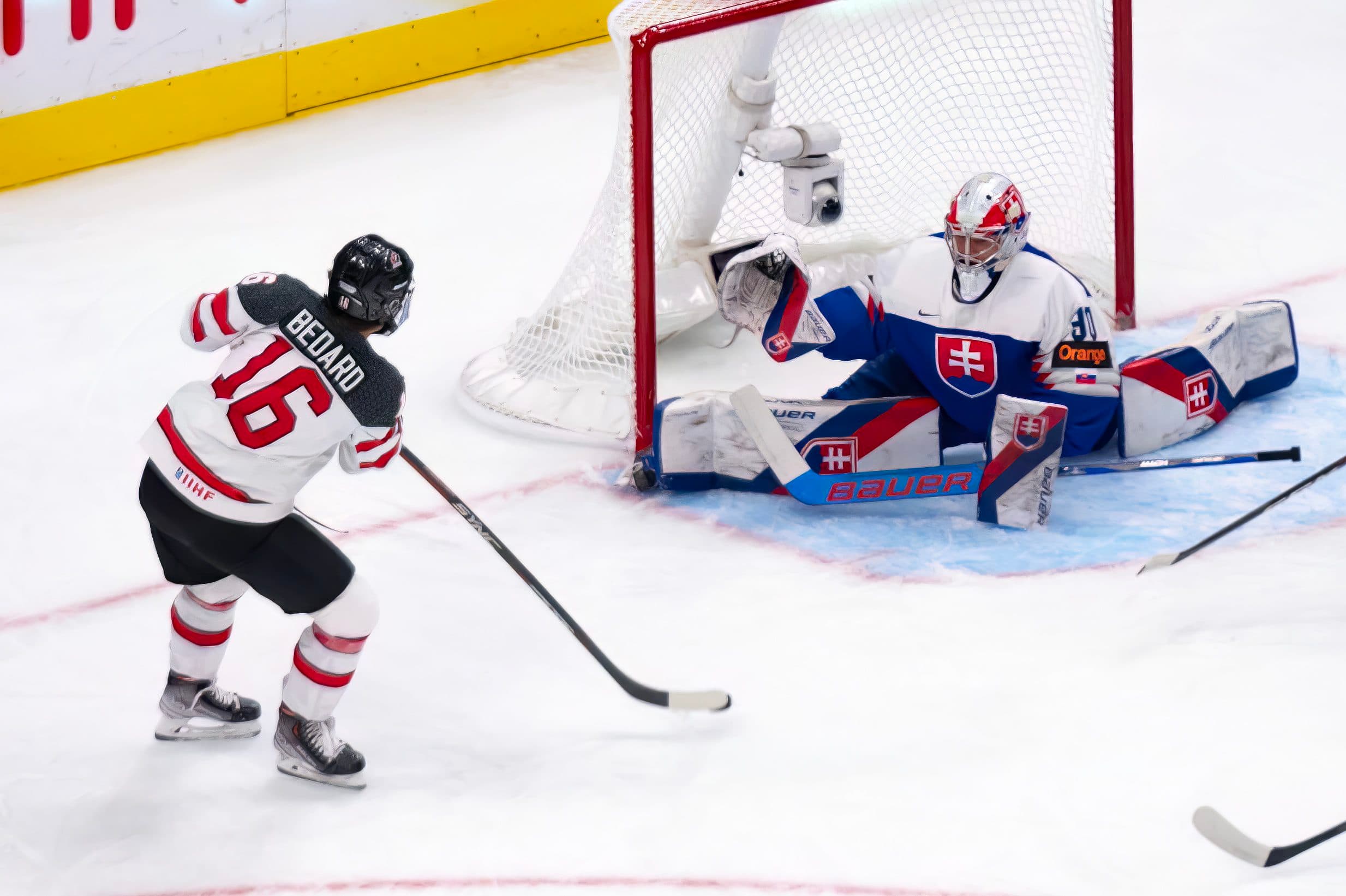
But it was the 2023 tournament that made Bedard into the household superstar he is today. While 20-plus point performances happened a handful of times in the 1980-90s, nobody had ever done it in the 21st Century. That all changed when Bedard registered nine goals and 14 points for a whopping 23 points in seven games, with Bedard registering at least three points in four straight games. Ironically, the only time he didn’t score was against the Czechs in the final, but he still was Canada’s best player by a long shot. Between the overtime winner against the Slovaks, to the 13 points he had over two nights against Germany and Austria, it’s a showing that’ll likely not get topped anytime soon. With 34 career WJC points, Bedard is the only active NHLer with over 30 points, and the only participant to do it since 1995.
Other notables: Andrei Vasilevskiy, Russia (2012-14); Richard Panik, Slovakia (2009-11); Jacob Markstrom, Sweden 2009-10); Alex Nylander, Sweden (2016-18); Jordan Schroeder, USA (2008-10)
SPONSORED BY bet365