2026 Stanley Cup Playoffs: Avalanche vs. Wild series preview

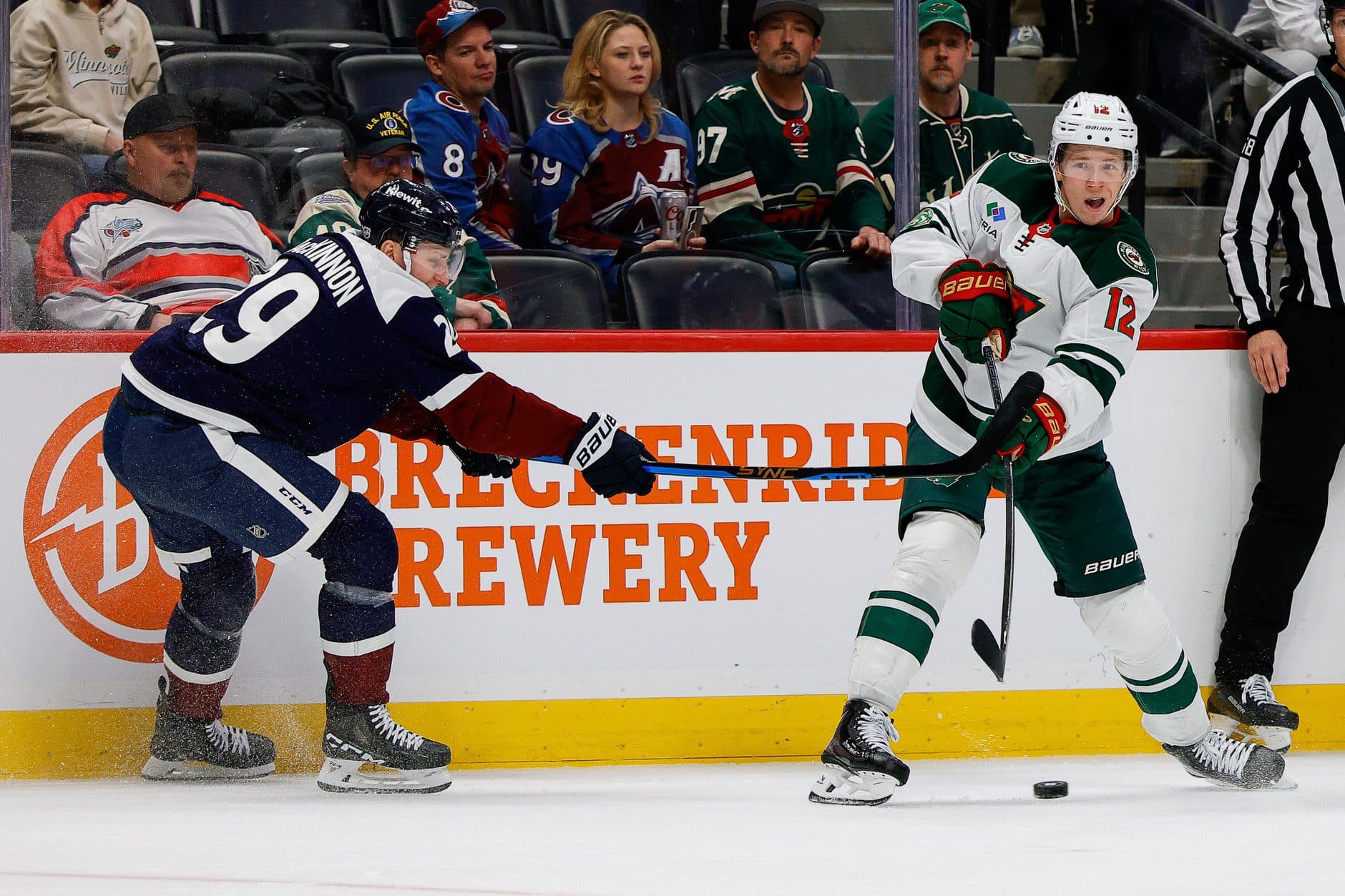
Colorado Avalanche: 1st in Central Division, 121 points, def. LAK in Round 1 (4-0)
Minnesota Wild: 3rd in Central Division, 104 points, def. DAL in Round 1 (4-2)
Schedule
| Game # | Date | Game (*if necessary) | Time (ET) |
| 1 | TBD | Minnesota at Colorado | TBD |
| 2 | TBD | Minnesota at Colorado | TBD |
| 3 | TBD | Colorado at Minnesota | TBD |
| 4 | TBD | Colorado at Minnesota | TBD |
| 5 | TBD | Minnesota at Colorado* | TBD |
| 6 | TBD | Colorado at Minnesota* | TBD |
| 7 | TBD | Minnesota at Colorado* | TBD |
The Skinny
A lot was made about the first-round series between the Dallas Stars and Minnesota Wild, and how the current playoff format failed the two teams by matching them up so early on. But with Minnesota advancing, that continues to be the case in the second round, as a matchup with the Colorado Avalanche should be the Western Conference Final, and to some, the Stanley Cup Final. These two titans of the West squaring off does feel premature, but it won’t take away from the entertaining hockey we’re about to get.
There was almost no doubt that the Avalanche were the best team in the league, at least in the regular season. But the Avalanche have yet to be challenged this season. They were untouchable through the first half of the season, only losing twice in regulation through their first 40 games. Even as they took a step back in the second half with a 24-14-4 record, they were still playing like a top-10 team and could comfortably cruise to a Presidents’ Trophy, especially after beefing up at the Trade Deadline. And while the Los Angeles Kings kept the first three games of the first-round series close, it still didn’t feel like the Avalanche were truly challenged in the sweep.
The Wild were third fiddle in the Central Division trifecta, as they didn’t really join the fold until a Quinn Hughes trade launched them into Cup contender status. Minnesota was a solid 17-9-5 before the trade but went 29-15-7 the rest of the way, which was still not good enough to get home-ice advantage in the first round.
Not only was their first-round series a tough draw against Dallas, but the Wild also had to carry the weight of an 11-year playoff series win drought despite only missing the playoffs twice in that span. Yet a dominant performance at even strength made for an easier matchup than expected, as after trailing 2-1, Minnesota won three straight to take the series.
How will the Avalanche fare against their first difficult test of the season? Will they be well rested? Will the Wild have the momentum after winning a tougher series and ending their playoff series win drought? And better yet, will this matchup end up deciding the West (or the Stanley Cup), or will the two teams tire each other out to the point of becoming cannon fodder for one of the remaining teams?
Head-to-Head
Colorado: 2-1-1
Minnesota: 2-1-1
It’s about as even as you can get with these two teams. Both have two wins, one in regulation and one in the shootout, and the goal differential is just +1 for the Avalanche, as they beat the Wild 5-1 while only losing 5-2. And it’s not like Colorado got a head start before Hughes arrived either, as the only game prior to the trade was a 3-2 shootout win for Minnesota on Nov. 28. As for how the teams looked after the deadline, they only met once there either, with the Avalanche winning 3-2 in the shootout two days after. It’s going to be close.
As for player performance, the stars all showed up in these matchups, as Kirill Kaprizov (three goals, six points) and Matt Boldy (two goals, four points, albeit all in one game) put up numbers for Minnesota, while Nathan MacKinnon (four goals, seven points), Martin Necas (three goals) and Cale Makar (one goal, four points) all played well, although the latter two were held off the scoreboard twice. Only Hughes struggled, getting just two assists in the three games he played. Scott Wedgewood (.945 save percentage) and Mackenzie Blackwood (.937 SV%) split the starts and both got wins, while Jesper Wallstedt (.925 SV%) started three of the four games, and played in relief in the other game for 1:04 after Filip Gustavsson fell ill.
Top Five Scorers
Colorado
Gabriel Landeskog, 4 points
Artturi Lehkonen, 4 points
Nathan MacKinnon, 4 points
Nicolas Roy, 3 points
Devon Toews, 3 points
Minnesota
Matt Boldy, 9 points
Kirill Kaprizov, 9 points
Quinn Hughes, 8 points
Brock Faber, 6 points
Joel Eriksson Ek/Mats Zuccarello, 5 points
Offense
Being the league’s best regular-season team usually means you’ll have better numbers on the year, and that was the case for the Avalanche. They finished first in goals for per game (3.63) and tied for first in 5v5 expected goals for per 60 minutes (3.33), while the Wild were a step behind, tied for 10th in GF/G (3.27) and tied for 11th in 5v5 xGF/60 (2.87). The only advantage the Wild had was on the power play, as they were third (25.2%) while the Avalanche struggled for most of the season in 27th (17.1%). However, the Wild currently have the offensive edge based on results in the playoffs, doing better in overall goals per game (3.83 per game to Colorado’s 3.25) and on the power play (16% to 9.1%). However, the Avalanche are doing much better at creating chances, with a 2.98 5v5 xGF/60 to the Wild’s 2.07.
Both teams are similar in terms of having a three-man unit of elite talent. For the Avalanche, it’s MacKinnon, who had another MVP-caliber season and continues to establish himself as, at worst, the second-best player in the league. Martin Necas was quiet in Round 1 against Los Angeles but has proven to be an adequate replacement for Mikko Rantanen (although for only $500,000 cheaper). And then there’s Cale Makar, who at his best is the top defenseman in the league. Like Necas, Makar was a bit quieter in the first round, but so was a lot of the Avalanche’s offense.
On the Wild’s side, their three-headed monster was much more dominant in the first round. Kaprizov is the top dog, a dynamic offensive threat whose impact on Minnesota is very apparent with how much faster they’ve played since his arrival in 2021. Boldy continues to see his game evolve, as he joined Kaprizov in the 40-goal club for the first time in his career. The two ran rampant against Dallas with nine points each. And yet the biggest impact piece might be Hughes, whose addition added a dynamic on the back end which the Wild have never seen in their franchise’s history and launched them into Cup contention.
Both teams also boast plenty of depth. For the Avs, they have veteran center depth of Brock Nelson and Nazem Kadri, power forwards Valeri Nichushkin, Artturi Lehkonen and the feel-good story that is Gabriel Landeskog, and several wild cards like Parker Kelly, Jack Drury, Ross Colton, Gavin Brindley and Logan O’Connor. Add in the strong playoff start from Roy (two goals and three points), and this is one of the deeper forward groups in the league.
The Avs also boast plenty of puck movers on the back end to support their offense. Makar is the obvious source for that, and hockey fans are more than familiar with Toews, but the rest of their blueline can also distribute the puck at a level which supports the team’s high-flying style. Sam Malinski has been a revelation this year, Nick Blankenburg and Brett Kulak have fit like gloves as midseason additions and even Brent Burns has looked several years younger. Heck, they got two assists in three games out of Josh Manson in the first round. There aren’t any glaring weaknesses here.
The Wild’s forward depth isn’t quite at the same level, but they have plenty of solid options of their own. That starts with two-way center Eriksson Ek and playmaker Zuccarello, who both act as excellent secondary scorers on their respective lines with Boldy and Kaprizov. Marcus Johansson had a resurgent season but had just one goal in the first round. Ryan Hartman is a nuisance on the forecheck and a better center for Kaprizov than many give him credit for. Vladimir Tarasenko is far from his prime self but can still have moments in the bottom six. The Foligno brothers aren’t big offensive options but bring a solid two-way game to the table. Yakov Trenin is as physical as they come with how often he throws around the body.
The Wild’s blueline is a strength of the team, but unlike with Colorado, it’s not for their puck-moving ability. Faber would make for a strong #1 option for their offense if Hughes didn’t join the team, but beyond him, the Wild defense corps is better known for, well, their defense. Jared Spurgeon still has a bit of an offensive touch but is definitely settled down as a defense-first defender at his age, while that was always more of Jonas Brodin’s game. Similarly, I wouldn’t expect much out of the likes of Jake Middleton, Zach Bogosian and Jeff Petry.
Defense
Defense is where the Wild close the gap on the Avalanche a bit more, at least in terms of actual goals. While the Avs were still first in goals against per 60 minutes by a wide margin (2.4), the Wild weren’t far behind in fourth (2.87). Minnesota’s penalty kill was a much bigger struggle in 16th (79.8%), while Colorado was once again first (84.6%), and the same went for expected goals against per 60, as the Avs were tied for fourth with 2.5, while the Wild were more middle of the pack, tied for 12th with 2.66. The same goes for the playoffs: the Avs were better in terms of GA/G (1.25 vs. 2.5) and PK% (81.3% vs. 60%), although the Wild do have the advantage in 5v5 xGA/60 (2.21 vs. 2.46).
If there’s one thing both teams have in common defensively, it’s that shutdown hockey shouldn’t be expected from their top stars. While the Wild’s big guns in Kaprizov (0.002 5v5 regularized adjusted plus-minus expected goals against per 60 this season) and Boldy (0.007) are more in the “not bad but not good” category compared to Colorado’s top guys in MacKinnon (0.112), Necas (0.072) and Makar (0.024), I wouldn’t expect many of them to be deployed as elite shutdown options. The only exception is Hughes, whose defensive play this year (-0.048) along with his offense should warrant some Norris Trophy love. That said, Faber struggles a bit more in his own end (0.011).
The Wild’s biggest advantage in this series is the defensive play of their blueliners. Brodin (-0.258 5v5 RAPM xGA/60) and Spurgeon (-0.181) remain two of the best shutdown defenders in the league, which allows the Hughes and Faber pair to run amuck against slightly weaker competition. MacKinnon and Makar will be tough to shut down, but there are few candidates better to shut them down than Brodin and Spurgeon. Add in the performances of Middleton (-0.091) and Petry (-0.117), and the Avalanche won’t have an easy time generating offense in this series.
Up front, the Wild’s bottom six is actually where they shine the most defensively. The likes of Michael McCarron (-0.123 5v5 RAPM xGA/60), Marcus (-0.119) & Nick Foligno (-0.08), Nico Sturm (-0.088), Danila Yurov (-0.069) and Bobby Brink (-0.045) give the Wild a plethora of options in the bottom six, meaning even if they don’t generate offense, they aren’t going to lose their minutes either. Outside of Marcus Johansson (-0.07), the top six is lacking in those options, as even Eriksson Ek (-0.004) wasn’t the elite shutdown center he usually is this season.
But it’s not like the Avalanche are lacking in defense, either. They do have a couple more defensive holes on their blueline, most notably Burns (0.091 5v5 RAPM xGA/60) and Makar (0.029). But between Malinski (-0.261), Josh Manson (-0.161), Toews (-0.111) and Blankenburg (-0.053), they have plenty of options to cover up those problems.
The same goes for Colorado’s forward group, as aside from the top end of their lineup, they boast plenty of defensively strong forwards. Drury (-0.261), Kelly (-0.195), Joel Kiviranta (-0.126), Nichushkin (-0.12) and Zakhar Bardakov (-0.112) are certainly their best options in that regard, while O’Connor (-0.051), Nelson and Roy (both -0.042) are no slouches, either.
Goaltending
If there’s one thing both teams have in common, it’s their depth in net. For Colorado, Wedgewood (.921 SV%, 20.73 5v5 goals saved above expected in 45 games) and Blackwood (.904 SV%, 13.49 5v5 GSAx in 39 games) faced similar workloads, with the only difference being the 16 games Blackwood missed to injury.
With Wedgewood proving to be the better goaltender of the two this season, he started in the playoffs and didn’t miss a beat with a .950 SV% and a 6.19 5v5 GSAx in the four games. While the Avalanche weren’t in significant trouble without his performance, it played a big role in sweeping the Kings, so the crease is his to start this series against the Wild.
The Wild had stretches where they split Gustavsson (.903 SV%, 13.88 5v5 GSAx in 50 games) and Wallstedt’s (.915 SV%, 7.71 GSAx in 35 games) workloads, but they certainly weren’t afraid to run with the hot hand when one goalie was running with it. Wallstedt had the edge to start the season, and while Gustavsson took over for most of the season, his game fell apart after losing the Sweden starting job at the Olympics (.895 SV%, -2.89 5v5 GSAx), while Wallstedt was much better (.918 SV%, 2.06 5v5 GSAx) in that time.
As a result, Wallstedt was the starter for the first round against Dallas, with his .924 SV% and 7.61 5v5 GSAx being a similar performance to Wedgewood’s. The parallels are quite strong here: both teams saw their backup goalies usurp the starters for the main gig in the playoffs and play well. But at the same time, the now-backups in Blackwood and Gustavsson are just as good and can come in if Wedgewood or Wallstedt struggle.
Injuries
The nice part about the Avalanche’s clean sweep in the first round is how they came out mostly unscathed. Josh Manson is day-to-day with an upper-body injury, one which caused him to miss Game 4 on Sunday. But it will be at least a week by the time Colorado plays again, so it’s possible he’s ready to return to the lineup by then.
As for the Wild, they were lucky to escape the first bloodbath of the Central Division with one injury, but it was a big one in Jonas Brodin. The shutdown defenseman missed Game 6 with a lower-body injury from blocking a shot, but like Manson, Brodin is being evaluated on a day-to-day basis, so he could also be ready to go for the start of the series.
Intangibles
While the Wild didn’t have the longest playoff series win drought in terms of time since their last win, their eight first-round exits were the most of any active drought. With the drought no longer looming over the franchise, will they fold under the pressure of actually taking another step and becoming contenders, or will they thrive with the weight off their shoulders?
Additionally, the Wild are one of five active teams to not make the Stanley Cup Final. They’ve only made the Conference Final once, which was 23 years ago. If this team wants to truly consider themselves a contender, they need to back it up, and there’s no better time than this season. Hughes has one year left on his contract after this, and Minnesota will have less cap space to work with next season when Kaprizov’s mega deal kicks in. The window isn’t closing, but now that they’ve gotten over the hump, there’s no better time than the present.
The Avalanche are faced with different stakes. They aren’t desperate to get their star duo in MacKinnon and Makar a championship because they already have the one. Any additional ones are gravy. But if they want another one, this is as good of a season as any. This was their best regular season in franchise history. All the consistent contenders either didn’t make the playoffs (Florida Panthers), have been eliminated (Dallas Stars, Edmonton Oilers) or are currently being pushed to the ropes (Tampa Bay Lightning, Vegas Golden Knights). Minnesota could very well be the best team Colorado plays in the remaining three rounds, so they may want to take advantage of it.
But the Presidents’ Trophy curse looms large. The Avs at least avoided a first-round upset, but they aren’t in the clear either. Add in their consistency issues in the playoffs, with their Cup win being the only time they’ve advanced past the second round in the MacKinnon era, and there is still a weird amount of pressure surrounding this team. Oh, and Makar’s contract is up after next season. Colorado might want to make the most of their window before he’s making eight figures.
X-Factor
Entering the second round, both teams are dealing with power-play struggles. While the Avalanche’s have lasted all season, the Wild had a dominant power play for most of the year only for it to go quiet in the first round against the Stars, only advancing on the backs of strong 5v5 play. Whichever team can sort out their power play issues could potentially swing the series. As the team who’s a step behind in this series, the power play advantage would be a much bigger help for them, as it would even up, if not give them the edge in this series. But if it’s the Avalanche who get their power play figured out, it might mean a quick series in favor of Colorado.
Series Prediction
The Wild enter this second-round series with arguably the best team in their franchise’s history. It got them their first series win in 11 years, and now they’ll be riding the momentum of the win against one of the toughest opponents in the playoffs. Kaprizov, Boldy and Hughes are so good it can overwhelm opponents, and Wallstedt is playing some of his best hockey of the year. They’re going to be a tough team to beat.
But then I look across the ice, and the Avalanche are just a step ahead. MacKinnon, Makar and Necas might be the better trio in the series. Wedgewood has been playing just as well in the playoffs so far and had a more consistent regular season than Wallstedt. Colorado boasts the better depth.
It’s not impossible to see how the Wild win this series. Four to seven games could be a short enough time for their slight disadvantages to swing the other way and play above Colorado. The Avalanche also haven’t been as battle tested as Minnesota. But the Avs are the better team, so it’s hard to pick against them.
Avalanche in six games.
_____
CHECK OUT OFF THE ROSTER – NEW EPISODES EVERY WEEKDAY

Off The Roster is Toronto sports. Hosted by Cabbie Richards, Lindsay Dunn, and Dan Riccio, this is the go-to morning conversation for everything happening in the 6ix – Hockey, Baseball, Basketball and everything in between. From breakout performances and questionable trades to throwback jerseys, viral moments, and the stories fans are actually talking about – it’s smart, sharp, and never scripted. Live weekday mornings on the Nation Network YouTube channel and available wherever you stream podcasts, the show delivers real opinions, real chemistry, and real Toronto energy. Missed an episode? Catch up anytime. Off The Roster—The new sound of the 6ix.
Recently by Scott Maxwell
- If analytics decided the 2025-26 NHL Awards, who would win?
- The 10 worst Leafs moves of the last 10 years
- Which NHL veterans are most deserving of their first Stanley Cup?
- Breaking down every Round 1 goaltending matchup in the 2026 Stanley Cup Playoffs
- What’s next for Sergei Bobrovsky?
- Which NHL teams look like 2026 Stanley Cup contenders right now?