Fumbling the Leafs’ prime contention window was Brad Treliving’s biggest failure

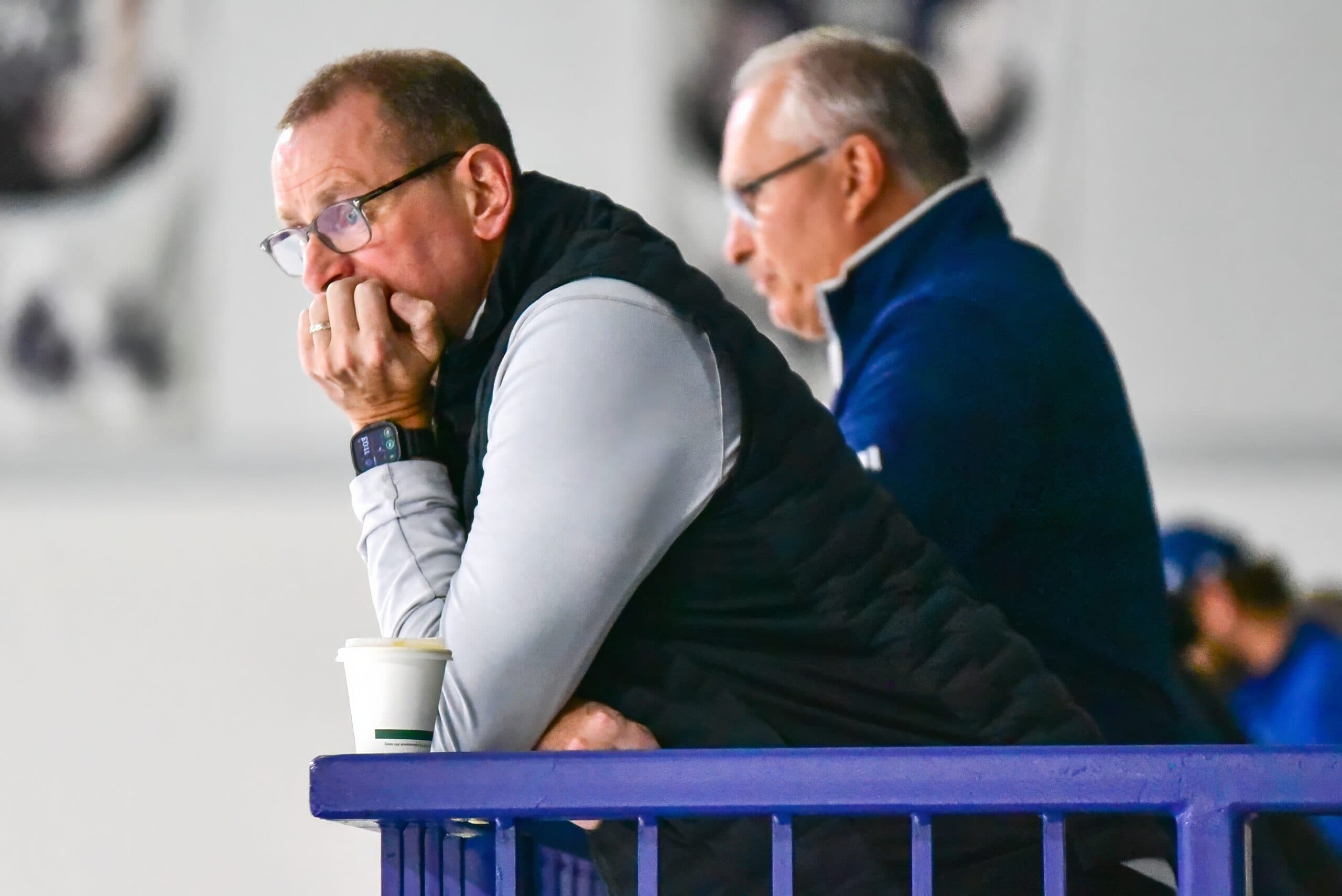
When Kyle Dubas was fired in 2023, the Toronto Maple Leafs had to make one of the most important decisions they would ever make during the current core’s tenure.
While there isn’t a set age for a player’s prime years, plenty of studies have found that players will generally hit their prime between the ages of 22-26 (see The Athletic’s Dom Luszczyszyn when referencing his model; stats site developers Josh and Luke, better known as the Evolving Wild twins, in 2017; or now-Carolina Hurricanes general manager Eric Tulsky back in 2014), and maybe see that prime stagnate through their late 20s, particularly the elite players.
At the time of Dubas’ firing, Auston Matthews was set to turn 26 before the start of the next season, William Nylander and Mitch Marner had just turned 27 and 26, respectively, at the start of the month, and John Tavares would be 33 at the start of the following year. Even Morgan Rielly was 29.
The Leafs’ core wasn’t just in their prime; they were creeping towards the end of it. They really needed to capitalize on these next few seasons to make the most of this core’s window as a Stanley Cup contender.
So, after going with the new-wave mind of Kyle Dubas this time around, the Leafs opted for experience. And fresh off of stepping away from his role as Calgary Flames general manager, there were few options out there better experienced than Brad Treliving. At least, he was the best of the options that were experienced and not clearly incompetent like Marc Bergevin or Peter Chiarelli. Not only had he maintained the Flames to be consistently solid under his tenure, highlighted by two 50-win seasons in 2018-19 and 2021-22, but he also knew how to handle a core on the fringes of dismantlement, something that felt imminent in Toronto after so many playoff failures with the same group.
But now, as we sit here not even three years later, and Treliving has been shown the door, the Leafs are further from Stanley Cup contention than they’ve ever been in the Matthews era, and with the core now three years older, the path to returning to that level is a daunting one.
So what went wrong under Treliving? How were the Leafs’ supposed best years wasted away, leaving little hope for a return to form?
The easiest culprit was Treliving’s failure to make a good trade. While not every trade was a Grade-A disaster, you look back at Treliving’s trade history in Toronto, and you’d be hard-pressed to find a win until just recently.
| Trading Partner | Toronto traded | Toronto received | Win/Loss? |
| Vancouver Canucks | Sam Lafferty | 2024 fifth-round pick | Leafs traded a first and second a month prior to acquire him and McCabe, loss on depreciated asset |
| Anaheim Ducks/Carolina Hurricanes | 2025 third-round pick, 2024 sixth-round pick | Ilya Lyubushkin and Kirill Slepets | Leafs traded a first and second a month prior to acquire him and McCabe, loss on a depreciated asset |
| Washington Capitals | 2024 third-round pick, 2025 fifth-round pick | Joel Edmundson | Leafs gave up two picks for a depth defenseman who was largely unimpactful, loss |
| Carolina Hurricanes | 2026 sixth-round pick | Cade Webber | Leafs took a gamble on a prospect, but Webber has had little impact in AHL, never mind NHL, loss |
| Minnesota Wild | Dmitry Ovchinnikov, 2026 fourth-round pick | Connor Dewar | Trade is largely inconsequential, but Dewar was misused and eventually sold for less, see trade with Penguins |
| Dallas Stars | Max Ellis, 2026 seventh-round pick | Chris Tanev | Trade got them early access to Tanev, who has been effective but also injured frequently, a light win at most |
| San Jose Sharks | Timothy Liljegren | Matt Benning, 2025 third-round pick, 2026 sixth-round pick | Mismanaged Liljegren and sold him at his lowest value with Leafs and got pennies on the dollar, loss |
| Philadelphia Flyers | Nikita Grebenkin, 2027 first-round pick | Scott Laughton, 2025 fourth-round pick, 2027 sixth-round pick | Laughton had good stretches in Toronto, but was misused, and never played to the potential for the price Leafs paid, loss |
| Pittsburgh Penguins | Connor Dewar and Conor Timmins | 2025 fifth-round pick | Asset mismanagement after acquiring Dewar for a fourth, loss |
| Boston Bruins | Fraser Minten, 2026 protected first-round pick, 2025 fourth-round pick | Brandon Carlo | Do I need to explain this one? BIG FAT LOSS |
| Minnesota Wild | Future considerations | Reese Johnson | Inconsequential trade |
| Utah Mammoth | 2027 third-round pick | Matias Maccelli | Trade wasn’t bad, but have since mismanaged him and reportedly won’t be qualified, so loss |
| Vegas Golden Knights | Mitch Marner | Nicolas Roy | Joshua’s contract is pricey enough that the Leafs should have gotten a fourth-round pick in addition, not given one up, loss |
| San Jose Sharks | Ryan Reaves | Henry Thrun | Got rid of Reaves, but Thrun has been mostly inconsequential, no clear winner |
| Vancouver Canucks | 2028 fourth-round pick | Dakota Joshua | Joshua’s contract is pricey enough that the Leafs should have got a fourth-round pick in addition, not given one up, loss |
| Colorado Avalanche | Nicolas Roy | 2027 protected first-round pick, 2026 fifth-round pick | Capitalized on the highly priced market for depth centers and got a great return for Roy, who didn’t work out in Toronto. Rare win. |
| Los Angeles Kings | Scott Laughton | 2026 conditional third-round pick | Somehow got less value for the center with the better market value in Laughton, and had one of the lowest returns of any bottom-six center, not to mention the added weight of how much Toronto paid for him, loss. |
| Seattle Kraken | Bobby McMann | 2027 second-round pick, 2026 fourth-round pick | Market was perceived to be higher for McMann, has since been extremely effective for Seattle, loss so far. |
Treliving’s wins were few and far between. The only clear-cut win is the recent deal sending Roy to the Avalanche for a first-round pick. And there are a couple of other trades that are wins, but with asterisks that lower the win. Treliving also went an eight-month stretch from July 17th, 2025, to March 5th, 2026, without making a trade. That entire time, the Leafs continued to sink in the standings.
But at the same time, aside from the 2024 trade deadline, Treliving’s trades weren’t egregiously bad either. Instead, it was several small losses, ones that slowly built up to one colossal loss. There’s the phrase “death by a thousand paper cuts.” That might be the best way to describe Treliving’s tenure with the Leafs. While he’ll be best remembered for his biggest mistakes like the Carlo trade, it was how he consistently lost moves in the quietest way, which slowly turned Toronto from a consistent Cup contender when he arrived in Toronto a few years ago to the non-playoff team they are right now.
That was particularly evident with the contracts he signed during his tenure with the Leafs. It was already well known that as a general manager he struggled to properly evaluate non-core players and often gave them too long a term and too much money. During his time with the Flames, he gave overpriced contracts to Deryk Engelland (three years x $2,916,667), Mason Raymond (three x $3.15 million), Troy Brouwer (four x $4.5 million), Michael Stone (three x $3.5 million), and James Neal (five x $5.75 million). Along with that, Treliving signed deals that were fine at the time but have aged poorly, such as Sean Monahan (seven x $6.375 million) and Jonathan Huberdeau (eight x $10.5 million).
That continued immediately upon joining Toronto with the signings of David Kampf (four years x $2.4 million) and Reaves (three x $1.35 million). While most of his contracts never reached the level of Engelland, Brouwer or Neal, he still dished out plenty of questionable contracts with too much money or term like Benoit (three x $1.35 million), Max Domi (four x $3.75 million) and the recent extension to Anthony Stolarz (four x $3.75 million). That’s also not including the few times Treliving signed a player without properly evaluating their health, whether that was Reaves’ lingering knee problem, John Klingberg’s hip issues, or Jani Hakanpaa’s degenerative knee problem.
It’s very on-brand for the Leafs’ continuous failures that Dubas and Treliving were on opposite ends of the salary cap spectrum, both in terms of what they had to work with and in their ability to manage it. While one could fault Dubas for how much he paid for an unproven core, the bigger issue was the ensuing COVID-19 pandemic, which created a flat cap 1-2 years after those signings. As a result, Dubas had to navigate a very tight salary cap to build strong teams, and while his limited resources meant the Leafs were lacking depth beyond the Core Four come playoff time, he still assembled competitive teams.
Meanwhile, Treliving joined the Leafs right as they began to have money to spend. In 2023, the Leafs had enough cap space to give almost $20 million worth of contracts to players outside of the Leafs’ five most expensive players. Then, even after signing Matthews and Nylander to a combined $24.75 million AAV, he had $22.6 million to spend in the summer of 2024. And after Marner left, the Leafs had over $30 million to spend on depth, minus what they then spent on Tavares and Matthew Knies. And yet, the Leafs’ depth is as unproductive as it’s always been, despite Treliving spending significantly more money on them than Dubas did.
It was this massive inefficiency in management, both in the trade market and in free agency, along with a clear shift in team build focus to add experience and toughness, which has led the Leafs to where they are now. The slow decline in the team’s skill level, as well as the increase in age (20th at 26.84 average team age in 2023 vs. eighth at 29.04 now) and weight (22nd at 90.47 kg vs. first at 94.78), has made them worse and slower, and that’s clear in the underlying numbers from the final few years with Dubas until this season, via Jeff Veillette.
But as you’ll notice, the Leafs didn’t get significantly worse until Treliving’s second season. Why? For starters, the 2023-24 team was still more Dubas’ roster than Treliving’s, meaning that the bad had yet to outweigh the good. Hs decisions did hold them back a little bit, transforming the team from a top Stanley Cup contender to merely a playoff contender, but they were still a good team.
But the biggest factor in the change from 2023-24 to 2024-25 was the coaching. Sheldon Keefe, while not without his own flaws, brought a fast-paced, possession-focused game to the Leafs, which their players thrived in, particularly their star players. But when Craig Berube entered the fold, his focus was instead on dump-and-chase, conservative hockey, largely sitting back and generating offense off of one-and-done offensive chances and crash-the-net cycling, one which their best players aren’t quite as effective at.
Look no further than Matthews’ play between the two coaches to get a better sense of how they impacted the team. Under Keefe, Matthews averaged 0.74 goals per game, a 60-goal pace in an 82-game season. But under Berube, Matthews has averaged just 0.47 goals per game, good for 38. Additionally, Dom Luszczyszyn pointed out another issue with Matthews under Berube: his system of getting the puck low and grinding the opponent was both incompatible with Matthews’ usual way of generating offense and created less space for him when he shot the puck.
But didn’t Berube also give the Leafs their most successful season last year? They won their lone Atlantic Division title and put themselves within one game of dethroning the Florida Panthers in the second round. Well, it wasn’t quite their most successful season. For starters, the Leafs’ .659 points percentage that year was lower than any of Dubas’ final three seasons in Toronto; the Atlantic was just worse in 2024-25. The Leafs also controlled play at the worst rate of the entire Matthews’ era (until this season), with a 49.39% 5v5 expected goal share, and largely found success thanks to a second-best 5v5 save percentage of 92.68% and a 22-4-4 record in one-goal games.
And then they got to the second round thanks to the easiest first-round matchup of the Matthews’ era against the Ottawa Senators, and leaned on their goaltending and one-goal luck through the first two games against Florida before the Panthers woke up and took over the series.
The flaws in that 2024-25 Leafs’ team were very evident, both in the numbers and in the eye test. While many saw the group “clamping down to find a way to win”, I saw a team constantly getting hemmed in their own zone and struggling to move the puck up the ice. Take away a superstar two-way forward in Mitch Marner, the elite goaltending and the one-goal game success, and suddenly that team was a lot more obvious to other people this season.
Combining Treliving’s inefficient management style with Berube’s overly conservative systems has been a recipe for disaster. And this isn’t me being reactionary, either, as I warned of the Leafs’ fall to mediocrity in the summer of 2024 after the Berube hiring, a piece that has mostly aged well, except for being optimistic on the Leafs and pessimistic about Dubas’ tenure with the Penguins. But as a result, the Leafs are in a horrible spot: too bad to be good, too good to tank for a top-five draft pick (which they need to actually have), and with very few assets to use to improve the team this summer.
But if the Leafs play their cards right, there’s a slight chance they can turn things around quickly.
That would require the Leafs pivoting to another Dubas-esque GM, not necessarily in player style preference, but in contract efficiency, to come in this summer and find all of the hidden gems in a bleak 2026 free agency pool, and maybe find the odd buy-low trade on the market. They would also need to move on from Berube, and find a head coach capable of elevating that team to a more consistent level of play, and the current coaching market (Bruce Cassidy, Peter DeBoer) certainly has those options. It also wouldn’t help if they STOPPED WINNING and fell into the bottom five of the league (or got insane lottery luck to end up there), and walked out of the draft with an elite talent who they could either insert into the lineup for cheap on his entry-level contract, or move for several pieces to fill out the roster.
But that’s a lot of what-ifs that don’t feel overly likely, especially with Rogers taking full ownership of the Leafs and already making decisions similar to those of the days of the Ontario Teachers’ Pension Plan (like cutting important roles to save money). It’s more than likely that, instead of finding a progressive mind to replace Treliving like Sunny Mehta, Toronto will instead opt for another “experienced hockey man” like Doug Armstrong or *shudders* Peter Chiarelli (even though, ironically, Mehta boasts more recent experience with the Panthers’ back-to-back Cup wins), and repeat the same mistakes the Leafs did three years ago when they brought in Treliving.
And as we sit here in the wake of Treliving’s destruction, I can’t help but again reflect on where the Leafs’ core players are in their careers. Matthews will be 29 at the start of next season. Nylander, 30. Tavares, 36. Rielly, 32. Marner is no longer on the team.
It’s plain and simple. Treliving entered his tenure with the Leafs with the core in their primes, and salary cap space to spend at free will to get this team to a Stanley Cup. Three years later, the core’s primes are practically over (save for a few more elite years from Matthews and Nylander), and they are further than ever from a championship, with few assets and just over $23 million in cap space to solve the problem.
Treliving failed as a general manager in Toronto, so it’s no surprise he’s now out the door after less than 3 years.
CHECK OUT OFF THE ROSTER – NEW EPISODES EVERY WEEKDAY
Off The Roster is Toronto sports. Hosted by Cabbie Richards, Lindsay Dunn, and Dan Riccio, this is the go-to morning conversation for everything happening in the 6ix – Hockey, Baseball, Basketball and everything in between. From breakout performances and questionable trades to throwback jerseys, viral moments, and the stories fans are actually talking about – it’s smart, sharp, and never scripted. Live weekday mornings on the Nation Network YouTube channel and available wherever you stream podcasts, the show delivers real opinions, real chemistry, and real Toronto energy. Missed an episode? Catch up anytime. Off The Roster—The new sound of the 6ix.
Recently by Scott Maxwell
- Six NHLers playing underrated defensive hockey in 2025-26
- Five underrated breakout players in the 2025-26 NHL season
- Buyer’s Remorse: Which trades will playoff contenders regret making?
- 10 salary-cap dump trade candidates for contending NHL teams
- What should selling look like for the Toronto Maple Leafs?