Buyer’s Remorse: Which trades will playoff contenders regret making?

The trade deadline has passed, and all 32 teams’ rosters are set for the final stretch of the season.
For the playoff teams, it means they have all the tools needed to contend for the Stanley Cup. Or at least, they have the tools they could afford within the salary cap and their assets.
Not every team is wary about spending the right amount for every player. Sometimes, a general manager wants a particular type of player and will acquire them at any cost. Sometimes, the market isn’t in the GM’s favour, and they cave just to bring that player into the fold.
But sometimes, the mistake is situational. A team can go all-in on a season in hopes of solidifying their chances at a Stanley Cup, and the trade only looks bad due to the chaos of the playoffs. But sometimes, a team gives up Filip Forsberg to get Martin Erat, and everyone knows the trade will age horribly.
Today, we’ll look at which trades made ahead of last week’s deadline could end up being ones the buying team regrets. This could be due to a high acquisition price or to the acquired player not being as good as the team thinks.
I will include one condition to this list to make it void of criticism in four months’ time. If a team on this list proceeds to win the Stanley Cup, then there’s obviously no buyer’s remorse. A first-round pick was an overpayment for Antoine Vermette in 2015, but I doubt the Chicago Blackhawks care after winning the Stanley Cup that season.
Buffalo Sabres
Trade in question: Logan Stanley and Luke Schenn for Jacob Bryson, Isak Rosen, 2027 second-round pick and conditional 2026 fourth-round pick
There are three reasons this trade could haunt the Sabres. The first reason is the acquisition price, which was too high for two depth defensemen. The second reason is necessity. Did Buffalo need to bring in two depth defensemen, especially when the team has gelled as well as they have for the last three months? Perhaps it causes more of a disruption than an improvement.
The third reason is the quality of players they’re bringing in. With Stanley on the ice, the Winnipeg Jets had a 44.01% 5v5 score-adjusted expected goal share. With Schenn was on the ice, it was 40.09%. When neither were on the ice, it was 51.6%. It’s the difference between ranking last in the league and in the top 10. If both defensemen have a similarly negative impact on the Sabres, who knows how it will impact the final stretch of their season?
Colorado Avalanche
Trade in question: Nicolas Roy for a conditional 2027 first-round pick and a conditional 2026 fifth-round pick
In a vacuum, Roy is an excellent addition for the Avalanche. He’s a great depth center with defensive prowess and an underrated playmaking skillset. He’s already made an impact, scoring a goal in his second game with the Avalanche. His $3 million cap hit through next season is great value for a team in need of depth at center.
But for everything Roy brings to the table, a first-round pick is still too high a price to pay. A first is meant for impact players, not complementary players, and Roy falls into the latter category. It also looks bad in hindsight after the Nazem Kadri trade. The Avs’ acquisition of Roy looked as if they had given up on getting Kadri and wanted to get any kind of center, regardless of the price. But when Colorado wound up getting Kadri anyway, it looked like the Roy trade wasn’t even necessary.
Dallas Stars
Trade in question: Tyler Myers for 2027 second-round pick and 2029 fourth-round pick
This is one of the few trades on the list where the acquisition cost isn’t the issue. Myers hasn’t been an effective defenseman for a while, so two draft picks (including a second) is on the pricier side. But there were far worse trades made these past few weeks. Where the buyer’s remorse comes in for the Stars is how they had an opportunity to do much more than they did.
A top-four defenseman has been a consistent need for Dallas for several seasons now. They have yet to find a fit for the role because they keep acquiring the wrong guy. Chris Tanev was perfect two years ago, but otherwise they’ve run Ryan Suter, Ilya Lyubushkin, Cody Ceci and more in that role to underwhelming returns. The Stars had plenty of cap space to work with after Tyler Seguin’s $9.85 million cap hit was placed on season-ending LTIR. So why settle for another slow defenseman who can’t move the puck in Myers? It’s like Dallas went into a car dealership after winning the lottery and decided to buy a tractor.
Edmonton Oilers
Trade in question: Jason Dickinson and Colton Dach for Andrew Mangiapane and conditional 2027 first-round pick
This trade is similar to my complaints with the Roy deal for Colorado. Dickinson is a good player and one of the more underrated defensive players in the league right now. The Oilers have lacked forward depth all season, and Dickinson provides them with a player who can drive a defensively responsible third line. But a first-round pick is a high price to pay, even for a player of Dickinson’s quality.
Now, there is a lot more involved with this trade than with the Roy’s, which makes it slightly more stomachable. 22-year-old Colton Dach was also part of the deal, although he doesn’t bring a notable impact at this stage of his career. More importantly, the first-round pick price is also due to the Blackhawks taking on money in this deal. In addition to retaining half of Dickinson’s $4.25-million cap hit, they also took on Andrew Mangiapane’s $3.6-million cap hit for this and next season. A first-round pick is still an overpayment for Edmonton, but it makes a bit more sense considering the $5 million+ Chicago took on in the trade.
Minnesota Wild
Trade in question: Michael McCarron for 2028 second-round pick
Boy, the market for depth centers sure was out of control, huh? You could cut the Wild some slack and say they were victims. They needed a center in their bottom-six, and they had to pay a high price to get it. Here’s the problem with this assumption, though: the Wild set the market. Prior to this trade, the only depth center moved was Nick Bjugstad to the New Jersey Devils for a fourth-round pick. No one was biting on the high prices for depth centers until Bill Guerin came in and took the bait. As a result, the entire market was thrown out of whack.
If the Wild were jumping the market for a center like Dickinson, Roy or Scott Laughton, their reasoning could be more understandable. But McCarron is not the same calibre of player. To his credit, he’s having the best defensive season of his career by a significant margin (-0.105 5v5 regularized adjusted plus-minus xG against per 60 minutes). But he’s otherwise been quite middling in his own zone. What he largely (no pun intended) brings to the table is his six-foot-six frame. While size is important in the playoffs, big players also need to contribute in other areas of their game. Minnesota will have to hope McCarron can continue his strong defensive play this season, or they will have plenty of egg on their face to clean up.
New York Islanders
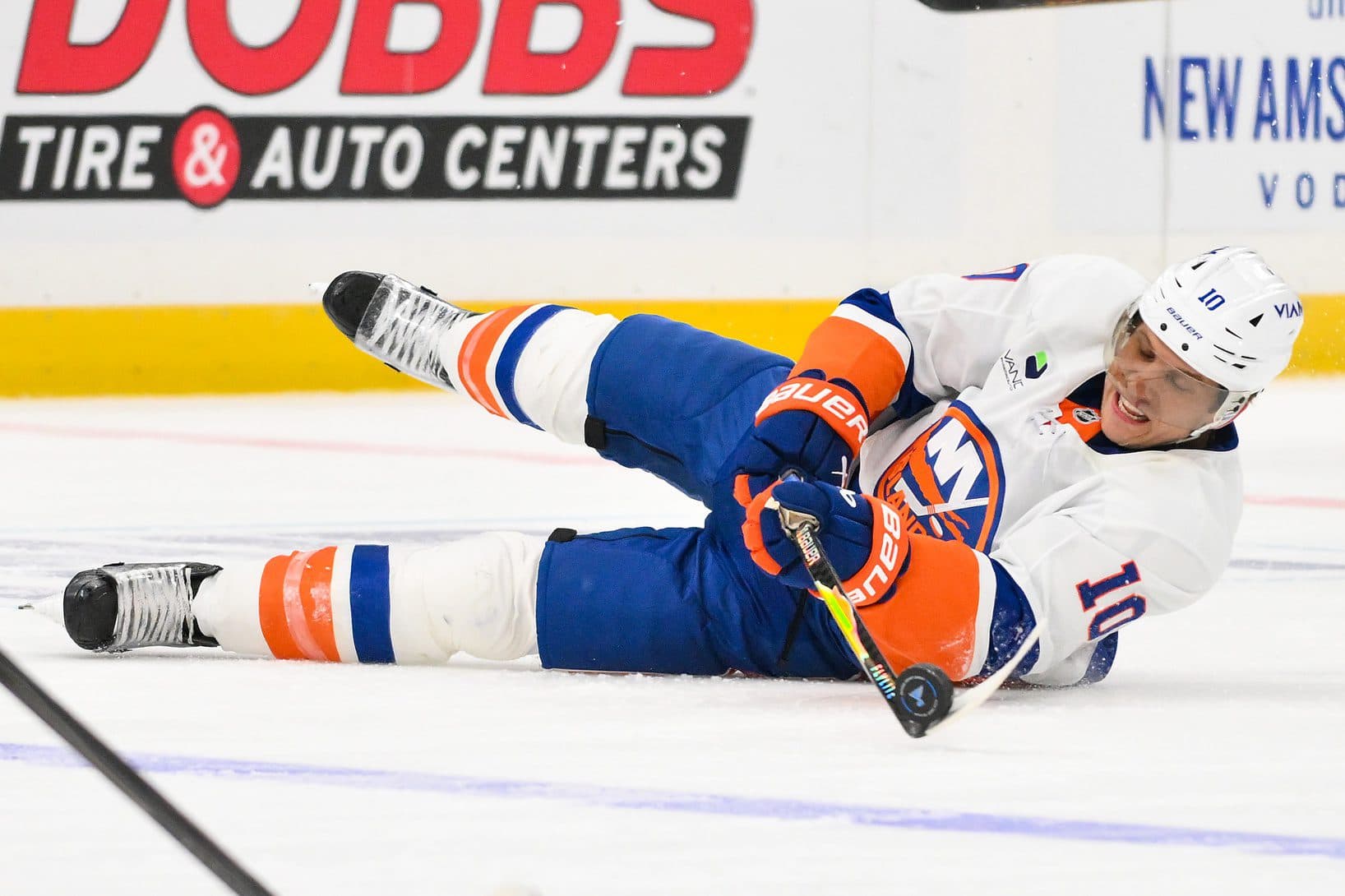
Trade in question: Brayden Schenn for Jonathan Drouin, Marcus Gidlof, 2026 first-round pick, and 2026 third-round pick
I just don’t understand this one. We’re only a year removed from the Islanders committing to a retool. They shipped off key players like Noah Dobson and Brock Nelson and accumulated high-end prospects to build around. But one of those prospects has already become a top player in this league, in Matthew Schaefer. Combined with Ilya Sorokin’s return to form, the Islanders are back in the playoff race well ahead of schedule. They’d been progressive with their approach to the deadline so far, either going for buy-low options like Carson Soucy or taking on bad contracts for draft capital. But they did neither of those when acquiring Schenn.
I don’t know what’s the worst part about this trade: the acquisition cost or Schenn not being a fit for the Islanders. Schenn is 34 years old and producing at a 37-point pace while earning $6.5 million a year for two more seasons after this one. He should be the kind of player teams should be receiving assets to take on, not giving up assets to take on. Instead, the Islanders gave up a solid prospect and a first-round pick to acquire Schenn, while only marginally upgrading on Drouin, who was also shipped out in the deal. Schenn also doesn’t fit the Islanders’ timeline at his age and only provides them with an additional center so they can play Mathew Barzal and Bo Horvat together. If that’s all New York needed him for, there were better and cheaper options on the market than Schenn.
Vegas Golden Knights
Trade in question: Nic Dowd for Jesper Vikman, 2029 second-round pick and 2027 third-round pick
This is the fourth depth center to crack the list, so I don’t think I need to rehash the same points I’ve made three times before. Dowd is an excellent player and very strong defensively, which is something the Golden Knights need right now. William Karlsson’s status for the rest of the season is up in the air, and Vegas was thin down the middle, often relying on Mitch Marner. Even when Karlsson returns next season, Dowd can still fill the fourth-line center role if Colton Sissons walks as a pending UFA.
But we’ve seen how the market turned out. Dowd is a great player, but not the kind of player worth a second- and third-round pick. Maybe just one pick could have been stomachable, but dealing two for a defensive depth forward is a misstep. That said, this is the Golden Knights. Their Stanley Cup contention window may still be open, but the frame holding it is fragile. Their cupboards are already bare, so what’s two more picks gone to keep the window open a little bit longer?
WOWY data via Natural Stat Trick.
RAPM data via Evolving Hockey.
SPONSORED BY bet365
Recently by Scott Maxwell
- 10 salary-cap dump trade candidates for contending NHL teams
- What should selling look like for the Toronto Maple Leafs?
- 2026 NHL Trade Deadline preview: Pacific Division
- 2026 NHL Trade Deadline preview: Metropolitan Division
- 2026 NHL Trade Deadline preview: Central Division
- 2026 NHL Trade Deadline preview: Atlantic Division