2026-27 NHL team preview: Buffalo Sabres

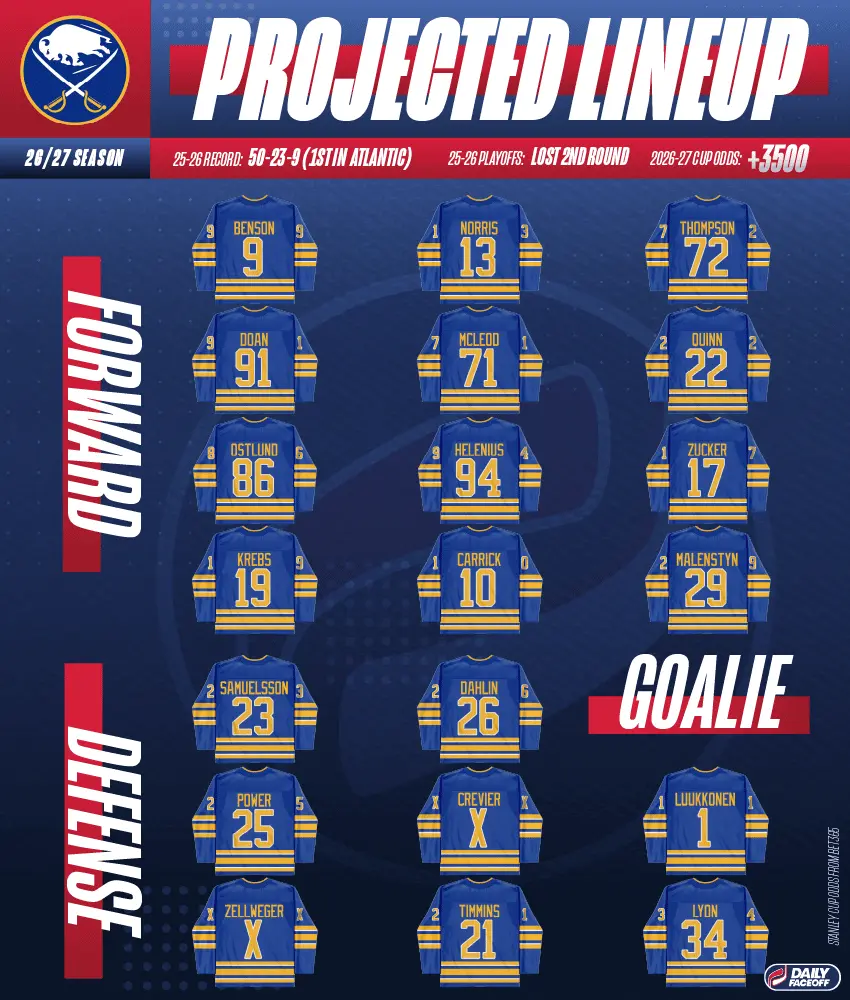
(Players marked with Xs on jersey have not chosen their numbers for 2026-27 yet, according to the team)
LAST SEASON
They finally did it.
After 15 long, painful years, the Buffalo Sabres made the Stanley Cup Playoffs. It almost felt like it would never happen again. The weight of the longest playoff drought in NHL history was reaching the point where it dragged down the team every season, making it feel insurmountable to overcome. But they got the job done, and as a result, we got to enjoy the city of Buffalo in the playoffs for the first time in forever.
That’s not to say the Sabres’ season was without its struggles. Twenty-nine games into the season, they had an 11-14-4 record and were last in the Eastern Conference, already eight points out of a playoff spot. At that point, it was just another year in Buffalo. Clearly, the season was already over and they were going nowhere, right?
But a 10-game winning streak followed Buffalo’s horrible start, and the rest was history. They went 39-9-5 for the rest of the season and climbed all the way up to first place in the Atlantic Division. For the sake of their fanbase, they didn’t make it a close call either, clinching their spot with five games to spare. And then not only did they make the playoffs, they won a round, too! They ousted the Boston Bruins in six games and then even went seven games with the Montreal Canadiens before losing in overtime.
The offseason brought plenty of changes that will benefit the Sabres in the long run. They said goodbye to local boy Alex Tuch, aiming to replace his production internally instead of tying themselves down to a $10.5-million cap hit. They sold high on Bowen Byram, opting not to pay him $12.5 million a season and instead acquiring the fourth-overall pick (for the draft they were hosting, to boot) and buying low on Olen Zellweger to replace Byram’s impact. A few other players also left, but aside from overpaid fourth-liner Jordan Greenway, none was consistently playing with the team, especially during the playoffs.
But did the Sabres do enough to replace key pieces in Tuch and Byram? Will they build on last season’s success and begin a window of playoff – and Stanley Cup – contention? Or will the slog in Buffalo continue with last season ending up a one-hit wonder?
KEY ADDITIONS & DEPARTURES
Additions
Olen Zellweger, D
Louis Crevier, D
Conor Sheary, LW
Dennis Gilbert, D
Departures
Alex Tuch, RW (Wsh)
Bowen Byram, D (Chi)
Jordan Greenway, LW (Chi)
Devon Levi, G (Edm)
Michael Kesselring, D (SJ)
Logan Stanley, D (UFA)
Luke Schenn, D (Van)
Tanner Pearson, LW (UFA)
Zac Jones, D (Uta)
OFFENSE
The Sabres’ offense drove their resurgence last season, ranking fifth in the league with 3.45 goals for per game. But surprisingly, they only had two players hit the 30-goal mark (Tage Thompson, Tuch), and three hit the 60-point mark (Thompson, Rasmus Dahlin, Tuch). Instead, the offense came from their depth: five players hit 20 goals, 13 reached 10 goals, and 10 players recorded at least 40 points. However, some of their production came from unsustainable play, as a fifth-ranked 10.66% 5v5 shooting percentage elevated them from a 2.87 5v5 expected goals for per 60 minutes (tied for 11th in the league). They also saw some struggles on the power play, as they were tied for 19th with a 19.5 percent success rate.
Tuch is with the Washington Capitals, but Thompson and Dahlin are still in Buffalo and are the centerpieces of this offense at forward and defense. Thompson is one of the game’s more unique players as a massive, power forward-type with a lethal shot, and he’s the primary source for goals in Buffalo. Dahlin is coming off a career year, was a Norris Trophy finalist for the first time and will elevate the play of every Sabres player with his puck-moving ability and intelligence. It’s hard to believe he’s still only 26, as it feels like he’s played for 15 years with his poise and IQ.
Surrounding this duo is the secondary core of Zach Benson, Josh Doan, and Owen Power. Benson and Doan are the Sabres’ answers to the Tkachuk brothers, bringing a frustrating level of forechecking and tenacity that few can match. The fact that this comes with points and strong two-way games makes them even more annoying to face. Power hasn’t quite lived up to his first-overall pedigree yet, but he doesn’t need to be “the guy” with Dahlin there. Still, Power is a strong play-driver, giving Buffalo one for multiple pairs.
Again, save for Thompson and Dahlin, none of these names jumps out as a franchise player, but Buffalo makes up for it with their depth options. Whether it’s chance creators like Jiri Kulich and Jason Zucker, pure scorers like Josh Norris and Jack Quinn, or two-way threats like Ryan McLeod, the Sabres have a diverse palette to shape their offensive gameplan. That’s not to mention rookie Konsta Helenius, who looked right at home in his 13-game stint in the NHL last season. Having so many options makes Buffalo all the more difficult to shut down, because even if an opponent is elite at stopping one type of offense, they can create it another way.
On their blueline, they will also have a couple solid offensive drivers on their bottom pair in Zellweger and Conor Timmins. Both have proven to do so in easy minutes, so the real question is whether they can do it in elevated roles should the situation demand it. Mattias Samuelsson had a great 2025-26 season offensively, but shooting 11.9 percent for 13 goals was a major factor there. Otherwise, he’s a great defensive option for the team. New addition Louis Crevier also brings some offense coming off a 25-point campaign, so it will be interesting to see how he produces in this environment compared to a weaker Chicago Blackhawks team.
DEFENSE
Like their offense, the Sabres’ defensive play saw their goals against outperform their expected goals against, but in both cases, the numbers were slightly worse than the offense’s. They allowed 2.93 goals per game, which was tied for 10th in the league, while their 2.79 5v5 xG against per 60 was tied for 16th. They were fourth in the league with an 81.9 percent penalty kill rate, so at least their special teams didn’t hurt them in their own end.
Again, Dahlin is the star of the show in this regard. While the aforementioned puck-moving ability and smarts helps keep the puck out of his own end, his intelligence also allows him to make effective plays in his own end, whether that’s by reading plays for turnovers or positioning himself well to chase the attackers away from better scoring chances. This part of his game has evolved so much in recent years, and it wouldn’t be a surprise if he wins a Norris Trophy at some point in his career.
However, the Sabres’ defensive problems begin when Dahlin is off the ice. When he was playing last season, Buffalo operated at a 53.62% 5v5 xGF%. When he wasn’t, it was 49.04%. That’s because aside from Dahlin, this team is lacking in elite defensive players. Benson (-0.117 5v5 regularized adjusted plus-minus xGA/60 in the past three seasons) and Noah Ostlund (-0.115) are their best options up front, while Samuelsson (-0.043) is their only other strong option on the blueline. However, they do have some solid depth options in Ryan Johnson (-0.044), Dennis Gilbert (-0.026) and Zach Metsa (-0.016).
It’s not that the Sabres have no other solid defensive players; Doan, McLeod (both -0.057 5v5 RAPM xGA/60) and Power (0) are good options in the top end of their lineup, while depth players Justin Danforth (-0.057), Tyson Kozak (-0.07), Beck Malenstyn (-0.037), Sam Carrick (-0.074), and Timmins (-0.01) ensure the Sabres aren’t losing their depth minutes. The issue is they need more strong defensive options to offset the fact that several players in important roles have negative defensive impacts, including Thompson (0.021), Zucker (0.062), Kulich (0.097), and Quinn (0.154) up front, as well as Crevier (0.063) and Zellweger (0.118) on defense. This imbalance tips the scales and allows more chances. Therefore, whether by improving personnel or adjusting systems, the Sabres will need to insulate those weaknesses.
GOALTENDING
The Sabres ran with a three-man tandem last season, and it appears they’re going to do the same again this season, unless they feel bold enough to sneak Colten Ellis through waivers this time around. To be fair, it did work, and they were even one of the rare teams to share the net in the playoffs. Well, it wasn’t a true tandem system. But Ukko-Pekka Luukkonen and Alex Lyon had very short leashes, and they swapped starting roles four times during the team’s 13-game run.
The three-goalie system worked because, up to this point, none of the three has played consistently well enough to seize the starting goalie job. Luukkonen is the one the Sabres were hoping would have by this point, as he has the most upside and is entering his prime, but he hasn’t had consecutive good seasons so far in his career. He was good last year in the regular season (.910 save percentage, 8.18 5v5 goals saved above expected), but slipped in the playoffs (.876 SV%, 1.28 5v5 GSAx). If he can just follow up his regular season performance this year, it would ease many long-term concerns in net for Buffalo.
Lyon will split most of the duties with Luukkonen again this season. The two started 34 games each last season, and Lyon was just as good as Luukkonen in the regular season (.907 SV%, 13.69 5v5 GSAx). But he was a bit more stable in the playoffs (.904 SV%, 1.69 5v5 GSAx), which is why Lyon got eight starts to Luukkonen’s five during their run. However, Lyon turns 34 in December, so he won’t be the long-term solution for Buffalo.
Ellis was also solid in the 16 games he played in the regular season (.903 SV%, 5.5 5v5 GSAx), but the Sabres hope they’ll get him in more games this season to see what his fit is with the team down the road. We haven’t gotten the best picture as to how effective the three-man goalie tandem was for the goalies or how it affected them mentally, but it does feel like it will have to come to an end at some point. So what the Sabres goaltending situation looks like long term will be interesting to watch, especially since they traded Devon Levi to the Edmonton Oilers.
COACHING
I believe I owe Lindy Ruff an apology. While I wasn’t cruel with my words when I talked about the Sabres’ coaching in their season preview last year, I can’t say I had a lot of faith in him getting the most out of this team. In my defense, the hiring did feel like nostalgia more than anything. But I should have remembered that his last coaching stint with the New Jersey Devils went similarly to his second stint with the Sabres so far: right when you doubt him, the team goes on a crazy run and surprises to make the playoffs. He did get fired a year later, so maybe I’m just early in believing he’s on the hot seat, but he did get the most out of this Sabres group.
Ruff and his four assistant coaches all return this season as the Sabres look to take the next step and become a consistent contender. It shouldn’t be a surprise considering the success from last season, but with the looming threat of a step back due to some of the personnel going out the door and the inflated percentages, it’ll be interesting to see how management reacts when that comes around.
ROOKIES
The big name coming into the fold this season for the Sabres is Helenius. He’s considered as their top prospect, and in his brief showing in the NHL last year, he looked right at home. Even defensively, he wasn’t too out of place. With Tuch gone, it opens the door for Helenius to potentially get top-six minutes and an opportunity to thrive. If anyone has the potential to replace Tuch’s impact instantly, it’s Helenius.
Beyond Helenius, there aren’t too many prospects knocking on the door for Buffalo this season. Most of their prospects are still in college or junior systems, or beginning to play at the pro level and not ready for NHL action. 2025 ninth-overall pick Radim Mrtka could get some games this year out of training camp or through injury, but he’d need to impress to get a full-time gig, and the Sabres have the depth on their defense corps to not force him into the NHL when he isn’t ready.
BURNING QUESTIONS
1. How will the Sabres replace Alex Tuch’s production? Moving on from Tuch was undoubtedly the right long-term decision for the Sabres. With a $10.5-million price tag, it didn’t make sense to keep Tuch for that much while trying to build a young team around him. But it doesn’t mean Buffalo won’t feel the short-term impact of losing Tuch’s production and chance creation. So who steps up in his absence to replace him? Helenius looks like the most likely candidate to do so based on his early showing in the NHL last season, but maybe healthy seasons from Kulich and Norris could also do the trick. The Sabres found a way to replace JJ Peterka’s production last season, so they shouldn’t be hard pressed to do the same this year with Tuch.
2. Will Luukkonen finally take the starting reins the season? With Lyon almost at 34 years old and Levi in Edmonton, Buffalo’s long-term starting goalie candidates are down to Luukkonen and maybe Ellis. Luukkonen has the higher ceiling, and he showed some of his potential for the 2025-26 regular season, but his playoff struggles have created more questions than answers for the Sabres. There isn’t a high-upside option in their prospect pipeline to lean on either, so they’ll need Luukkonen to solidify his game and give the team a reliable option in net for the better part of their recently-opened contention window.
3. How will the Sabres build on last season’s success? The Sabres must have felt like Atlas with the pressure of the team’s NHL-record playoff drought on their shoulders for so long. To finally see it come to an end and witness playoff hockey in Buffalo again was a much-needed breath of fresh air. But that doesn’t mean the city still isn’t traumatized and worried the team was a one-hit wonder. Some luck was involved in the Sabres’ run, largely covering up their defensive deficiencies, and they lost some quality players with not nearly as many replacements, so they are due for a step back. But will they regress so much that they miss the playoffs again?
PREDICTION
While I think the 2025-26 Sabres overperformed, I still think this is a very good team. With most of their key players under the age of 30, they’re poised to contend for the playoffs for years to come, especially with the monkey off their back and some playoff experience under their belt. I do think the combination of regression and the losses to their roster will mean they aren’t the frontrunners for the division title again, but they should still contend for a playoff spot. Then again, the Atlantic Division looks quite strong this year, so unless at least two of the five or six other playoff contenders in the division underperform expectations, the Sabres may still be in a tough spot, even if they perform as expected.
SPONSORED BY bet365
Recently by Scott Maxwell
- 2026 updates to the NHL team salary cap rankings
- Five NHL players who could thrive with their new teams in 2026-27
- The five best bargain options available in NHL free agency
- What the Red Wings would look like with better lottery luck
- The top five remaining NHL goalies in free agency
- The five most mediocre NHL teams of the past 10 years
- The 10 most overplayed songs at sporting events