Eight NHL records and trends to watch in 2026


Time flies when you’re having fun.
The NHL’s jampacked, Olympic-year schedule is rolling by quickly. As we embark on the back nine of the league’s 1,312-game gauntlet, we’re starting to see what will make the 2025-26 season special.
Today, we’re looking at unique accomplishments and trends in the second half of the regular season calendar. These won’t be near formalities like Patrick Kane getting four points to pass Mike Modano (1,374) for most by an American-born player. Or Anze Kopitar’s requisite nine points to retire as the Los Angeles Kings‘ all-time leading scorer. The marks highlighted today may all come down to the wire.
What key feats and figures will have our attention in 2026? I think we’re all ready to leave the ‘6-7’ craze in 2025. So, here are eight intriguing records and trends to keep an eye along the NHL’s stretch drive.
#1. Can three generations of superstars break their age records?
In hockey, we tend to separate generations by 10-year increments. Despite significant career crossover, few would put Sidney Crosby (born in 1987) in the same generation as Connor McDavid (born in 1997). Matthew Schaefer (born in 2007) feels like yet another generation removed from McDavid.
No matter the generational divide, we’re witnessing some historic offensive performances right now. There are nine single-season age records in play this season, summarized below.
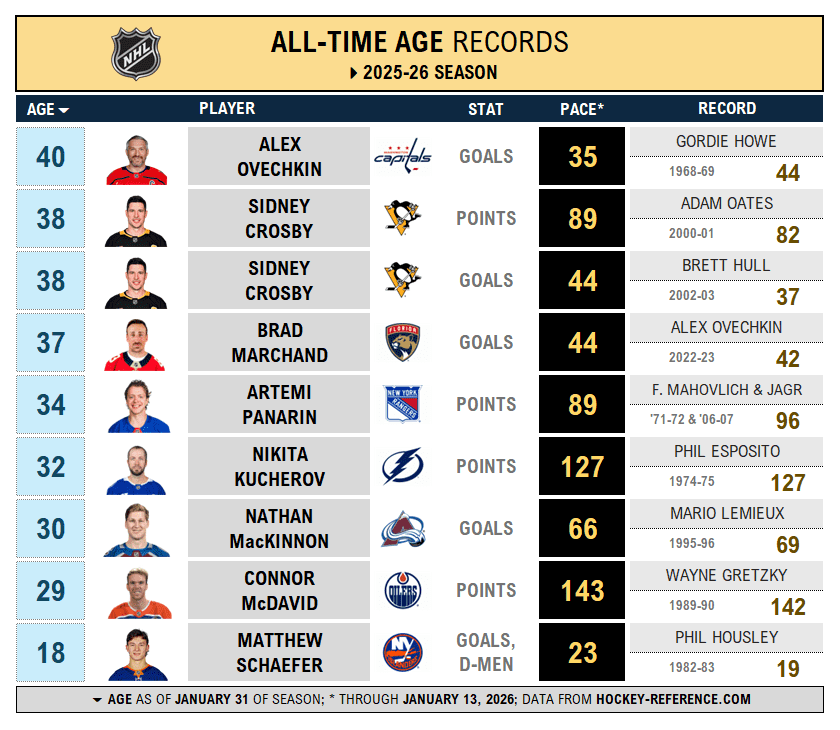
While games missed are inevitable and sizzling first halves can fade fast, many of these records are reachable. The two age-38 records Crosby is pursuing are within his typical output. Schaefer is just six goals short of Phil Housley’s 43-year-old mark. And always question Nikita Kucherov’s and McDavid’s ability to bank points at your own peril. From greenhorns to graybeards, the generational overlap is a thrill right now.
#2. Will the Oilers break their own power-play record?
Team power-play data has been tracked since 1977-78. That same year, the Montreal Canadiens‘ juggernaut ran off a scorching 31.9% success rate. That stood as the record until three seasons ago when the 2022-23 Edmonton Oilers went 89-for-275, establishing a new man-advantage mark of 32.4%. Led by 32 power play goals from Leon Draisaitl (second-most ever) and an absurd 71 power play points from McDavid (fourth-most ever), the Oilers made history.
They may be rewriting their own history this season, however. Through 47 games, the same core power play is firing at 33.8% — that’s 1.4% ahead of their 2022-23 rate. Given the Oilers’ patented slow start is behind them, this one feels within the wheelhouse of this resurrected wrecking crew.
#3. Are 150 points and 70 goals back in play?
While league-wide offense is still neutral at around six goals per NHL game, the scoring environment has blossomed compared to 2007 to 2017. That was the lowest-scoring decade since JFK was elected President. With potent league-wide power plays, 3-on-3 overtime, and unprecedented empty net goals, the last decade has been a fun time to be a superstar scorer.
The improved offensive climate has restored possibilities of 150 points and 70 goals. While there’s a lot of hockey left and playing all 82 games is never assured for high-usage studs, both Nathan MacKinnon and McDavid are at least pacing near potential immortality.
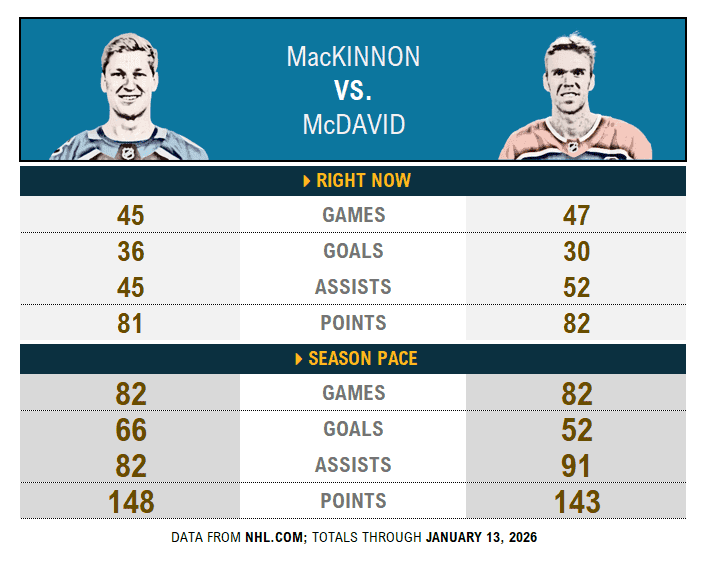
McDavid has been here before — his 153 points in 2022-23 are the salary-cap-era record. But he’ll need the Oilers’ power play to maintain its record pace to hit 150 again as he’s ‘only’ 31st in 5-on-5 points per 60. MacKinnon, meanwhile, is doing it the hard way — the Colorado Avalanche power play is a dreadful 16.9%, or 24th in the NHL.
As for 70 goals, MacKinnon’s shooting 17.3% versus his career average of 10.9%. So, a legit pursuit of Auston Matthews’ cap-era-record 69 goals may be a stretch. Sixty goals, however, remains possible for both Canadian dynamos. It will be intriguing to see the impact, if any, of a condensed schedule and two intense Olympic weeks in Italy. Could we see a clawback in minutes or load management in April?
#4. Will some seriously long playoff droughts finally end?
Let’s hope so. The graphic below — particularly the number of seasons some franchises have gone without winning a playoff round — should come with an NSFW warning.
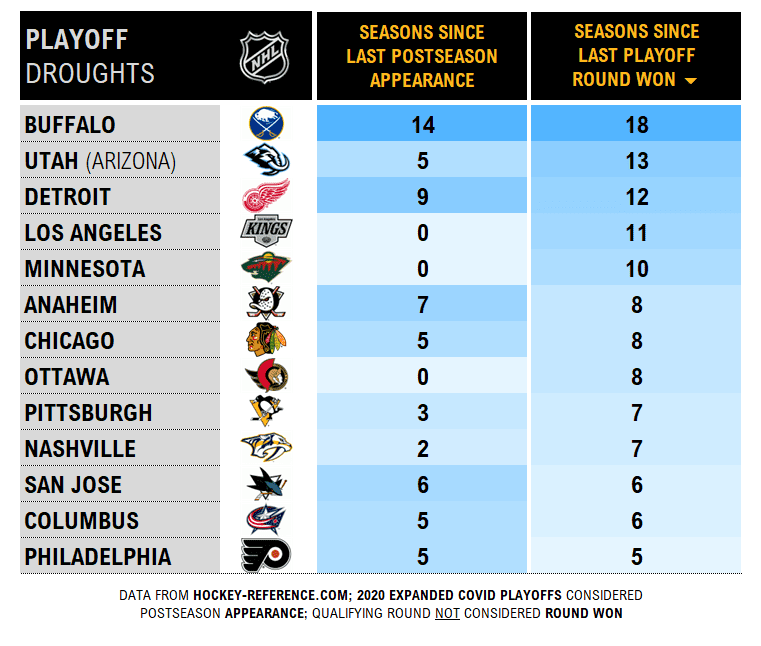
Eight franchises have gone at least five seasons without a playoff game, part of a cycle of teardown rebuilds common today. The good news? Barring a perfect storm, a few of these teams will qualify for the playoffs. One or more of Detroit, Philadelphia, Buffalo, or Columbus should make the Eastern Conference dance. Out West, Utah, San Jose, Anaheim and Chicago have strong odds of a spot collectively.
But it’s the playoff series win droughts that cut deep. Eighteen seasons for Buffalo? That’s so long ago that not a single player on that 2006-07 team is still playing. Twelve seasons for Detroit? Todd Bertuzzi was on that team — he turns 51 next month. Eleven, eight, and seven seasons for the Kings, Blackhawks, and Penguins, respectively? Those Cup years seem like yesterday. As the NHL balance of power slowly shifts, it’s time to exorcise some demons.
#5. Will overtime games and loser points shatter records?
In late November, I wrote about the so-called Season of Parity — the early phenomenon of close games and the inherent ‘loser points’ and tight standings. At the time, a record 28.1% of games were going to overtime. The trend has dialed back to 25.9%, still a cap-era record.
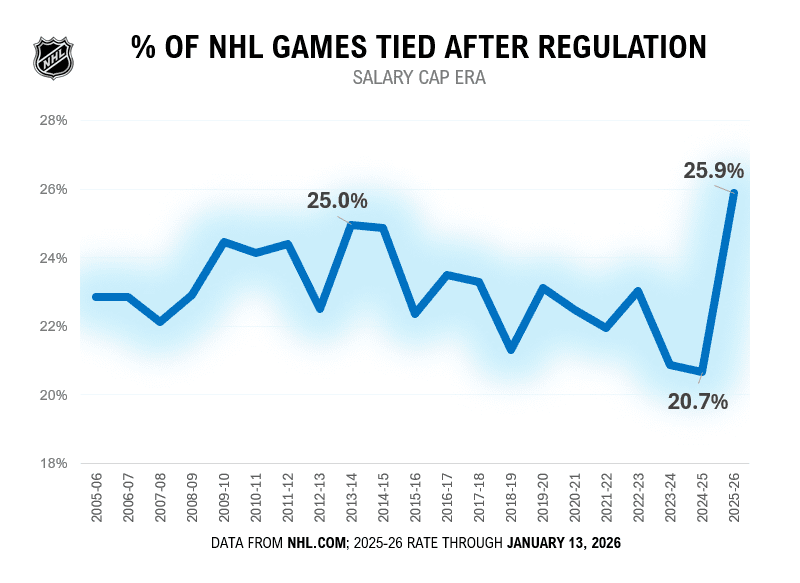
This projects to 340 loser points clogging the standings. That’s 69 more points in the system than last season. More overtime also means more shootouts — the current pace of 123 shootouts is a whopping 60% more than 2024-25 when the shootout was on life support. Perhaps most concerning, though, is that 3-on-3 overtime isn’t deciding games like it used to. Only 63.7% of overtimes are solved, the lowest mark since 3-on-3 OT was introduced in 2015-16. After a record 71.6% of overtimes featured a goal last season, the extra frame’s pace of play has slowed and shootouts are (unfortunately) deciding more games.
#6. Can Colorado become the best regular-season team ever?
With the evolution of the NHL schedule and various tiebreaking formats since 1917, the ‘best regular season team ever’ has long become convoluted. Any of the following teams have a claim:
- 1929-30 Boston Bruins: an NHL-record .875 winning percentage but played a 44-game schedule with 10-minute, non-sudden-death overtime.
- 1943-44 Montreal Canadiens: .830 winning percentage played without access to overtime achieved over a 50-game schedule but in a watered down wartime NHL.
- 1976-77 Montreal Canadiens: 60-8-12 record (132 points) in an 80-game schedule without overtime
- 1995-96 Detroit Red Wings: a then-record 62 wins but played an 82-game schedule, one point fewer than the ’76-77 Habs.
- 2022-23 Boston Bruins: an NHL-record 135 points but played in the current ‘no ties’ league with shootouts and points for losing after regulation.
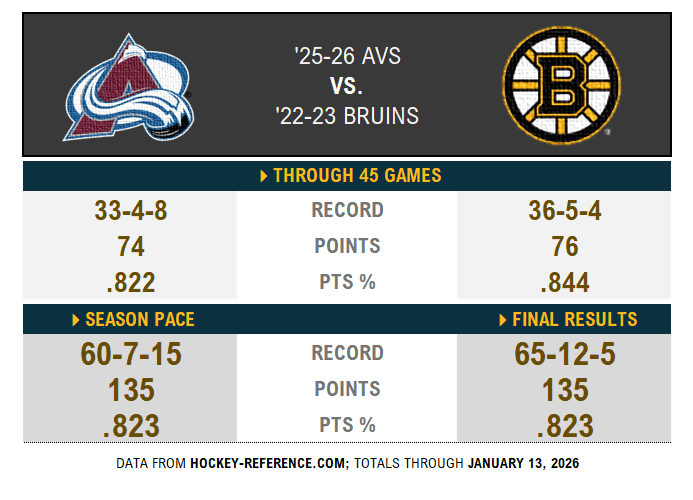
There’s no right or wrong answer. But it seems only fair to limit current teams to the current format introduced in 2005-06: no ties; shootouts; loser points. That means the ’25-26 Avalanche are chasing the ’22-23 Bruins’ 135 points if we want apples to apples. The heavyweight tale of the tape shows a deadlock:
#7. Can Sidney Crosby become the all-time assist leader with one franchise?
It’s been a record-breaking year already for Crosby, having passed former owner/landlord/teammate Mario Lemieux for most points (1,723) in Penguins’ history. He’s presently trending to extend his points-per-game season record to 21. That’s one department where Crosby has passed Wayne Gretzky, a rare feat given 99’s dominance and the high-scoring 1980s.
Crosby’s next pursuit this season? Twenty-five assists over Pittsburgh’s final 37 games moves him past Ray Bourque for most assists (1,111) with one franchise. That’s right near Crosby’s average assist rate the last three seasons, so it could be a nailbiter. Next season? Seventy-four points bests Gordie Howe for most ever with a single franchise (1,809) and 42 goals passes Lemieux for most by a Penguin (690). At any age, let alone pushing 40, there are no guarantees in sports, however. Enjoy Crosby (and 40-year-old Alex Ovechkin) while you can.
#8. Can Toronto become the best faceoff team in recorded history?
This isn’t the type of record that will land your team commercials, but it’s a shoutout to the specialists. Faceoff tracking began in 1997-98, which makes this the 28th season of recordkeeping. The top rate by a team is 56.4%, set in the lockout-shortened 2012-13 season by Boston over 48 games, anchored by Patrice Bergeron’s 62.1%. The full-season record belongs to the 2001-02 Carolina Hurricanes at 56.1% — Rod Brind’Amour won 1,218 draws (fourth-most ever) at a 59.2% clip.
Through 46 games this season, the born-again Toronto Maple Leafs have won 56.3% of their draws, flirting between both records. While Toronto has around 2,000 more draws to take this season, here are the four primary centers on the long, attentive drive toward the record book.
| Center | Faceoffs Won | Faceoff Winning % |
| John Tavares | 427 | 59.3% |
| Auston Matthews | 391 | 58.1% |
| Nicolas Roy | 256 | 53.0% |
| Scott Laughton | 199 | 59.9% |
How many of these records fall or milestones reached? Can these trends continue into 2026?
Only time will tell…
Data from Hockey-Reference, NHL.com, Natural Stat Trick
_____
POST SPONSORED BY bet365