Ranking the rebuilds: Habs, Hawks on track; Devils, Kraken stumble


Close your eyes and picture future commissioner Bill Daly about to hand over the Stanley Cup.
The arena is rocking. It took a while to get here, after all. Rebuilds mean a lot of bad hockey. Long, painful nights with uninspired crowds. TV remotes tossed in frustration. “These guys suck” texted far too often in the group chat. Front office commitments made with no certainty they can ever be kept.
Which rebuilding franchise’s captain is lifting the Cup in your mind’s eye?
Is it Connor Bedard?
No, it has to be Macklin Celebrini, right?
Nick Suzuki, maybe?
Rasmus Dahlin erasing the curse?
Dylan Larkin or Clayton Keller?
Let’s dive in and explore the current rebuilds to find some answers.
🚧 The Approach
We aren’t ranking the rosters right now. Some teams are relatively early in their rebuilds. Others have been floundering for a decade or longer. For example, both the standings and eye test tell us that Detroit is a better team than San Jose today. But Detroit should be, given the head start.
The rebuilds will be ranked on how likely each franchise is to win a Stanley Cup in the next seven seasons. After all, that should be every general manager’s goal: construct a high-end roster that delivers a strong Cup contention window. Call it the 2027 through 2033 Cup window, if you like.
Why seven seasons? Anything shorter fails to offer enough runway for a recent rebuild to truly cook. In four seasons, Bedard will still be 24 years old. That’s too soon. Setting the range to 10 years has the opposite problem — rosters and front offices are safe bets to be unrecognizable by then.
Daily Faceoff prospect expert Steven Ellis’ pre-season pipeline rankings were indispensable to today’s feature.
🚧 What Defines a Rebuild Anyway?
This past summer, I wrote about rebuilds. It got a lot of attention, with two notable takeaways:
- Rebuilds take a lot longer than we think: after a team bottoms out, it needs an average of 8.5 years to make the playoffs in back-to-back seasons.
- Traditional rebuilds work: if a franchise finishes near the bottom of the NHL at least twice and eventually gets to the playoffs in consecutive seasons, success is very likely.
While acknowledging each situation has considerable nuance, for the purposes of that piece, a rebuild was defined as follows:
- A rebuild starts when a team:
- Has at least two bottom-10 finishes, including a bottom-eight finish, in a three-year period
- A rebuild ends when a team:
- Makes the playoffs in consecutive years (or wins the Stanley Cup in its postseason return)
- Makes the playoffs in consecutive years (or wins the Stanley Cup in its postseason return)
The article identified 13 franchises that entered 2025-26 in a rebuild: Anaheim; Buffalo; Columbus; Chicago; Detroit; Montreal; New Jersey; Ottawa; Philadelphia; San Jose; Seattle; Utah; Vancouver.
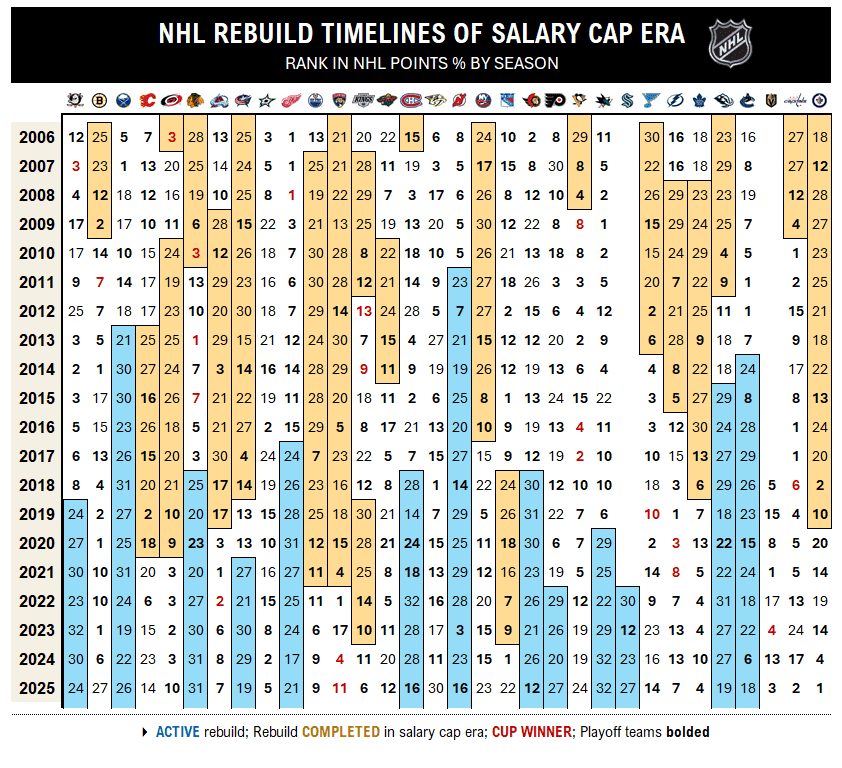
We’re going to spare Vancouver, given they are in dead last without ever closing the previous rebuild. The New York Rangers won’t officially meet the definition until the offseason. Same with Calgary. Meanwhile, Boston, Nashville, New York Islanders, and Pittsburgh haven’t stacked the two requisite bad seasons yet. Consider these four franchises in ‘retools’ for now, if you like.
With our twelve rebuilding franchises set, let’s rank the field…
12. Seattle Kraken
General Manager: Jason Botterill (since 2025)
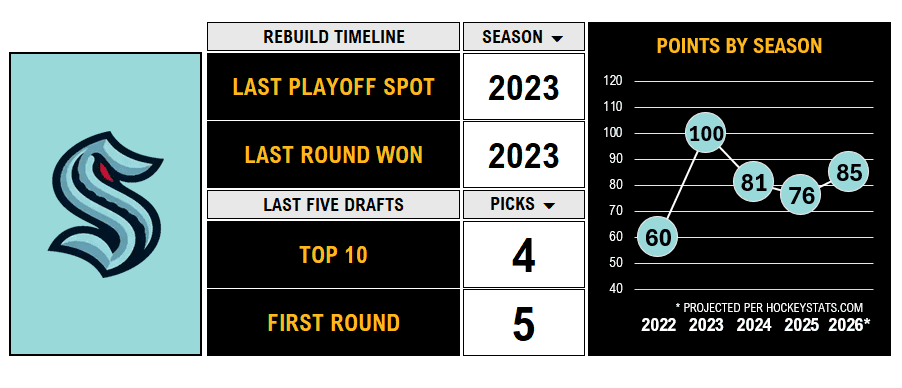
While Seattle’s flirted with a playoff spot all season, that’s true of nearly every team in the league. Make no mistake, this organization has a long way to go. It’s absolutely lifeless offensively at the NHL level. The good news? The Kraken have a strong, forward-heavy pipeline. But player development has to be a concern. Shuffling through three head coaches in three seasons, top-eight picks Matty Beniers, Shane Wright, and rookie Berkly Catton have yet to contribute meaningfully as scorers.
Bottom Line: With neither Beniers or Wright on star trajectories and a few onerous contracts to navigate, Seattle is going to have to start converting prospects to elite players soon in order to become Cup contenders.
11. New Jersey Devils
General Manager: Tom Fitzgerald (since 2020)
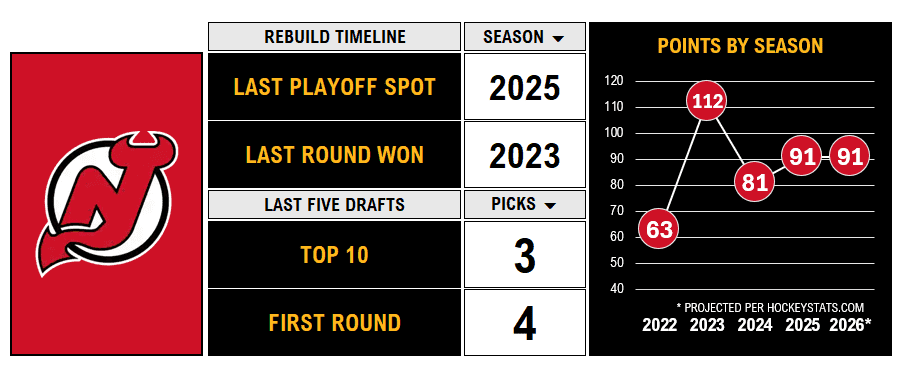
New Jersey made the postseason last April and is only a few years removed from a 112-point performance. But this season hasn’t gone according to plan. Top-four picks Simon Nemec and Luke Hughes have struggled and aren’t reminding anyone of Scott Niedermayer. Jacob Markstrom — signed through 2028 — is a problem. There isn’t a lot of notable help left to pull from the system. The front office is handcuffed from its addiction to long-term deals with player-friendly trade clauses. And superstar Jack Hughes may be out for six weeks with a new injury by the time you’ve read this sentence.
Bottom Line: In terms of organizational talent, the Devils aren’t far behind most teams on this list. This group can make the playoffs and get back on track. On track and Cup threat are different things, though.
10. Columbus Blue Jackets
General Manager: Don Waddell (since 2024)
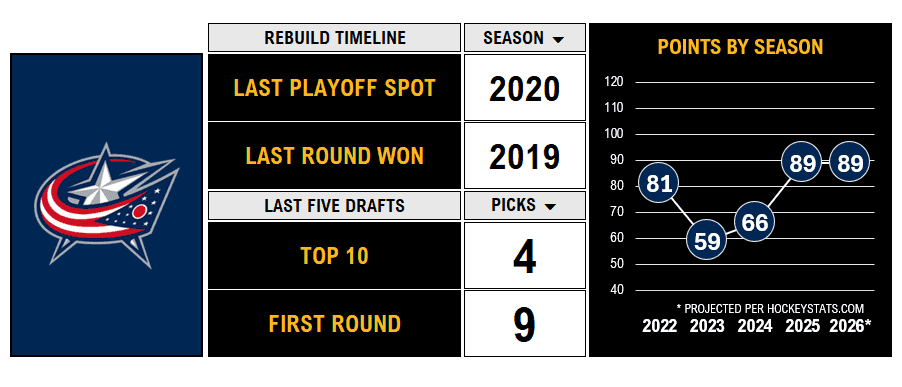
I want to believe in Columbus. They’ve stockpiled talent through nine first-round selections in the last five drafts. Waddell had a lot of success building the Carolina Hurricanes into perennial contenders. Jet Greaves looks like a legit starting goalie. Yet Adam Fantilli hasn’t been the immediate sensation they hoped. Kent Johnson and Cole Sillinger are struggling. And the Jackets feel so dependent on Zach Werenski’s brilliance that should he decline, get injured, or walk after 2028, I’m not sure this franchise isn’t lost overnight.
Bottom Line: Columbus has done plenty of good things in its latest rebuild. But the team is highly leveraged on Werenski and has a dicey record of both developing and attracting talent.
9. Philadelphia Flyers
General Manager: Daniel Brière (since 2023)
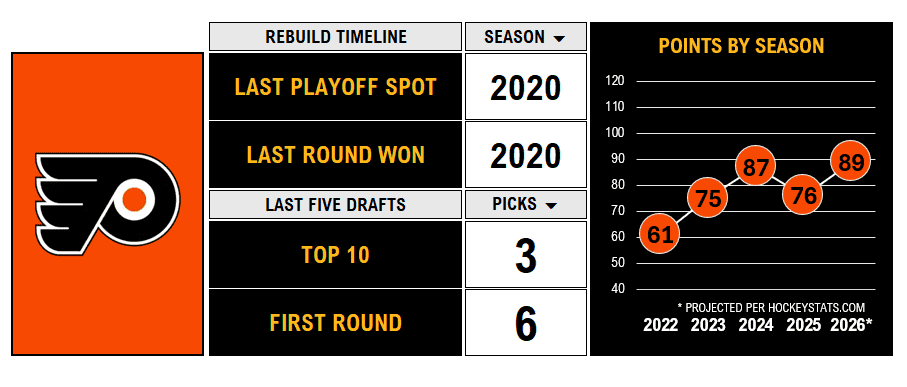
This spot might seem like a shot at the Flyers. They’re an up-and-coming franchise. They play in a division that lacks current or future heavyweights outside of Carolina. But there are questions. Is Trevor Zegras actually this good? Will the timeline work out so that Matvei Michkov and prospects Porter Martone, Jett Luchanko, and Oliver Bonk make an impact while critical veteran Travises (Konecny and Sanheim) remain relevant? Most of Philadelphia’s best talent — both present and future — are forwards.
Bottom Line: Apologies if you’ve heard this before… with journeymen goaltenders and dicey prospect depth on the blueline, this feels like a future playoff fixture that may never prevent goals at an elite level.
8. Ottawa Senators
General Manager: Steve Staios (since 2023)
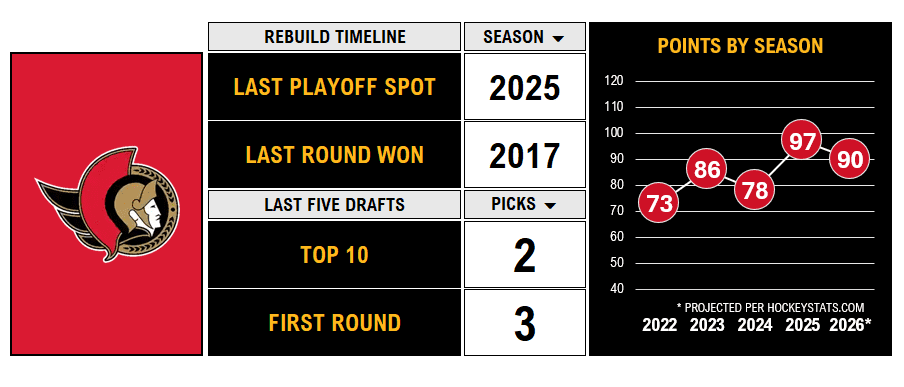
This has felt like a lost year for the Senators. Their odds of consecutive playoff appearances are slimmer by the day. Internal dysfunction. Finger pointing. Awful goaltending. None is a good sign for a team looking to level up. But it’s that goaltending — an unfathomable .866 save percentage — that has completely skewed Ottawa’s season. It’s the worst by any team’s goaltenders since 1993-94. No group can overcome that. In terms of expected goals against, most models have the still-pesky Sens as the best defensive team in the NHL. That’s right. A roster with Brady Tkachuk, Jake Sanderson, and Tim Stutzle remains a credible threat with average (let alone good) goaltending.
Bottom Line: Despite Ottawa’s miserable season, don’t write them off yet. A shakeup move or two and some goaltending insurance should go a long way. I’m expecting a big 2026-27 rebound.
7. Detroit Red Wings
General Manager: Steve Yzerman (since 2019)
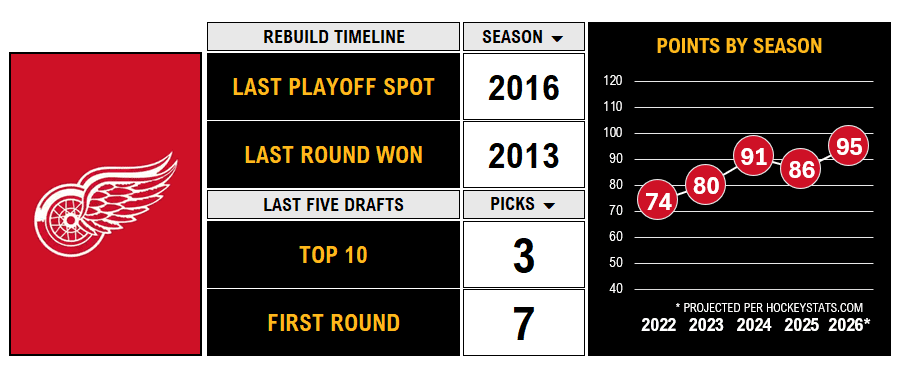
After a decade of uninspiring, non-playoff teams, Detroit is poised to return to the postseason. Bad draft lottery luck. Yzerplans. Regrettable free agent signings. Shaky goaltending. It’s in the past. Right? Maybe. The truth is the Wings’ underlying metrics are below average. They’ve been outscored at 5-on-5 this season. And reclamation project John Gibson may not go on a 17-2 run again next year. So, why are the Wings ranked in the middle of the rebuilds? Moritz Seider and Lucas Raymond have blossomed into superstars. And I think there’s significant psychological benefit in this group finally making the playoffs and restoring faith in both the process and its potential.
Bottom Line: After years of plenty going wrong, plenty has gone right in Hockeytown. The league is better for it. But this group still needs to get considerably better to be a recurring Cup threat.
6. Buffalo Sabres
General Manager: Jarmo Kekäläinen replaced Kevyn Adams in December 2025
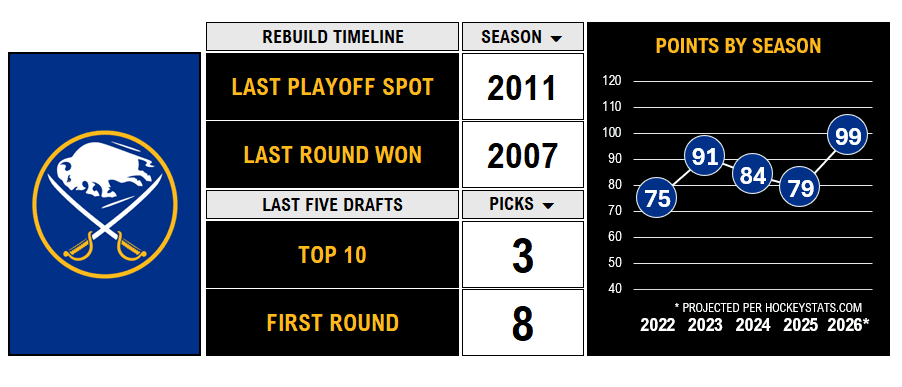
You’re seeing that right… Buffalo last won a playoff round in 2007. Zach Benson hadn’t had his second birthday yet. It’s been a bit. HockeyStats.com, the site that provided the projected 2025-26 team point totals, has the Sabres as the third most likely Eastern playoff team (87%). Whether this is a fluke or a glacial rebuild finally taking shape is in the eye of the beholder. I’m leaning toward Door #2. Buffalo has thrived despite a middling power play and without relying on unsustainable goaltending — two great signs.
Bottom Line: The resurgent Sabres are one of the youngest teams in the NHL, with ample room to grow. Rasmus Dahlin and Tage Thompson are elite and contracted through 2030. Lots has to go right for this group to sniff a Cup, but there are more young, talented, controlled pieces than you think.
5. Utah Mammoth
General Manager: Bill Armstrong (since 2020)
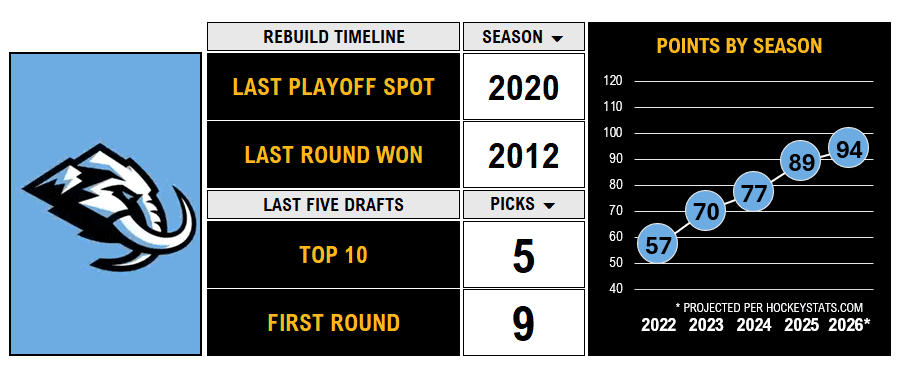
How nice is that visual of the Mammoth’s yearly progress? It’s been a patient and steady climb. Navigating endless uncertainty, a college home rink, and franchise relocation hasn’t been easy for Armstrong. But selecting nine first-rounders — including five in the top 10 — since 2021 has inched Utah toward contention. They’ve made some savvy adds. They’ve locked in an underrated starting goalie in Karel Vejmelka (25-12-2 this season). They’ve got solid ownership. Their underlying metrics are exceptional. And they’ve done it all with key cog Logan Cooley out since mid-December. Without a top-six defenseman under 27, Utah will need to inject some youth to the blueline soon.
Bottom Line: I’m a big fan of Utah’s upside. If they were in any other division, they’d be near the top of the list. But as Colorado, Dallas, and Minnesota eventually fade, the Mammoth will be ready to thrive.
4. Anaheim Ducks
General Manager: Pat Verbeek (since 2022)
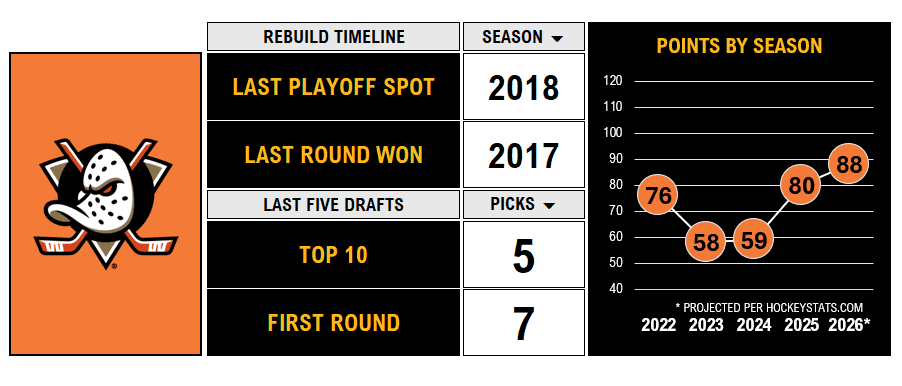
With five top-10 picks in the last five drafts, Anaheim is also seeing the fruits of its scouting and development labor. The Ducks have talented, controlled forwards on the rise. But they are a really bad defensive team right now, not surprising given young players in significant roles. But I’d expect coach Joel Quenneville — who is closing in on 1,000 wins — to iron out these issues and mold a two-way identity soon. Anaheim is a little further ahead of its rebuild than Western rivals Chicago and San Jose, so it’s easy to assume they’re doing it better. But ahead isn’t necessarily better.
Bottom Line: There’s ample talent on the roster and more on the way for Anaheim. It may take a few more seasons to marinate but get excited to serve duck a l’orange at all of your future postseason parties.
3. Chicago Blackhawks
General Manager: Kyle Davidson (since 2022)
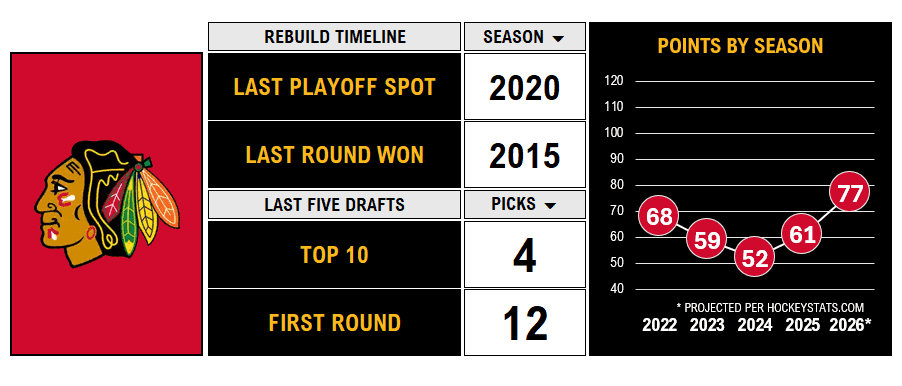
Chicago is still getting outplayed regularly, near the bottom of the league in most 5-on-5 metrics. But fear not, a tsunami of talent is rising. Davidson’s preseason checklist might have looked something like this… Rise 15 points in the standings? Check. Bedard graduating to elite status? Check. Spencer Knight holding up as a strong #1 goalie over a full season? Check. Have another handful of key prospects see NHL time? Check. The difference between Chicago’s future and the others on this list is prospect volume. Not every high pick becomes Victor Hedman or Mitch Marner. But the Hawks’ possess unparalleled insurance, having quietly drafted 11 times in the first round and 25 times in the first three rounds in the last four drafts.
Bottom Line: While progress may feel slow for Blackhawks’ fans, it will be worth the wait. This teardown rebuild is well positioned to contend for a very long time.
2. San Jose Sharks
General Manager: Mike Grier (since 2022)
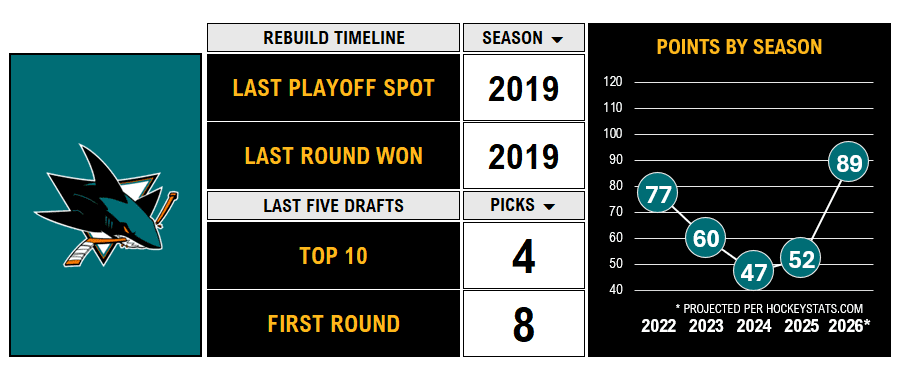
San Jose is often paired with Chicago from a Western Conference rebuild standpoint. Celebrini versus Bedard will have that effect. The Sharks don’t have Chicago’s prospect volume or as many young defensemen playing pro hockey. But playing in the Pacific Division figures to give them an easier path over the next seven years as the heavyweight teams age. Celebrini is the crown jewel, but the Sharks’ prospect cupboard is loaded. The progress of Yaroslav Askarov, 23, in net may affect the speed of this rebuild.
Bottom Line: Teams don’t gain 35 to 40 standings points in one year, so some regression is in order. In fact, I’d bet that both San Jose and Celebrini get fewer points next season. Fear not. Once this prospect pool develops around its teenage Hart candidate, expect a fun, lethal franchise for a decade.
1. Montreal Canadiens
General Manager: Kent Hughes (since 2022)
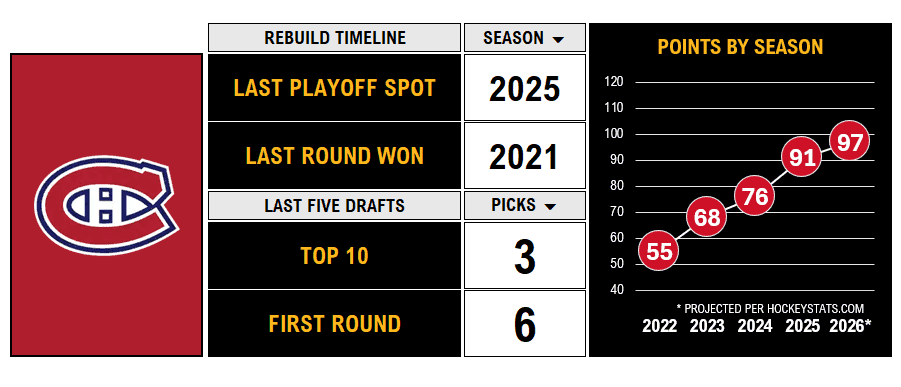
In the NHL 2030 project last summer, I’d picked Montreal as the Stanley Cup champions. Everything appears to be on track with Hughes’ rebuild. In the crammed Eastern standings, the Habs are not a playoff lock (70%). But there’s much to be excited about. Last year, Montreal slipped into the playoffs but weren’t controlling play, relying on Sam Montembeault to prop up a flawed group. This year? Below-average goaltending has hurt a team that’s improved its process. HockeyStats.com has Montreal eighth overall in expected 5-on-5 goal share. The team has skill and swagger, evidenced by an 9-3 overtime record.
Suzuki, Lane Hutson, and Cole Caufield are high-impact players steadily improving. Dynamic rookie Ivan Demidov and Juraj Slafkovsky round out the Habs’ top-five scorers — all homegrown players 26 years old and under. While the teams ranked #2 to #4 in this exercise have accumulated prospect talent, Montreal has successfully converted many into very good NHL players already. Some combination of Jakub Dobes, rookie Jacob Fowler, and Montembeault should be able to supply steady future goaltending.
Bottom Line: Hughes’ recent comments about the trade deadline suggest Montreal isn’t in win-now mode. Yet. But they are close. The Canadiens are poised to be the class of the Atlantic Division as Tampa Bay, Florida, and Toronto are dependent on many players exiting or past their primes. This rebuild is working. Suzuki emerges as our most likely captain to lift the Cup among the rebuilding franchises.
Data from Hockey-Reference; HockeyStats.com; PuckPedia
_____