Which team is the best Women’s Olympic hockey squad of all time?

Women’s ice hockey has been part of the Winter Olympics program since 1998. Since that thrilling end to the tournament in Nagano, the women’s game has found a way to enter the limelight on the world stage every four years.
Every year, something happens that wows fans. Whether it be thrilling gold medal games or dominating individual efforts, each of the first seven editions of women’s hockey at the Winter Games has had at least one moment that we look back fondly.
One of the biggest questions is, which team is the greatest of all time? Sure, the United States and Canada have dominated the sport since its inception, but trying to compare each championship team to each other can be tough, since there always seems to be plenty of changeover every four years.
Today, our women’s hockey “experts,” Hunter Crowther, Tyler Kuehl and Ben Steiner come together to discuss which gold-medal-winning squads were the best in the history of women’s hockey at the Olympics.
Ben: 2010 Team Canada
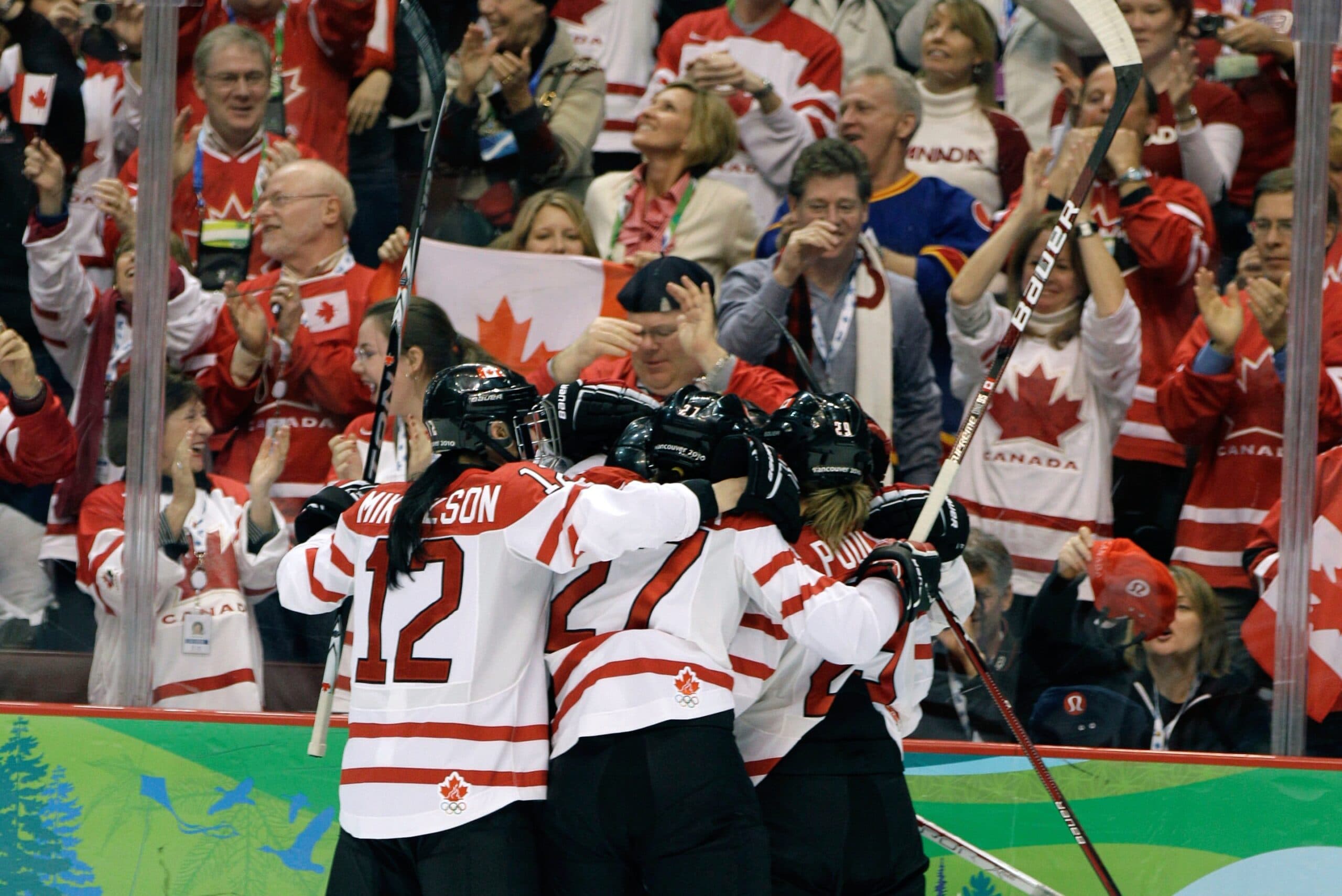
The first Olympic gold medal for Marie-Philip Poulin, the Canadian players getting in some hot water for underage drinking on the ice of Canada Hockey Place after a gold medal and a true passing of the torch between generations of talents, nothing will match the Vancouver 2010 edition of Team Canada at the Olympics.
Not only did that team, still led by Hayley Wickenheiser, defeat the U.S. 2-0 in front of a sold-out arena for gold, but they also posted one of the most impressive stat lines throughout the tournament, lofted, of course, by an 18-0 tournament-opening beatdown of Slovakia.
Canada scored 48 goals across five games and allowed only two, and every player on the roster finished with a plus-minus of +5 or better. In the knockout rounds, they didn’t allow a goal against either Switzerland or the U.S.
The impact of that success can still be felt 16 years later on the Milano-Cortina 2026 roster, which features a veteran-heavy lineup, including Poulin, who repped the red and white back in 2010. A total of six of that roster are involved in the PWHL in some capacity.
Hunter: 2002 Team Canada
For me, it’s the 2002 Canadian women’s team, who arrived in Salt Lake City with the weight of a country on their shoulders after losing to the U.S. in Nagano just four years earlier. That 2002 squad had a motivated group of returning players, led by Hayley Wickenheiser, Jayna Hefford, Jennifer Botterill, Danielle Goyette and Geraldine Heaney — all future Hall of Famers — along with up-and-coming superstars like McGill University superstar Kim St-Pierre in net and Minnesota-Duluth standout Caroline Ouellette.
The first three games of the tournament were a mere formality for Canada, winning by a combined score of 25-0, but the semi-finals proved difficult as Finland was up 3-2 after two periods. Canada would score five unanswered goals in the third to win 7-3, setting up a rematch of ‘98 against the U.S.
Canada was up 1-0 when they were called for eight straight minor penalties, with the U.S. tying the game on one of their advantages. Wickenheiser scored in the second period to retake the lead, then Hefford added another on a breakaway with one second left in the frame to give Canada a 3-1 lead.
The U.S. made it 3-2, but Canada held on to win their first-ever Olympic gold medal in women’s hockey. Wickenheiser and Goyette were tied with a tournament-leading 10 points, and Wickenheiser was named tournament MVP, capped with an iconic post-game speech over a rumor that would be disproven just days later.
It still doesn’t make the speech any less epic.
Tyler: 2006 Team Canada
I know some people groan when looking back at how things ended the last time the Winter Games were in Italy, given that it didn’t end with the U.S. and Canada playing in the final. However, even if the Americans avoided the upset against Sweden, I don’t know what they had that could’ve stopped Canada, or Wickenheiser for that matter.
The Canadians had future Hall of Famers in Wickenheiser, Goyette, Hefford, Botterill, Caroline Ouelette and Kim St-Pierre. The team ran through Group A, which included the host nation, Russia, and Sweden. The red and white surrendered just one goal in the first three games, that coming against the Swedes in an 8-1 victory. They scored a ridiculous 36 goals, beating Italy and Russia by double digits, to easily finish first in the group.
In the semifinals, they took on a Finnish team that led the U.S. into the third period during the group stage. Yet, Canada wasn’t impressed, bullying the Scandinavian team 6-0 to get back to the gold medal game. Then, in the rematch against Sweden, Canada took it easy, only winning 4-1 (though they held Sweden to just eight shots).
In all, Canada outscored its opponents 46-2, a goal differential that was only beaten four years later. Wickenheiser had a performance for the ages, scoring five goals and 12 assists for 17 points. Her scoring record stood for 16 years, until Sarah Nurse bested Wickenheiser by one point, though her 18 points came across seven games.