Where do the Tampa Bay Lightning go from here?



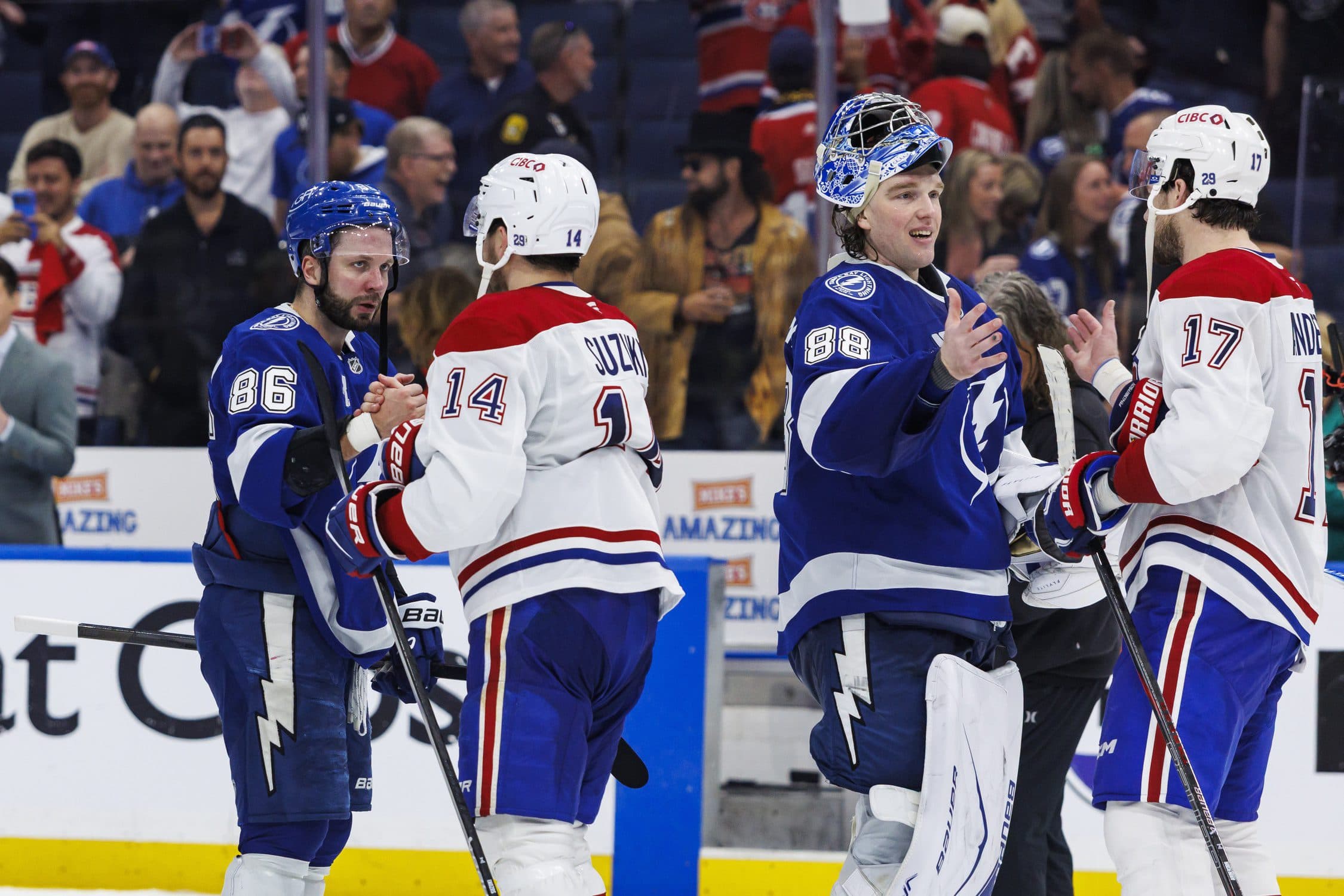
How the mighty have fallen.
The Tampa Bay Lightning were once the model of consistency in the NHL. Beyond just the two Stanley Cup wins in 2020 and 2021, they’ve made the playoffs in 11 of the last 12 seasons, and their .643% regular season points percentage in that span is the best in the league. From 2015 to 2022, they had made the Conference Finals in six of eight seasons and the Cup Final in four of them. Since 2013, there has been no better team than the Lightning.
But in the last four years, that legacy has slipped a bit. They’re still churning along in the regular season with a .616 PTS% (albeit, the seventh-best rate in that span), but come playoff time, struggles have emerged. For four consecutive years, the Lightning have been bounced in the first round of the playoffs. Their .304 playoff win percentage in that span is the fourth-worst in the league (and second-worst to only the Los Angeles Kings among teams with at least 20 games played).
In 2023, Tampa fell to a Toronto Maple Leafs team who was due for their first playoff series win. In 2024 and 2025, it was to the back-to-back Stanley Cup champions in the Florida Panthers. And this season, it was to a young Montreal Canadiens team with a bright future ahead. The Lightning’s opponents deserve their flowers just as much as Tampa deserves criticism, but ultimately you can’t fault them too much.
It was a stretch that was bound to happen for the Lightning eventually. No Cup contention window lasts forever (at least, in the post-Original Six era), and with the eighth-oldest team in the league at 29.42 (and the remains from their Cup-winning teams averaging at 31.75), they were bound to take a step back. And looking back on their run, you can’t be disappointed with the results.
But this is the Lightning we’re talking about. Their ruthlessness to keep their contention window alive is matched by only the Vegas Golden Knights. It feels like they shouldn’t be done yet. But what needs to change after four years of playoff disappointment? Let’s explore a few possibilities and how much sense they make.
A coaching change
We already know this won’t happen (and likely won’t for a very long time) after general manager Julien BriseBois’ affirming comments on Tuesday. Nor should it. Jon Cooper is the most successful head coach in Lightning history, 22nd in all-time wins, first among coaches to only do so with one team, and his .639 PTS% ranks second in NHL history among coaches with at least 500 games. Even this season, he’s a finalist for the Jack Adams Award. It would be insane to move on from him.


Cap Summary
Draft Picks
But there’s a reason every coach ahead of him on the all-time wins list has done it with multiple teams. Eventually, a coach loses the room. Just look at the other multi-Stanley Cup winners in the salary-cap era. Darryl Sutter was fired by the Los Angeles Kings just three seasons removed from two Cup wins in three seasons. Joel Quenneville was fired by the Chicago Blackhawks 15 games into his fourth season removed from three Cup wins in six seasons. Mike Sullivan finally parted ways with the Pittsburgh Penguins last season. Even the best coaches have expiration dates.
And sometimes, a coach sees the game pass him by. While Cooper is still an innovative head coach, there have been some signs of slipping up, particularly in this year’s playoff series. He had the Lightning playing with truculence in the early stages of the series, afraid to lose to the Panthers for the third year in a row even though Florida didn’t make the playoffs. He was playing Scott Sabourin in key shifts. Cooper refused to let any other line but Anthony Cirelli’s play against Cole Caufield, Juraj Slafkovsky and Nick Suzuki, to the point where it gave Martin St. Louis full control of the matchups.
You can also look to Cooper’s performance with Canada at the Olympics this season and find similar warts. Some roster decisions, particularly the insistence on bringing in bottom-six specialists instead of more scoring threats, could have made the difference for a Canadian team who struggled to generate offense consistently beyond loading up their top line with Macklin Celebrini, Nathan MacKinnon and Connor McDavid. Bringing back the same blueline as the 4 Nations Face-Off without a second thought led to some struggles in their own end and moving the puck out of their zone. And while Jordan Binnington didn’t lose Canada any games, Cooper’s blind reliance on the St. Louis Blues netminder instead of giving a borderline elite goaltender like Logan Thompson a run could have cost them in a gold-medal game where goaltending was the difference.
Cooper hasn’t lost the plot yet, and he certainly shouldn’t be fired just yet. But there are slight signs of the game passing him by which, at the very least, shouldn’t make him invincible either.
“Playoff Vasilevskiy”
It’s funny that, to start off this piece, my targets are the two members of the Lightning currently confirmed as finalists for awards. But while Cooper and Andrei Vasilevskiy had excellent regular seasons, they took steps back in the playoffs, and for Vasilevskiy, that’s been the case for four years now.
In the past four playoff runs, Vasilevskiy has an .885 save percentage and a -6.02 5v5 goals saved above expected. Only Connor Hellebuyck has fared worse in both stats, while Pyotr Kochetkov is the only other goalie with a lower 5v5 GSAx. This season was Vasilevskiy’s “best” playoff form of the four years, but he still only had an .897 SV% and 0.57 5v5 GSAx. And he saved his worst performance for Game 7, where he allowed two goals on nine shots while Jakub Dobes stopped 28 of 29 to give the Canadiens the series win.
It’s a shocking drop in form from a goaltender who was once considered the pinnacle of playoff performers in net. From his debut in 2014 until the Lightning’s most recent Cup Final run in 2022, Vasilevskiy was sixth among goalies with at least 20 playoff games with a .922 SV%, and second with a 17.31 5v5 GSAx. He was ice cold in the 2021 Cup run with a .937 SV% and a 17.33 5v5 GSAx, earning him the Conn Smythe Trophy. He was money in Game 7s for the Lightning as well. But Tampa hasn’t gotten this Vasilevskiy for some time now.
However, the solution here isn’t to trade Vasilevskiy – at least, not yet. You could argue the bigger issue for Vasilevskiy come playoff time is fatigue. He’s fourth in games played in the regular season in the last four years, starting close to 60 games in all but the 2023-24 season, which saw him miss the first 20 games of the season due to back surgery. He still played 52 that year.
The Lightning’s problem is they have to rely on him because they haven’t had an adequate backup goaltender to start games beyond back-to-backs. In 2022-23, it was Brian Elliott, who had an .891 SV% and -3.16 5v5 GSAx. For the last three years, it’s been Jonas Johansson, who’s boasted an .889 SV% and -11.19 5v5 GSAx in that span.
Tampa has lacked the ability to lighten Vasilevskiy’s load because their backup goalies are incapable of playing the 20ish game load they already do. That overworks Vasilevskiy in the regular season and doesn’t leave a lot of gas left in the tank for the playoffs. He could do that during the Lightning’s prime years, as he was 23 in his first year as a starter and 27 during Tampa’s 2022 Cup Final run. Now in his 30s, Vasilevskiy needs more support.
The Bolts have the funds to do it this year with more than $13 million in cap space and only Darren Raddysh left to re-sign. But they also have Johansson locked up for next year at a $1.25 million cap hit, so they lack true flexibility to add better depth in net. But in a perfect world, they can upgrade there, to the point where they bring Vasilevskiy’s regular-season workload down to a near even split and preserve him for the playoffs.
Break up the core
Technically the Lightning have already done this one. Several times, in fact, depending on what your definition of their core is. But at the very least, they’ve already pivoted from an aging Steven Stamkos in the 2024 offseason and replaced him with a younger forward in Jake Guentzel. As ruthless as it was to move on from their captain of 10 years, it was a smart move that paid off for the Lightning, as it appeared to somewhat reopen their contention window. It didn’t change their playoff success, but under the hood, it transformed the Lightning from a 50.14% 5v5 xGF% (19th in that span) team from 2022 to 2024 to a 53.44% 5v5 xGF% team (tied for fourth) the past two seasons.
While you could argue that the move didn’t work because the Lightning are still struggling in the playoffs, the improvements it made might actually indicate doing further work in this regard. Between the lack of a market in free agency and the lack of their own core players with expiring contracts (save for Nikita Kucherov next season), it won’t be as easy as the Stamkos/Guentzel swap. But the trade market is a little bit more active, and maybe that’s where the Lightning find the solution.
The question then becomes: who do you move on from? While Kucherov has had his struggles in the playoffs recently (only two goals in 23 games these past four playoffs, albeit while still producing at a point-per-game pace), he’s still a top-five forward in the league. It doesn’t make sense to move on from him. And as I established previously, the same goes for Vasilevskiy. Despite his playoff struggles, it makes more sense to lighten his regular season workload than to trade him.
But then you move further down the list. Victor Hedman? He’s coming off the worst season of his NHL career, is past his prime, and it’s not like the Lightning aren’t afraid to move on from a captain when he’s past his prime, whether that’s Stamkos, Martin St. Louis or Vincent Lecavalier. But Hedman also dealt with mental health issues this season, so that could have played into his struggles.
Brandon Hagel? Definitely not. He was their biggest performer this season, and is the only player under 30 and signed to under $7 million a season. He’s improved every season and is one of the game’s best power forwards. But he’s also the only core member without a no-trade clause – until July 1. If the Lightning want to alter the core without any issues from the player, Hagel is their only option.
Perhaps the more interesting option is Brayden Point. From 2022 to 2025, he averaged 47 goals per 82 games. This season, he had 50 points and didn’t even get 20 goals. He missed some time to injuries, but those also reportedly didn’t slow him down. His struggles were more just luck based, as he shot 14% this year compared to his usual 20+%. But perhaps the 20% seasons were the outliers?
It really depends on if the Lightning think this season is the Point they’re going to get going forward. If so, a $9.5-million cap hit is a lot to pay for a player whose 82-game pace was 23 goals and 65 points. But you’d also be selling low, so you’d have to tread carefully and make sure you find a team who makes a move under the impression they’re still getting 50-goal Point. But swap him for a younger center (Robert Thomas?), and you’ve made a similar move to Stamkos for Guentzel.
And maybe it just involves moving on from a secondary core piece. Anthony Cirelli had a down year defensively. Nick Paul’s long-term contract was never one that made sense, even at an affordable cap hit. Yanni Gourde’s long-term extension is in the similar vein, even more so as he enters his mid-30s. Erik Cernak is another one as well where, as solid as he’s been and as solid as the contract has been, he isn’t a necessity on a deep Lightning blueline. It’s not that these contracts are back-breaking, but as the Lightning continue to churn out depth players out of nowhere like Declan Carlile, Max Crozier, Charle-Edouard D’Astous, Gage Goncalves and Dominic James, perhaps moving on from older players on bigger contracts to move these players up the lineup would also give the Lightning cap space to improve in other areas.
Of course, there is one larger problem from all of this: outside of Hagel, every player has some form of a no-trade or no-move clause, and Hagel gets one on July 1st. Unless a player wants out or can be convinced to move, the Lightning have almost no flexibility here.
Stay the course
Or of course, you do what the Lightning did for the first six seasons of this run of consistency, and not overreact. This is probably the lowest the team has felt in this era since the 2019 Lightning team who were swept by the Columbus Blue Jackets after a 62-win season, so maybe they need to pull lessons from that team.
At that point in time, the Lightning went into full panic mode in the summer and *checks notes* traded J.T. Miller, dumped Ryan Callahan’s cap hit, and signed Kevin Shattenkirk along with several depth players. Okay, so maybe it’s not time to panic. Sure, there are a couple large moves in there, but the core stayed intact after a disappointing season and didn’t fire Cooper.
Now this is a different situation. That Lightning team was still in their prime, this one is past it and may not have the juice for another Cup run. That team still needed to create their legacy, this one only has a legacy to lose. It’s not that they need to be complacent and accept their fate as a one-and-done playoff team because they’ve already won, but they don’t need to be desperate and make the wrong move to win another one.
But “being smart” works the other way too. The Lightning didn’t play smart in their first round series against the Canadiens, and lost as a result. It felt like, for the third season in a row, the Panthers beat them. Tampa tried to bully Montreal into submission and the Habs ignored the violence and beat the Lightning with speed and skill, much like what they used to do in their prime years.
At the end of the day, that’s all Tampa Bay needs to do to get back into playoff form: stop playing dumb.
_____
CHECK OUT OFF THE ROSTER – NEW EPISODES EVERY WEEKDAY
Off The Roster is Toronto sports. Hosted by Cabbie Richards, Lindsay Dunn, and Dan Riccio, this is the go-to morning conversation for everything happening in the 6ix – Hockey, Baseball, Basketball and everything in between. From breakout performances and questionable trades to throwback jerseys, viral moments, and the stories fans are actually talking about – it’s smart, sharp, and never scripted. Live weekday mornings on the Nation Network YouTube channel and available wherever you stream podcasts, the show delivers real opinions, real chemistry, and real Toronto energy. Missed an episode? Catch up anytime. Off The Roster—The new sound of the 6ix.
Recently by Scott Maxwell
- Breaking down every Round 2 Stanley Cup playoff goaltending matchup
- 2026 Conn Smythe Trophy power rankings: Playoff MVP candidates entering the second round
- If analytics decided the 2025-26 NHL Awards, who would win?
- The 10 worst Leafs moves of the last 10 years
- Which NHL veterans are most deserving of their first Stanley Cup?
- Breaking down every Round 1 goaltending matchup in the 2026 Stanley Cup Playoffs

