The 10 best value contracts in the NHL for 2026-27

I don’t need to tell you how important a good-value contract is for an NHL team. In a salary-cap league where saving as much as you can is essential to winning, bringing in a player who is worth far more than their cap hit indicates can be a big difference maker.
So as the preseason begins, and teams are deciding on their rosters for the season while also trying to stay under the salary cap, let’s look around the league at some of the best-value contracts for this season.
To do so, I’ll be taking the contract rating system that was used in my salary-cap rankings series earlier in the summer to decide the value of each player’s contract and how much value teams are getting out of them. For an explainer on how the contract rating system works, you can learn more here. However, since there are more forwards than defensemen and goalies, it means forwards have a higher ceiling for their contract ratings, so the defensemen and goaltender ratings will be adjusted up based on how many players both positions have compared to the forwards.
One important distinction with this system is that it looks strictly at the discrepancy between the player’s on-ice value over the last three seasons and their cap hit for this season. So term won’t play a role in this, mostly due to my inability at this time to project players’ future impacts in relation to the future market. This means a great-value deal with one year left will have the same value as one with several years left. It also won’t include extensions given to players in addition to their current deals; it only considers the cap hits for the 2026-27 season.
The only requirements for a player to make this list is that they had to spend more time in the NHL than the AHL last season, they had to establish themselves as a consistent NHLer by the end of the season, and they can’t be on their entry-level contract.
10. Maxwell Crozier, Tampa Bay Lightning
Cap Hit: $875,000 (two years remaining)
Adjusted Contract Rating: +293.56
Amidst injuries to key Tampa blueliners like Victor Hedman, Ryan McDonagh and Erik Cernak, the Lightning needed their depth players to step up and stop as much bleeding as possible. Crozier is one of two Tampa defensemen on this list, which should go to show that these replacements not only stopped the bleeding but excelled. Crozier did so in a limited role, only playing 35 games, but he managed to provide value, especially with his ability to suppress shot attempts and scoring chances. Unlike most players on this list, he actually has term remaining on his deal, so the Lightning will retain this value for the next two seasons. That should age well as his role grows over those two seasons.
9. Matthew Robertson, New York Rangers
Cap Hit: $850,000 (one year remaining)
Adjusted Contract Rating: +299
The Rangers’ blueline depth has been an issue in recent seasons, with GM Chris Drury remodelling the corps on several occasions over the past two years. But one defenseman who wasn’t a part of that problem last season was Robertson. He not only established himself as an everyday NHLer but was also quietly effective in his role on the Rangers’ bottom pair. There’s nothing about his game that truly impresses you, but there also isn’t anything that scares you, and that’s more than New York has gotten from some of their defensemen in recent years. They’ll take that, especially at a league-minimum salary. Even if the minutes were somewhat easy, the performance at least established a baseline for what to expect from him and maybe leaves the door open for a larger role in the event of an injury.
8. Jakob Dobes, Montreal Canadiens
Cap Hit: $965,000 (one year remaining)
Adjusted Contract Rating: +307.54
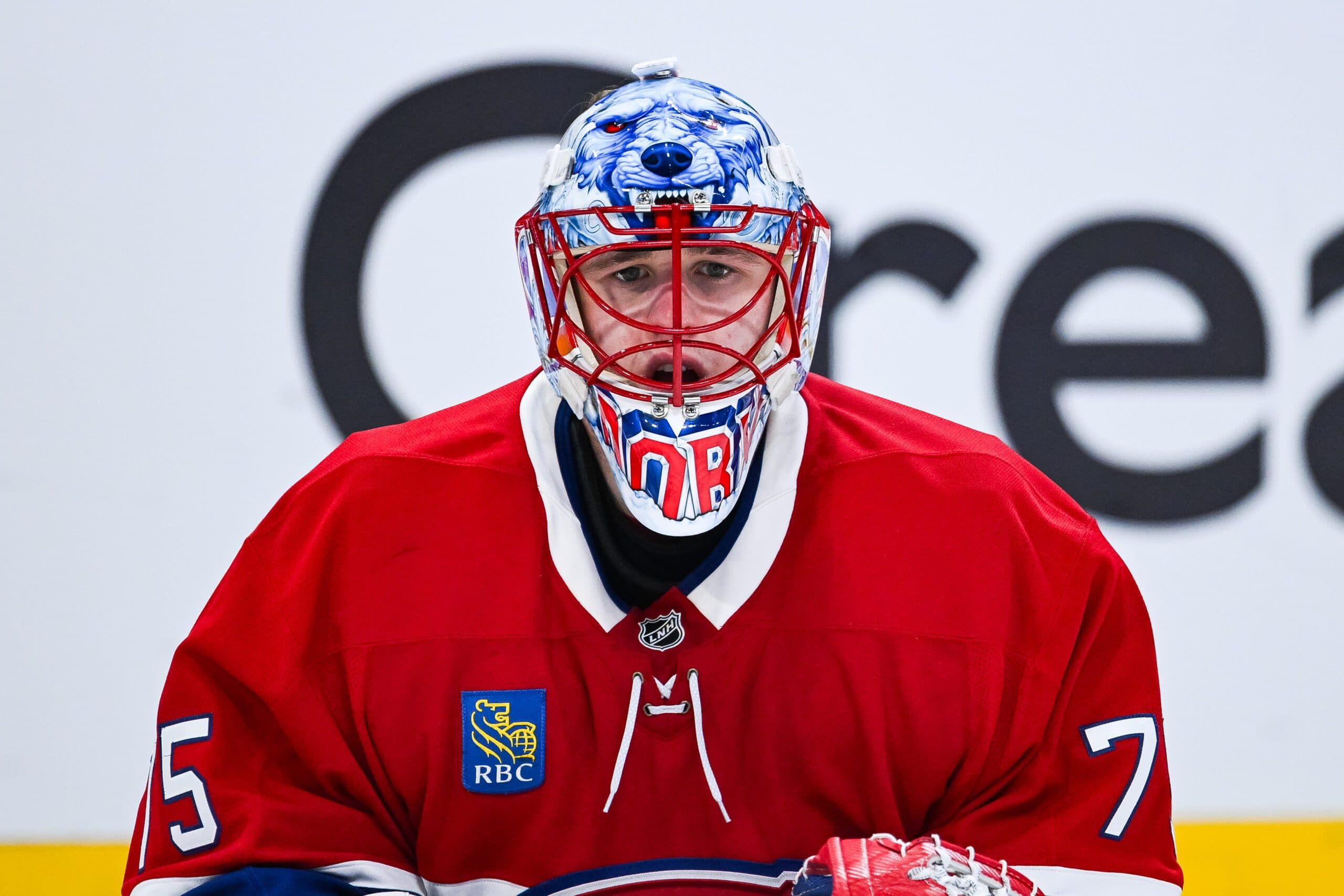
No goaltender provides more value for their team than Dobes does for the Canadiens right now. He had a solid debut for Montreal in 2024-25, but he really stepped up his game in the final months of the 2025-26 season to establish himself as the starting goaltender. While my model doesn’t take playoff performances into account, Dobes’ probably would have ranked him even higher on this list. He has one more year on this contract before a three-year extension with a $5,357,575 cap hit kicks in, which would drop his contract rating to a +45.56. That’s not a bad thing, but it shows how valuable six-figure AAVs are in a rising-cap world.
7. Jordan Harris, Boston Bruins
Cap Hit: $850,000 (one year remaining)
Adjusted Contract Rating: +324.37
Harris admittedly makes this list because he has played lighter competition over the years. He’s never been a regular in an NHL lineup (partially due to injuries), and when he has, he hasn’t gotten a ton of ice time. But the lack of usage has worked to his advantage in this case, as he’s actually produced quite well despite those minutes. While averaging under 14 minutes a game, he’s managed 0.68 5v5 primary points per 60 over the past three seasons, which is better than the likes of Devon Toews, Mikhail Sergachev and Brock Faber. Considering that those defenders are getting paid at least $7 million, getting that kind of production at just $850,000 is good value for Boston. He also drives play well, so even if it comes in easy minutes, getting a defenseman who can play at an elite level in those minutes provides valuable depth if he’s used properly.
6. Alex Turcotte, Los Angeles Kings
Cap Hit: $850,000 (one year remaining)
Adjusted Contract Rating: +324
Turcotte is now entering his eighth season since he was selected fifth overall in the 2019 NHL Draft, and it’s safe to say he hasn’t quite lived up to that draft pedigree. With only 43 points and 162 NHL games under his belt, it took him until his sixth season to even become an everyday NHLer. But in the last two years, he’s actually proven to be solid at driving play and generating chances, even if it hasn’t shown in his production. It came while playing alongside players like Kevin Fiala, Adrian Kempe, Anze Kopitar and Andrei Kuzmenko over the past two years, but perhaps it proves he deserves a spot higher in the lineup with better players going forward. Considering the Kings’ center depth beyond Quinton Byfield is Erik Haula, Scott Laughton and Samuel Helenius, I don’t see why they couldn’t try Turcotte higher in the lineup instead.
5. Jamie Benn, Dallas Stars
Cap Hit: $850,000 (one year remaining)
Adjusted Contract Rating: +337
As you’ll see later on this list, my model loves previously elite veterans still playing at high levels while signed to league-minimum contracts. Benn isn’t the Art Ross Trophy winner he used to be, but that stems from no longer being a primary power-play option for the Stars. At even strength, he’s still producing at the same rates as some of the league’s best. On his team alone, he’s delivered 0.01 5v5 points per 60 less than Wyatt Johnston and 0.09 more than Mikko Rantanen. It’s that kind of production at that kind of price that Dallas needs right now as they’re pressed up against the salary cap. Yes, they have the loyalty benefit, with Benn playing with the Stars for his whole career and doing what it takes to win the Stanley Cup, but any advantage is a good one.
4. Charle-Edouard D’Astous, Tampa Bay Lightning
Cap Hit: $875,000 (one year remaining)
Adjusted Contract Rating: +387.79
D’Astous is the second of the Lightning’s breakout defensemen to crack this list, and while Crozier was more of a depth option, D’Astous actually became a mainstay on Tampa’s blueline. In his rookie season, D’Astous produced like a top-pair defenseman (relative to his minutes) and also drove play at an elite level, particularly in terms of his chance suppression. He didn’t play super tough minutes, but they weren’t soft, either. The Lightning were smart to sign him to an extension at another six-figure salary for this season just after the turn of the calendar because it’s hard to see him making so little money again after this year. This is the kind of cost efficiency Tampa needs to remain a Cup contender at the current stage of their window.
3. Mike Reilly, Carolina Hurricanes
Cap Hit: $850,000 (one year remaining)
Adjusted Contract Rating: +404.1
Reilly has always been an analytics darling, so it’s no surprise my model considers him one of the best contracts in the league right now. He produces at a high-end rate at 5v5, and drives play at an elite level, both in terms of generating and preventing chances. The Hurricanes are the perfect fit for a player like Reilly, and he worked excellently as a depth defenseman they could plug into their lineup when injuries called for it. It’s why Carolina didn’t miss a beat when Jaccob Slavin missed a good portion of the regular season. Reilly’s back with the Canes for another season at a cheaper price, and considering the current contract rift between Carolina and Alexander Nikishin, Reilly could see a bigger role, earning his contract even more than last year.
2. Brent Burns, Colorado Avalanche
Cap Hit: $850,000 (one year remaining)
Adjusted Contract Rating: +409.54
Burns is the only player to return from last year’s list, largely because every other player on that list either got worse, retired, or graduated to a more expensive contract. Meanwhile, Burns actually comes in at a cheaper price in his return with the Avalanche, as he’s clearly leaving money on the table in pursuit of a Stanley Cup. He came close last season and sees the Avs are as capable as any team of getting him his Cup, so it makes sense why he’d come back. Not only that, but Colorado also put him in a more suitable role than he had with Carolina, which allowed him to play closer to his Norris Trophy-winning level than he had in years. It obviously came in easy minutes, but the Avalanche don’t need him playing tough competition with the blueline depth they have.
1. Justin Sourdif, Washington Capitals
Cap Hit: $825,000 (one year remaining)
Adjusted Contract Rating: +456
All hail the Capitals’ professional scouting department. They’ve developed a reputation for finding gems everywhere, and Sourdif is their latest example. The second-round pick used to acquire him from the Florida Panthers felt shockingly high at first, but as soon as Sourdif took the ice, it was easy to see why they paid what they did to get him. His two-way game is already developing into one of the more impactful ones in the league, and it feels like there’s still potential to add more production to the 35 points he had last season. His contract rating was by far the best, partly because he’ll be making a salary below the current league minimum as he finishes his two-year deal. The Caps already committed long-term to Sourdif beyond this year, and while the $6.35-million cap hit would currently rate as a -5 by my model, there are nine years for him to add value to that.
_____
PRESENTED BY THE DAILY FACEOFF NEWSLETTER