Ranking every NHL team’s 2026 salary cap situation: #8-1

NHL training camp is finally here, and preseason hockey is just a day away. With teams rushing to lock down their restricted free agents and signing any last-minute unrestricted free agents, we’re getting the true picture of every team’s salary-cap situation for the season.
It also means it’s time for the salary-cap rankings at Daily Faceoff, where we look at all the different aspects of managing and excelling in the salary-cap era and rank teams based on their performance. This is accomplished through a somewhat complex process and system, which I have outlined in a summary for your convenience.
We’ve already ranked teams from ninth to 16th, 17th to 24th, and 25th to 32nd, but now we move on to the final edition of the list, the best of the best. While some teams are in limbo with notable RFAs, and could very well drop out of this part of the list when those contracts are signed (it already happened to the Anaheim Ducks), others are just consistently smart salary-cap navigators. They make many more good decisions than bad, and it’s positioned most of them well to maintain competitiveness on the ice.
All contract information comes courtesy of our partners at PuckPedia.
The recent flurry of transactions over the past few days has resulted in more movement from past editions of the rankings. The Montreal Canadiens‘ recent moves dropped them from 19th to 25th, with almost every team in between moving up one spot in response. The only exceptions were the 20th-placed Utah Mammoth, who moved up to 17th; the Los Angeles Kings, who moved back to 23rd; and the St. Louis Blues, who moved up to 19th. The other teams in between moved down a spot. In the third part, the Buffalo Sabres moved up to 13th, and the New Jersey Devils, originally 13th, dropped to 15th. The aforementioned Ducks dropped to 14th, meaning the Colorado Avalanche moved up to 12th and the New York Rangers to 11th as a result. The Winnipeg Jets also moved up to ninth.
8. Dallas Stars
Last Year: 4th
Contract Rating: 3rd
Contracts with No-Trade/No-Move Clauses: t-12th
Dead Cap Space: 22nd
Quality of Contractual Core: 4th
Cap Space to Team Quality Differential: t-13th
In previous parts of this year’s rankings, I spoke of teams that were consistently great at managing the salary cap but have slipped this year. So it’s fitting this article begins with this series’ last remaining salary cap dynasty: the Stars are the only team to have ranked in the top 10 in all five editions of these rankings. And if not for Jamie Benn and Justin Hryckowian’s bonus overages giving Dallas $2.08 million in dead cap space this season, they actually could have ranked even higher.
The Stars finished in the top five in both contract rating and quality of contractual core, meaning they know how much they need to spend on each player, and they know which ones deserve to be locked up long term. Most of their core players are locked into market-value deals for long term (save for Miro Heiskanen and Jason Robertson), and then Dallas complements their core with younger players who’ve yet to have their first big salary breaks (Oskar Back, Lian Bichsel, Nils Lundkvist, Hryckowian) and veterans signed to minimal cap hits (Jamie Benn, Colin Blackwell, Casey DeSmith, Joel Kiviranta).
And yet there’s a more impressive aspect of the Stars’ contract management. Despite living in a state with no state taxes, only nine players are locked in to no-move clauses (although Thomas Harley and Wyatt Johnston are just waiting for their RFA years to end), and even though they’re almost capped out, my model considers them one of the few teams worthy of being so.
7. Tampa Bay Lightning
Last Year: 7th
Contract Rating: 2nd
Contracts with No-Trade/No-Move Clauses: t-29th
Dead Cap Space: t-1st
Quality of Contractual Core: 17th
Cap Space to Team Quality Differential: t-5th
When I first started these rankings, it came at the same time the Lightning were beginning to make their “post-Cup win” loyalty oversights. As a result, they always found themselves in the middle-10 portion of the rankings. They were good, but not great at managing their salary cap, as they committed term to secondary core pieces who didn’t need it. But the last couple years, they’ve locked back in and have returned to their former glory of elite management, a big reason why they found second life as a Cup contender last season.
Tampa thrives because, by way of diligence with new signings and working to clean out previous messes, they don’t have a lot of bad contracts on their books. All that remains of their sloppiness in past years with core contracts is Erik Cernak, while the only other bad contracts belong to Jonas Johansson, Jeffrey Viel and Brayden Point. The latter’s contract is problematic due to his struggles last season and continuous defensive issues. Their diligence combined with finding some of the most valuable contracts at their respective positions with Maxwell Crozier, Charle-Edouard D’astous, Dennis Hildeby, Dominic James and Jakob Pelletier gives the Lightning one of the best contract ratings.
Tampa’s only struggles come in two areas, with plenty of explanation for why. The first is having the second-most contracts with clauses in their system, but that’s the downside to living in a no-tax state, as the players need some form of protection when signing reasonable deals. The other is their quality of core, which is middling and would look much better if not for most of their top pieces (Victor Hedman, Nikita Kucherov, Ryan McDonagh, Andrei Vasilevsky) falling under the four-year minimum to qualify. It leaves some uncertainty to the Lightning’s ability to maintain this current group, but they can cross that bridge when they get there.
6. Columbus Blue Jackets
Last Year: 25th
Contract Rating: 21st
Contracts with No-Trade/No-Move Clauses: t-17th
Dead Cap Space: t-1st
Quality of Contractual Core: 10th
Cap Space to Team Quality Differential: 4th
For the first time in my five seasons doing these rankings, the Blue Jackets have not only brought themselves into the top 20, they’ve actually found their way into the top 10. But don’t celebrate too quickly, Columbus fans, as there is an elephant in the room which could significantly impact their ranking: Adam Fantilli.
As you’ll see with a couple other teams with notable RFAs still without a contract, the Blue Jackets’ cap situation looks better than it is because they still have significant cap space left, but most of it will go to Fantilli. If I gave him a $14-million cap hit, he would have a -412 contract rating, one of the worst among forwards. It’s not a slight on Fantilli, because my model is going off what he’s shown thus far and not what he can be, but it would alter Columbus’ ranking. It’s also doesn’t factor in how that would impact their quality of contractual core and cap space to team quality differential.
It’s a massive unknown factor lingering over an otherwise mediocre salary-cap situation. The Blue Jackets have their fair share of players on great-value contracts (like Conor Garland, Jet Greaves, Kent Johnson, Kirill Marchenko and Denton Mateychuk), but they also have several on bad contracts (Erik Gudbranson, Ryan Lomberg, Isac Lundestrom, Elvis Merzlikins, Ivan Provorov, Cole Sillinger and Miles Wood). Add in how Marchenko and Zach Werenski are in the final years of their contracts with potential uncertainty about them staying longer, and this has the makings of a salary-cap situation which could implode in due time.
5. Pittsburgh Penguins
Last Year: 12th
Contract Rating: 9th
Contracts with No-Trade/No-Move Clauses: t-8th
Dead Cap Space: 13th
Quality of Contractual Core: 19th
Cap Space to Team Quality Differential: t-2nd
If I had a platform for these rankings at the height of Kyle Dubas’ time with the Toronto Maple Leafs, you’d know it’s no surprise to see a team run by him in the top five. He had a rocky start with the Penguins but has seemingly adopted the playbook first run by the Capitals: the best way to get a second life with a team that has an older core is to buy low on young upside. Dubas has done that in spades for the past year or so, and it paid off with a playoff appearance last year.
The Penguins’ cap management is quite clean, as Dubas has offloaded the majority of the bad contracts he either inherited or signed; only Ryan Graves and Kris Letang’s remain of that bunch. Arturs Silovs’ contract looks bad, but it’s only for the year. This contract, along with several others involving younger players with upside (like Declan Carlile and Ville Koivunen), has the potential to age well with a rising cap. That combined with some great contracts like Justin Brazeau’s, Kaedan Korczak’s and Thomas Novak’s gives the Pens a strong contract rating. With almost $11 million in cap space left to work with, their cap space to team quality differential is amazing for a team projected to contend for a playoff spot.
The Penguins’ veteran core does leave a lot of uncertainty for how the team will look down the road, but at the very least, Dubas hasn’t overcompensated by dishing out long-term contracts to players unworthy of them. Pittsburgh is actually tied for the fewest contracts with four or more years of term, with the three on their books belonging to Koivunen, Korczak and Novak, all solid gambles. It does mean the Pens have a weaker contractual core than most teams, but it’s the reality of their situation. And it’s one Dubas has made the best of, while not jeopardizing the future of the team.
4. Washington Capitals
Last Year: 1st
Contract Rating: 4th
Contracts with No-Trade/No-Move Clauses: t-12th
Dead Cap Space: t-1st
Quality of Contractual Core: 11th
Cap Space to Team Quality Differential: t-21st
It’s only fitting the team whose strategy Dubas mimics is the one who finishes ahead of the Penguins on this list. The Capitals have found new life in the final few years of Alex Ovechkin’s career. Smart drafting (Martin Fehervary, Aliaksei Protas) and buying low on young players with upside (Rasmus Sandin, Dylan Strome, Logan Thompson) has allowed Washington to build a competitive team around their franchise legend and possibly even position themselves for success after he retires. Even as those players graduated to slightly more expensive contracts, the Capitals continue to find value thanks to that smart drafting (Cole Hutson, Ryan Leonard, Ilya Protas) and buying low on younger players with upside (Jordan Kyrou, Justin Sourdif).
That’s not to say the Capitals are perfect at managing their salary cap. This summer alone, they dished out contracts to Vincent Desharnais and Alex Tuch, which my model views as slight overpayments, and with the term baked in, those could age poorly by the time they finish. As a result, Washington is a bit more capped out than they should be, but not by much: my model views them as the sixth-best team in the league, and they’re spending like the third. But those being Chris Patrick’s lone blemishes is a strong indication to how well run this team is.
The Desharnais and Tuch contracts are cancelled out by a plethora of great contracts on the Capitals’ books, both in terms of those tactically acquired younger players (Sourdif, Thompson) and their own prospects (Hutson, the Protas brothers). And even with the second-most players signed for at least four years of any team in the league, most of them are considered high-quality and worthy of that term. That combined with minimal clauses and no dead cap space has Washington set up well for the next era when ‘Ovi’ retires.
3. Ottawa Senators
Last Year: 10th
Contract Rating: 13th
Contracts with No-Trade/No-Move Clauses: t-3rd
Dead Cap Space: 21st
Quality of Contractual Core: 3rd
Cap Space to Team Quality Differential: t-5th
Where was this salary-cap savviness during the Eugene Melnyk era? The Senators were long known as a team aiming to spend close to the salary floor under their previous owner, and while it’s not an ideal situation for maintaining competitiveness, the right general manager can make it work. However, the Senators never hired that GM, at least until now… after Michael Andlauer took over the team and provided them with a bit more financial flexibility.
One compliment to Steve Staios’ work is that the only “bad” category, Senators’ dead cap space, stems from Pierre Dorion’s work: Colin White’s buyout cap hit and retained salary on Joonas Korpisalo’s contract. The fact that Staios turned the latter’s horrendous contract into Linus Ullmark to finally give Ottawa some stability in net is a miracle in and of itself. Perhaps only having six contracts with clauses could be a different kind of concern (are players less committed to a smaller-market team, especially in the wake of Brady Tkachuk’s trade?), but other than that, Staios has done an excellent job since taking over as GM.
The highlight of Staios’ work comes from his ability to identify core members of the team and lock those players down. Players like Tim Stutzle, Jake Sanderson and Drake Batherson have all become important parts of the team, with Dylan Cozens, Shane Pinto and Jordan Spence all having the potential to join that group at manageable cap hits. That and having some great contracts like Michael Amadio, Warren Foegele and Claude Giroux’s allows Ottawa to still have a reasonable amount of cap space for the quality of their team, and gives them room to bring in and retain other talented players. And most of their bad contracts end in the next two years. The sky is the limit for this Senators team, even without Tkachuk.
2. Detroit Red Wings
Last Year: 8th
Contract Rating: 22nd
Contracts with No-Trade/No-Move Clauses: 11th
Dead Cap Space: t-1st
Quality of Contractual Core: 1st
Cap Space to Team Quality Differential: t-10th
Much like the Blue Jackets, a massive “what if” hangs over the Red Wings’ ranking: Simon Edvinsson. It not only creates the illusion of significantly more cap space than Detroit will have during the regular season, which impacts their cap space to team quality differential, but it also alters their contract rating and could change their first-ranked quality of core.
To be fair, Edvinsson’s addition to Detroit’s “core” wouldn’t alter their ranking, it would just change the gap they have over second place from 7.07 to 2.3. That’s a significant bright spot in their cap management, as they’re exclusive with who they give term to these days. Only Dylan Larkin, Mason Raymond and Moritz Seider belong in that club, and Larkin, the worst of the three, is likely out the door soon, and could make it even better.
But otherwise, there’s too much up in the air to fully credit Detroit as this strong of a salary-cap manager. Their contract rating is probably the best indicator of where they sit as a team, more in the middle. While they have some prospects (Emmitt Finnie, Marco Kasper) and lower-lineup players (Jacob Bryson, Wilmer Skoog) on well-valued contracts, they lose out by having far too many overpaid players (Mason Appleton, Ben Chiarot, J.T. Compher, Andrew Copp, Justin Faulk, Keegan Kolesar, Michael Rasmussen, among a few smaller ones). If not for the uncertainty of Edvinsson’s contract, no dead cap space and minimal contract clauses (although one belongs to a player using maximum control to get his desired destination), Detroit’s contract rating would weigh much larger on their cap situation and ranking. Case in point: the Ducks were in the top five before signing Cutter Gauthier. After the signing, it dropped them to 13th.
1. Carolina Hurricanes
Last Year: 2nd
Contract Rating: 1st
Contracts with No-Trade/No-Move Clauses: t-29th
Dead Cap Space: 1st
Quality of Contractual Core: 2nd
Cap Space to Team Quality Differential: 1st
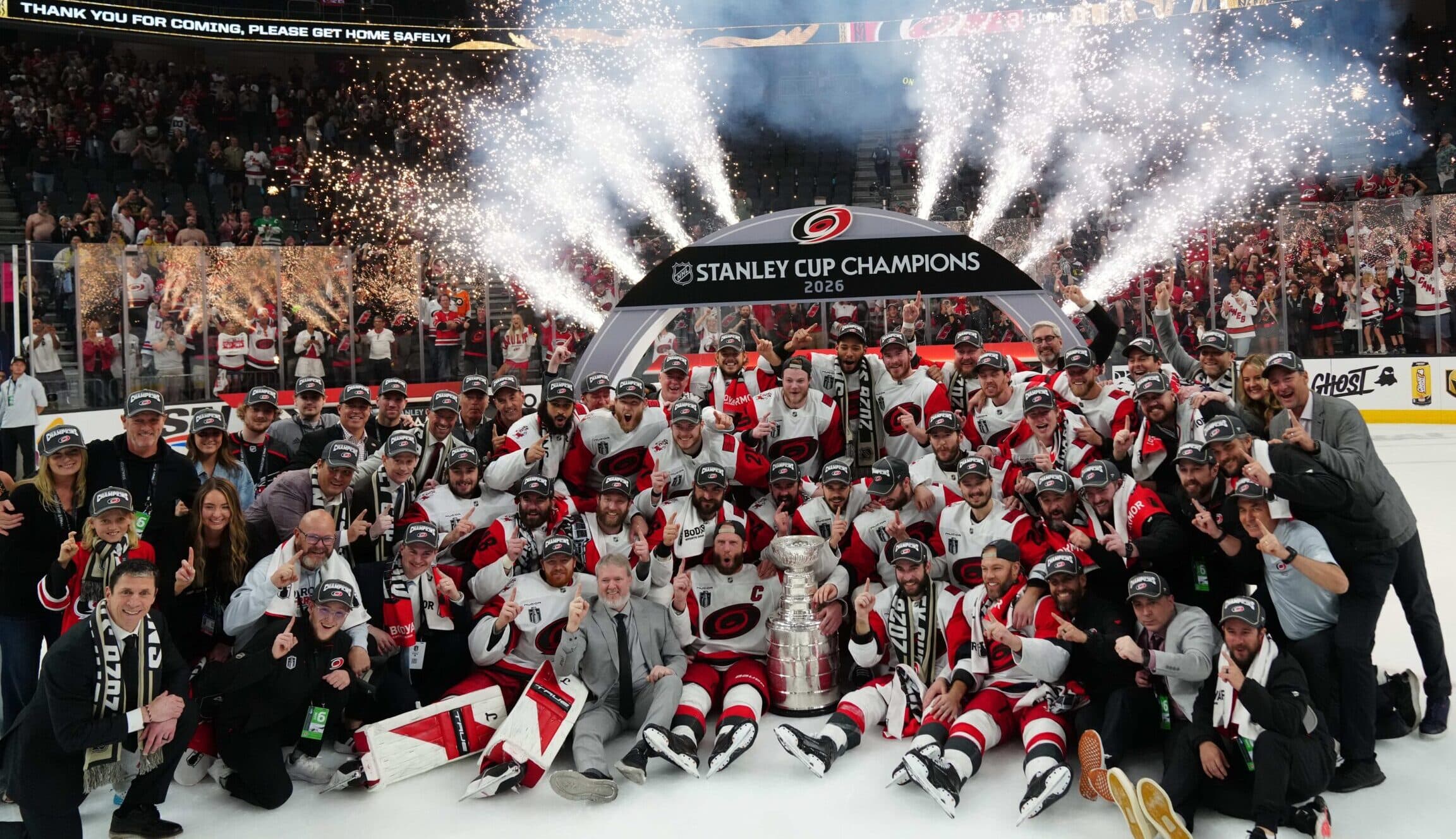
If there’s one indication that my model knows what it’s doing, it’s the fact that the reigning Stanley Cup champions fare well on this list. While they don’t always finish first (the 2022 Colorado Avalanche were the only other team to do so), they always finish in the final part of this series. It shouldn’t be a surprise, because it takes strong cap management for teams to put themselves in such strong positions. These teams also rank well in the few years prior to their Cup win, implying you need diligence for several seasons just to lay the foundation for the team that finally gets the job done. The Hurricanes further prove this, because they were a top-10 team in these lists for the past three years as well.
But Carolina might be on another level of salary-cap management under Eric Tulsky. This year, the Canes rank first in three different categories and second in another. They have no dead cap space. They have the 11th-most cap space despite having the best roster in the league according to my model (although if they end up signing Alexander Nikishin, that possibly changes). Their second-ranked quality of contractual core is also a feat in itself, considering they have 10 players locked in for at least four years. But almost all the players belong there. Besides Jesperi Kotkaniemi, every player with term is in the top 20 percent of their position.
However, the Hurricanes’ contract rating is a true accomplishment. They have their fair share of players signed to great-value contracts (like William Carrier, Shayne Gostisbehere, Mark Jankowski, Jordan Martinook, Joel Nystrom, Eric Robinson, Jordan Staal, Sean Walker, the list goes on), but what’s more impressive is that they just don’t have many players on bad contracts. Kotkaniemi is the obvious one, Nicolas Deslauriers and Pyotr Kochetkov haven’t quite lived up to the value of their current cap hits in recent years, and then my model just doesn’t like Andrei Svechnikov because of his poor defensive play and lagging production. Otherwise, every contract on this team is well worth the paper it’s printed on. It’s not only a statement to their current success, but an indication of their future success as well, especially when cheaper contracts like Jackson Blake and Logan Stankoven will get baked into the rapidly-changing contract market.
SPONSORED BY bet365
Recently by Scott Maxwell
- Ranking every NHL team’s 2026 salary cap situation: #16-9
- 2026-27 NHL team preview: Nashville Predators
- Ranking every NHL team’s 2026 salary cap situation: #24-17
- 2026-27 NHL team preview: Detroit Red Wings
- Ranking every NHL team’s 2026 salary cap situation: #32-25
- 2026-27 NHL team preview: Colorado Avalanche
- 2026-27 NHL team preview: Buffalo Sabres