2026-27 NHL team preview: Colorado Avalanche

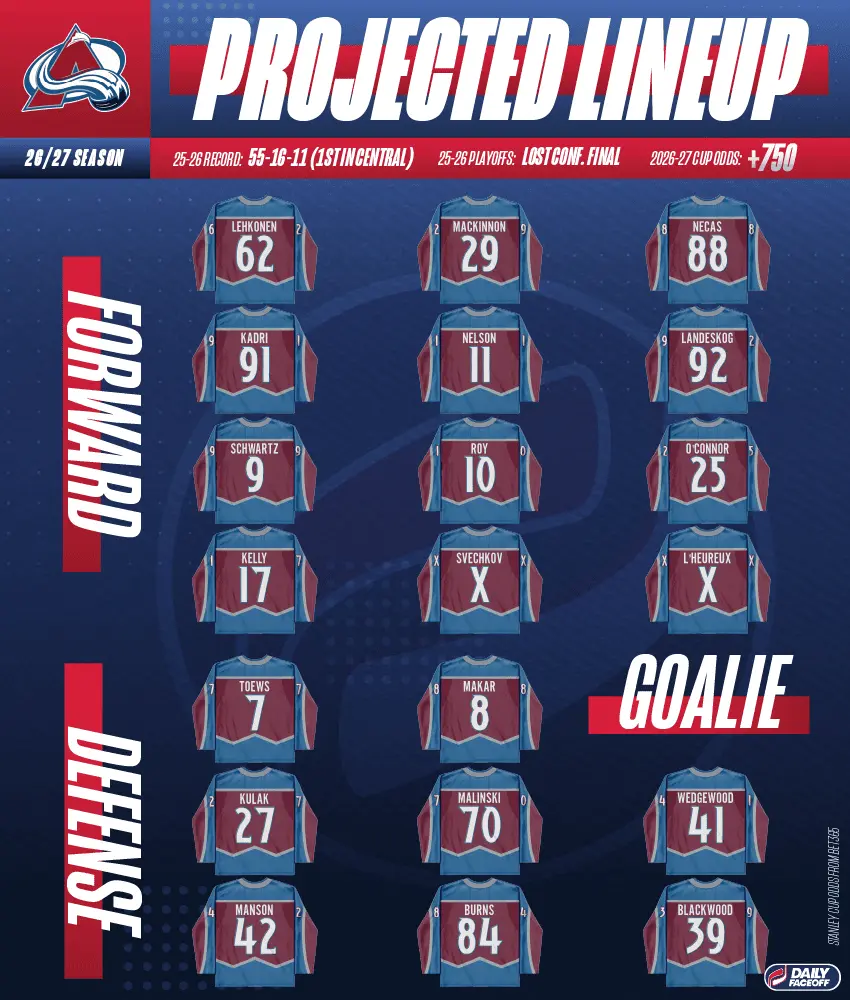
(Players marked with Xs on jerseys have not chosen their numbers for 2026-27 yet)
LAST SEASON
For 99 percent of the season, things were going very well for the Colorado Avalanche. The team exploded out of the gate, losing only once in regulation in their first 26 games, and 40 games in, they were 31-2-7. The second half of the season was slower by their standards, but still excellent compared to other teams’, as they went 24-14-4 the rest of the way. They were eight points clear of the Carolina Hurricanes for the best record in the NHL, and to some, Colorado looked unbeatable going into the playoffs.
As a result, the Avs went all in at the Trade Deadline as well. Gone were Samuel Girard, Victor Olofsson, Max Curran, two first-round picks, two seconds and two fifths, and in were Nick Blankenburg, Nazem Kadri, Brett Kulak and Nicolas Roy as Colorado bolstered their depth to surround Nathan MacKinnon, Cale Makar and company in the hopes of their first true run at a Stanley Cup in four years.
The bad news for the Avalanche is that the one percent of their season which went poorly was the final one percent of their season. After making quick work of the Los Angeles Kings and Minnesota Wild in the first two rounds in the tough Central Division, the only thing in Colorado’s way of another Stanley Cup Final was the Vegas Golden Knights, who wouldn’t have even made the playoffs if they played in the Eastern Conference. But injuries (whether they took players out of the lineup or hindered their play) caught up with the Avs, and Vegas ran over them in a four-game sweep – which was also the first time all season they lost four consecutive games in regulation.
This summer, the Avalanche paid the price for their gamble at the deadline and had to ship out several players just to make the salary-cap math work. Valeri Nichushkin, Ross Colton and Jack Drury were all dealt, while Nick Blankenburg left for free agency. With no one in the pipeline to replace them, Colorado looked to the bargain bin, signing veteran Jaden Schwartz, and acquiring young, cheap depth players Zachary L’Heureux and Fedor Svechkov in the Drury trade. Even without spending too much, it leaves the Avs with barely $400,000 in salary cap space.
But how will the offseason losses impact the Avalanche? Did they fill out enough around the edges to keep the team as a Cup contender, or are they due for a step back? Will they become a one-and-done team in the MacKinnon-Makar era, with their lone high coming in 2022?
KEY ADDITIONS & DEPARTURES
Additions
Jaden Schwartz, LW
Zachary L’Heureux, LW
Fedor Svechkov, C
Vinnie Hinostroza, RW
Noah Juulsen, D
Departures
Valeri Nichushkin, RW (Col)
Ross Colton, LW (Nsh)
Jack Drury, C (Nsh)
Nick Blankenburg, D (UFA)
Joel Kiviranta, LW (Dal)
Zakhar Bardakov, C (KHL)
Ivan Ivan, C (Bos)
Alex Barre-Boulet, LW (SJ)
Jacob MacDonald, D (Wsh)
OFFENSE
When you’re a team with the eighth-best winning percentage in the salary-cap era, you’re probably going to have a good offense. The Avalanche led the league in goals for per game with 3.63, and the underlying numbers matched up with that, as they were tied with the Hurricanes for the most 5v5 expected goals for per 60 minutes in the league with 3.33. In fact, the Avs’ 5v5 numbers slightly underperformed their metrics, as they scored 3.3 5v5 goals per 60 minutes. Sometimes Presidents’ Trophy-winning teams succeed due to shooting luck, but that wasn’t the case for Colorado, as they were 16th in 5v5 shooting percentage with 9.65%.
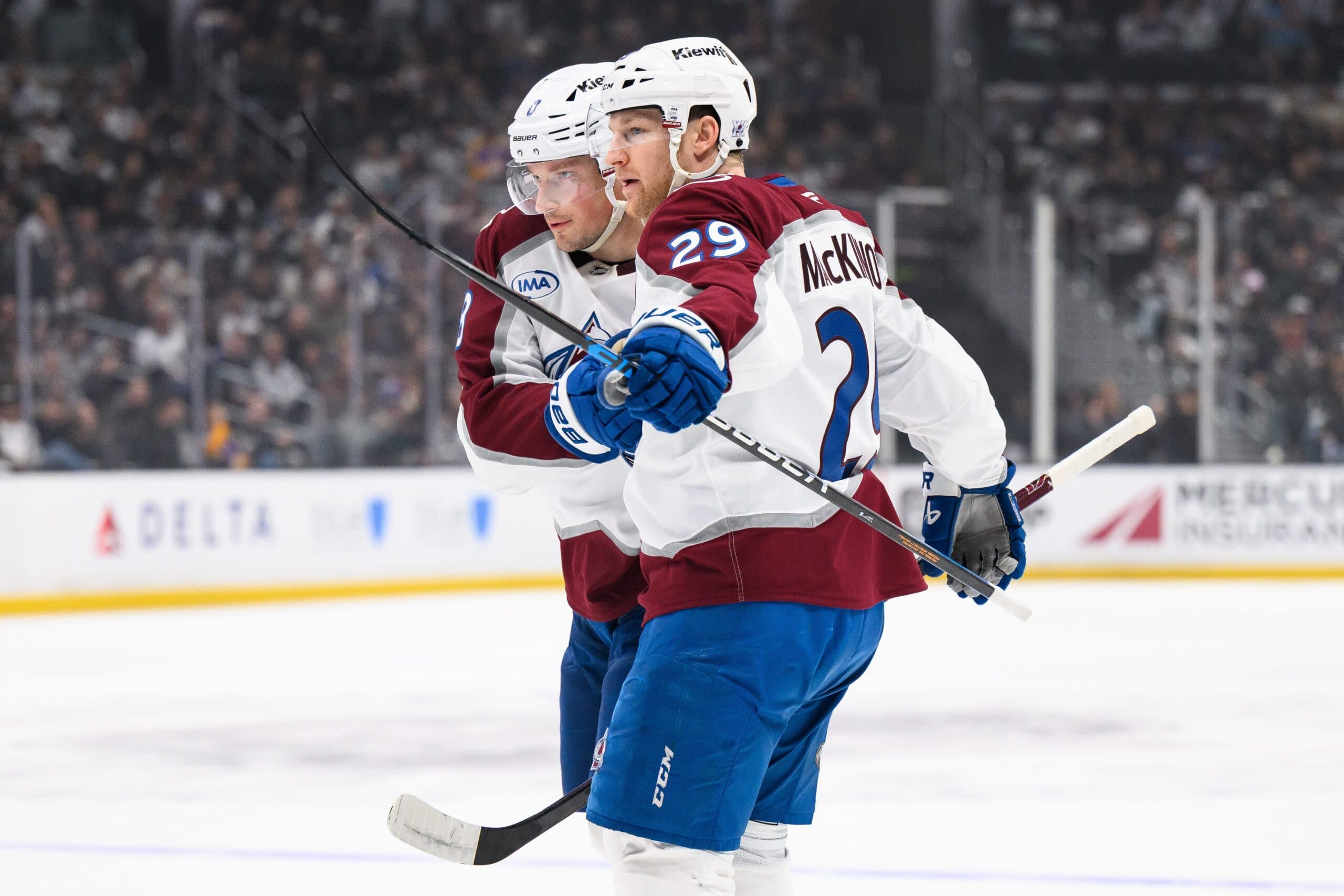
Colorado’s offense is led by the two-headed monster that is MacKinnon and Makar. While the cast around them has changed, these two are the nucleus. Both are smart and fast, MacKinnon with his bull-esque tenacity in his stride, while Makar with more of a silky-smooth glide that allows him to slip through defenses. Both are always respective Hart and Norris Trophy candidates, and they set the pace and play style for the rest of the team.
Surrounding MacKinnon and Makar are Martin Necas, Brock Nelson, Artturi Lehkonen, Devon Toews and Kadri. Colorado doesn’t have another elite name like they used to with Mikko Rantanen, and Necas isn’t the cheap replacement the team was hoping for after signing his new contract, but he’s an ideal complementary piece to MacKinnon and produces at a high rate. Lehkonen is the perfect forechecker to complete the top line, while Nelson and Kadri give the Avs the flexibility to either stack up their top six or run some of the best center depth in the league. Toews isn’t elite offensively, but his pairing with Makar is one of the best in the league, and Toews works so well as the secondary piece on their pair.
The real question for Colorado’s offense is who is going to produce beyond this top group, especially up front with Nichushkin, Colton and Drury gone. There’s Gabriel Landeskog, who had a solid return to the NHL last season, but there’s still a cloud of uncertainty with him turning 34 two months into the season and missing close to three years of hockey. Regardless, he’s not who he once was. Parker Kelly is the only other returning forward who got more than 25 points last season, but it was a career year driven by shooting percentages, so it’s unlikely he gets 21 goals and 35 points again. Logan O’Connor, Nicolas Roy and Jaden Schwartz have proven to produce at a solid rate in the past, so they could possibly fill the void if they play full seasons in this environment. New additions L’Heureux and Svechkov, along with last season’s addition in Gavin Brindley, are young and intriguing options, but they haven’t produced at the NHL level just yet.
However, if there’s one part of the lineup the Avalanche shouldn’t worry about for offense, it’s their blueline, and not just because of Makar and Toews. Among defensemen with at least 2,000 5v5 minutes in the last three seasons, five of Colorado’s blueliners rank in the top 30 in 5v5 points per 60 minutes: Makar (1st), Toews (tied for 12th), Sam Malinski (tied for 18th), Josh Manson (tied for 20th) and Brent Burns (27th). Whether it’s the ability of the defense corps themselves or a product of the systems Jared Bednar deploys, the Avs get a lot of offense out of their D-corps.
DEFENSE
The Avalanche’s defense was similarly elite to their offense last season. While some of it was due to the performance of their goalies, they were still one of the best teams at preventing chances (2.5 5v5 xG against per 60, fourth) and goals (2.4 GA/G, first). In fact, only Colorado and the Tampa Bay Lightning finished in the top five in goals for and against per game last season, while the Avs were the only team in the top five in xGF/60 and xGA/60 at 5v5.
Makar and Toews are excellent at driving offense from the back end, but their defensive play isn’t bad, either. Makar’s game in his own end has slipped from elite to just fine in recent years (-0.034 5v5 regularized adjusted plus minus xGA/60 since 2023-24), but Toews (-0.084) more than makes up for it his defensive smarts. The pairing’s elite play-driving metrics are driven more by their offensive play than their defense, but the other team can’t score when the puck is in their end. Both players being excellent puck-movers makes them all the more frustrating for opposing offenses to deal with.
The rest of Colorado’s blueline are also great in their own end, as Brett Kulak (-0.082 5v5 RAPM xGA/60, 51st), Malinski (-0.126, 27th) and Manson (-0.095, 40th) all rank in the top 64 in 5v5 RAPM xGA/60 in the past three seasons, meaning they defend at a top-pair level. Like Makar and Toews, they do so with an overwhelming pace to tire their opponents and move the puck. Burns is the lone weak spot on the blueline (0.042), but he’s insulated in a sheltered third-pair role, so he won’t hurt the Avs too much.
The Avalanche need defensive consistency from their blueline because their forwards, especially at the top of the lineup, lack defensive acumen. Amongst their top-six forward group, only Lehkonen (-0.053 5v5 RAPM xGA/60) has a positive defensive impact, so the Avs need the insulation from the back end to support them.
While there are some question marks regarding how the bottom six will produce offensively, they can at least contribute defensively to the lineup. O’Connor (-0.209 5v5 RAPM xGA/60) has produced some of the best defensive results in the league (albeit in easier minutes), while Kelly (-0.154) has suppressed chances at a similar level. Roy (-0.068) is as reliable as they come for defensively solid bottom-six centers, while L’Heureux (-0.087) is an all-around great play-driver, and if he improves offensively, he could be a sneaky good part of the return for Drury. The only blemishes in this group are Brindley (0.104), Schwartz (0.01) and Svechkov (0.028), but they can be insulated easily.
GOALTENDING
The Avalanche had the best goaltending in the league last season, as they were first in team save percentage at all strengths with .9062 and first in team save percentage at 5v5 with .9202. It’s amazing how just two seasons ago, goaltending was sinking this team out of a playoff spot, but the quick pivot from Alexandar Georgiev and Justus Annunen to Mackenzie Blackwood and Scott Wedgewood drastically shifted their performance in net.
The surprise from the Avalanche goaltending last season was how, after they locked up Blackwood to a five-year extension, it was Wedgewood who had a career year at 33 and got a slightly larger chunk of the starts, especially in the playoffs. Some of that was due to an early-season injury to Blackwood, which thrust Wedgewood into the starter’s role, but he was still very good. He was the only goalie in the NHL with more than five games played to have a SV% above .920, and even if you want to chalk it up to playing behind an elite Colorado team, his 20.73 5v5 goals saved above expected was ninth. It’s hard to imagine a world where he repeats this level of success again, but I wouldn’t expect a drastic fall off either: he has a career .909 SV%, and he’s posted a positive 5v5 GSAx in four of his last five seasons.
Blackwood wasn’t as good as Wedgewood, but Blackwood put up numbers which were still more than good enough for a team as good as the Avalanche. His .904 SV% was tied for 17th among goalies with at least 30 starts, and his 13.49 5v5 GSAx was 20th. The Avs will likely deploy him and Wedgewood as a tandem unit again, but since Blackwood is only 29 and signed for four more seasons, Colorado probably sees him in their long-term plans in net.
COACHING
Bednar should be about as untouchable of a head coach as there is in the NHL, save for Jon Cooper. Besides a horrendous first season (where he was hired just weeks before training camp and had no prep time), the Avalanche have made the playoffs every season, and their .617 points percentage during his 10-year tenure is the seventh best in the league (and second-best among Western Conference teams). While his teams haven’t always thrived in the playoffs, they did once, winning the Stanley Cup in 2022.
But even with all his success, it doesn’t take much imagination to see why some think Bednar is on the hot seat. Now four years removed from their 2022 Cup victory, Colorado has fallen short of expectations in the playoffs every year since and has yet to win a game past the second round. Heck, last season’s eight playoff wins were the second most in a single run under Bednar. To some, the Cup win can look like an outlier compared to the other playoff disappointments, even if it is a very good outlier to have. With MacKinnon turning 32 in the next week and Makar turning 29 at the end of October, time is starting to run out on their prime years and the Avalanche’s contention window. Oh, and Bednar is also in the final year of his contract.
If it feels like Bednar has lost the room or is falling short of expectations, maybe Joe Sakic pulls the plug on his tenure and opts for a new voice in hopes of getting another Cup or two out of this team. It worked for MacKinnon’s Cole Harbour buddy Sidney Crosby and the Pittsburgh Penguins; who says it won’t for the Avs?
ROOKIES
As is the case with most teams consistently making the playoffs and gunning for Stanley Cups, the Avalanche don’t have a strong prospect pool. In fact, they have one of the worst in the league. As such, don’t expect any high-impact rookies to make the NHL squad, at least on a meaningful basis. Injuries could pave the way for lower-end prospects like Sean Behrens, Fabian Lysell and Nikita Prishchepov to get some games under their belts, but it’d be surprising to see any rookies on a full-time basis with the team this season.
Another name who could play the odd game is Ilya Nabokov. He’s making his North American pro hockey debut after two seasons post-draft in the KHL, and is easily Colorado’s best prospect in their system. He likely won’t make the team on pure talent with Wedgewood and Blackwood under contract, and he may not even be the primary callup with Trent Miner also in the system. But if Nabokov has an excellent AHL rookie season, it wouldn’t be surprising if he plays some games with the Avs this season, or at least make the team’s decision to retain Wedgewood after his contract expires much harder (or easier?).
BURNING QUESTIONS
1. What will Cale Makar’s next contract look like? While the other pending-UFA Norris candidate, Quinn Hughes, isn’t as much of a shoo-in for re-signing with the Wild, there’s no doubt Makar will extend with the Avalanche. He’s won his Stanley Cup, and the Avalanche will give him every cent he asks for. So it’s a matter of when, not if, Makar extends. But how expensive will the new contract be? The current market for superstars was set by Kirill Kaprizov last year, and Colorado is projected to have around $32 million in cap space next season. How much of the pie Makar takes up could be the difference between the team continuing to contend for Cups or just floating along in mediocrity. We may not have to wait long to find out though.
2. Will the Avalanche power play improve this season? As good as Colorado’s season was, there was one blemish: their power play. They were near the bottom of the league in power play percentage (PP%) for the entirety of the season, only rising to sixth-worst towards the end with 17.1%. It’s not like they were unlucky either, as their 8.89 PP xGF/60 was 24th in the league. It improved slightly to a 20% click once they acquired Kadri, and they were better at generating chances with a 9.55 PP xGF/60, so maybe a full training camp with this group can get them back into form, because it’s shocking how a team who had the fifth-best power play from 2020 to 2025 couldn’t score on the power play last year.
3. How hot is Jared Bednar’s seat? It feels insane to talk about Bednar as a potential firing candidate after the regular season the Avalanche just had. But after four-consecutive playoff runs ending earlier than expected, especially this season, it’s possible Bednar has just reached his expiration date. Add in the constant links to University of Denver head coach David Carle and the hiring of recent Memorial Cup-winner Jussi Ahokas for Colorado’s AHL team, and it feels like there are a couple strong replacements if Bednar is let go.
PREDICTION
The Avalanche did lose a bit of depth this summer, but by no means does this mean they’ll fall too far from where they were last season. Maybe they don’t play to a .700+ points percentage, but they’ll still hold their own with the game’s elite teams, so long as MacKinnon and Makar are healthy. The real question will be the playoffs. Can Colorado go on a run and win another Stanley Cup? Will Bednar be a part of that? Those are the big questions. But it would take a lot to go wrong for them to fall out of the playoff race for the first time in 10 years.
SPONSORED BY bet365