Five NHL players in danger of negative regression in 2026-27

Whether you like it or not, math and luck play roles in hockey. Sometimes players score or stop the puck at higher rates than usual, and sometimes they do so at lower rates. Regardless, the bill always comes due, and those percentages swing the other way, unless the player is just that good.
Every year, we see some players produce at rates that are big outliers compared to the rest of their careers, and they hardly keep it up. So I thought it would be a good idea to look at some players who overperformed their percentages in 2025-26 and will possibly see those results go the other way next year.
It’s not a guarantee every player on this list will get worse, especially when percentages don’t have as much of an impact on regression as they used to. But it’s still important to look at and be aware of them, especially if you’re a fan wanting to manage expectations or a fantasy hockey manager looking for players to avoid in next season’s draft. And to put things in perspective, last year’s edition saw four of the five players take a step back last season, so this is still an effective predictor.
Wyatt Johnston, Dallas Stars
2025-26 Stats: 82 games, 45 goals, 41 assists, 86 points
What’s the outlier?: PP SH% was 8.81% higher and on-ice PP SH% was 4.39% higher than career average
A quick glance at most of Johnston’s percentages from 2025-26, and all signs would point to a 22-year-old forward taking the next step as one of the league’s more prolific scorers. At all strengths, he shot 21.8% (only 4.7% higher than his career rate) with a 14.89% on-ice SH% (2.55% higher), and at 5v5, he shot 14.29% (which is also his career rate) with a 10.31% on-ice SH% (0.26% higher). It’s a sign he may see his production slightly drop off, but not to a concerning extent.
But where Johnston really saw his play reach unsustainable levels was on the man advantage. When the Stars were on the power play, he shot 30.86% (compared to a 21.99% career rate) and his on-ice SH% was 21% (compared to a 16.61% career rate). Expecting Johnston to have 27 goals and 42 points on the man advantage while only generating 18 goals and 44 points in every other game state is unrealistic, even for a budding young star on an elite power play unit.
Johnston’s youth will likely play a role in his regression not having a significant impact on his overall production. While I expect his power-play production to drop in 2026-27, he’ll likely see an increase in his even-strength production to counteract the regression and give him a similar point total to last season (or maybe a larger one).
Parker Kelly, Colorado Avalanche
2025-26 Stats: 82 games, 21 goals, 14 assists, 35 points
What’s the outlier?: SH% was 8.6% higher than career average
Kelly was one of the Avalanche’s biggest surprises from their dominant 2025-26 season. After never registering more than eight goals and 19 points in a single season beforehand, he broke out for 21 goals and 35 points on the year. He joined Nathan MacKinnon, Martin Necas, Brock Nelson, Artturi Lehkonen and Cale Makar as Colorado’s 20-goal scorers, so he felt out of place as far as reputations go.
Well, if Kelly’s production in 2025-26 gives you pause, you aren’t wrong to think so. While his on-ice shooting percentage wasn’t too far off of what he normally sees (9.48% last season vs. 8.05% in his career), he saw a massive increase in his SH%, as he was clicking at a 20.2% rate last year as a career 11.6% shooter. His shot rate and ice time remained the same as prior seasons, and he also didn’t get a lot of minutes with many of the Avs notable scorers (Brent Burns, Jack Drury, Joel Kiviranta, Sam Malinski and Josh Manson were the only players Kelly played at least a third of his minutes with). It’s clear some luck in the shooting department played a role in his goal production last season.
If Kelly were to see a clean swing in regression next season, he could score as little as two goals, although it’s hard to see a player fall that far. Regardless, the Avalanche aren’t too worried, as they locked up Kelly to a four-year contract with a $1.7-million cap hit before last season even started.
Anthony Mantha, New Jersey Devils
2025-26 Stats: 81 games, 33 goals, 31 assists, 64 points
What’s the outlier?: SH% was 7.9% higher and on-ice SH% was 4.31% higher than career average
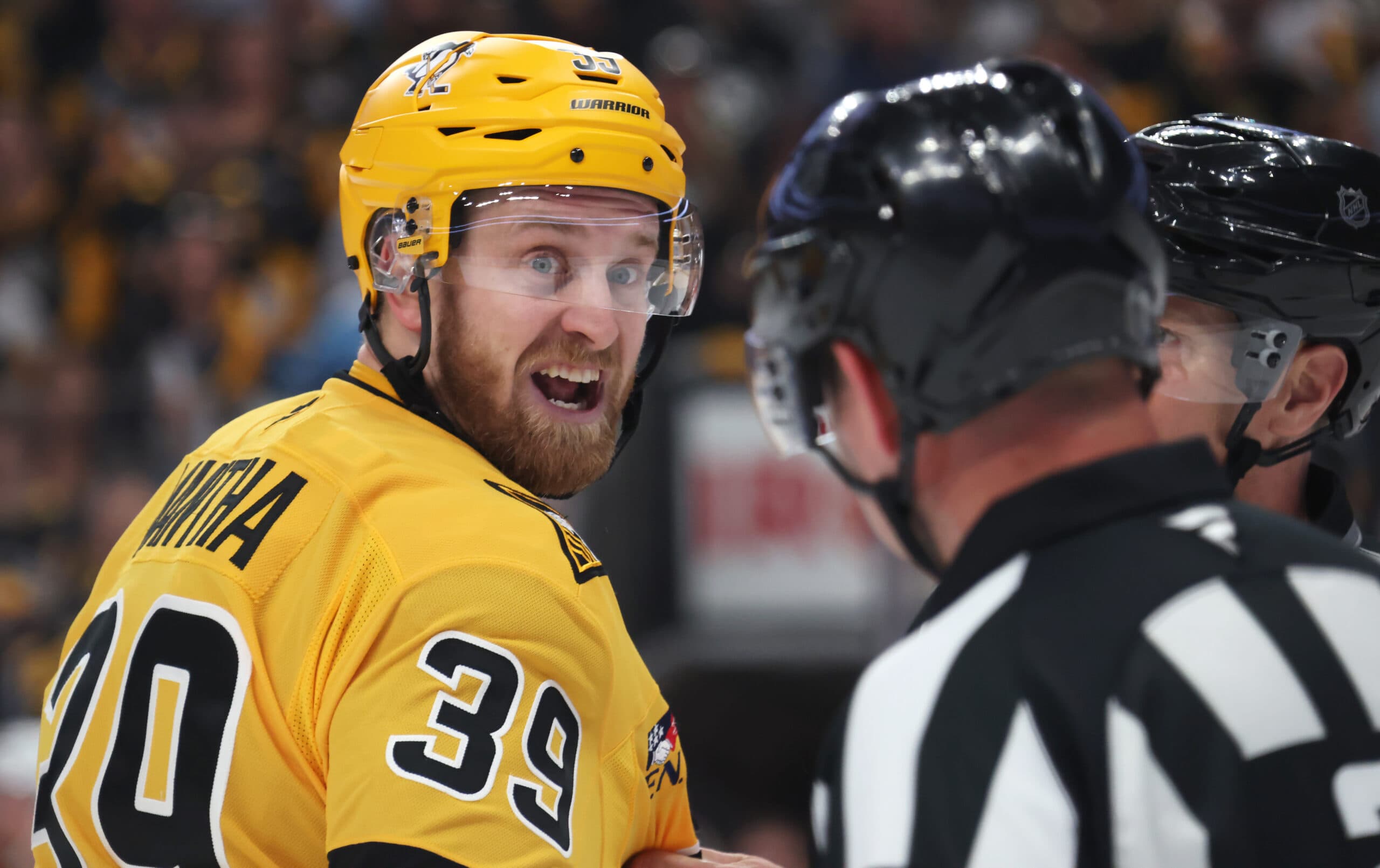
Mantha’s career has long been a question of “What if?” Once thought of as a top-six winger capable of scoring 30+ goals when he was drafted 20th overall in 2013, Mantha just couldn’t find a fit in the NHL. Injuries and inconsistent playing time led to him never hitting his potential, and after stints with the Detroit Red Wings, Washington Capitals, Vegas Golden Knights and Calgary Flames, he signed a “show-me” contract with the Pittsburgh Penguins for the 2025-26 season. The decision paid dividends for Mantha, as he set career highs in goals, assists and points.
Mantha is one of the more efficient goal-scorers since entering the league, with his 0.93 5v5 goals per 60 minutes tied for the 62nd-best rate with the likes of Alex DeBrincat, Evgeni Malkin and Sidney Crosby. But Mantha’s 2025-26 season was not a result of him finally getting the ice time he deserved and producing alongside Crosby or Malkin. Mantha’s season was instead driven by the percentages, as his 21.7% SH% and 14.76% on-ice SH% were significantly higher than his respective 13.8% and 10.45% career rates, explaining why a man who had never surpassed 25 goals or 48 points suddenly had 33 and 64 last season.
Unfortunately for Mantha, the market was relatively skeptical of his career year, and he didn’t fully cash in. He earned just a two-year commitment from the Devils at a $4.75-million AAV not remotely befitting 30-goal production.
Mark Stone, Vegas Golden Knights
2025-26 Stats: 60 games, 28 goals, 45 assists, 73 points
What’s the outlier?: SH% was 5.7% higher and on-ice SH% was 4.01% higher than career average
A quick glance at Stone’s boxcar stats from the 2025-26 season, and nothing appears too out of the ordinary. He didn’t even hit 30 goals, and he only had 73 points on the year. That’s not too extreme for an elite two-way player. But then you remember this is, in fact, Mark Stone, and he definitely didn’t play the entire season. Lo and behold, he only played 60 games, and suddenly those totals do feel abnormally large. He finished 11th in the league in points per game and 24th in goals per game, quite the hefty totals for a guy who had never had more than 67 points in a season prior to last year.
While injuries have kept Stone’s raw goal and point totals down over the years (he’s only played more than 70 games in a season thrice in his career), he’s usually hovered around the point-per-game mark in his career. So 1.22 points per game will wave some yellow flags about how sustainable his performance is, especially in his age-33 season. His percentages aren’t as much of an outlier as those of other players on this list, but the fact he’s seen a 4%+ surge in both his SH% and on-ice SH% are still an easy indicator of a step back next season.
Now, as long as Stone is playing with the likes of Jack Eichel, Mitch Marner and Shea Theodore, he’s still in a great position to produce. But the percentages, Stone’s age and his health history should leave you feeling bearish on him repeating this performance next season.
Pavel Zacha, Boston Bruins
2025-26 Stats: 78 games, 30 goals, 35 assists, 65 points
What’s the outlier?: SH% was 9.8% higher and on-ice SH% was 4.49% higher than career average
Zacha has had an interesting career. While he’ll never live up to his sixth-overall draft pedigree, he’s seen a big turn in his career since joining the Bruins. Usually good for 20-35 points when with the New Jersey Devils, he’s since become a consistent 50-point player in Boston, especially alongside fellow Czech David Pastrnak. Zacha’s not a perfect center, but he’s good enough to support the elite play-driving and production Pasta provides.
But for the first time as a Bruin, Zacha wasn’t a regular alongside Pastrnak. While Pasta spent a lot of his time with some combination of Morgan Geekie, Marat Khusnutdinov, Elias Lindholm and Fraser Minten last season, Zacha mostly played with Viktor Arvidsson and Casey Mittelstadt. Despite not playing with Boston’s star winger, Zacha saw an increase in production with 30 goals and 65 points despite never having more than 21 goals and 59 points in his career prior to then. Not surprisingly, he got incredibly lucky doing so with an almost 10% increase in his individual SH%.
Now, I have been burned by doubting Bruins players’ ability to maintain lucky performances in the past with this series. The only player to not take a step back from last year’s list was Geekie, who’s proven capable of sustaining his SH% based on 2025-26. But I feel a bit safer saying Zacha will take a step back towards his 20-goal, 55-point production next year, especially if he remains away from Pastrnak. Also, last season was already a positive regression from Zacha’s 14-goal, 47-point season in 2024-25, so he got some good fortune out of 2025-26.
SPONSORED BY bet365
Recently by Scott Maxwell
- Five NHL players who may benefit from positive regression in 2026-27
- The five best contracts signed in 2026 NHL Free Agency so far
- The five worst contracts signed in 2026 NHL Free Agency so far
- Buyer Beware: Which UFAs might get too much money and term this summer?
- The biggest bust selected at each top 20 NHL Draft spot