Five NHL players who may benefit from positive regression in 2026-27

Whether you like it or not, math and luck play a role in hockey.
Sometimes players are scoring or stopping the puck at a higher rate than they usually do, and sometimes they’re doing it at a lower rate. Regardless, the bill always comes due, and those percentages swing the other way, unless the player is just that good.
Every year, we see some players have down years compared to the rest of their career, and they usually bounce back the following season. So I thought it’d be a good idea to look at some players who underperformed their percentages in 2025-26 and could see those results go the other way next year. This list will just look at regular-season performances, as the playoffs, with their small sample sizes even for teams going on deep runs, mean there are too many anomalies to choose from.
It’s not a guarantee that every player on this list will get better, especially when percentages have far less impact on regression than they used to. But it’s still important to look at and be aware of them, especially if you’re a fan wanting to manage expectations, or a fantasy hockey player looking for potential steals in this season’s draft. And to put things in perspective, last year’s edition saw four of the five players (with the other, Alexandar Georgiev, not even playing in the NHL last season) take a step forward, so this is still an effective predictor.
Ross Colton, Nashville Predators
2025-26 Stats: 73 games, 9 goals, 15 assists, 24 points
What’s the outlier?: SH% was 5.5% lower than career average
Remember when Colton had eight goals in his first nine games in 2024-25? Well, last season Colton had just nine in total. While one would assume that 2025-26 was the regression from Colton’s hot start the year prior, but he actually already regressed in that season, as he only scored eight more goals in the remaining 52 games. All in all, he shot just 12.8% this season, only 1.4% above his career high of 11.4%, so it’s far from an aberration. But last season, Colton’s SH% was just 5.9%, far from what he’s used to in his career. At 29 years old, he’s far from experiencing age-related decline either, so a bounce-back season should be expected.
One thing that will certainly help Colton is a change of scenery, which he will get with the Predators. While one would think he would benefit from playing on a stacked Colorado Avalanche team last season, it was the opposite. He was often buried in the lineup, with his 12:31 ice time per game ranking 12th among forwards, and, obviously, the bounces didn’t go his way. With Nashville, he’ll have a better role right out of the gate, and certainly have the room to move up the lineup if he plays well.
Last season’s production was too low for a forward generally good for 15-20 goals and 30-40 points, especially given that his assists were around his career average. A clean regression the other way would see Colton get around 25 goals next season, and that’s before any adjustments to a higher role in the lineup in Nashville (albeit with a team not nearly as talented). If that’s the case, Colton could prove to be a solid gamble, especially for only a couple third-round picks.
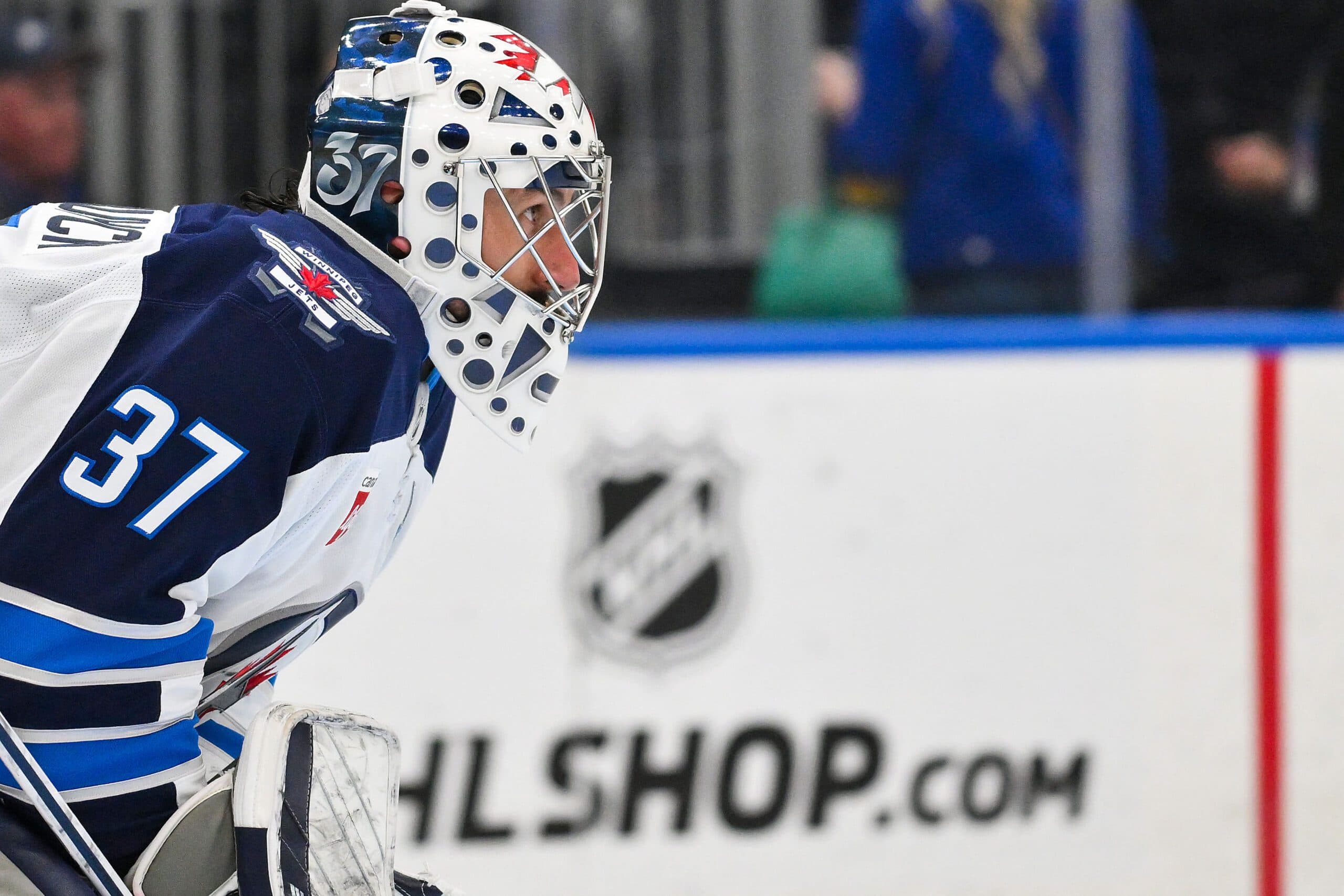
Connor Hellebuyck, Winnipeg Jets
2025-26 Stats: 57 games, 23-23-11 record, .895 Sv%, 16.09 5v5 GSAx
What’s the outlier?: Sv% was .021 lower than career average
Normally, when I look at positive regression candidates, I’m more likely to steer clear of players the older they get, especially in their 30s. Once a player hits 30, it’s open season for their play to fall off due to natural decline, and it has less to do with luck. But even at 33, Connor Hellebuyck feels like the exception. After one of the stronger three-season runs we’ve seen from a goalie (particularly in this era of increased scoring) with a .921 SV% and 90.12 5v5 GSAx, Hellebuyck saw a significant drop in his play in 2025-26, particularly with his .895 SV%. It was the first time in his career he’d ever fallen below .900 in a season (his previous lowest was .907), so it was a shocking run of form from one of the game’s best netminders.
However, plenty of factors went into Hellebuyck’s struggles. He missed 12 games due to a knee injury after a career in which he had hardly ever missed games (he’d missed 8 combined to injury prior to last season). Despite the injury, he still played 57 games, which was 81.43% of the games he was healthy for. Also, Winnipeg was significantly worse defensively, as they went from allowing 2.34 5v5 xGA/60 in 2024-25 to 2.85 5v5 xGA/60 last season, which is why Hellebuyck was still 15th in the league in 5v5 GSAx. Besides, he had to have a down year eventually.
While age could certainly mean that we don’t see Hellebuyck return to his Hart Trophy-winning form, and the Jets didn’t exactly improve the team in front of him, I’d imagine a healthy season and some better luck will at least see him return to the consistently strong goaltender we’ve come to expect from him. And considering the possibility that he may also be on the move, perhaps he may find himself in a stronger defensive environment as well.
Nils Hoglander, Nashville Predators
2025-26 Stats: 38 games, 2 goals, 3 assists, 5 points
What’s the outlier?: SH% was 5.9% lower and on-ice SH% was 2.95% lower than career average
The Predators appear to be investing in positive regression candidates for next season, as Hoglander is the second player on Nashville to make this list while also having been dealt to the team this summer. It’s not the worst idea for short-term improvement without giving up notable assets, and in Hoglander’s case, acquiring him only cost Nashville a third-round pick. It’s not guaranteed to work, but it’s certainly the cheapest way to go about it.
Hoglander had a forgettable season in 2025-26. In addition to missing 33 games due to lower-body injuries, he was a healthy scratch for another 11. His inconsistent place in the Vancouver Canucks‘ lineup likely played a role in only getting five points last season, but even in a full season, he was only on pace for 10 points, which would have been his worst production among his seasons with at least 50 games played. With a 5.7% SH% and 5.97% on-ice SH%, it’s easy to see how he struggled to both score and set up his teammates – the puck just wasn’t going in the net when he was on the ice. Some of that may be the leftovers of a regression swing from 2023-24 (he had 24 goals and 36 points while shooting 20% and his teammates shooting 11.94% with him on the ice), but he certainly isn’t this bad.
Hoglander is generally good for 10-20 goals and 20-30 points, and that’s not accounting for him still being 25 years old and capable of taking another stride or two, especially in a new environment in Nashville (or even just away from Vancouver and the mess they’ve become). Assuming last season was a regression from 2023-24, Hoglander will probably get around 15 goals and 30 points next season, and that’s if his role doesn’t increase in Nashville.
Adin Hill, Vegas Golden Knights
2025-26 Stats: 27 games, 10-9-6 record, .871 Sv%, -10.73 5v5 GSAx
What’s the outlier?: Sv% was .034 lower than career average
I’ll admit that I’m not the biggest believer in Adin Hill. While he was excellent during the Golden Knights’ Stanley Cup run in 2023, he’s coasted on that reputation since then, which has led Vegas to hurt themselves by trading Logan Thompson and extending Hill to a six-year contract with a $6.25 million cap hit. The Golden Knights could be paying Thompson less money to do a much better job, but they’ve invested in Hill, and it’s proven to be the wrong decision.
But while I don’t think highly of Hill, it’s because I think he’s a league-average goalie who’s treated like a surefire starter. What he isn’t is the unplayable goalie we saw last season. Yes, injuries played a role in his struggles, including a lower-body injury that sidelined him for 38 games. That also led to him eventually losing the starting gig to Carter Hart, so an inconsistent role likely hurt his performance. But luck likely played a role as well, as he’s generally been a goalie who’s hovered around a .900 SV% and a neutral 5v5 GSAx (especially as a starter).
Again, I don’t think this is a sign that he’s going to become the consistent starter the Golden Knights have needed in net over the past few seasons. Perhaps regression swings the other way, and Vegas gets one really good season out of him, but I wouldn’t expect anything beyond that season. However, what the Golden Knights can expect from Hill is for a return to the goalie who is just good enough behind their defense to be a playoff contender. Even at 30 years old, he still has a few solid years left in him.
Kent Johnson, Columbus Blue Jackets
2025-26 Stats: 76 games, 7 goals, 15 assists, 22 points
What’s the outlier?: SH% was 6.2% lower than career average
The Blue Jackets were one of the feel-good stories of the 2024-25 season. In the wake of the tragic death of star winger Johnny Gaudreau, Columbus saw many of their young players take steps forward and become big contributors to the team, driving the team to a surprise season where they missed the playoffs by only a hair. One of the bigger breakouts was Johnson, who set career highs with 24 goals, 33 assists and 57 points in just 68 games. At just 22 years old, it felt like a step in the right direction for the 2021 fifth-overall pick.
But one year later, and the future looks bleak for Johnson – at the very least, in Columbus. After such a successful 2024-25 campaign, last season was the exact opposite. In fact, he had fewer points in 2025-26 (22) than he did just goals the year prior (24). Some of his struggles were due to a negative regression from his breakout season (he shot 7.2% more than his career rate and his on-ice SH% was 2.68% higher than usual), but he also struggled to get a consistent role with the Blue Jackets, as he finished the season 10th among Columbus forwards in ice time per game. That’s not exactly the right way to utilize a 60-point player. Even after the Blue Jackets fired Dean Evason and hired Rick Bowness, he was still the 10th most-used forward – in fact, his ice time decreased.
It’s hard to gauge what we will see from Johnson this season because it largely depends on where he is played. If he’s used as a top-six forward like 2024-25, expect to see him take more steps forward after last season’s hiccup. But if Bowness still doesn’t trust Johnson and plays him minimally, we may see his struggles continue. And if the latter is the case, it may take a change of scenery to truly fix this.
SPONSORED BY bet365
Recently by Scott Maxwell
- The five best contracts signed in 2026 NHL Free Agency so far
- The five worst contracts signed in 2026 NHL Free Agency so far
- Buyer Beware: Which UFAs might get too much money and term this summer?
- The biggest bust selected at each top 20 NHL Draft spot
- Five lessons other NHL teams can learn from the Hurricanes