NHL 2030: Projecting the top 30 players of the future

One year ago, we asked you to picture the not-too-distant future: the 2030 offseason.
Connor McDavid — the 33-year-old version — headlined our list as the projected best player in 2030. While the next generation had arrived, no one looked ready to take McDavid’s crown anytime soon. But much has changed in the last year.
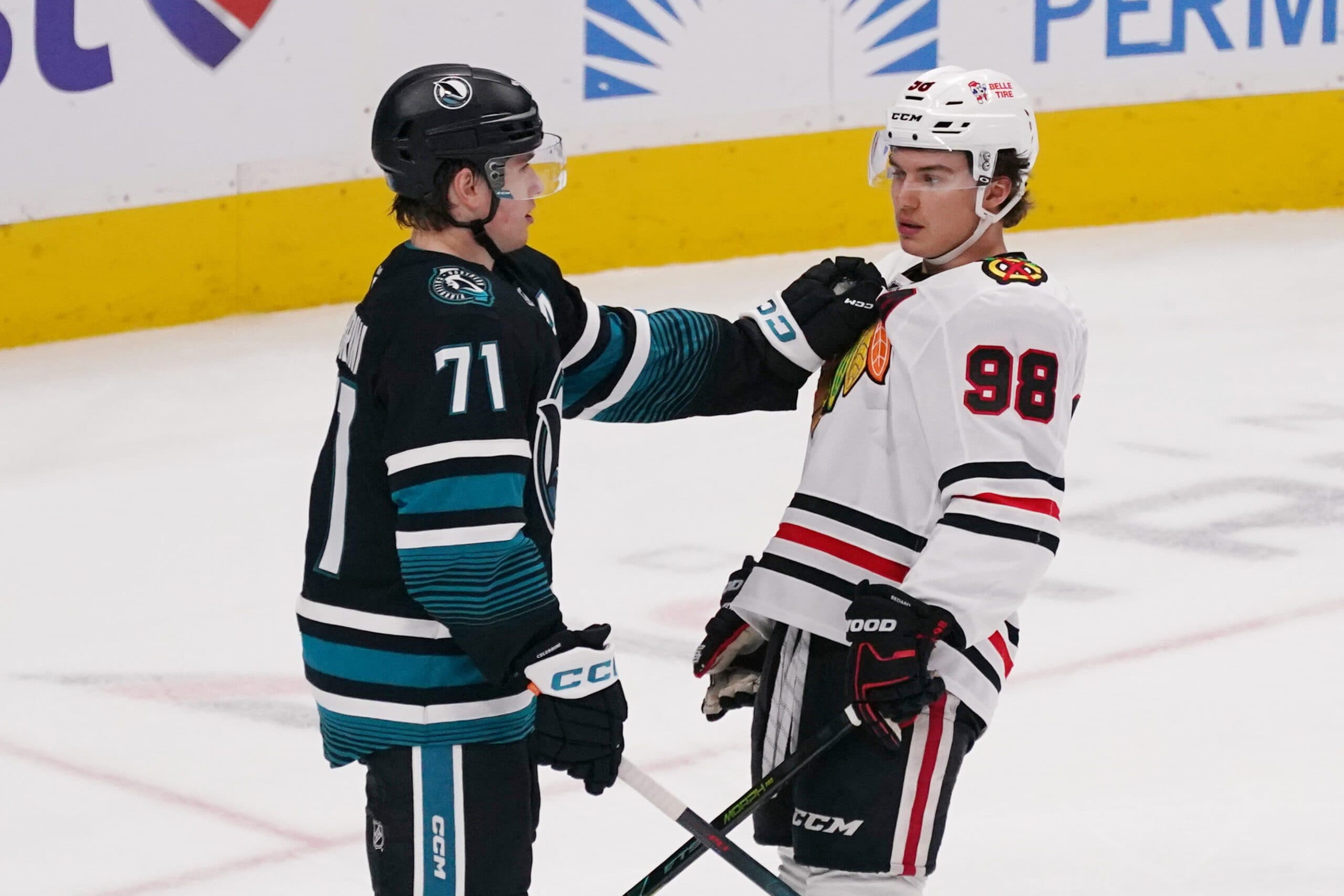
Macklin Celebrini exploded as a sophomore. Gavin McKenna was drafted by the Toronto Maple Leafs after a turbulent but exceptional college rookie season. Matthew Schaefer had one of the greatest seasons ever by a teenage defenseman. Connor Bedard dominated offensively before a mid-season injury. In sports, one year can feel like an eternity in the trajectory of a career.
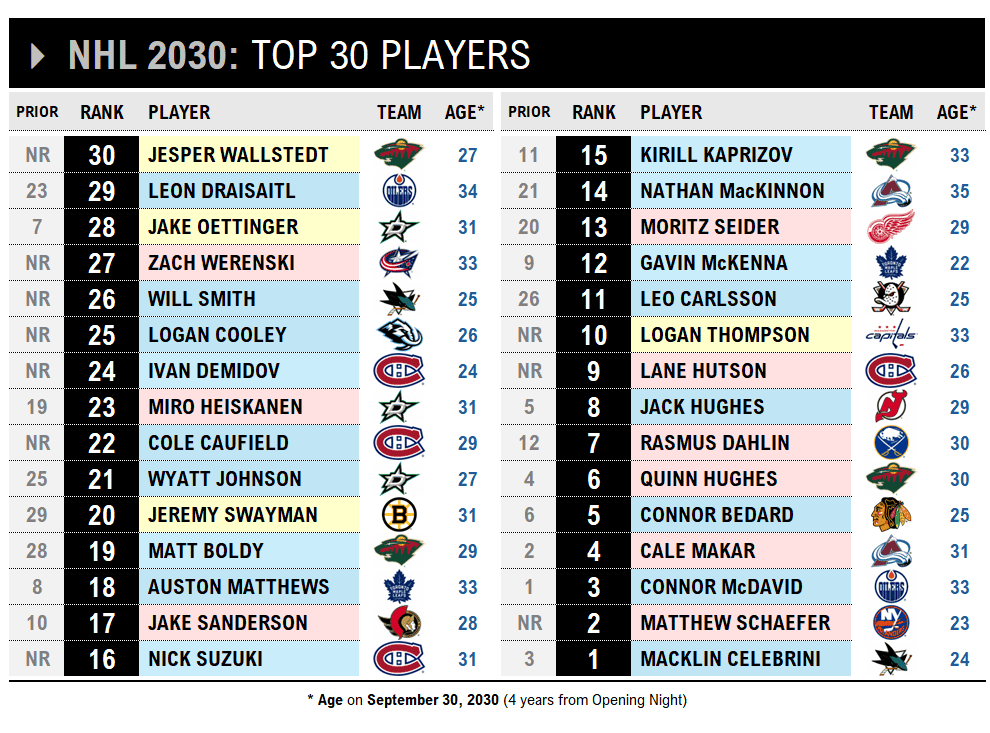
After a year of development, decline, and hindsight, we’re updating the projection: Who will be the 30 best players in the NHL in 2030?
💻 The Approach
The method taken to build the list was similar to last year. A statistical profile of age, box score stats, and advanced metrics was assembled for over 100 players. From there, a combination of aging curves, public scouting profiles, and subjectivity based on factors like playing style, roster opportunities, and potential future teammates were used to narrow the list to 30 players.
It’s important to consider age in this exercise. In 2025-26, only one forward among the top 17 point scorers (Celebrini) was outside their age-24 to age-32 seasons. For defensemen, eight of the top 10 scorers were between their age-25 and age-29 seasons — Lane Hutson and Erik Karlsson were the exceptions. So, a list crowded with current, prime-aged superstars that will be well into their 30s by 2030 isn’t a defensible ranking. New blood will inevitably take over the NHL.
Much like draft rankings, there are no right or wrong answers… until 2030. Even then, deciding on a top 30 will trigger debate. Will Leon Draisaitl at 35 still be a better player than Leo Carlsson at 25? Projections are meant to be fun and thought-provoking in the offseason.
We’ll count down by position — four goaltenders, nine defensemen, and 17 forwards — to reveal the list. All ages are as of September 29, 2030 (i.e., four years from this season’s opener).
🔮 Goaltenders (4)
30. Jesper Wallstedt, Age (in 2030): 27
The 20th overall pick in the 2021 NHL Entry Draft, Wallstedt’s much-anticipated rookie season was a success. In 35 appearances, he stopped 13.3 GSAx — good for eighth in the league on a per-game basis (minimum 30 games). He took control of the Minnesota Wild crease in the postseason, starting 10 of 11 games and stealing the net from incumbent Filip Gustavsson. Younger and with more upside, Wallstedt should continue to force John Hynes’ hand.
28. Jake Oettinger, Age: 31
Over the last five seasons, the 27-year-old is sixth in starts (272), tied for second in wins (173), and sixth in GSAx (58.7). That’s an average of 35 wins per season, placing Oettinger on the short list of modern NHL workhorses that consistently deliver above-average goaltending. While Oettinger was unspectacular in the postseason and falls 21 spots to #28, he’s a critical piece of a well-built Dallas Stars team that is perennially competitive.
20. Jeremy Swayman, Age: 31
Swayman was charitably given the #29 spot on this list last year despite a contract dispute and shaky start in 2024-25. His drive and ability felt too strong for mediocre play. That trust was rewarded. Both Swayman and his Boston Bruins rebounded nicely in 2025-26. Swayman finished third in GSAx (+26.5), earned a Vezina finalist nod, and won Olympic Gold in a backup role. Boston returned to the playoffs after a rapid retool.
10. Logan Thompson, Age: 33
In two seasons in Washington, Thompson has finished fourth in Vezina voting twice. He probably should have won the award last year but the Capitals missed the playoffs by three points, typically a punch to the nose when it comes to award votes. Reborn under longtime Caps’ goalie coach Scott Murray, Thompson has relatively few miles on his tires and feels like a goalie on the rise at 29. He’s the frontrunner for Canada’s crease at the 2028 World Cup.
HONORABLE MENTIONS: Spencer Knight (Age in 2030: 29); Jet Greaves (29); Jakub Dobes (29); Igor Shesterkin (34); Dustin Wolf (29)
OFF THE LIST: Filip Gustavsson (#13); Yaroslav Askarov (#15); Igor Shesterkin (#24)
🔮 Defensemen (9)
27. Zach Werenski, Age (in 2030): 33
Fresh off his first Norris Trophy, Werenski has the toolkit to remain elite for many years. But he’ll be 33 in 2030 and the modern NHL has shifted toward young defenders headlining Norris conversations. With his situation in Columbus murky at best on a contract ending in 2028, there’s plenty of uncertainty around the Michigan native’s future home.
23. Miro Heiskanen, Age: 31
At 26, Heiskanen remained a pillar of the Stars’ defense in 2025-26. He’s an elite play driver in both directions and his 63 points were the second-most of his career. The bottom line: Heiskanen has few weaknesses. He’s a 25 minute per night defenseman that plays tough competition and rarely takes penalties. There’s no evidence to suggest he won’t be a dominant force into his early 30s.
17. Jake Sanderson, Age: 28
Sanderson leveled up further last season on both sides of the puck. While missing 15 games hurt his final stat line, he scored at a pace of 17 goals and 66 points in his age-23 season. Incredibly, he took only four minor penalties last season while leading the Ottawa Senators to a defensively dominant campaign. The current generation of two-way blueliners is spectacular and Sanderson fits right in near the top of the cohort.
13. Moritz Seider, Age: 29
Seider got the #20 spot last year, a sign of trust that his breakout 2024-25 wasn’t a one-off. While his Detroit Red Wings were a mess during and after the 2025-26 season, there’s nothing messy about Seider’s game. He now controls the ice both offensively and defensively and there should be Norris Trophy finalist nods between now and 2030. He leaps seven spots to #13.
9. Lane Hutson, Age: 26
Last year, I didn’t even include Hutson as an honorable mention. Not factoring an undersized rookie in the top-13 blueliners on a projection five years into the future was hardly meant to be a snub, though some took it that way on social media. I was looking to see Hutson flash above-average defensive chops over a full season as a sophomore. He checked that box and replicated the dazzling playmaking skills that have become his calling card. Finishing fourth in points by a defenseman (78), he also led the Habs to a surprise Final Four appearance.
7. Rasmus Dahlin, Age: 30
Dahlin’s eighth NHL season boosted his reputation on two fronts: his Buffalo Sabres ended the longest postseason drought in NHL history and he was a Norris Trophy finalist for the first time. He added another 14 points in 13 playoff games. Somehow, Dahlin is a year-and-a-half younger than Cale Makar and six months younger than Quinn Hughes. Still 26, the Sabres’ captain looks like he could do this for another five to ten years. He jumps five spots from #12 to #7.
6. Quinn Hughes, Age: 30
It was a unique year for Hughes. He maneuvered his way off a sinking ship in Vancouver. He landed in Minnesota on a team in win-now mode. He won Olympic Gold in February, winning Best Defender. He’s expected to sign a mid-length extension with the Wild. While Hughes finished seventh in Norris voting in 2025-26, both statistically and reputationally he has few equals. He drops from #4 to #6, strictly from the emergence of a pair of much younger players.
4. Cale Makar, Age: 31
Makar’s play driving curiously dipped last season. But at the end of the year, he had his sixth consecutive point-per-game season and Norris finalist nod, joined Hughes on the Olympic All-Star team, and averaged 24:51 on a Colorado Avalanche juggernaut that sailed to the Presidents’ Trophy. There’s enough noise in the underlying numbers that it’s plausible other defenders catch Makar by 2030. But he’s still projected as a top-two defenseman and top-four player overall.
2. Matthew Schaefer, Age: 23
I’m not sure a single person in hockey expected Schaefer to debut as one of the NHL’s better defensemen. In fact, anyone suggesting he’d score 23 goals and drive play in both directions probably wouldn’t have been taken seriously. Throwing him an honorable mention last year felt more like insurance than a confident bet. But that’s why we watch the games: to be amazed. Schaefer was truly amazing last season — dynamic, fun, delightful. All as an 18-year-old. Even slow, incremental progress the next four seasons would move Schaefer to the top of the NHL’s blueline before his 23rd birthday.
HONORABLE MENTIONS: Evan Bouchard (Age in 2030: 30); Jackson LaCombe (29); Sam Dickinson (24); Adam Fox (32); Thomas Harley (29); Brandt Clarke (27)
OFF THE LIST: Luke Hughes (#14); Thomas Harley (#16); Zeev Buium (#27); Owen Power (#30)
🔮 Forwards (17)
29. Leon Draisaitl, Age (in 2030): 34
Draisaitl has had some lingering injuries in recent seasons and will turn 35 in October 2030. We also have no idea if he will still be anchored to McDavid on the power play or be a frequent linemate for stretches. And very very few 35-year-olds are top-30 players in any sport. But I couldn’t leave Draisaitl off. He’s simply too skilled, productive, and consistent that even the inevitable steep plummet from his current 122-point pace yields an elite NHL forward.
26. Will Smith, Age: 25
It’s hard to know who will play with Celebrini in 2030. The San Jose Sharks have a wealth of talent upfront that leaves countless options based on progress, chemistry, and flexibility. Will Ivar Stenberg or Michael Misa be better than Smith by then? Maybe. But Smith is first out of the gate and will be 25, near the peak of his powers by 2030. He just scored at a 70-point pace in his age-20 season.
25. Logan Cooley, Age: 26
This spot could just as easily go to teammate Dylan Guenther, who broke out last season. But Cooley feels like a forgotten man, having missed 28 games in 2025-26. With blazing speed, the third overall pick in 2022 slots in seamlessly with the Utah Mammoth‘s group on the rise. Cooley quietly scored at a 31-goal, 69-point pace the last two seasons in his age-20 and age-21 seasons.
24. Ivan Demidov, Age: 24
While Demidov wasn’t a young rookie — he turned 20 in December 2005 — he was an exceptional one. He fit in nicely on a Montreal team learning how to battle for wins, scoring 62 points despite averaging only 15:30 of ice time. He flashed exceptional playmaking skills and added flair to a group that thrived on dramatic moments last season. Everyone is excited to see how Demidov builds on a highly successful debut.
22. Cole Caufield, Age: 29
I wasn’t certain where to slot Caufield. He just scored 51 goals, including an NHL-best 12 game-winners on one of the most exciting teams in hockey in a big market, yet he’s polling more like a top-30 forward at Hockey-Stats.com. It’s difficult to be a consensus top-30 player. But that should shift over time if Mr. Saturday Night can pop 40 goals annually, tighten up his play away from the puck, and the Habs’ remain a contender. He’s a blast to watch play.
21. Wyatt Johnston, Age: 27
Much of Caufield’s commentary above applies to Johnston. While he’s a half-foot taller and two years younger, Johnston was already a world class sniper at 22 last season. He’s offense-only right now but his 27 power play goals were tied for second-most in 30 years. Only four players in the cap era have scored more goals from their age-19 to age-22 seasons: Steven Stamkos, Alex Ovechkin, Auston Matthews, and Sidney Crosby. Remarkable company.
19. Matt Boldy, Age: 29
Boldy’s ceiling will drive his future status as a top-30 player. While his defensive impact has dipped the last two seasons, his résumé has grown. Boldy had his first 40-goal year and first point-per-game season — a 45-goal, 92-point pace at 24. He added the opening goal in the Olympic Gold Medal Game and seven goals in his first postseason beyond the First Round.
18. Auston Matthews, Age: 33
Matthews’ inclusion this high might ruffle some feathers. While the Leafs’ captain fell 10 spots on the list from #8 last year, missing 22 games and scoring at a vanilla 37-goal pace (by his standard) screams decline to many. Dismissing his struggles as lingering injuries, a terrible coaching fit, and low shooting percentages are easy excuses, but an all-world sniper in his mid-20s named Alex Ovechkin suffered the same fate a generation prior. I’m banking on a rebound for Matthews on both sides of the puck that proves to be a renaissance for his career.
16. Nick Suzuki, Age: 31
Fresh off a well-deserved first Selke Trophy, 101-point season, Olympic Silver, and Conference Finals run as captain, it was a career year for Suzuki. Nothing about it was statistically fluky though, other than perhaps some of the Habs’ playoff puck luck. Suzuki is here to stay, a respected leader on a team maturing around him. He’s finally getting the credit he deserves and I do wonder if he has some kind of Barkov-esque arc in his future. Suggesting the possibility feels like a big compliment. One year later, that’s four Canadiens in the top 30. There were none last year.
15. Kirill Kaprizov, Age: 33
Kaprizov’s place in the NHL reminds me a lot of Artemi Panarin. It’s not just the passport, either. Arriving late to North America, both just produce year after year. Kaprizov has scored at a 49-goal, 102-point rate for five seasons. Has anyone done that in the cap era with less fanfare or award love? He should deliver elite production for another half-decade, particularly if Hughes’ services are secured through 2030 or beyond.
14. Nathan MacKinnon, Age: 35
I know, I know, my earlier pep talk said there are so very few elite players in their mid-30s. But like Draisaitl, MacKinnon has produced at such an outsized level, there is ample room to age gracefully. After winning his first Rocket Richard Trophy at 30, it’s MacKinnon’s wheels, drive, and fitness that should keep him defying the aging curve in a unique way. I’m bullish on the 2013 first overall pick, who rises seven spots after another MVP-caliber year.
12. Gavin McKenna, Age: 22
What to do with McKenna on the list? Having never played an NHL game, slotting him 12th is generous. I had him ninth last year after a peerless junior career. He thrived at Penn State in 2025-26, finishing on the 10-person list of Hobey Baker candidates in a season he began at 17 years old. In the short-term, playing with Matthews on a team trying to make a big push to compete the next two seasons should help his development. But the big what-if: what might a Matthews-less Leafs team look like by 2030?
11. Leo Carlsson, Age: 25
Right now, it feels like Carlsson’s offer sheet and contract are major distractions, the ripple effect trickling into every notable contract signed since. How that ultimately affects Carlsson and the Anaheim Ducks‘ locker room and cap situation is too early to say. But Avalanche captain Joe Sakic signed an offer sheet in 1997 and it didn’t interrupt his Hall of Fame career — he remains their President and GM nearly three decades later. As for Carlsson, he rises 15 spots to #11. In early December, still 20 years old, he was scoring at 107-point pace, which offered a glimpse of his tremendous upside.
8. Jack Hughes, Age: 29
The Golden Goal was cool and will make him legitimately famous his entire life. But Hughes was an exceptional player before and remains one after. But I still don’t think we’ve seen his best hockey. He’s played more than 62 games once in seven seasons, creating a loop of starts and stops. Hughes quietly scored at a 99-point pace over the last five seasons and may find another gear if healthy for a full campaign. He drops three spots to #8 in 2030.
5. Connor Bedard, Age: 25
Early on last season, the 20-year-old phenom was doing generational scoring things. An injury derailed a promising year and an offseason shoulder surgery will slow Bedard’s 2026-27 preparation. But some additional offensive support via Bowen Byram, Roman Kantserov, and Patrick Kane (cool it people, he’s almost 38), plus internal development, should offer Bedard an improved climate to thrive. Despite some early bumps, I’ve never lost faith that Bedard will score 50 goals and compete for scoring titles eventually.
3. Connor McDavid, Age: 33
McDavid was praised in this space last week as he wrapped his ninth consecutive season holding The Torch as the best player in the NHL. One year ago, no one had really shown enough yet to confidently say McDavid could be dethroned by 2030. But even the biggest McDavid homer would have to admit that Celebrini’s (and Schaefer’s) mind-bending performances last year created a frenzy that no had seen since, well, McDavid a hockey generation ago. In 2030, McDavid will have completed 15 seasons and whether Celebrini, Bedard, Schaefer, or someone else, it’s increasingly likely that Number 97 won’t be Number One.
1. Macklin Celebrini, Age: 24
There’s no guarantee that Celebrini improves upon his 45 goals, 115 points, and fourth-place finish in Hart Trophy voting in 2026-27. Through injuries, a shift to shooting more, and an NHL-wide drop in offense, Crosby never bettered the 120 points from his age-19 season. Maybe the San Jose Sharks tighten up defensively or Celebrini doesn’t shoot 15.7% next year? Maybe. But let’s be honest: Celebrini was a freight train last season as a teenager. His motor never stopped. His game-breaking skill never wavered. His 10 points at the Olympics while hanging with the best of the best showed us the future. Much like the commentary on Schaefer, modest gains (or gulp, no gains at all) may still bring Celebrini to the NHL’s mountain top. He’s that good right now.
The superstar gauntlet of Celebrini, Schaefer, McDavid, Makar, and Bedard make it an all-Canadian future top five. But the overall top-30 list leans south of the border: USA (13); Canada (9); Sweden (3); Russia (2); Germany (2); Finland (1).
HONORABLE MENTIONS: Seth Jarvis (Age in 2030: 28); Tim Stutzle (28); Juraj Slafkovsky (26); David Pastrnak (34); Ivar Stenberg (23); Dylan Guenther (27); Michael Misa (23); Aleksander Barkov (35); Jason Robertson (31); Porter Martone (23); Beckett Sennecke (24); Jack Eichel (33); Anton Frondell (23); Nikita Kucherov (37); Lucas Raymond (28); Mitch Marner (33)
OFF THE LIST: Tim Stutzle (#17); Seth Jarvis (#18); Lucas Raymond (#22)
Data from Hockey-Reference; HockeyStats.com; Elite Prospects
Recently by Paul Pidutti
- The Torch: Naming the best player for every year in NHL history
- Is the NHL entering its Trade Era?
- Day-after reaction: Hockey Hall of Fame’s Class of 2026 (mostly) gets it right
- Projecting the 2026 Hall of Fame Class: Bergeron, Price, Räty and endless possibilities
- Who makes the Hockey Hall of Fame All-Snub Team?
- Spoiler alert: Goaltending decides the NHL playoffs
- What can the modern history of No. 1 picks tell us about Toronto’s future?