Seven unexpected players put in opportunistic roles to start 2026-27

We’re a couple weeks into the NHL season, and while we’re still several more from the point where we can really react to what has happened, we can still be proactive. The easiest way to do that is by looking at how teams have deployed players in the early going. While a player’s usage can always change, how they are deployed and who they play alongside can significantly impact their performance.
Many teams took the predictable route with their lineups, using their six best forwards in the top six and their four best defensemen in the top four. But every now and then, teams throw us a curveball, and a surprising player ends up playing with some elite talent.
So today, we’ll look at seven players placed in these opportunistic roles to start the season who could be in store for unexpected campaigns. Whether you’re a fantasy hockey manager scouring the waiver wire for a potential breakout, or you’re just a fan of the game looking for the next deep cut, this list is for you (although for the former situation, you may already be too late). However, this won’t include high-profile rookies who were already expected to receive this kind of ice time. Not every rookie is omitted, but don’t expect to see Viggo Bjorck or Roman Kantserov on this list.
Luca Cagnoni, San Jose Sharks
On a Sharks team littered with young talent, Cagnoni wasn’t on many people’s radars as a 2023 fourth-round pick. But after back-to-back 40-plus-point campaigns in the AHL, it was clear that he was ready to at least test the next level, so he found himself on the Sharks roster to start 2026-27. But while a sheltered third-pairing role was expected for the offensive defenseman, a spot on the top power-play unit came as a bit more of a surprise.
Now, when you actually think about it for a minute, Cagnoni’s power-play role isn’t that shocking. The Sharks needed a new quarterback on the unit after letting John Klingberg walk, and none of their experienced blueliners were clear replacements. Considering Cagnoni’s dynamic offensive game, only playing him on the third pair would have hurt his development. So why not also give him a chance to thrive and display his talents alongside some of the best young players like Macklin Celebrini, Will Smith and Ivar Stenberg? He did lose the spot to Dmitry Orlov during Tuesday’s 6-3 loss to the Boston Bruins, so we’ll see what his future is there, but the Sharks have done well on the power play there with a 23.5% success rate, the 10th-best in the league.
Declan Carlile, Pittsburgh Penguins
Carlile is yet another example of the development factory that is the Tampa Bay Lightning. After signing as a college free agent, Carlile spent parts of four seasons largely in the AHL before injuries to Tampa’s blue line finally gave him the opportunity to establish himself as a consistent NHLer in 2025-26, largely in a depth role. The Lightning opted to let him walk to free agency in the summer, and the Penguins happily brought him into the fold.
Now, Carlile has found himself in an even bigger role in Pittsburgh, playing on the top pair alongside Erik Karlsson. It’s not because of injuries, either, as these two were together prior to Trevor van Riemsdyk’s injury. It’s worked out well so far; the Penguins sport a 58.66% 5v5 goal share and 57.34% 5v5 expected goals share when the duo is on the ice. Carlile has even benefited offensively, as he’s already set career highs with two goals and four points in seven games. I wouldn’t expect his production to continue at that level, but he’s certainly in a position to improve upon his four points in 46 career NHL games prior to this season.
William Carrier, Carolina Hurricanes
Carrier is one of the most experienced players on this list, now in his 11th season, and is also the lone Stanley Cup winner. He’s far from an unknown name, but thus far in his career, he’s generally been a bottom-six forechecker and defensive specialist. But with Seth Jarvis out of the lineup to start the season, the Canes needed a forechecking player to work alongside Sebastian Aho and Andrei Svechnikov, so they have opted for Carrier.
This likely won’t be a long-term combination, especially as Jarvis nears a return. But so far, the returns from putting Carrier on the top line have been bountiful. Aho and Svechnikov are currently putting up career-best paces early on, Carrier has also been productive with six assists in eight games, and the line has been churning up the competition with a 73.59% 5v5 expected goal share. It’s going so well that perhaps it gives the Canes the flexibility to spread out their top players more and put Jarvis on another line. Of course, you’d be tinkering with Stanley Cup-winning lines, but it’s at least nice to know there’s a backup plan for the Aho and Svechnikov combo.
T.J. Hughes, Colorado Avalanche
College free-agent signings have always been hit-or-miss. Sometimes you get a respectable longtime NHLer like Tyler Bozak or Brandon and Chris Tanev, and sometimes you even get a hidden superstar like Adam Oates or Martin St. Louis. But for every success story, it feels like there are several others who flame out, especially at the top of the class in a given year. Remember Jimmy Vesey? While he stuck around in the NHL for a bit, he never lived up to the hype he got when he was signed. And that’s not even touching the likes of Drew LeBlanc or Matt O’Connor, who amounted to nothing in the NHL.
Hughes was this offseason’s top college free agent after finishing as a finalist for the Hobey Baker and ultimately signed with the reigning Presidents’ Trophy winners, the Avalanche. Not only is he joining a top NHL team with the roster openings to put Hughes in the big leagues right away, but they’ve also put him in one of the best situations for a rookie player to get acclimated offensively: on the power play alongside Nathan MacKinnon and Cale Makar. To be fair, this was a power play that struggled immensely at 17.1% last season, so it’s not an automatic recipe for success like Edmonton’s top unit. But the Avs have seen improvement on the man advantage so far this season, clicking at a respectable 23.8%. While Hughes hasn’t contributed just yet (he has just one 5v5 assist in six games), it will be interesting to see how he develops in this role.
Kasperi Kapanen/Vasily Podkolzin, Edmonton Oilers
Speaking of the Oilers’ power play, they’ve had a relatively consistent top unit for several seasons. Ever since Zach Hyman joined the Oilers, they’ve clicked at a 27.9% rate (3% higher than the second-ranked Toronto Maple Leafs in that span) with him, Connor McDavid, Leon Draisaitl, Ryan Nugent-Hopkins and either Tyson Barrie or Evan Bouchard on the top unit. But with Hyman and Nugent-Hopkins injured to start the season, the Oilers have had to find temporary replacements until they return.
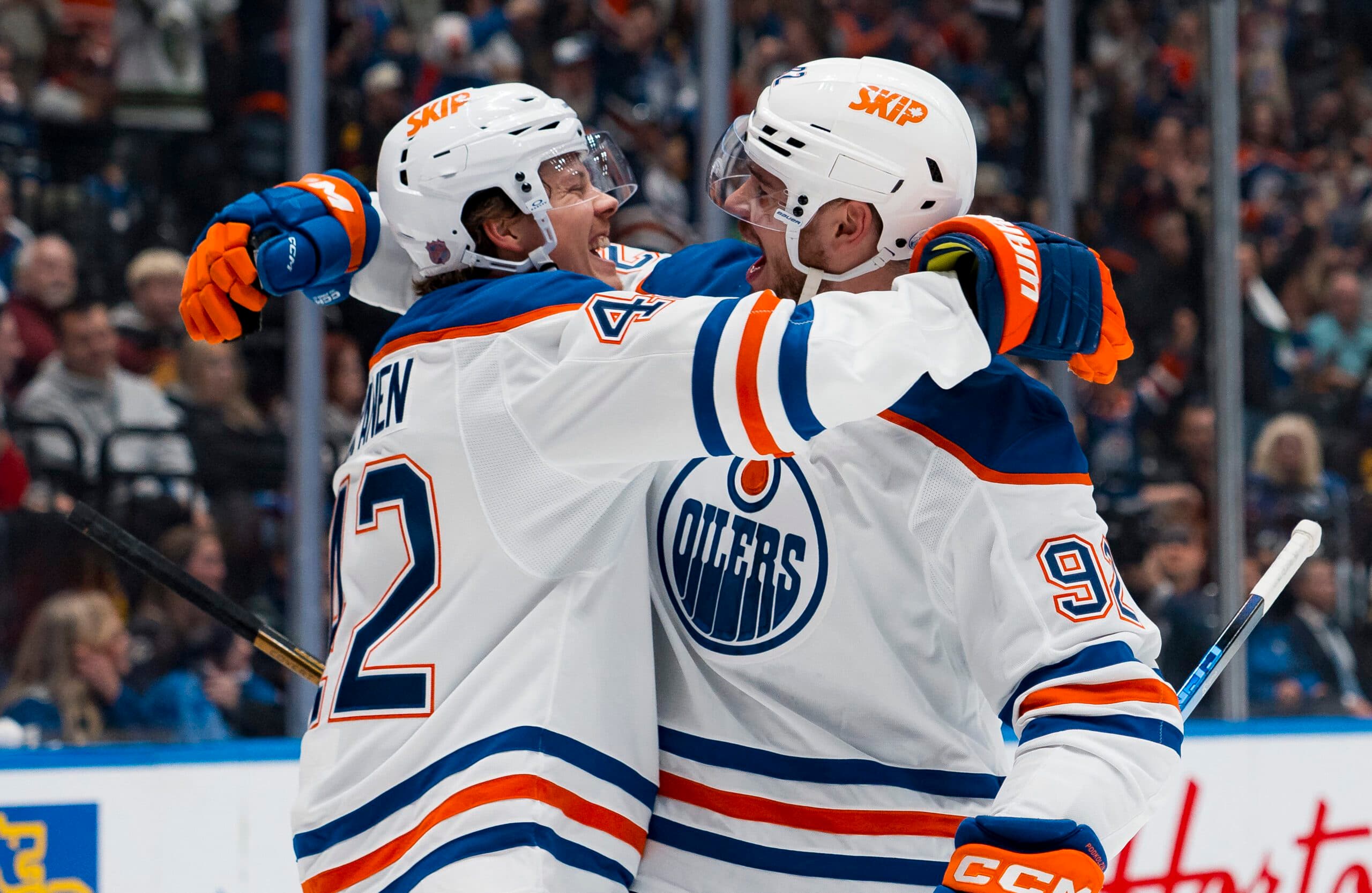
Enter Kapanen and Podkolzin. Neither player is a stranger to playing in a beneficial role in Edmonton, as both were consistent running mates with Draisaitl last season, but the top power play with the Oilers’ best players is a completely different opportunity. Kapanen has been a bit quieter so far with just two power-play points, but Podkolzin has seized the opportunity with seven goals and nine points in six games, including three goals and four points on the man advantage. To be fair, he has a bit more of an advantage since he’s also playing on the top line with McDavid and Draisaitl. Podkolzin has fit right in and is starting to produce like many expected when he was drafted 10th overall in 2019. Still, has he earned the opportunity to keep the role once Hyman and Nugent-Hopkins return? Only time will tell.
Maxim Shabanov, Minnesota Wild
Shabanov was an intriguing signing by the New York Islanders in the summer of 2025, as he was coming off a strong season in the KHL with 23 goals and 67 points in 65 games. For an Islanders squad that lacked firepower up front, he was a good gamble. But between that lack of firepower, poor deployment, injuries and healthy scratches, Shabanov didn’t work out on Long Island, and the Isles opted not to tender him a qualifying offer.
Shabanov wound up signing a one-year, $1.6 million contract with the Wild in the summer, and so far, they aren’t looking to repeat the Islanders’ mistake. At 5v5, he started the season alongside fellow Russians Kirill Kaprizov and Danila Yurov, at least until the Wild opted to load their top line with Kaprizov, Matt Boldy and Joel Eriksson Ek. But even with that change, Minnesota is still giving Shabanov a chance on the man advantage, as he’s playing with that top line and Quinn Hughes. So far, that power play has clicked at a league-leading 36.8%, and while Shabanov isn’t the driving force, he’s still chipping in with three power-play points. As far as high-opportunity situations go, few compete with this.
PRESENTED BY DAILY FACEOFF GEAR

Daily Faceoff has new merch. Rep the game you love with premium Nation Gear x Levelwear tees, hoodies, hats and layers — designed for hockey fans on game day and every day. The home for hockey fans.
SHOP DAILY FACEOFF → nationgear.ca