2026-2027 NHL team preview: St. Louis Blues



LAST SEASON
Fans of the St. Louis Blues have gotten used to watching their team heat up in spring after they’ve already played themselves out of contention, but they thought 2024-25 would be different. Led by coach Jim Montgomery, that season’s Blues really seemed to gel during the 4 Nations Faceoff break and came within two seconds of knocking off the Presidents’ Trophy-winning Winnipeg Jets in the first round. St. Louis looked like it had built something that could work in 2025-26 and beyond.
Instead, the Blues reminded everyone why they needed a 12-game win streak just to claim the eighth seed. Cam Fowler, who had performed so well beside Colton Parayko the previous season, played himself off the top pair in the fall. Offseason trade capture Logan Mailloux couldn’t buy a friendly bounce and needed a hard reset in the AHL. Jordan Binnington and Joel Hofer, a goalie tandem that was supposed to be one of the team’s greatest strengths, started ice cold, and only Hofer bounced back.
St. Louis was dead in the water by the Olympic break, and outgoing GM Doug Armstrong wasn’t going to wait for another epic spring to turn things around. ‘Army’ parted company with captain Brayden Schenn and veteran defender Justin Faulk ahead of the Trade Deadline and would have moved Parayko, too, if the big blueliner hadn’t vetoed a move to the Buffalo Sabres. Naturally, the Blues finished with a 12-4-3 flourish to bring their season total to 86 points, but it wasn’t enough to fool Armstrong and protege/successor Alexander Steen into tripling down on a core that had run its course.
Out went Jordan Kyrou, a talented but inconsistent sniper who had become a fan-favorite whipping boy. In came middle-six speedster Connor McMichael, acquired in Kyrou’s trade to the Washington Capitals, and Mason McTavish, the former Anaheim Ducks third-overall selection who cost the Blues the picks they acquired for Schenn and Faulk. Can a younger, fresher St. Louis roster shake off its bipolar ways and compete in a stacked Central Division?
KEY ADDITIONS & DEPARTURES
Additions
Connor McMichael, C
Mason McTavish, C
Brandon Carlo, D
Ross Johnston, LW
Departures
Jordan Kyrou, RW (Wsh)
Jonathan Drouin, LW (UFA)
Justin Holl, D (Wsh)
Matthew Kessel, D (NYI)
OFFENSE
At the Trade Deadline, it started to look possible that Armstrong would exercise the nuclear option, a Robert Thomas trade. It may have relieved many St. Louisans when no one could meet Armstrong’s astronomical asking price, but it shouldn’t have surprised them; top centers (Thomas has averaged more than a point a game since 2022) with good contracts in their 20s never become available for a reason.
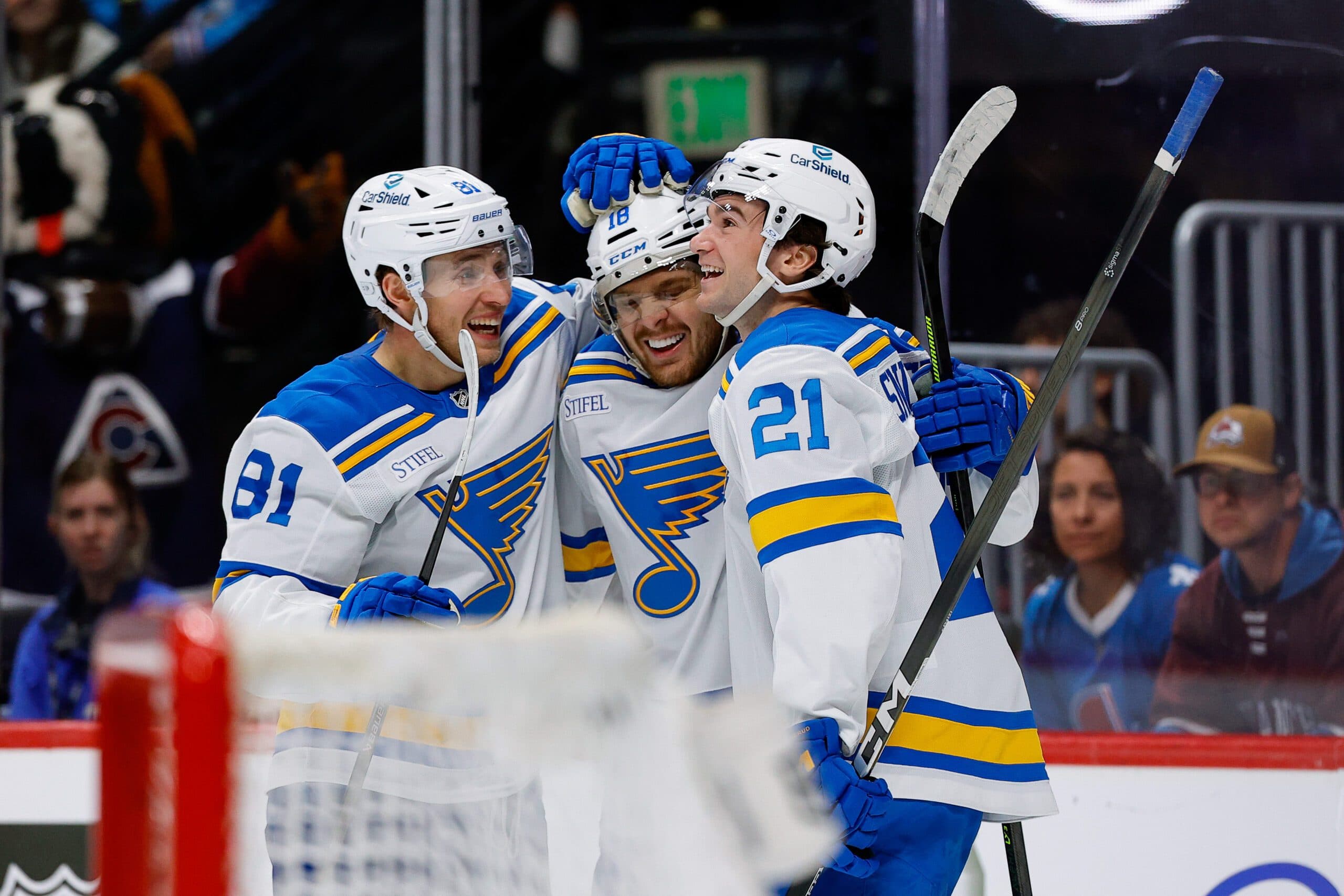
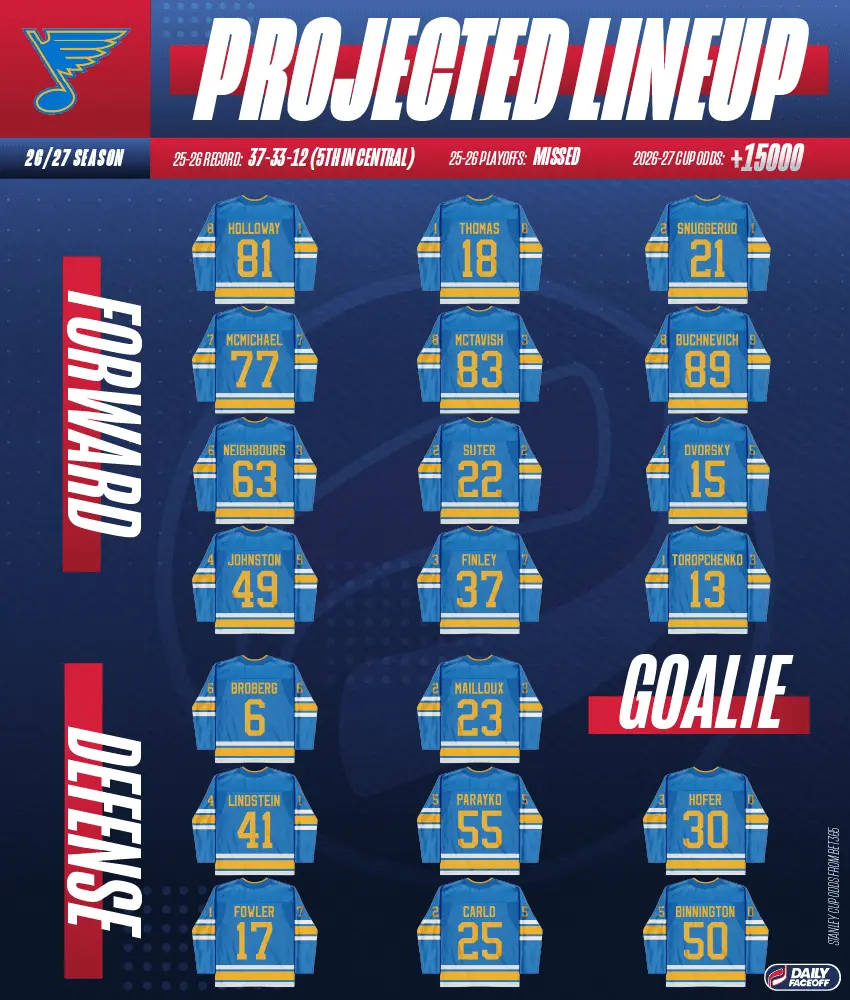
Any thought of moving the slick playmaker out the door went out the window for good when Thomas found dynamite chemistry with two of St. Louis’ other foundational players, speedy power forward Dylan Holloway (51 P, 121 hits in 59 GP) and rookie sniper Jimmy Snuggerud (21 G in 70 GP), down the stretch (22-6 game score in 21 GP as a unit); the 180° was completed when Steen named Thomas captain earlier this summer. With a physical beast in Holloway on the left wing and the defensively adept Thomas down the middle, Snuggerud had ample room to fire off his slick release (3.2 SOG per game after the deadline). All three players (even Thomas, who is still just 27) have time on their side. They could provide a real threat at the top of the Blues’ lineup for years to come.


Cap Summary
Draft Picks
McTavish, a 220-lb bowling ball who loves to set up in the low slot, and McMichael, who brings the wheels (91st percentile in 20 mph bursts, per NHL EDGE) that are lacking from McTavish’s game and the willingness to get to hard areas that was always an issue for Kyrou, will likely form the basis of the second line. Both players are only a year removed from 50-point seasons. Steen is betting they can return to (and hopefully surpass) that level in prime deployments. If crafty veteran Pavel Buchnevich, whose star has faded since his brilliant first three seasons with the Blues (83 G, 206 P in 216 GP), can tee up McTavish on the doorstep or spring McMichael on the rush with regularity (Buchnevich averages 37 A per 82 GP for STL), he’ll hear significantly less chatter about being overpaid.
St. Louis’s top six is promising but not enough to improve on last year’s paltry 230-goal finish in 2025-26 (24th) without depth scoring. One middle-six player they’ll need a boost from is Jake Neighbours, the fan-favorite workhorse whose propensity for tip-ins ran dry last season; though his even-strength goal scoring held strong (14), Neighbours notched only a single goal on the power play after chipping in eight in 2024-25. A return to form in front of the net could help elevate a 26th-ranked man advantage. Dalibor Dvorsky, a clever young center who notched 12 goals as a rookie, could also stand to provide more offense after finishing with only nine assists in 71 games despite long stretches on the second line. Maybe Dvorsky just needs better luck; the Blues scored just eight percent of their shots with the former 10th overall pick on the ice.
The Blues could also use more scoring from their blueline, where Faulk’s departure opened up more than 130 minutes of power-play ice. Slick veteran Fowler produced the most chances for St. Louis’s man advantage last season (7.67 xGF/60) of any defenseman who ran the unit. Philip Broberg (6.65) has a bigger shot than Fowler, though, and is among the team’s highest developmental priorities as an emerging top defenseman. Broberg will likely get first dibs, with Fowler on deck if things look clunky to start the season.
DEFENSE
For the Blues’ defense, chaos has been a constant since Armstrong’s fateful falling out with Stanley Cup-winning captain Alex Pietrangelo six years ago. Could a wave of promising young defensemen and a reworked system end the disjointedness? In early December, Montgomery switched St. Louis to a man-to-man system that encouraged a quick-skating blueline to attack on the walls and give his then-struggling goalies clearer views of opposition shooters. Thereafter, the Blues ranked 11th in expected-goal suppression and eighth in limiting scoring chances.
As for those promising defensemen, Broberg leads the pack. The Swede ranked in the 95th percentile or better in all skating categories tracked by NHL EDGE and supplanted Parayko as the team’s most used defenseman. If Broberg, signed to an offersheet in 2024 in a double swoop that also netted Holloway, can build on his offensive output (34 P, most among STL defenders), the 25-year-old will quickly earn recognition as an elite do-it-all option. Now, Montgomery only needs to figure out who to play next to him.
The simple answer is Parayko, whose size, speed, and ability to tackle brutal matchup minutes earned him a spot on Team Canada at two best-on-best tournaments. That would keep ‘Monty’ from having both Broberg and Parayko shepherd a less experienced D-man in a top-four role like they did to close out last season. For Parayko, that player was promising rookie Theo Lindstein. Broberg, meanwhile, teamed up with Mailloux. A 23-year-old with all the tools of a top-pair defenseman, Mailloux was infinitely better in the second half than during his rough start in St. Louis, but his growing pains forced Broberg into a more conservative game. The twosome’s strong results (17-14 game score) were driven by puck luck (1.04 PDO), and Parayko could be one Mailloux hiccup away from reuniting with Broberg, with whom he played for over 700 solid minutes last season.
Further down the lineup, Fowler and new guy Brandon Carlo seem like a perfect fit, even if their partnership would have been a lot more interesting five years ago. Fowler is still the best puck handler on St. Louis’s blueline, and, though Carlo has struggled since leaving the Boston Bruins and feels a lot older than 29, he seems a sensible foil for Fowler as a true defensive defenseman who should give a laboring PK a boost (76.7%, 25th). In a perfect world, Fowler and Carlo, who Montgomery coached in Boston, would stay put on an overqualified third pair. Still, Montgomery could slide one or both up the lineup if Mailloux or Lindstein struggles.
Just as St. Louis’ offense is waiting for a defenseman to emerge as a dangerous puck mover, its defense could use a real-deal matchup line. Newly acquired bruiser Ross Johnston, hulking young center Jack Finley, and 6-foot-6 forechecker Alexei Toropchenko will certainly make life difficult for the other guys. Still, it’s hard to imagine a true fourth line taking on the other team’s best with any measure of success. If Thomas is to avoid that responsibility and focus on piling up points, Pius Suter, a Swiss Army Knife by nationality and by nature, and a third line that could also feature the hard-working Neighbours will need to do some of the heavy lifting on ‘D.’
GOALTENDING
What a strange career Jordan Binnington has had. His rookie heroics in 2019, international duels with Connor Hellebuyck, and an unmatched competitive streak have made Binnington one of the most memorable goaltenders of his generation. When kids check out his stats in 20 years, though, they might be surprised how rarely he was among the best. ‘Binner’ seemed to stop his year-over-year slide in 2023-24, but he was only average the next year, and he bottomed out with an ugly .873 save percentage that kept any interested contenders from making a move for his big-game pedigree.
Now, it seems, Binnington’s time in St. Louis is nearing its end. Whether Binnington, whose contract expires in July, is snatched up by a goalie-needy team at the deadline or the Blues play too well to sell, No. 50 will be determined to finish up his time wearing the Blue Note as he started it, as a positionally aggressive lightning rod that galvanizes the one fan base that never tires of his antics.
Binnington might have grabbed top billing in this piece as a monumental player in Blues history, but Hofer is the headliner on the ice. A lanky, reserved shotstopper who uses his big frame to cut angles from deep in his crease, Hofer is the anti-Binnington, a prototypical goalie for the modern game.
After two solid seasons as a 30-game backup, Hofer looked just as lost as Binnington for two months (.877 SV% before Dec.) before Montgomery changed the Blues’ defensive scheme. After the switch, Hofer, among the top candidates to replace Binnington on Team Canada in the long term, looked like a Vezina-caliber netminder (21-10-3, 2.34 GAA, .918 SV%) while adjusting to a starter’s workload (46 GP). The 26-year-old Manitoban will get priority starts as the Blues evaluate his franchise goalie potential in a contract year.
COACHING
Early in the 2024-25 season, Montgomery, who assisted Craig Berube for two seasons, returned to St. Louis as a savior who galvanized the Blues amid a playoff charge that was tantalizingly reminiscent of their worst-to-first Stanley Cup season in 2018-19 until Winnipeg’s Cole Perfetti pulled the rug out from under them. Last year, Montgomery’s usual positivity quickly gave way to frustration with what he perceived as a lack of commitment from his men. Unwilling to patch over their roster’s flaws with a fourth coaching change in four seasons, the Blues’ brass heeded Montgomery’s gripes and shook up a stagnant core.
Montgomery’s seat is decidedly cool (he is signed through 2028), but this season is nonetheless a critical opportunity for the bench boss to put his stamp on a young, hungry roster that he asked for in not so many words. His personability and flair for the inspirational help his odds, though growth from McTavish, Mailloux, and other St. Louis’s other promising players will be that much sweeter if results follow.
Montgomery’s new special teams coaches certainly have name value. Vinny Prospal scored more than 700 points in the NHL before transitioning to the coaching ranks a few years ago, stewarding the Sabres’ perennially-stacked prospect pipeline as an assistant with AHL Rochester. Prospal will run St. Louis’s power play and has plenty of first-hand wisdom to impart to its younger forwards.
Greg Cronin’s run as the stiff-necked coach of the Ducks brought more frustration than success, but he is nonetheless respected in hockey circles for his ability to drill defensive structure into his players. Cronin returns to the NHL to run Montgomery’s PK after a season as head coach of the AHL Iowa Wild.
ROOKIES
The Blues are excited about 2025 first-round pick Justin Carbonneau’s potential as a big, abrasive kid who can quickly work his way into the NHL ranks after he scored 97 goals over his final two QMJHL seasons, but won’t force it. Letting Carbonneau develop at his own pace in the AHL Springfield while more experienced players like Jonatan Berggren and Nathan Walker jostle for depth roles would be prudent.
Otto Stenberg, a responsible young winger who was himself a first-rounder in 2023, burned up his Calder eligibility last season (3 G, 10 P in 32 GP) but is in the same boat as Carbonneau; 18 minutes a night in Springfield could be better for Stenberg than 12 in St. Louis, especially as he works to find his shooting gloves at the pro level.
Lindstein, it seems, is done waiting his turn after only a season of acclimating to the North American game. The Swede’s physical tools pale in comparison to Broberg’s or Mailloux’s, but Lindstein already reads the game at an NHL level and didn’t look out of place beside Parayko on a unit that controlled more than 55% of expected goals during its 5-on-5 minutes (17 GP). Smaller defensemen who don’t score are always at risk of getting frozen out by regressive thinking, but Montgomery trusted Lindstein with a legitimate workload (15:46 ATOI) and wouldn’t have seen anything that gave him cold feet about that decision.
BURNING QUESTIONS
1. What’s Dalibor Dvorsky’s ceiling? Part of Dvorsky’s appeal in 2023, when the Blues made him the No. 10 overall selection, was his extensive experience against grown men. Dvorsky was never going to take long to reach the NHL as a 200-pound natural center with a sweet release. After a 21-goal AHL debut, he played all but six games of his second North American season against the world’s best. Dvorsky never looked out of place during a rookie year that saw him bury five power-play goals. We knew more about his floor than his ceiling before he was drafted, though, and that’s still the case. At worst, he’s a smart, strong forward with special teams utility. If he can assert himself and that big shot in Year 2, though, the Blues could boast enviable center depth for years to come.
2. What’s the best-case scenario for the retool? Trying to get better and younger without a scorched-earth rebuild is always a nervy process for an NHL club. No one is more experienced at the dreaded retool than the Blues, though, and it’s tough to argue that netting Broberg, Hollaway, Mailloux, McTavish, McMichael while retaining a strong pipeline isn’t tidy work. St. Louis has acquired a few legitimate building blocks and several more potential ones, but is their path back to the Cup any clearer for it? Broberg would need to bring more to the table offensively; Mailloux would have to establish himself as a top-four option; Holloway would have to stay healthy long-term despite his high-impact style; and one (or, preferably, both) of McTavish and Dvorsky would need to grab a top-six role by the horns to make this Blues team one that can win with depth the way their 2019 vintage did. That outcome is by no means impossible, but 2025-26 will be an important season for gauging its likelihood.
3. Is another big trade coming? The Blues’ commitment to getting younger at the NHL level means that a fair few of their roster spots could be locked down long-term. It could also make Steen more willing to trade futures that could end up contributing to logjams. The team has closely monitored Alexander Nikishin’s discontent with the Carolina Hurricanes and could potentially make its move without significantly impacting the current roster; the ‘Canes are never shy about stocking up for the future. If not Nikishin, don’t be surprised to find the Blues sniffing around other players in McTavish, Broberg, and Holloway’s age range.
PREDICTION
Last year, St. Louis finished fifth in the Central, and it will be tough sledding to improve on that placement: the Colorado Avalanche and Dallas Stars are perennial Cup contenders, many expect the Utah Mammoth to join that tier before long, and the Minnesota Wild have legitimate star power, albeit on a top-heavy roster. The Blues could add 10 or so points by finding their best lineup quickly and avoiding another slow start (a return to normalcy from Binnington would help, too), but will more likely than not find themselves duking it out with the Nashville Predators and Los Angeles Kings for a Wildcard spot.
In a season that has very slim chances of yielding a second Stanley Cup, the Blues’ ability to ice a competitive, driven team led by their young new leadership group featuring Thomas, Holloway, Broberg, and Neighbours will determine the success of their season more so than whether they finish in seventh place or 10th in the West.
_____
_____
DAILY FACEOFF NEWSLETTER

Recently by Anthony Trudeau

