2026-27 NHL team preview: Utah Mammoth

LAST SEASON
After being decimated by injuries in their first season in Salt Lake City, the Utah Mammoth took a respectable step forward and became a playoff team in 2025-26. Led by a pair of high-end forward duos, the Mammoth lived up to their preseason billing as one of the most talented offensive teams in the ultra-competitive Central Division, and while they weren’t without their flaws, they still managed to make the playoffs for the first time and put up a decent fight against the eventual Western Conference champion Vegas Golden Knights.
Utah’s greatest strengths remained the best parts of what they inherited from the Arizona Coyotes: Clayton Keller, Nick Schmaltz, Dylan Guenther, and Logan Cooley. Those four forwards give the Mammoth a strong nucleus bested only by a handful of contenders in the league. While Guenther and Cooley still have some work to do on the defensive side of the puck to become true two-way forces, the Keller-Schmaltz duo ranked among the NHL’s very best in virtually every play-driving metric throughout the 2025-26 season. It certainly helped that Schmaltz put together his second consecutive full 82-game season — a marked contrast to his early-career struggles with the injury bug.
Still, it wasn’t a perfect year in Utah. Since arriving in the Beehive State, the Mammoth have been all too eager to flip the script from their time in Arizona, where never-ending financial problems consistently limited their ability to acquire top talent. Under Ryan Smith’s ownership, Utah has aggressively pursued big names at every opportunity, drawing rave reviews along the way — but the on-ice results for those acquisitions have been far from spectacular. The JJ Peterka trade will go down as one of Utah’s biggest early missteps, and it certainly isn’t hard to imagine the Mammoth finding much more success these past playoffs with Josh Doan in his place.
It’s a minor miracle that Utah GM Bill Armstrong managed to flip Peterka for two first-rounders after he was benched in the postseason; Utah already swapped one of those picks for young goaltender Sebastian Cossa, who should help ease the strain on Karel Vejmelka in 2026-27.
The Mammoth have plenty of upside, especially when you consider that they still haven’t brought high first-rounders Tij Iginla, Caleb Desnoyers, and Daniil But into the lineup on a full-time basis. But they still have real questions to answer regarding their defense, goaltending, and overall depth before they can truly be considered championship contenders in the Western Conference. They took the step they needed to take last year, but the next one might be the toughest.
KEY ADDITIONS & DEPARTURES
Additions
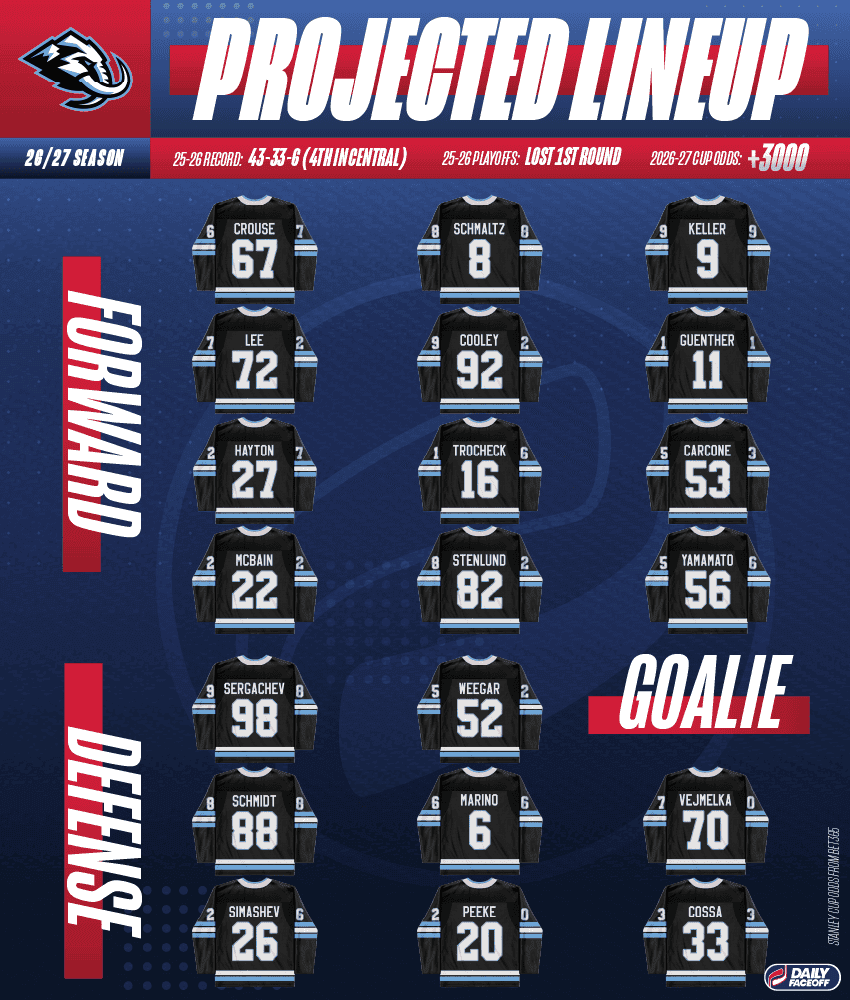
Vincent Trocheck, C
Anders Lee, LW
Sebastian Cossa, G
Andrew Peeke, D
Departures
JJ Peterka, LW (BOS)
Sean Durzi, D (NYR)
Ian Cole, D (CHI)
Alex Kerfoot, C (NSH)
Vitek Vanecek, G (NYI)
OFFENSE
The Mammoth have long built their forward lineup around duos, and they’re fortunate enough to have two high-end ones in Keller-Schmaltz and Cooley-Guenther. Their top-six lines operate in such a way that two players spend most of the time with possession while the third does the lion’s share of the off-puck work. For Keller and Schmaltz, that third wheel has typically been Lawson Crouse or Barrett Hayton; Cooley and Guenther have skated with a wide variety of wingers, but this year, it’ll probably be Anders Lee, who has typically been much more reliable than the departed Peterka (but is also 12 years older).
Utah has generally skewed older with its acquisitions over the past six months, and that rings especially true up front, where they brought in a pair of 30-somethings from New York teams over the summer. Lee certainly has much stronger underlyings than Vincent Trocheck, who comes to Utah with much fanfare (and sky-high expectations) after being acquired for a package headlined by recent first-round pick Cole Beaudoin. Trocheck is 33 and coming off multiple seasons in which he’s given up far more than he’s generated offensively. Still, he might find success in Utah if he’s put into more of a secondary role.
Hayton, Jack McBain, Michael Carcone, and Kevin Stenlund round out a Utah bottom-six group with genuine two-way upside. The Mammoth sidestepped a shrewd attempt by the New Jersey Devils this summer to poach Hayton away from them with an offer sheet; as a result, the 26-year-old forward could be destined for unrestricted free agency next summer. Hayton has never quite lived up to his billing as a fifth-overall draft pick, but has developed into a quality third-line forward who excels in the faceoff dot.
The biggest question about Utah’s offense remains whether their top guys truly belong in the upper echelon of the league. Cooley is a tremendously skilled young center, but does he have the makeup of a future Cup-calibre 1C? Keller and Guenther are both highly capable offensive wingers, but are they actually elite talents? Proponents of this Mammoth team will point to the Carolina Hurricanes, who just steamrolled their way to the Stanley Cup without overwhelming star power up front. Detractors will look at the Ottawa Senators or Detroit Red Wings, whose ceilings are inarguably limited by their lack of an unquestioned gamebreaker. Utah is much better off than most teams, but at the same time, there’s no Macklin Celebrini here. This year represents the biggest opportunity yet for Cooley and Guenther to prove they’re actually a cut above the rest.
DEFENSE
Only three teams allowed fewer goals than the Mammoth last year, and they were the Colorado Avalanche, Tampa Bay Lightning, and Dallas Stars. Utah finished in a three-way tie for fourth in the NHL with just 240 goals against, matching the Hurricanes and the Minnesota Wild. Not bad for a team that had one of the league’s worst defensive groups on paper when they first arrived in Utah.
Mikhail Sergachev has been Utah’s de facto workhorse on the blue line over the past two seasons, but it was actually the pairing of John Marino and Nate Schmidt that did the vast majority of the heavy lifting for last year’s Mammoth at 5-on-5. Marino ultimately finished the season with a ludicrously high plus-42 rating, and it wasn’t an aberration — he and Schmidt truly dominated together, posting downright remarkable figures in shot and chance suppression from start to finish. In July, the Mammoth signed Marino to an eight-year extension worth $6.75 million per season, and if he keeps playing as he did in 2025-26, he’ll be worth every penny (although, given that he’ll be 30 when the deal starts, it’s certainly not without risk).
In contrast with the Schmidt-Marino pairing, Sergachev’s on-ice results in 2025-26 were relatively pedestrian, falling below 50 percent in both expected goals and high-danger chances. He still managed 59 points in 78 games, enough to rank fourth in team scoring, but for $8.5 million per year, Sergachev needs to more positively influence play to provide surplus value as Utah’s No. 1, especially considering that they gave up both J.J. Moser and Conor Geekie to get him. Sergachev will likely start the 2026-27 season on a pairing with recent trade acquisition MacKenzie Weegar, who is coming off undoubtedly the weakest season of his career to date.
Weegar, who turns 33 in January, managed just 21 points and a ghastly minus-35 rating in 60 games with the Calgary Flames to start the 2025-26 season before being flipped to Utah for a sizeable package of assets (including three 2026 second-round draft picks). The veteran right-hander is signed for five more years at a $6.25 million cap hit, but his expected goal and chance shares in Calgary and Utah last year were genuinely dreadful, in stark contrast with his well-earned reputation as an analytical darling. The Weegar deal was yet another big swing by this Utah front office, but if the Ottawa native can’t reverse his fortunes in 2026-27, the Mammoth might be forced to elevate youngsters Dmitri Simashev and Maveric Lamoureux into more prominent roles ahead of schedule.
GOALTENDING
Karel Vejmelka is back for his sixth season with the Coyotes-turned-Mammoth. The 30-year-old right-catching netminder has always run hot-and-cold, but the aggregate results have generally been positive across his five NHL campaigns to date. Vejmelka set career highs in games played (64) and wins (38) with the Mammoth in 2025-26, although he certainly didn’t set the world on fire with his .897 save percentage. The Mammoth have Vejmelka under contract through 2030 at a $4.75 million cap hit, and while he’s probably good enough for where they are right now, they might be in the market for an upgrade before long if their internal succession candidates don’t pan out as hoped.
Who are those succession candidates, exactly? Enter Sebastian Cossa and Michael Hrabal, two of the more highly touted young goaltenders in the sport. Sure, they have exactly one game of NHL experience between them, but both were the first netminders selected in their respective draft classes and should have lots of runway to prove themselves in Utah. Cossa, who turns 24 in November, will likely get the first crack at the backup gig after being acquired from the Red Wings in June; the 6’7″ keeper posted a 26-8-4 record, five shutouts, and a .915 save percentage in 39 AHL games with the Grand Rapids Griffins in 2025-26.
COACHING
Andre Tourigny’s tenure with the Mammoth/Coyotes franchise aligns almost exactly with Vejmelka’s. Both men first joined the Coyotes organization in the summer of 2021 and have remained in their roles ever since. Like Vejmelka, Tourigny has been generally successful in helping this team transform from an also-ran into the up-and-comers they are now, but the question remains whether he’ll still be in his position when Utah is actually ready to contend.
Tourigny, 52, served as head coach of the OHL’s Ottawa 67’s for three seasons before first joining the Coyotes. Under his tutelage, both Keller and Schmaltz have developed into much more successful offensive players after initially struggling to reach their full potential under Tourigny’s predecessor, Rick Tocchet. Tourigny has also been an assistant coach with the Avalanche and Senators and a head coach with the QMJHL’s Rouyn-Noranda Huskies and Halifax Mooseheads during his career; furthermore, he coached Team Canada to a silver medal at the 2021 IIHF World Junior Championship.
Mammoth assistant coaches John Madden and Blaine Forsythe have served on Tourigny’s staff since the Arizona days, as has goaltending coach Corey Schwab. However, there will be one new face behind the bench in Utah this season: Adam Foote, who has taken over from Mario Duhamel as the team’s primary defensive coach. Foote joins the Mammoth after one year as head coach of the lowly Vancouver Canucks.
ROOKIES
Simashev played in 28 games with the Mammoth last year, three more than the limit for maintaining his rookie status into the 2026-27 season. It’s still worth taking some time to highlight the 2023 sixth-overall pick, who put up 35 points in 40 games as a 20-year-old with the AHL’s Tucson Roadrunners last year. Simashev had never previously been renowned for his offensive production, with his size, skating, and defensive abilities typically taking center stage, but if he can carry over even some of his newfound scoring output into the NHL, he’ll be a top-four lock for a very long time. (Daniil But, Simashev’s old KHL teammate and fellow 2023 draftee, also barely misses the cut as a “rookie” after playing in 29 NHL games in 2025-26).
As far as actual Calder Trophy candidates go, watch out for Tij Iginla. The 20-year-old forward is Jarome’s middle child, and with all due respect to Jade and Joe, he might be the most talented of the bunch. Iginla put up 41 goals and 90 points in just 48 games with the WHL’s Kelowna Rockets in 2025-26; he also skated in seven games with Canada at the World Juniors, collecting four goals and eight points. Unlike his dad, he shoots left, and he’s also spent extended stretches of his career playing down the middle. Utah has a pretty jam-packed forward group, but don’t be surprised if Iginla still manages to carve out a top-nine role for himself as a first-year pro.
BURNING QUESTIONS
1. Can Anders Lee hang with Cooley and Guenther? Lee has been the model of consistency throughout his 923 NHL games to date, typically scoring anywhere between 20 and 30 goals per season while posting genuinely impressive underlying metrics. However, the Edina product left the New York Islanders, the only pro franchise he’s ever known, to sign a three-year deal with the Mammoth on July 1. Now, at age 36, Lee’s new job will be to complement two players nearly 15 years his junior. How long will he be able to keep up?
2. Is Weegar the answer on the top pairing? The Mammoth are betting that Weegar’s poor results in 2025-26 were more strongly influenced by the quality of his surroundings in Calgary than anything else. Still, he isn’t exactly young anymore, either. Weegar is a highly competitive and skilled two-way defender who wears his heart on his sleeve, and he’ll have no problem endearing himself to the fans in Utah, but when push comes to shove, he still needs to prove that his performance last year was a one-off.
3. What does Barrett Hayton’s future hold? As a consequence of Utah matching his offer sheet, Hayton cannot be traded for a full calendar year, meaning the Mammoth essentially only have two choices for the pending unrestricted free agent: keep him, or let him walk. The Mammoth currently have a decent chunk of cap space to accommodate a potential Hayton extension, but they must bear in mind that Lawson Crouse is also due for a new deal — and, of course, Clayton Keller’s contract is up in 2028.
PREDICTION
The Mammoth have a fair bit going for them. They were one of the league’s better possession teams in 2025-26, and while they weren’t quite on the level of some of their Central Division rivals, they still managed to give the Golden Knights a bit of a scare in the first round of the 2026 playoffs. That experience will give Utah’s younger players something highly valuable to build upon as they continue to develop.
Still, Utah has to grapple with the fact that they’re in the most competitive division in hockey, going up against teams led by the likes of Nathan MacKinnon and Cale Makar, Miro Heiskanen and Mikko Rantanen, and Quinn Hughes and Kirill Kaprizov. For all the commendable work they’ve done to lay a foundation for future success, the Mammoth just don’t have the franchise-level pieces required to take on those giants and consistently win. What they have is a pretty well-rounded group with very few glaring weaknesses and an impressive crop of prospects ready to make an impact. The sum of all those parts is likely another fourth-place finish in the Central.
_____
PRESENTED BY THE DAILY FACEOFF NEWSLETTER

Recently by Mike Gould
- NHL 27 Review: Frustratingly low-rent presentation overshadows gameplay improvements
- Sketching out how the Flames can (eventually) trade Jonathan Huberdeau
- Top NHL sophomore breakout candidates for 2026-27
- Projecting which NHL teams will send the most star prospects to the 2027 World Juniors
- Nemec, Eklund, and other breakout candidates joining new teams in 2026-27
- Why the Yzerplan failed in Detroit — and where the Red Wings go from here
- Grading the Brady Tkachuk trade: Sens lose captain to Florida, gain valuable retooling capital