How Adam Pelech became one of the NHL’s best (and most underrated) defensive defensemen

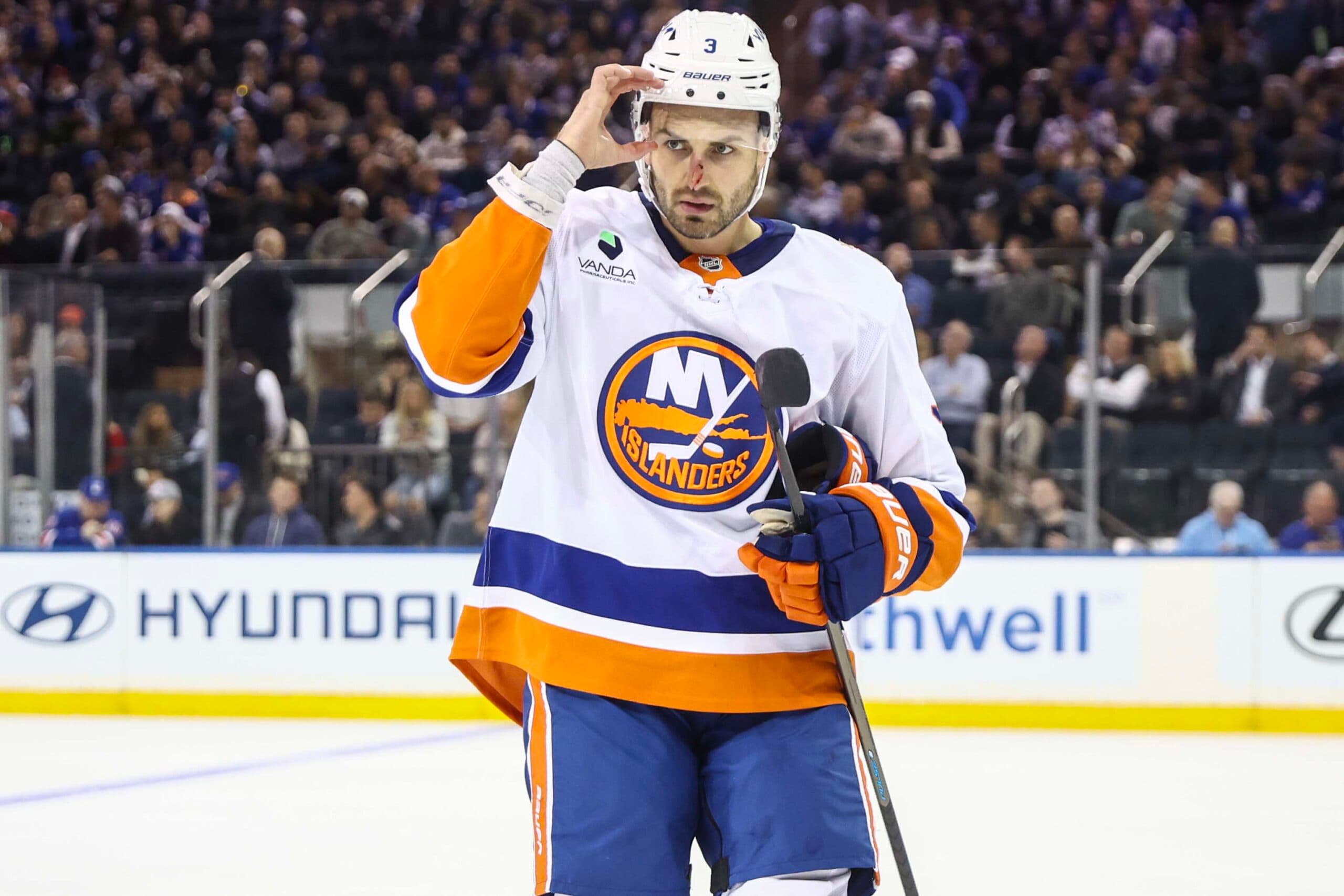
The art of the defensive defenseman is often lost on hockey fans.
To be fair to the casual follower, it’s sometimes difficult to properly enjoy a defensive masterclass. If you want to appreciate an elite goal scorer or intelligent playmaker, you just have to watch for when the puck is on their stick and witness them work their magic. Defensive players thrive when nothing is happening. Kind of hard to follow along with nothing, right? Unless these players accumulate enough points to catch people’s eyes, or go on a deep enough playoff run so everyone learns their names, they often remain obscure to all but the diehard hockey fan.
Defensive defensemen were much easier to appreciate in the 1990s and early 2000s, back when physicality was the dominant trait for that player type. While big names like Chris Pronger and Scott Stevens were smart players in their own right, they excelled in the game by physically boxing out opponents and knocking them on their asses when they had their heads down. So you knew players like them were hard at work when the hits were flying.
But as the game has gotten quicker over the last 10-15 years, physically strong defensive defensemen have mostly been phased out into depth roles, because they just don’t have the speed to keep up with today’s talents. Instead, defensive defensemen are smart, positionally sound, effective with their sticks and possess some puck-moving ability to escape their own zone in a pinch.
Few defensive defensemen better exemplify the modern game than New York Islanders blueliner Adam Pelech. While his 6-foot-3, 211-pound frame certainly could have dominated in the era of Pronger and Stevens, Pelech doesn’t rely on it: his 3.97 hits per 60 minutes only rank in the 49th percentile of defensemen with at least 82 games played since he entered the league in 2015-16. But he doesn’t need to, either, because hitting a player means that player has the puck and you don’t. And when Pelech is on the ice, his opponents don’t have the puck for very long to begin with.
When watching his game, it’s apparent he’s one of the smartest players on the ice, even compared to some of the elite talent he’s forced to shut down on a nightly basis. He’s always in the right spot, whether he’s holding the blueline to deny a zone entry or getting back to beat his opponents to pucks in his own end. Despite his large frame, he can also be surprisingly quick, with average skating speed in the 71st percentile according to NHL EDGE.
“In my 10 or so years in the league, [the game’s] gotten a lot faster,” Pelech told Daily Faceoff. “I’ve definitely had to still work on my skating all the time, and it’s become a lot more about defending with your feet, because guys are so fast.
“I think the most important thing for guys like us is to be super reliable.”
The numbers back up the eye test regarding Pelech’s defensive game as well. Since 2022-23, he’s ranked in the 70th percentile or higher in the league in entry denial percentage, according to Hockeystats.com. In that same span, he’s almost always ranked in the 90th percentile or higher for defensive zone retrievals. And when he gets the puck, he’s no slouch at converting it the other way with, consistently ranking in the 75th percentile or higher in zone exits, and the 60th percentile or higher in exits with possession.
Pelech also preaches discipline as a key component of his game.
“A guy who really exemplified that who I played with was Andy Greene,” Pelech said. “He was very disciplined in the way that he played. It’s hard not to take the risk to get a puck that you think you might be able to get a scoring chance out of.”
While he won’t win Lady Byng Trophies for his discipline, he stays out of the penalty box; his 2.2 penalty minutes per time on ice percentage ranks in the 55th percentile among defenders since he entered the league, per NHL.com. In that same time, Greene was in the 97th percentile with 1 PIM/TOI%. It’s another layer of Pelech’s hockey IQ: he usually puts himself in a position where he won’t take a penalty, and if he gets beaten, he finds another solution to recover than by taking a desperate penalty.
It’s no surprise that defense is such a significant part of his game, as it has been ingrained in his hockey DNA since before he played junior hockey with the Erie Otters. Some defensive specialists were scoring phenoms in junior but then had to adapt their games after realizing they couldn’t play at the same level in the pros. But for Pelech, his defensive game was already receiving high praise when he entered the 2012 NHL Entry Draft and was selected 65th overall by the Islanders.
He didn’t do it all on his own either. Pelech credits his work with Dan Brown, father of New Jersey Devils winger Connor Brown, in minor hockey and with coach Robbie Ftorek when Pelech played with the Otters in the OHL as the foundation of his defensive skillset.
“[Ftorek] really helped me a lot, taught me a lot about the game. He was an educator type of coach, and he would have great sayings about teaching guys how to play defense,” Pelech said. “And I think he helped me a lot. Early on, it was a lot [about] good stick [work] and good awareness.
“I think I was lucky to have a lot of great coaches over the years. Having [Brown] as my coach my whole childhood, and then Robbie Ftorek in junior, I felt definitely very lucky with coaching [over] the years. I felt like they taught me a lot.”
Like all players entering the league, Pelech wasn’t a top-end defensive specialist in his first few seasons. He wasn’t bad by any means, but his numbers weren’t elite quite yet. In his first three seasons, he had a 1.6 defensive expected goals above replacement and a -0.041 5v5 regularized adjusted plus-minus expected goals against per 60 minutes, which ranked 135th and 84th among defensemen with 1,000 minutes played in that span. He also wasn’t getting many tough minutes in that span, ranking seventh among regular Islanders defensemen in quality of competition RAPM xG+-/60 in 2016-17 and then creeping up to third in 2017-18.
But it wasn’t until Barry Trotz was hired as head coach in 2018 that Pelech’s game took significant strides. Trotz’s time on Long Island was well known for creating one of the most structured, defensively sound systems at the time, and Pelech benefited from it.
“There’s a little less of that educating/teaching aspect of coaching at this level,” Pelech said. “But Barry emphasized a lot of things. When I came in [to the league], I just defended with my stick and with the smarts and awareness. And then Barry forced me to play a heavier game, more physical, kind of like ‘prison rules in front of the net’ mentality, stuff like that.
“We were obviously very successful, one of the best defensive teams in hockey. So I think getting that mindset out of everyone, especially the defensemen, was a big part of the influence that he had on us.”
Trotz needed less than one season to recognize what he had in Pelech, and from the 2019 Stanley Cup Playoffs onward, Pelech ranked in the top two on the Isles in QoC RAPM xG+-/60 with Ryan Pulock in every season under Trotz. Since then, Pelech has been one of the game’s best shutdown defenders, as his 43.4 defensive xGAR ranks fourth in the league and his -0.205 5v5 RAPM xGA/60 ranks third since 2019.
Pelech’s breakout performance came in his first playoff appearance in 2019 against the Pittsburgh Penguins, where Trotz tasked him and Pulock with shutting down Sidney Crosby. It’s a moment in Pelech’s career he looks back on fondly.
“Being matched up against that line, that was definitely a ‘holy shit’ type of moment, but also a huge challenge and a huge opportunity,” Pelech said, “[Crosby’s] obviously one of the best to ever do it. But he’s also just such a hound and so intense, and he can be a prick out there.”
That matchup wound up being a “bend, but don’t break” situation for Pelech and Pulock. While Crosby’s line had a 61.66% 5v5 expected goal share against Pelech, the Isles outscored the Pens 3-1 in that time according to Natural Stat Trick, with Crosby getting just one assist in the series. Of course, that’s not to discredit the help that Robin Lehner provided in net with a .956 save percentage and a 5.18 goals saved above expected in the series. New York ultimately swept Pittsburgh.
But even after that performance, along with back-to-back runs to the Conference Finals in 2020 and 2021, Pelech remains under the radar for many casual hockey fans. His defensive metrics place him among Jaccob Slavin, Chris Tanev, Devon Toews or MacKenzie Weegar. But while most of those names get high praise around the league, and even consideration for international teams, Pelech remains out of the conversation.
Perhaps that will come with a different supporting cast. For most of Pelech’s career, he’s played alongside the likes of Tony DeAngelo, Noah Dobson, Scott Mayfield and Pulock. All are great players, but none is a household name. So far this season, Pelech has that household partner, as he and sophomore sensation Matthew Schaefer have frequented as the Isles’ top defensive unit. Predictably, they’ve played well together, rocking a 56.7% 5v5 xGF% and outscoring the competition 3-1.
But whether that attention comes or not doesn’t truly matter. Pelech’s performances night in and night out have been among the best in the league for quite some time now, whether the people have noticed or not.
_____
PRESENTED BY DAILY FACEOFF GEAR

Daily Faceoff has new merch. Rep the game you love with premium Nation Gear x Levelwear tees, hoodies, hats and layers — designed for hockey fans on game day and every day. The home for hockey fans.
SHOP DAILY FACEOFF → nationgear.ca