NHL 2030: Projecting the standings from 32nd to Stanley Cup champion

Four years ago, the NHL’s competitive landscape looked completely different.
The Calgary Flames cruised to the Pacific Division title. The Toronto Maple Leafs finished fourth in the regular season. The New York Rangers and St. Louis Blues had 110 and 109 points, respectively. On the flip side, the Montreal Canadiens had fallen from Stanley Cup Finalists to the NHL’s basement. The Utah Mammoth were still the hopeless Arizona Coyotes, a 57-point team about to move to a college arena.
The lesson? Four years can be an eternity in a franchise’s life cycle. With the salary cap rising, expansion in the forecast and players forcing trades and signing shorter contracts, it’s a time of significant transition.
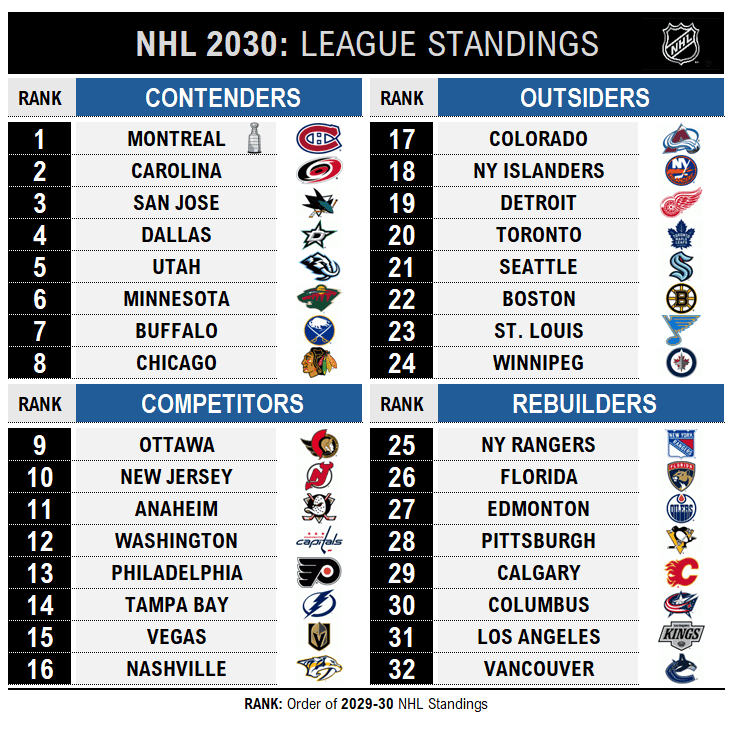
In the second half of our NHL 2030 series, we’re forecasting the future standings by ranking all 32 teams from worst to first. Who will lift the 2030 Stanley Cup? How has each franchise’s outlook shifted since we checked in last offseason?
🎯 What We Know Today
Between expiring contracts, trades, free agency, graduating prospects, and draft selections, NHL rosters can be transformed in four months, let alone four years. But we can leverage what we know now to make insightful forecasts:
- Rosters, salary cap commitments, and contract timelines (from PuckPedia)
- Top 10 Prospect Pool breakdowns (Daily Faceoff‘s Steven Ellis)
- 2026-27 standings projections (HockeyStats.com)
- Ownership groups, general managers, and coaching staffs and their past results and tendencies
- The projected salary cap through 2027-28 (NHL.com)
- Takeaways on franchise life cycles from my past deep dives into rebuilds and retools
- My projected top 30 NHL players in 2030
- Each franchise’s future draft pick count (PuckPedia)
- An understanding of player aging curves (The Athletic)
🔮 What We Know About the Future
A few friendly reminders about the approach to the team projections:
- Many superstars will be unrestricted free agents before 2030. Connor McDavid, Auston Matthews, Zach Werenski, and Quinn Hughes headline the stars that can test free agency before 2030. With the exception of Cale Makar’s expected long-term deal, we won’t assume any UFAs re-sign through 2030.
- Players in their late 20s or older today won’t be the same in 2030. Even rare players who age well deliver declining value after 30. Nathan MacKinnon today will not be the same guy at 35.
- Few current prospects will be impact players in 2030. A 2026 draft pick will be 21 or 22 years old in 2030. Only the most elite prospects become stars that quickly. Most teams have no such prospects.
- The front office matters. We can’t know how a roster will be constructed. But a GM’s track record and ownership’s willingness to spend or be patient factor into these rankings.
- Subjectivity is included. Anything can happen in four years. Despite exhaustive research and information, subjectivity is part of the forecast. So, as always, have some fun and keep an open mind.
🪜 NHL 2030: Countdown from #32 to #1
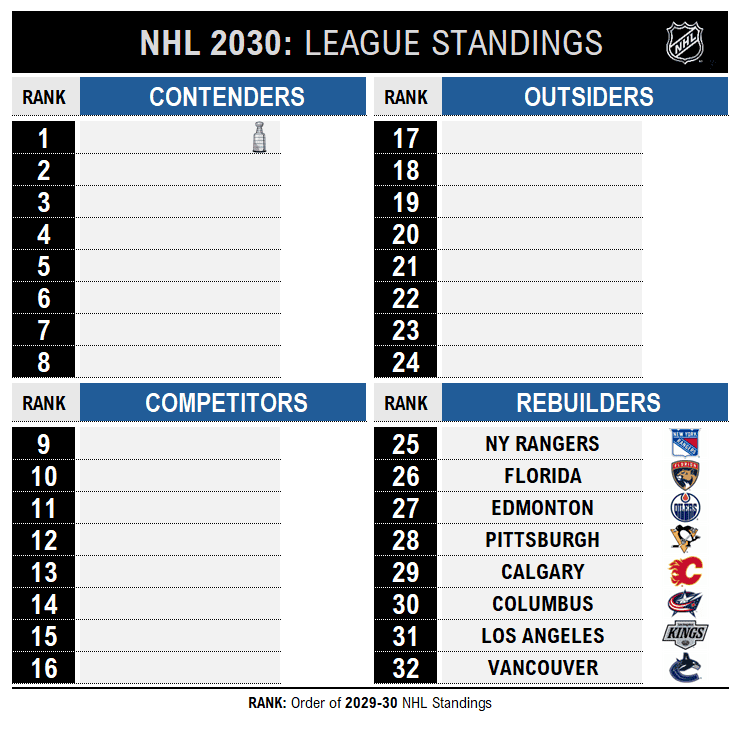
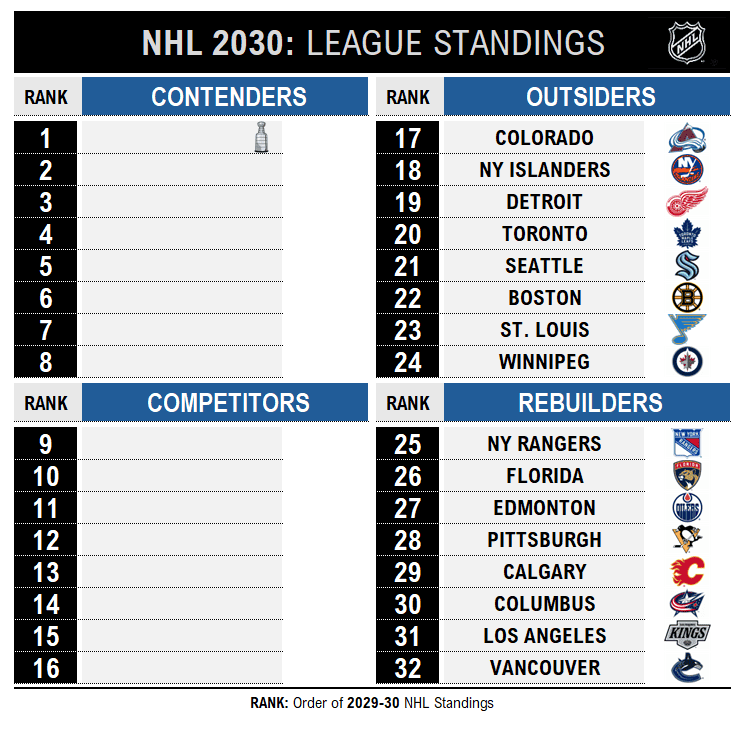
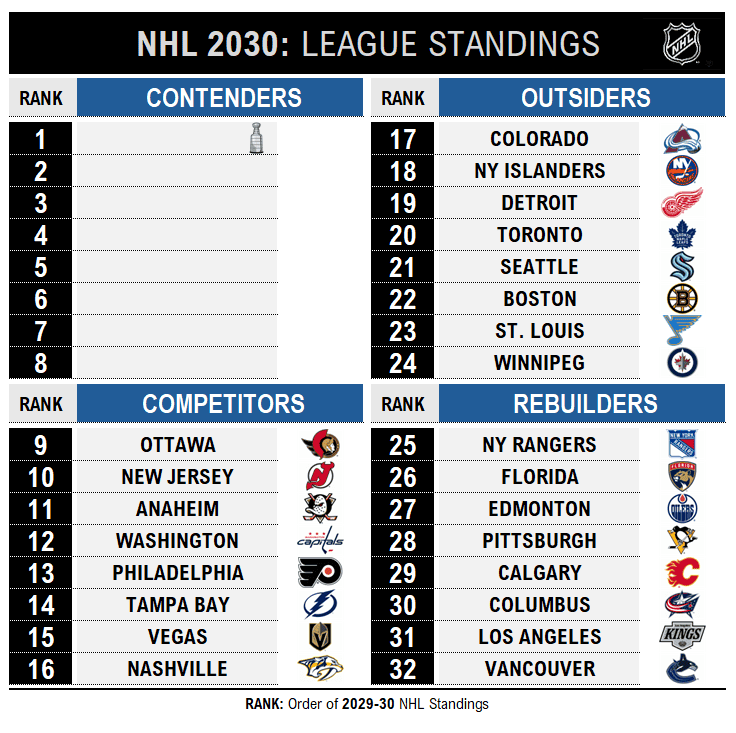
All 32 teams will be tiered and ranked as follows: Rebuilders (32nd to 25th); Outsiders (24th to 17th); Competitors (16th to 9th); and Contenders (8th to 1st). The rankings represent the forecasted NHL standings for the 2029-30 season, with the top-ranked team the 2030 Stanley Cup pick.
For each team, we’re listing five notable players that are: 1. Under team control through the 2029-30 season: the franchise’s de facto future core; and 2. Not under team control through 2029-30: unrestricted free agents before Summer 2030.
If a player was ranked in our NHL Top 30 in 2030, their ranking is listed; ‘HM’ means an honorable mention.
⏳ Tier 4: Rebuilders
#32. Vancouver Canucks (-2 spots)
2030 Core: Caleb Malholtra; Zeev Buium; Elias Pettersson; Brock Boeser; Jonathan Lekkerimaki
UFAs Before 2030: Marco Rossi; Thatcher Demko; Filip Chytil
When you glance at the rebuild timelines of Anaheim, Chicago, Detroit, and San Jose, many lean years ahead in Vancouver are inescapable. The shadows of the past generation — Pettersson, Boeser, Filip Hronek, and Thatcher Demko — are still here. Finding a way to extract returns from these veterans with trade protection could bring a much-needed boost. Malholtra (No. 3 overall in 2026) is a great get, but otherwise new GM Ryan Johnson inherited few high potential prospects. It may take until 2030 for a path to contention to become clear.
#31. Los Angeles Kings (+1 spot)
2030 Core: Brandt Clarke (HM); Adrian Kempe; Mikey Anderson; Hampton Slukynsky; Henry Brzustewicz
UFAs Before 2030: Artemi Panarin; Quinton Byfield; Kevin Fiala
With only three NHL players signed through 2030 and no entry-level contracts, the good news is that the Kings will have a lot of flexibility in the future. But with one of the league’s weakest prospect pools, it feels inevitable that L.A. will be extremely short on NHL talent by 2030. GM Ken Holland made a tidy signing with Clarke’s extension. Otherwise, it’s more old to very old veterans signed to short deals. While you have to admire the Kings wanting to stay competitive, the steady track of first-round losses is a proven recipe for long-term pain.
#30. Columbus Blue Jackets (-16 spots)
2030 Core: Adam Fantilli; Denton Mateychuk; Valeri Nichushkin; Ivan Provorov; Damon Severson
UFAs Before 2030: Zach Werenski (#27); Jet Greaves (HM); Kirill Marchenko
While stranger things have happened, it feels unlikely Werenski is the face of the franchise beyond his deal expiring in 2028. Much of Columbus’ current roster is in one of two categories: second-tier veteran signed into their mid-30s, or UFA before 2030. While they have some goaltending pipeline depth, the Jackets don’t have any true blue-chip prospects. It leaves the team in win-now mode, only without the horses to win now or the cap space to transform the roster once Fantilli is extended. It’s hard to see how Columbus avoids a rebuild before 2030 — the 16-spot drop from last year’s projection is the NHL’s biggest.
#29. Calgary Flames (-8 spots)
2030 Core: Dustin Wolf (HM); Simon Nemec; Zayne Parekh; Carson Carels; Cole Reshny
UFAs Before 2030: Morgan Frost; Joel Farabee; Connor Zary
When your 2030 core features a pair of college teammates (University of North Dakota’s Carels and Reschny), it means the franchise is a long way from competing. Calgary has high hopes for Parekh, 20, to make an immediate impact. But it’s Wolf (signed through 2033) that will determine whether the Flames are lottery bad or just bad over the next few seasons until their highly regarded prospect cupboard opens up. With a new arena in 2027, it will be interesting to see how patient the front office will be given rebuilds have been ultra rare in the Calgary market’s long history.
#28. Pittsburgh Penguins (+3 spots)
2030 Core: Ben Kindel; Harrison Brunicke; Rutger McGroarty; Sergei Murashov; William Horcoff
UFAs Before 2030: Sidney Crosby; Erik Karlsson; Bryan Rust
Given the age of the Penguins’ best players, the only guys under contract through 2030 are middle-six forward Tommy Novak, newcomer Kaedan Korczak, and Ville Koivunen (two NHL goals). Pittsburgh’s pipeline has greatly improved to league average under GM Kyle Dubas. Without taking some major steps backwards, however, the post-Crosby era Penguins will have a difficult time finding a top-six forward group and two pairs of defensemen that can contend. Dubas has found exceptional value through trades and free agency, but not drafting in the top 10 in the last 14 years has zapped the organization of elite talent.
#27. Edmonton Oilers (-14 spots)
2030 Core: Leon Draisaitl (#29); Matthew Savoie; Isaac Howard; Jake Walman; Ryan Shea
UFAs Before 2030: Connor McDavid (#3); Evan Bouchard (HM); Zach Hyman
Seeking out Mike Babcock was icing on Edmonton’s desperation cake. I’m bullish on the Oilers making another playoff run, though, by thriving with modest expectations like the Washington Capitals in 2018. If Edmonton wins the Stanley Cup in the next two years, their entire future will pivot. But that’s a big if… and this projection is about 2030. As of now, they only have control of a nearly 35-year-old Draisaitl, young projects Savoie and Howard, a handful of veterans that will be well into their 30s, and no farm system. One year ago, I’d incorrectly assumed a long-term McDavid extension into the projection. Without their captain or Bouchard under contract in 2030, this barren roster falls 14 spots into the Rebuilders tier.
#26. Florida Panthers (-1 spot)
2030 Core: Aleksander Barkov (HM); Matthew Tkachuk; Sam Reinhart; Seth Jones; Anton Lundell
UFAs Before 2030: Brady Tkachuk; Jacob Markstrom; Dmitry Kulikov
General manager Bill Zito has made some win-now plays to improve the odds of a return to Cup contention. But by 2030, this team looks poised to set LTIR records. Here are the ages of players signed through 2030 with some form of trade or movement protection: Brad Marchand (42); Jones, Carter Verhaeghe (35); Barkov, Reinhart, Aaron Ekblad, Gustav Forsling, Sam Bennett, Niko Mikkola (34); Matthew Tkachuk (32). Throw in one of the league’s worst farm systems and this geriatric roster may be commuting from a retirement condo by 2030.
#25. New York Rangers (-1 spot)
2030 Core: Igor Shesterkin (HM); Pavel Dorefeyev; Alexis Lafreniere; Albert Smits; Gabe Perreault
UFAs Before 2030: Adam Fox (HM); Will Cuylie; Sean Durzi
Since announcing its planned retool last season, GM Chris Drury has quietly improved the roster. With Shesterkin, Fox, Dorefeyev, and an aging but capable guard of 30-somethings, this could be a playoff team if everything breaks right. But their big picture feels… small. They have few efficient deals and remain dependent on Miller, Zibanejad, and Gavrikov — a trio that looked very old at times last year. Maybe they rise from last year’s rubble, but in a post-Fox world with a top-heavy pipeline, a more dedicated rebuild feels inevitable before 2030.
⛔ Tier 3: Outsiders
#24. Winnipeg Jets (+5 spots)
2030 Core: Connor Hellebuyck; Mark Scheifele; Kyle Connor; Gabriel Vilardi; Viggo Bjorck
UFAs Before 2030: Josh Morrissey; Dylan Samberg; Dylan DeMelo
The Jets could certainly slip back into a playoff spot this year with a Hellebuyck rebound. By 2030, however, most of their top dogs will be past their primes and Morrisey is a 2028 UFA. Given they operate in a precarious market situation, they may never commit to a major fire sale rebuild. My gut is that Winnipeg will reluctantly face the music in the next few years and pivot to better supporting a new generation through a retool. The Jets rise a few spots by securing Connor’s and Perfetti’s services long-term since last summer.
#23. St. Louis Blues (-4 spots)
2030 Core: Robert Thomas; Dylan Holloway; Philip Broberg; Jimmy Snuggerud; Colton Parayko
UFAs Before 2030: Jake Neighbours; Joel Hofer; Cam Fowler
St. Louis also enters 2026-27 with a shot at a playoff return. But it’s hard to see a high ceiling absent an overhaul. Thomas, Holloway, Broberg, and Parayko are all nice players. Snuggerud had a nice debut as a 21-year-old rookie. Mason McTavish and Connor McMichael are nice bets with high floors. There are a few nice prospects on the way. Yet it all feels a little too ‘nice’ if the goal is to win another Stanley Cup in the next half-decade. Low on high-end talent, the Blues aren’t likely to be serious contenders in the short or long term.
#22. Boston Bruins (+4 spots)
2030 Core: Jeremy Swayman (#20); David Pastrnak (HM); Charlie McAvoy; Morgan Geekie; James Hagens
UFAs Before 2030: Casey Mittelstadt; Pavel Zacha; Mason Lohrei
The good news for GM Don Sweeney is that the Bruins roster is secured for the next half-decade, almost exclusively on contracts signed before the rising salary cap shifted the market. That’s also the bad news. Boston’s an ordinary NHL team right now and only Hagens, 19, is an upper-tier prospect. So, it’s difficult to see this group’s collective ceiling rising further. Elias Lindholm, Hampus Lindholm, and Nikita Zadorov will still be under contract in 2030. Many signs points to this being a weathered franchise facing some tough decisions before then.
#21. Seattle Kraken (-3 spots)
2030 Core: Matty Beniers; Mackie Samoskevich; Joey Daccord; Berkly Catton; Chase Reid
UFAs Before 2030: Vince Dunn; Jared McCann; Jordan Eberle
The Kraken remain lost at sea. Even with ample cap space and three excellent prospects in Reid, Catton, and Jake O’Brien headlining a deep system, it’s going to be a long battle to relevance. Beniers and Shane Wright remain complementary pieces, not cornerstones. General manager Jason Botterill has inherited some dud contracts. They just don’t have a lot of talent on the NHL roster right now, and it will be a while until their prospects can become impact players. It’s going be ‘Wait Until Next Year’ for a few more years in Seattle.
#20. Toronto Maple Leafs (+6 spots)
2030 Core: Gavin McKenna (#12); William Nylander; Matthew Knies; Darren Raddysh; Easton Cowan
UFAs Before 2030: Auston Matthews (#18); John Tavares; Jack Roslovic
An optimist’s view: Matthews is reborn with McKenna. The reprieve from Craig Berube’s style restores team swagger. Raddysh realigns the defensemen to better-suited roles. Sergei Bobrovsky stabilizes the crease. An improved bottom six is harder to play against. Yes, that’s asking a lot. And even if it all breaks right, it’s still an old roster with a number of concerning contracts. Since this projection excludes 2028 UFA Matthews from future plans, it’s likely more retooling in the next few years around No. 1 pick McKenna. Winning the draft lottery and selecting the coveted talent bumps up the Leafs a few spots.
#19. Detroit Red Wings (-8 spots)
2030 Core: Moritz Seider (#13); Lucas Raymond (HM); Dylan Larkin; Axel Sandin-Pellikka; Simon Edvinsson
UFAs Before 2030: Alex Debrincat; John Gibson; Victor Arvidsson
It often feels like I’m way too harsh on the Red Wings. But their lack of secondary talent and history of confusing bets on low-ceiling players has never screamed ‘contender.’ Whether their captain Larkin stays or not, he’ll be 34 by 2030. Life comes at you fast. Their new GM will have Sandin-Pellikka, 21, Edvinsson, 23, Marco Kasper, 22, top prospect goalie Trey Augustine, 21, and some other solid bets in the pipeline. But the question remains: is there enough here to go from perennial playoff outsiders to contenders in four years? The Wings drop from the Competitors tier to the Outsiders tier until they can put together a full season.
#18. New York Islanders (+5 spots)
2030 Core: Matthew Schaefer (#2); Mathew Barzal; Ilya Sorokin; Bo Horvat; Calum Ritchie
Not Under Control in 2030: Adam Pelech; Kyle Palmieri; Simon Holmstrom
Between the remnants of Lou Lamoriello’s long-term gambits and some dicey deals by GM Mathieu Darche, the Islanders are carrying a lot of dead weight for a team in limbo. In 2030, the age of their long-term signees reads: Scott Mayfield (37); Sorokin, Horvat, Ryan Pulock (35); Barzal (33); Alexander Romanov (30). But Schaefer’s stunning debut and a solid pipeline deliver some light at the end of the tunnel. While the current team was built for yesterday and there may be some mid seasons ahead, this will be an interesting team — their best is likely beyond 2030, however.
#17. Colorado Avalanche (no change)
2030 Core: Cale Makar (#3); Nathan MacKinnon (#14); Martin Necas; MacKenzie Blackwood; Sam Malinski
UFAs Before 2030: Artturi Lehkonen; Brock Nelson; Scott Wedgewood
While the Avalanche should ice a team featuring MacKinnon, Makar (the one UFA we are assuming re-signs), and Necas in 2030, it’s difficult to see this roster still contending. The reigning Presidents’ Trophy winners don’t have an impact player under 27 right now, and their prospect pool is paper thin from years of high finishes. Father Time’s icy grip is pushing to close this competitive window. A retool of some kind will be needed before 2030, and they’ll do so without respected GM Chris MacFarland at the wheel.
✅ Tier 2: Competitors
#16. Nashville Predators (+11 spots)
2030 Core: Juuse Saros; Filip Forsberg; Mavrik Bourque; Brady Martin; Wyatt Cullen
UFAs Before 2030: Roman Josi; Ryan O’Reilly; Steven Stamkos
While former GM Barry Trotz’s attempt at a grand slam in Summer 2024 flopped, the Preds have quietly banked picks and drafted well. They should have a fairly clean spreadsheet by 2030 with only Brady Skjei’s and Saros’ deals slated to both age poorly and still be on the books. Nashville has a deep pipeline with some exciting names, most notably Cullen (10th overall, 2026) and Martin (fifth overall, 2025), plus another five first-rounders in the system. The Preds are unlikely to be a true threat by 2030 but should be a rising team with a solid foundation. They leap 11 spots, easily the most in the Western Conference.
#15. Vegas Golden Knights (+1 spot)
2030 Core: Jack Eichel (HM); Mitch Marner (HM); Shea Theodore; Noah Hanifin; Tomas Hertl
UFAs Before 2030: Mark Stone; Ivan Barbashev; Brayden McNabb
Aggressive, shrewd, cutthroat, and fresh off an impressive Stanley Cup run, no one deserves the benefit of the doubt more than Vegas’ front office. They’ve been able to routinely wiggle out of cap hell like an escape artist. But by 2030, this will be a preposterously old roster with no new help on the way. Their listed five-man core above will each be 33 to 35 years old. At some point, they’ll have to infuse talent through the draft, right? Right? I simply can’t bet against the house, so Vegas hangs on the edge of the Competitors tier out of respect for their successful history.
#14. Tampa Bay Lightning (+6 spots)
2030 Core: Jake Guentzel; Brandon Hagel; Brayden Point; J.J. Moser; Anthony Cirelli
UFAs Before 2030: Nikita Kucherov (HM); Andrei Vasilevskiy; Victor Hedman
Julien BriseBois is an excellent GM who has managed to keep the Lightning elite. But it’s been four consecutive first-round losses. You have to wonder if Tampa is in its 2018-2022 Penguins era where the big names, skilled roster, and winning pedigree remain yet the team is reliably out of gas and ideas every April. By 2030, all the Bolts’ central cogs will be on the wrong side of 30, Kucherov is a 2027 UFA (and would be 37 in 2030, anyway), and their best prospects project as middle-six forwards. Like Vegas, Tampa holding a Competitor tier spot is a tribute to its front office’s past creativity.
#13. Philadelphia Flyers (+2 spots)
2030 Core: Porter Martone (HM); Trevor Zegras; Matvei Michkov; Travis Sanheim; Travis Konecny
UFAs Before 2030: Noah Cates; Cam York; Rasmus Ristolainen
General manager Daniel Briere’s team had a successful 2025-26 by any measure, slipping into the playoffs and winning a round. They’re irrefutably a team on the rise. But how high is their ceiling? The Flyers have a remarkable 10 players signed through at least 2030. While the cost certainty is nice, none of the 10 is elite. A number of these deals range from just okay to concerning. Philly’s biggest X-factors toward reaching ‘Contender’ tier are the ceilings of Martone and Michkov, and whether Dan Vladar (signed through 2033) is a reliable starter.
#12. Washington Capitals (+2 spots)
2030 Core: Logan Thompson (#10); Jakob Chychrun; Ryan Leonard; Cole Hutson; Ilya Protas
UFAs Before 2030: Aliaksei Protas; Dylan Strome; Justin Sourdif
I have all day for GM Chris Patrick’s tidy work that has kept the Capitals relevant without bottoming out. By 2030, Alex Ovechkin will be a wonderful memory and Tom Wilson will be 36. This team will be in the hands of Thompson, Chychrun, Leonard, Hutson, and (Ilya) Protas, with hopes that new acquisitions Kyrou and Alex Tuch age well in D.C. I want to believe in Washington as a blueprint that retools are possible without long, painful talent strips. The big question: will the Caps have enough weapons in 2030 to thrive? I’m betting on Patrick’s ability to continue to find talent.
#11. Anaheim Ducks (-4 spots)
2030 Core: Leo Carlsson (#11); Jackson LaCombe (HM); Bennett Sennecke (HM); Cutter Gauthier; Lukas Dostal
UFAs Before 2030: Mikael Granlund; Chris Kreider; Frank Vatrano
Between the distractions from Carlsson’s shocking offer sheet ($18 million AAV through 2031) and Gauthier remaining unsigned, it’s easy to forget how much young talent and momentum the Ducks have built up. Whether there will be enough cap space to keep this band together long-term — let alone adding the requisite depth to compete annually — has quickly become a ghost haunting GM Pat Verbeek’s front office. That cap hell drops the Ducks four spots and out of the Contenders tier until they get their house in order.
#10. New Jersey Devils (no change)
2030 Core: Jack Hughes (#8); Nico Hischier; Jesper Bratt; Luke Hughes; Timo Meier
UFAs Before 2030: Dougie Hamilton; Dawson Mercer; Arseny Gritsyuk
New GM Sunny Mehta inherited a roster with some solid NHL players, yet it’s a group that has never been able to hang as a credible contender. He immediately did some tinkering through quiet but sneaky additions and deletions, parting ways with 2022 second-overall pick Simon Nemec and shaky goaltender Jacob Markstrom. There are no special players in the Devils’ system right now. So, the big bet here is that Mehta, who apprenticed under several exceptional GMs, can take a stale New Jersey franchise that projects as a 101-point team to the next level before Jack Hughes’ deal expires in 2030.
#9. Ottawa Senators (-1 spot)
2030 Core: Jake Sanderson (#17); Tim Stutzle (HM); Shane Pinto; Jordan Spence; Dylan Cozens
UFAs Before 2030: Drake Batherson; Linus Ullmark; William Eklund
The Senators controlled play among the league’s very best teams last year and deserved their playoff spot. Since then, the franchise lost their captain, added Eklund, and otherwise shuffled a few chairs around. But this team still has considerable upside: the talented five-man unit of Sanderson, Stutzle, Pinto, Spence, and Cozens are all 24 or 25 years old and signed to below market deals through at least 2030. If the front office can add shrewdly around this core, this will be a regular playoff team set up to outlast past regular season titans Florida, Tampa Bay, Boston, and Toronto in the Atlantic Division.
👑 Tier 1: Contenders
#8. Chicago Blackhawks (-4 spots)
2030 Core: Connor Bedard (#4); Anton Frondell (HM); Bowen Byram; Roman Kantserov; Sam Rinzel
UFAs Before 2030: Spencer Knight (HM); Tyler Bertuzzi; Patrick Kane
By executing a complete teardown, the Blackhawks signed up for a long rebuild. Waiting was always part of the deal. The depth of GM Kyle Davidson’s U23 group is staggering: forwards Frank Nazar, Ryan Greene (22 years old), Bedard, Kantserov, Oliver Moore (21), Nick Lardis (20), Frondell, Vaclav Nestrasil (19); and defensemen Rinzel, Kevin Korchinski (22), Artyom Levshunov (20). Byram, Knight, and Alex Vlasic are still just 25 years old. Player development will now determine the future ceiling and path of this franchise. While not every player needs to become a star, several prospects beyond Bedard have to emerge as top-of-the-lineup talent. Chicago dips a few spots given last year’s 72-point season means a little more patience.
#7. Buffalo Sabres (+15 spots)
2030 Core: Rasmus Dahlin (#7); Tage Thompson; Owen Power; Zach Benson; Josh Doan
UFAs Before 2030: Ukko-Pekka Luukkonen; Ryan McLeod; Jack Quinn
After a breakout season, the Sabres have a clear four-year runway to contend. Dahlin will only be 30 years old by 2030 and leads the capable core group above plus Mattias Samuelsson, Olen Zellwegger, and Josh Norris — all eight are signed through at least 2030. Daxon Rudolph, the No. 4 overall pick in 2026, plus top-16 picks Radim Mrtka, Konsta Helenius, and Noah Ostlund are potential impact prospect options before 2030. Does this team have Cup-winning upside? That’s to be determined. But what is clear: it’s Go Time in Buffalo. The 15-spot leap is the largest from last season.
#6. Minnesota Wild (-3 spots)
2030 Core: Kirill Kaprizov (#15); Matt Boldy (#19); Jesper Wallstedt (#30); Brock Faber; Filip Gustavsson
UFAs Before 2030: Quinn Hughes (#6); Joel Eriksson Ek; Jonas Brodin
Locking in Hughes would deliver much-needed certainty to GM Bill Guerin’s future plans. But with this being a 2030 projection, it means we’re moving on without Hughes. Through promotion or as part of trades, Minnesota has no prospect depth left. So, don’t expect much talent injected internally by 2030. That leaves the enviable trio of Kaprizov, Boldy, Faber, plus an excellent goaltending duo of Wallstedt and Gustavsson as the Wild’s committed future. That’s enough surefire talent to confidently build around both now and later in what should be a loaded Central Division through 2030 and beyond.
#5. Utah Mammoth (+5 spots)
2030 Core: Logan Cooley (#26); Dylan Guenther (HM); Mikhail Sergachev; Karel Vejmelka; Tij Iginla
UFAs Before 2030: Clayton Keller; Barrett Hayton; Vincent Trocheck
The vibes are great in Salt Lake City these days. Fresh off their first playoff spot, Mammoth fans have a lot to be excited about. Cooley, Guenther, Sergachev, Vejmelka, Nick Schmaltz, and John Marino are signed to reasonable to excellent deals as long-term faces of the franchise. The prospect pool is strong with Iginla, Caleb Desnoyers, and stealth goalie acquisition Sebastian Cossa. Several vets have been brought in to add leadership. Utah jumps five spots from last offseason. The doubts? Whether they can re-sign or replace Keller in 2028 and whether this core maxes out as exceptional or very good.
#4. Dallas Stars (-2 spots)
2030 Core: Wyatt Johnston (#21); Jake Oettinger (#28); Thomas Harley (HM); Mikko Rantanen; Roope Hintz
UFAs Before 2030: Miro Heiskanen (#23); Jason Robertson (HM); Matt Duchene
Dallas should be a legitimate contender for a long time. They dip two spots given a tough cap crunch, the future free agency of Robertson (2027) and Heiskanen (2029), and have no inexpensive, top-tier prospects arriving soon. But with the exception of Robertson, GM Jim Nill’s core is intact, in its prime, and signed long-term. Johnston, Oettinger, Harley, Rantanen, Hintz, and Esa Lindell aren’t all on perfect deals but collectively come in way below market value through at least 2030. The Stars have both a bright present and future and are a well-run organization.
#3. San Jose Sharks (+2 spots)
2030 Core: Macklin Celebrini (#1); Will Smith (#26); Ivar Stenberg (HM); Michael Misa (HM); Sam Dickinson (HM)
UFAs Before 2030: Tyler Toffoli; Yaroslav Askarov; Michael Kesselring
There’s a point where every franchise needs to end a losing culture and make progress in the standings. General manager Mike Grier had a busy offseason trying to do that, betting that veterans Darnell Nurse, Jacob Trouba, and Mason Marchment would meaningfully shift the Sharks’ rebuild forward. Signing all three polarizing players through at least 2030, however, may complicate San Jose’s future cap situation unnecessarily fast.
But this franchise’s future won’t be determined by a handful of dicey contracts. The future is about blue-chip prospects with brilliant upside. Celebrini (1st overall) is already a top-five NHL player. Stenberg (2nd overall), Misa (2nd), Smith (4th), Keaton Verhoeff (9th), Dickinson (11th), Ryan Lin and Igor Chernyshov all have massive potential. Having these eight players all aged 21 or under make the Sharks the NHL’s most exciting future franchise. Whether San Jose’s young guns are ready to go from a team outscored by 41 goals in 2025-26 to a team that competes for Cups by 2030 is a valid question. While they remain a playoff toss-up in 2027, with proper insulation and solid goaltending, I can see a post-lockout Penguins’ path to accelerated success with Celebrini playing the role of Crosby.
#2. Carolina Hurricanes (+4 spots)
2030 Core: Seth Jarvis (HM); Sebastian Aho; Jackson Blake; K’Andre Miller; Nikolaj Ehlers
UFAs Before 2030: Andrei Svechnikov; Sean Walker; Shayne Gostisbehere
While the Hurricanes relied on graybeards Jordan Staal, Taylor Hall, and Frederik Andersen on their Stanley Cup-winning run, this is a team built to compete for many years. In addition to the core listed above, GM Eric Tulsky also has fearless leader Jaccob Slavin and offensive spark plug Logan Stankoven signed long-term. That’s seven deals below market value running through at least 2031. After the club won at least one playoff round for six straight seasons, Carolina’s farm system is in the league’s bottom third. But under coach Rod Brind’Amour, the franchise has consistently extracted exceptional value from players light on pedigree or star power. The Hurricanes are the quintessential lunchpail team — built for 2026 and 2030.
#1. Montreal Canadiens (no change)
2030 Core: Lane Hutson (#9); Nick Suzuki (#16); Cole Caufield (#22); Ivan Demidov (#24); Juraj Slafkovsky (HM); plus Jakub Dobes (HM)
UFAs Before 2030: Alexandre Carrier; Jake Evans; Alex Newhook
The Habs are #1 again. Montreal’s collective contract signings, high-end talent, momentum, and future cap situation are the envy of the league. No matter how things turn out, GM Kent Hughes has made many smart, timely decisions for years. No, the Habs don’t have a 20-year-old Celebrini. But the Sharks — and nearly every other team — don’t have a 22-year-old Hutson, either. It takes very little creativity to see Demidov and Slafkovsky becoming elite players to join Selke winner and 100-point man Suzuki and 50-goal sniper Caufield as an unparalleled forward quartet. With four players in my projected Top 30 Players of 2030, plus two honorable mentions in Slafkovsky and Dobes, Montreal had found a lot of weapons. While the team’s current NHL depth isn’t exceptional, prospects Jacob Fowler, Michael Hage, Alexander Zharovsky, and David Reinbacher are top-50 prospects that should help before 2030.
Now, before we channel our inner Jean Beliveau and award the Canadiens the next five Stanley Cups, there are always other outcomes to consider. Montreal was at best an average possession team in 2025-26: HockeyStats.com had them 17th in 5-on-5 expected goal share (50.5%); Natural Stat Trick said 23rd (48.6%). And yes, while the Bell Center was rocking last spring, we saw a team going long stretches underwater and dependent on sensational play by Dobes. So, there is a world where we’ve seen Peak Caufield and Suzuki, they never get better goaltending than Dobes provided, the team struggles to add depth, and the Habs never become an elite 5-on-5 play driver under Martin St. Louis. But all signs point to a cohesive team building on a successful season. One with the cap space to add future talent. And one boasting a pipeline that isn’t done bettering the current fun, determined, and dynamic roster.
Recently by Paul Pidutti
- NHL 2030: Projecting the top 30 players of the future
- The Torch: Naming the best player for every year in NHL history
- Is the NHL entering its Trade Era?
- Day-after reaction: Hockey Hall of Fame’s Class of 2026 (mostly) gets it right
_____
POST SPONSORED BY bet365