Kirill Kaprizov’s hot start is more sustainable than you think


Very rarely does a superstar player’s stat line cause a double take.
After all, these players are the best of the best. We should be accustomed to seeing them put up crazy numbers every season. Heck, Connor McDavid is averaging almost three points a game, and no one is batting an eye because it’s not out of the realm of possibility for a player of his caliber.
But Kirill Kaprizov’s start to the season might raise an eyebrow or two.
If you told me that, one eighth into the season, he’d be leading the league in goal scoring, I wouldn’t be surprised. He’s an incredibly talented player, and he’s playing alongside Matt Boldy and Quinn Hughes. That’s a recipe for success, so an increase in goal scoring isn’t all that surprising.
But 14 goals in 14 games is a stat line that raises a few more questions. First off, it’s very rare for a player to average a goal per game in the NHL, at least since the league’s early years. According to NHL.com, only 31 players have averaged a goal-per-game pace or higher in a season with a minimum of 18 games played (the fewest games ever played in an NHL regular season, occurring in 1918-19). Twenty-four of those instances happened in the first seven seasons of the league, when teams consistently averaged four-plus goals per game. The other seven seasons belong to Maurice Richard (1944-45), Wayne Gretzky (1981-82 and 1983-84), Mario Lemieux (1988-89 and 1992-93), Brett Hull (1990-91) and Cam Neely (1993-94, although he only played 49 of 84 games). That’s extremely elite company, and even then, those performances occurred during the other highest-scoring periods in league history.
Because of that historical context, usually when a player scores at a goal-per-game pace, it’s viewed as extremely unsustainable. Look at the other two players who already have double-digit goal totals this season. Leon Draisaitl is an incredible talent, but he is shooting 26.1 percent and is benefiting from McDavid’s incredible start. Artturi Lehkonen is shooting even higher at 45.5 percent and is mostly riding the coattails of the duo of Nathan MacKinnon and Martin Necas. With that kind of company, the same should be said about Kaprizov’s scoring pace, especially since his 29.2 shooting percentage also points to an inevitable regression.
But this isn’t the fixed-percentage era of the 2010s. Tracking good and bad luck isn’t as easy as looking at a shooting percentage and assuming it will regress to the mean, at least as much as it used to be. Not all shots are created equal, and we now have the data to account for that. Maybe not 14 different models of information like Sunny Mehta and the New Jersey Devils, but it’s still a solid amount of information to go off of as far as public data goes.
If you look at Kaprizov’s career shooting percentage stats, you would expect some form of regression. He has a 16.9 career SH%, which would be considered high on its own if it weren’t coming off a stick as talented as his. So the fact that his 29.2 SH% this season is almost double that would lead many to think that it would regress back to normal. All he needs is a five-to-10-game goalless drought while maintaining his shot-per-game pace, and everything will return to normal.
However, the biggest difference between Kaprizov and the league’s other top scorers right now is that while their shot paces are similar (at least between him and Draisaitl), Kaprizov’s shots are of a much higher quality. While Draisaitl has 12 goals, he is only generating 6.14 individual expected goals, meaning he’s scoring 5.86 goals above expected. Similarly for Lehkonen, he has 10 goals but only 4.46 individual expected goals, meaning he’s scoring 5.54 goals above expected. But Kaprizov is actually scoring at a rate nearly identical to the chances he’s generating, as his 14 goals come from 14.37 individual expected goals. Technically, he’s scoring below expected at -0.37, but it’s so marginal that saying so would just be an exaggeration.
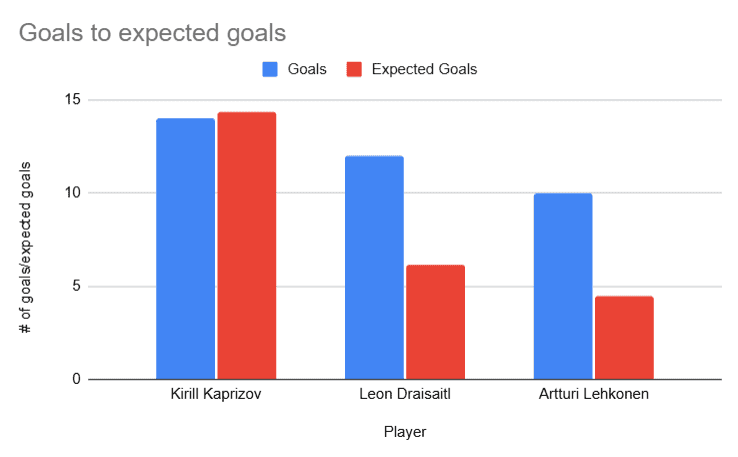
What this means is that while Draisaitl and Lehkonen are benefitting from the occasional low-danger chance finding its way past the goalie (or more specifically with Lehkonen, he just isn’t generating a ton of shots in the first place), Kaprizov is generating enough chances to earn the goals he’s scored so far. He’s done an excellent job generating chances off his own shot (the most in the league, in fact, with the only players even close to him being linemates Boldy and Joel Eriksson Ek), and while not every big chance has gone in, it has all evened out.
Now, a couple factors could still dictate whether he keeps up this pace all season. But unlike the other top goal scorers, these factors have less to do with luck and more to do with usage.
The first factor is how the Minnesota Wild are currently deploying their forward group, particularly with Kaprizov. For the first three games of the Wild’s season, Kaprizov played on a line with fellow Russians Maxim Shabanov and Danila Yurov, and that line struggled. Not only were they outscored 1-0, but they also had a 39.23% 5v5 expected goal share and generated only 1.34 5v5 expected goals for per 60 minutes. Those results aren’t good for a line featuring one of the league’s best players.
But then John Hynes loaded the top line with Kaprizov, Boldy and Joel Eriksson Ek, and the results are significantly different. They’ve outscored their competition 10-0, hold a 72.64% 5v5 expected goal share, and are generating 5.05 5v5 expected goals per 60 minutes, the second most in the league among lines with 70 minutes together. These three are extremely dynamic in their own zone, whipping passes back and forth until someone has a chance too good to pass up, especially when Hughes is on the ice with them. As long as they’re together, it feels like they could continue to generate chances and goals at a high pace. But if they separate again, Kaprizov’s chances (and goals) may go down.
That chemistry has also translated to the power play, as those three along with Hughes and Shabanov have created a similarly stellar system for creating chances. They currently lead the NHL in power play expected goals for per 60 minutes with 15.66, which is 2.14 higher than the second-placed Edmonton Oilers. Not surprisingly, this is primarily driven by the top guys: when Kaprizov is on the ice during the power play, that number jumps up to 16.98. Kaprizov isn’t even scoring at an unsustainable rate on the power play either; he’s generating five individual expected goals on the man advantage and has four goals as a result.
If there’s one area in the numbers which identifies some form of regression for Kaprizov, it’s at 5v5. While he’s scored eight goals at even strength, he only has 4.05 individual expected goals. That’s significant, because even if he generates all these chances over the course of the game, he isn’t doing so as much in the most constant and predictable state of game play. As mentioned before, the Wild are still generating plenty of chances at 5v5 with him on the ice, but not quite enough to sustain that production.
So if he’s got 12 goals at 5v5 and the power play, but only 9.05 individual expected goals, where’s the rest that makes up the 14.37 coming from? Surprisingly, it’s not at 4v4 or 3v3, as he doesn’t even have a shot attempt in those game stats this season. It’s actually at 5v6, but even then, there’s still a tad bit of regression: despite Kaprizov having 11 shot attempts when the other team’s goalie is pulled (which has generated that number of expected goals), he’s only hit the net (and scored) twice.
Still, Kaprizov’s lack of success with the empty net won’t cause as much of an upward swing as his 5v5 numbers will likely swing down. But even then, the regression won’t be overly drastic. If you completely discounted the four goals he’s scored above expected at 5v5, he’d still be tied for second in the NHL with 10 goals, only two behind the “new” league leader, Draisaitl. And that doesn’t account for similar regression from the other top scorers. Among the league’s highest goal scorers, only Auston Matthews is on a similar level of sustainably high scoring (nine goals, 7.88 expected goals).
Is Kaprizov’s hot performance a perfectly sustainable start? Of course not. Not even prime Alex Ovechkin was capable of scoring at a goal-per-game pace. But compared to many of the other top goal scorers this season, Kaprizov is generating chances that make his numbers feel at least somewhat reasonable.
Kaprizov probably won’t maintain a goal-per-game pace, but if he and his teammates continue to generate chances at the rate that they are, he will certainly be in the running for a Rocket Richard Trophy – his first major piece of hardware since his Calder Trophy win. At the very least, he’s doing a good job of living up to his lofty $17-million cap hit in the first year of the contract that set the stage for the current market.
All standard stats courtesy of NHL.com.
All advanced stats courtesy of Evolving Hockey.
PRESENTED BY DAILY FACEOFF GEAR

Daily Faceoff has new merch. Rep the game you love with premium Nation Gear x Levelwear tees, hoodies, hats and layers — designed for hockey fans on game day and every day. The home for hockey fans.
SHOP DAILY FACEOFF → nationgear.ca
Recently by Scott Maxwell
- Gavin McKenna and Ivar Stenberg are living up to early career expectations
- How Adam Pelech became one of the NHL’s best (and most underrated) defensive defensemen
- Seven unexpected players put in opportunistic roles to start 2026-27
- The 10 NHL players paid closest to their on-ice values in 2026-27
- The 10 worst value contracts in the NHL for 2026-27
- The 10 best value contracts in the NHL for 2026-27