Has Elias Pettersson finally returned to form for the Canucks?

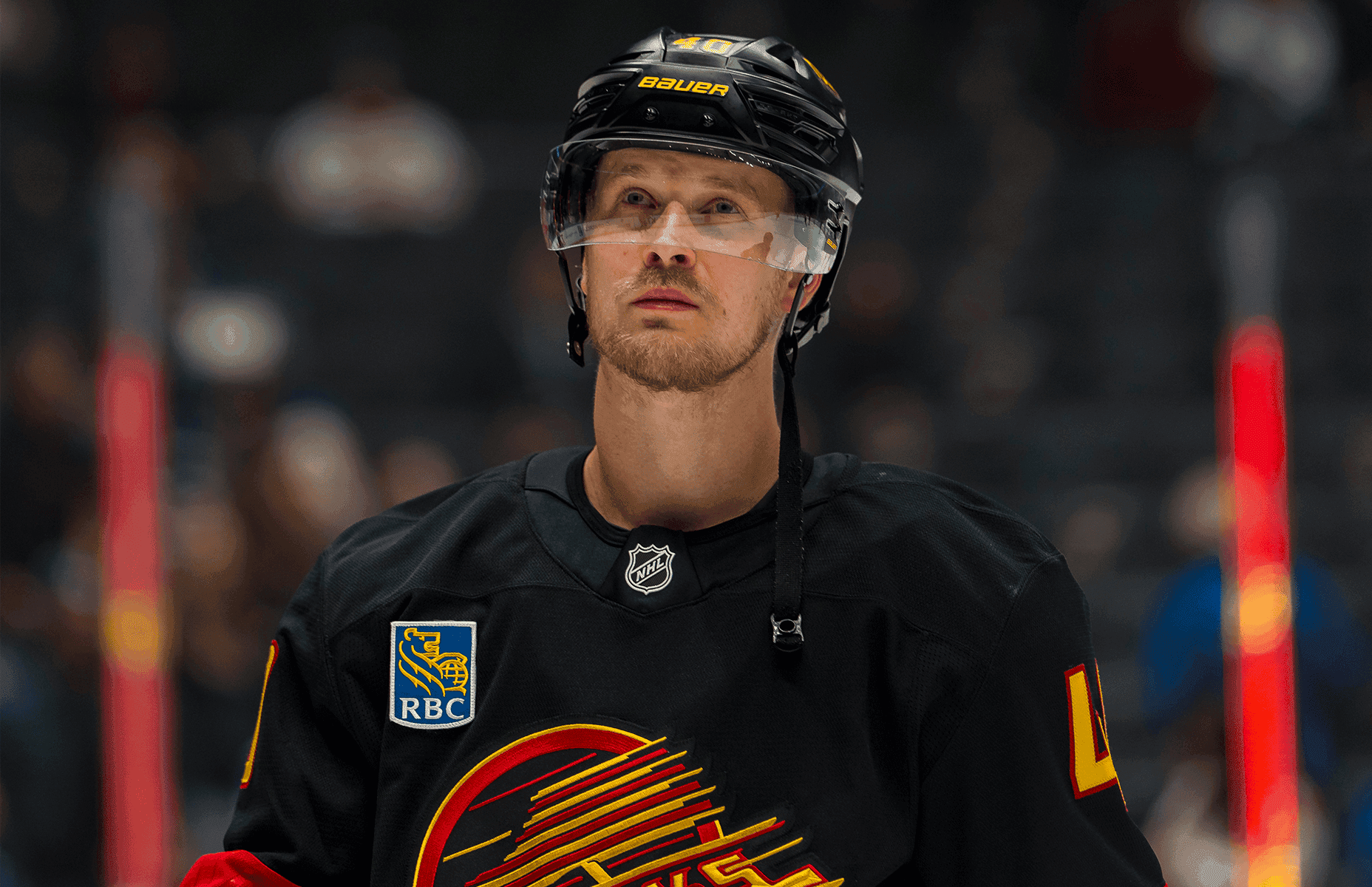
No player better represents the potential – and ultimate disappointment – of the Vancouver Canucks‘ previous core of players better than Elias Pettersson.
Sure, Quinn Hughes was the face of it, and his jumping ship to the Minnesota Wild triggered the Canucks’ current rebuild. But at the same time, the only wasted potential Hughes had in Vancouver was minimal playoff success. He rose to superstardom as one of the league’s top defensemen with the Canucks, won a Norris Trophy in 2024 and was still at the top of his game when he was traded, ensuring Vancouver received solid assets in return for him.
Pettersson best represents the “what if” of this era for the Canucks because he himself has become a “what if.” He broke out onto the scene with an electric rookie season in 2018-19, accumulating 28 goals and 66 points in 71 games, and captured the Calder Memorial Trophy for his efforts. He followed that up with another 66-point season in 2019-20 (this time in 68 games), but impressed come playoff time with seven goals and 18 points in 17 games as the Canucks came two goals (not counting two empty net goals) shy of a Western Conference Final appearance.
After two more seasons, Pettersson established a baseline, usually scoring at a 30-goal, 70-point pace. It was a great first step for the 2017 fifth-overall pick, but it still felt like there was more of his game to unlock.
In 2022-23, his ceiling came to the forefront. He exploded for 39 goals and 102 points, ranking 10th in the league, and he finished 18th in Hart Trophy voting. He also established a more consistent defensive game, with a -0.197 5v5 regularized adjusted plus-minus expected goals against per 60 minutes, ranking 28th among forwards. Suddenly, he was one of the game’s best, combining elite hockey IQ and vision with a lethal shot, and he was stifling in his own zone to boot.
That play carried over into the next season, as through 62 games, he had 29 goals and 75 points, a pace for 38 goals and 99 points. It was only a slight step behind the previous season, but it still established Pettersson’s new baseline. Add in that the team around him had stepped up their game and become one of the best in the Western Conference, and everything was in the right place. The future was bright in Vancouver, and Pettersson was one of the faces of it. With his restricted free agent status pending that season, the Canucks decided to lock up Pettersson for the long term, giving him an eight-year contract with an $11.6-million cap hit on March 2, 2024.
And just like that, it felt like a switch had been flipped.
It happened very quietly during the 2023-24 season. Pretty much right after signing the contract, Pettersson’s production slipped; he finished the year with only five goals and 14 points in the final 20 games of the season. It became more noticeable when his playoff statline started from scratch, as he managed only one goal and six points in 13 games.
The following season brought the same struggles, as Pettersson recorded only 15 goals and 45 points in 64 games. That struggles were at least chalked up to off-ice drama weighing down his on-ice play, as that season saw a notable divide between him and J.T. Miller. But the same nosedive carried over to his first full season without Miller, as last year Pettersson had 15 goals and 51 points in 74 games. It felt like that was the nail in the coffin for Pettersson’s career, at least as an elite first-line center. Barring a change of scenery, it seemed the Canucks were out of options to bring back the old Petey.


Cap Summary
Draft Picks
But with expectations low heading into the 2026-27 campaign, he’s begun to heat up. He started the season with points in five straight games, totaling eight in that span. Since then, he’s consistently chipped in a point or two most of the time this season, going only four games without a point in Vancouver’s first 17. As a result, he has four goals and 18 points, above a point-per game pace for the first time since signing his contract two and a half years ago.
So is Pettersson actually back? The point totals certainly indicate that. If you look at his on-ice goal totals, the Canucks appear to be generating offense at a rate better than those of his best seasons. The problem is that every other part of the process has not only well below that level, but it also shows some of the worst on-ice chance generation numbers of his career thus far.
| Season | 5v5 GF/60 | 5v5 SF/60 | 5v5 CF/60 | 5v5 xGF/60 |
| 2018-19 | 2.91 | 29.21 | 56.78 | 2.27 |
| 2019-20 | 3.94 | 33.53 | 62 | 2.71 |
| 2020-21 | 4.08 | 29.08 | 51.59 | 2.61 |
| 2021-22 | 2.3 | 30.58 | 57.55 | 2.54 |
| 2022-23 | 3.55 | 28.98 | 52.78 | 2.73 |
| 2023-24 | 3.78 | 28.14 | 60.51 | 2.72 |
| 2024-25 | 2.33 | 23.84 | 54.17 | 2.24 |
| 2025-26 | 1.8 | 23.68 | 50.27 | 2.66 |
| 2026-27 | 3.96 | 23.44 | 45.26 | 2.35 |
Whether it’s the initial shot attempt needed to make things happen, the shots that find their way to the net, or the shots within that group that actually have a strong chance of being converted to a goal, the Canucks just aren’t doing enough to justify the number of goals occurring when Pettersson is on the ice. His 5v5 shots and shot attempts for per 60 this season are the lowest rates of his career, while his 5v5 expected goals for per 60 is the second worst. These low rates aren’t limited to 5v5; even on the power play, those rates are down significantly.
| Season | PP GF/60 | PP SF/60 | PP CF/60 | PP xGF/60 |
| 2018-19 | 7.25 | 49.74 | 94.2 | 5.65 |
| 2019-20 | 8.74 | 56.99 | 106.25 | 7.07 |
| 2020-21 | 6.31 | 48.02 | 110.52 | 6.47 |
| 2021-22 | 10.88 | 62.64 | 118.46 | 9.05 |
| 2022-23 | 8.78 | 62 | 121.25 | 9.69 |
| 2023-24 | 9.88 | 61.7 | 122.77 | 10.91 |
| 2024-25 | 9.76 | 48.99 | 101.05 | 8.65 |
| 2025-26 | 9.53 | 55.99 | 108.04 | 11.19 |
| 2026-27 | 9.97 | 38.64 | 82.44 | 5.71 |
Some of this can be attributed to the fact that when Pettersson is on the ice, he isn’t generating many chances off his own stick. Just like his overall on-ice numbers, his individual shots, shot attempts and expected goals per 60 are the lowest of his career, contributing to a respective 17.79%, 22.27% and 21.28% of the team’s total contributions when he’s on the ice. That at least shows up in the results, as he has just four goals, all coming on the power play.
| Season | iSF/60 | iCF/60 | ixGF/60 |
| 2018-19 | 6.68 | 12.38 | 0.7 |
| 2019-20 | 7.71 | 15.62 | 0.9 |
| 2020-21 | 7.83 | 15.66 | 1.03 |
| 2021-22 | 7.74 | 15.61 | 0.98 |
| 2022-23 | 9.41 | 17.88 | 1.23 |
| 2023-24 | 7.71 | 14.97 | 1.14 |
| 2024-25 | 5.48 | 12.61 | 0.84 |
| 2025-26 | 5.6 | 12.52 | 0.94 |
| 2026-27 | 4.17 | 10.08 | 0.5 |
But that doesn’t fully explain the difference between the Canucks’ chance creation and their goal totals. The reality is that Pettersson is benefitting from the oldest trick in hockey analytics: a high shooting percentage. When he’s on the ice at even strength, the Canucks are shooting 16.9%, which is higher than any rate he’s seen over a full season. Heck, the more concerning stat might be that despite only averaging 0.236 goals per game, he’s shooting 16.7%, which is 0.9% higher than his career rate. It’s another indication of how much he’s struggling to generate shots and chances on his own.
On top of that, Pettersson is also benefitting from a few more secondary assists than he usually gets. While all points are considered equal, goals and primary assists better predict future success because they are goals contributed directly from your stick, either as the person setting up the shooter or as the shooter. The secondary assist helps, but at that point it’s no more valuable than the tertiary assist which remains uncredited (in my opinion, assists should either only be primary or include every player who touched the puck prior to the goal). Ultimately, secondary assists are just noise.
Unsurprisingly, Pettersson has been relying on secondary assists more than he ever has. Most seasons, he had somewhere between 10 and 15 secondary assists, and in his two seasons of elite production, it was closer to 25. He hasn’t even reached the quarter mark of this season, and he already has six.
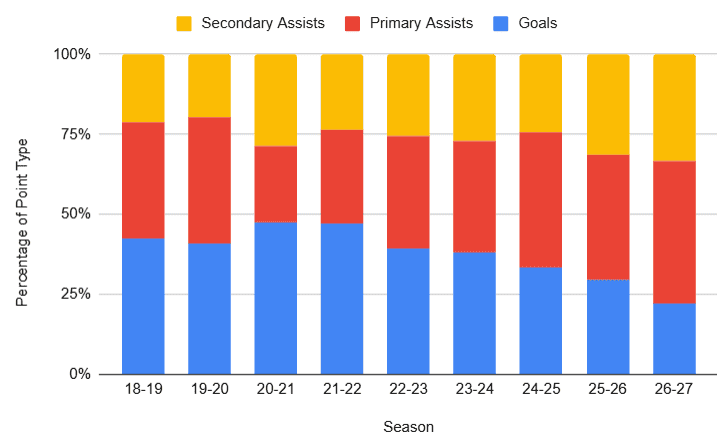
If you’re a Canucks fan hoping Pettersson’s hot start signals a return to his old self, I hate to be the bearer of bad news, but that doesn’t seem to be the case. While his point totals match the level of his elite 2022-23 and 2023-24 seasons that earned him his current contract, the underlying numbers remain at the same low totals from the past two disappointing seasons. Unless he steps up his play, his production is more likely to drop than to maintain its current pace.
But it’s not all bad news. Just because Pettersson’s numbers indicate he’s been lucky doesn’t mean they will fall back to Earth starting with his next game. Players can go multiple months, sometimes even an entire season, before regression kicks in.
Point totals will also shift the market value for a player. So it’s quite possible that Pettersson produces at close to a point-per-game pace for the rest of the season (or more importantly, to the Trade Deadline) and raises his market value enough to generate interest from other teams. If he can, there may not be a better time for the Canucks to move him while getting the best return and limiting the amount of salary cap space they have to retain.
Before, it looked like Pettersson might need to be moved at a lesser value to dump his salary. Now, we may have a hockey trade on our hands again. Sure, a smart team like the Carolina Hurricanes or New Jersey Devils might not bite on him, but there’s no shortage of teams looking for a top-line center (the Detroit Red Wings sans-Dylan Larkin certainly come to mind).
So yeah, Pettersson’s current form isn’t a chance for Canucks fans to relive the success of the previous core’s brief run. But it may give the team a chance to take another big step toward building the next core and move on from Pettersson to get the kind of assets they thought they never would for him ever again.
_____
PRESENTED BY DAILY FACEOFF GEAR

Daily Faceoff has new merch. Rep the game you love with premium Nation Gear x Levelwear tees, hoodies, hats and layers — designed for hockey fans on game day and every day. The home for hockey fans.
SHOP DAILY FACEOFF → nationgear.ca
Recently by Scott Maxwell
- Kirill Kaprizov’s hot start is more sustainable than you think
- Gavin McKenna and Ivar Stenberg are living up to early career expectations
- How Adam Pelech became one of the NHL’s best (and most underrated) defensive defensemen
- Seven unexpected players put in opportunistic roles to start 2026-27
- The 10 NHL players paid closest to their on-ice values in 2026-27
- The 10 worst value contracts in the NHL for 2026-27
- The 10 best value contracts in the NHL for 2026-27

